How to Get a 7 in IB Economics: A Realistic Guide
By Michael Thompson · Education Specialist; 10 years teaching the IB at Bromsgrove School · Published 4 September 2026 · Updated 4 October 2026
Getting a 7 in IB Economics is achievable, but it requires more than memorising theory - the mark scheme rewards specific analytical habits that most students develop too late. Economics at both SL and HL tests your ability to apply concepts, evaluate trade-offs, and structure arguments precisely under timed conditions. This guide breaks down how the assessment works, what the examiners are looking for at the top grade boundary, and where candidates most commonly drop marks. The practical advice here applies to both HL and SL, with HL-specific points flagged where the demands differ.
Key Takeaways
- Grade boundaries shift each session: The IB does not publish fixed percentage thresholds for a 7; boundaries are set after each exam diet, so consistency across all papers matters more than chasing a single target score.
- Command terms are the instruction set: Words like 'evaluate', 'discuss', and 'examine' each carry a distinct mark-scheme requirement - confusing them is one of the fastest ways to drop from a 6 to a 7.
- The IA is 30% of your final grade at SL and 20% at HL: Most students lose marks on the IA through weak economic analysis rather than weak writing - diagrams must be fully explained in the commentary, not just inserted.
- Evaluation separates the top grades: A 6 typically offers description and some analysis; a 7 requires sustained, two-sided evaluation with a reasoned conclusion that responds to the specific question asked.
- Past-paper practice by topic beats random paper attempts: Working through all available questions on a single topic before moving to the next builds the pattern recognition examiners look for in band 7 answers.
- Five mark-losing habits are almost universal: Undefined terms, diagram errors, single-perspective analysis, ignoring the article in Paper 2, and running out of time on evaluation paragraphs account for the majority of lost marks at the top boundary.
In This Article
- What a Grade 7 Actually Requires
- IB Economics Command Terms and How They Determine Your Mark
- Paper 1, Paper 2 and Paper 3 Structure: What Each Paper Tests
- How the Internal Assessment Contributes - and Where Students Lose Marks
- A Realistic Revision Structure: Two Years Into the Last Twelve Weeks
- Five Mark-Losing Habits at the Top Grade Boundary - and How to Fix Them
- What to Do Next
1. What a Grade 7 Actually Requires
Knowing how to get a 7 in IB Economics starts with understanding what the grade actually means within the Diploma Programme framework. IB subjects are graded on a scale of 1 to 7, with 7 being the highest. Those six subject scores, combined with up to 3 bonus points from Theory of Knowledge and the Extended Essay, produce a maximum total of 45 diploma points, per the IB's DP passing criteria.
The IB does not publish fixed percentage thresholds for a grade 7. Boundaries are set after each examination session based on cohort performance, which means the raw mark required shifts from one diet to the next. Targeting a specific percentage, say 75%, is therefore unreliable. The safer approach is consistent high performance across every component.
The component split differs by level:
- HL students are assessed on Papers 1, 2, and 3, plus the Internal Assessment (IA), with the IA contributing 20% of the final grade.
- SL students sit Papers 1 and 2 plus the IA, with the IA at 30% of the final grade.
One counter-intuitive consequence of moving boundaries: a student who performs unevenly, strong on one paper and weak on another, can fall short of a 7 even with a high total, because the IB also applies per-component minimum standards when awarding grades. Consistent performance across all components, rather than a single outstanding paper, is what the grade boundary structure actually rewards.
2. IB Economics Command Terms and How They Determine Your Mark
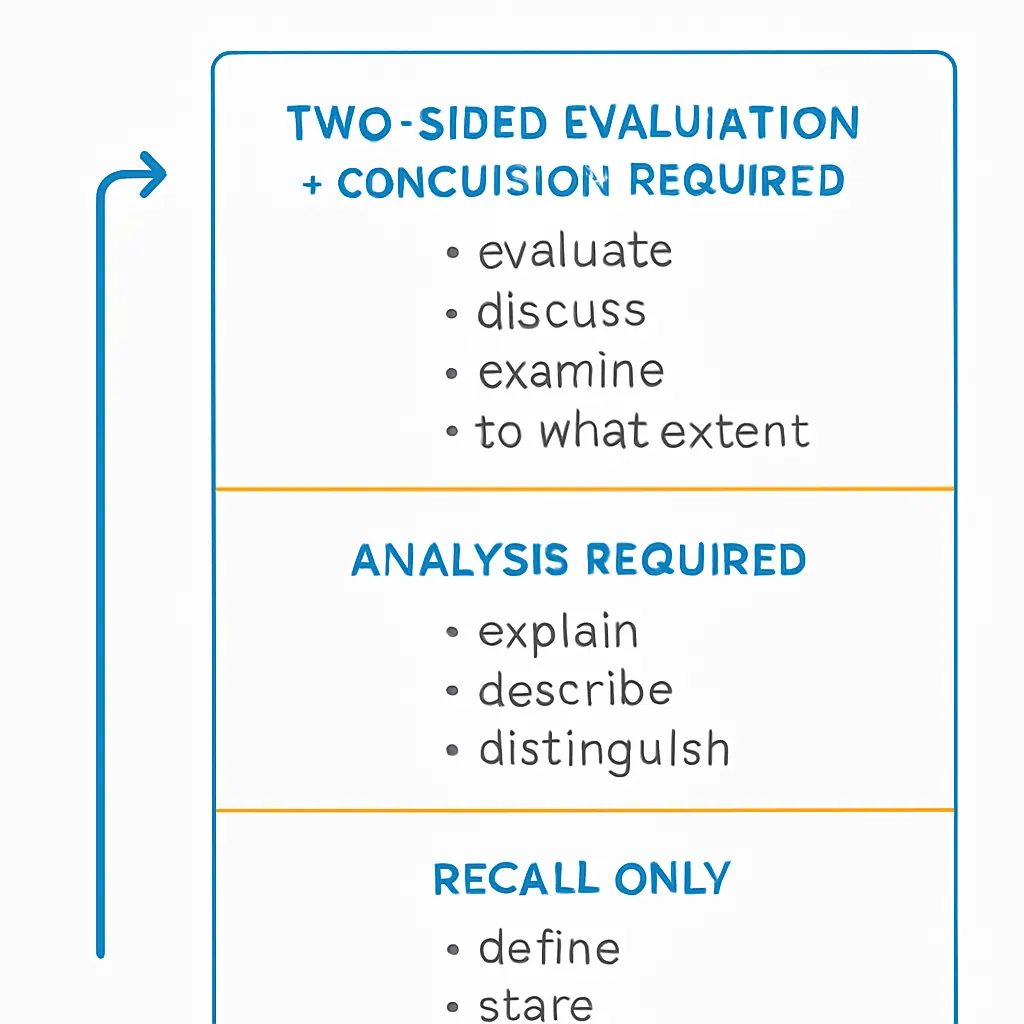
Every IB Economics question opens with a verb. That verb is not decorative. The IB calls these command terms, and they function as the examiner's instruction set: they define exactly what cognitive work is required and, by extension, which mark band is available to you.
The IB organises command terms into tiers:
| Tier | Examples | What the examiner expects |
|---|---|---|
| Lower-order | Define, State, List | Accurate recall, no elaboration needed |
| Mid-order | Explain, Describe, Distinguish | Developed prose, supporting diagram, causal chain |
| Higher-order | Evaluate, Discuss, Examine, To what extent | Two-sided analysis, weighed arguments, qualified conclusion |
The non-obvious gotcha: mid-order terms require diagrams even when the question does not say so. An "explain" question on market failure without a correctly labelled externalities diagram will lose marks at the top end, because the mark scheme treats the diagram as the mechanism of explanation, not an optional add-on.
Worked contrast: price floor
Prompt: "Explain the effects of a price floor set above equilibrium."
A correct response identifies that the floor prevents the price falling to equilibrium, draws a supply-and-demand diagram with the floor above P*, labels the resulting surplus, and describes the welfare loss. One direction. One diagram. Done.
Prompt: "Evaluate the effectiveness of a price floor set above equilibrium."
A higher-order response does all of the above, then weighs the argument: the floor may protect producer incomes, but its effectiveness depends on how elastic supply and demand are. A highly elastic supply response produces a larger surplus and greater deadweight loss, making the policy less effective. It then considers assumptions: whether the government can enforce the floor or purchase the surplus. The conclusion is qualified: "effective in supporting producer incomes in the short run, but likely inefficient where supply is elastic and enforcement capacity is limited."
(Both examples written for this guide, not sourced from student work.)
The structural difference is not length. It is the presence of a reasoned, qualified conclusion that emerges from the weighing of arguments, which is what separates a 7-band response from a 6-band one. Submitting an explain-shaped answer to an evaluate question is the most consistent reason students miss the grade 7 boundary.
3. Paper 1, Paper 2 and Paper 3 Structure: What Each Paper Tests
The three papers test different skills, and confusing their demands is one of the quickest ways to drop marks you could otherwise collect.
Paper 1 is the essay paper. You answer one two-part question from a choice of three, drawn from across the syllabus. Part (a) asks you to explain or analyse a concept, typically for around 10 marks, and rewards clear definitions, well-labelled diagrams, and logical development. Part (b) is evaluative, worth more marks, and explicitly requires you to weigh arguments, consider limitations, and reach a supported judgement. The counter-intuitive trap in Paper 1 is that students who write more in part (a) often perform worse overall, because they leave themselves too little time for the part (b) that carries the heavier mark allocation.
Paper 2 is the data-response paper. Each question is built around a real-world article or stimulus, and shorter sub-questions build towards at least one extended evaluative response. The IB ib economics paper 2 structure is designed so that top marks are only available to students who explicitly reference the stimulus data in their answers. Paraphrasing the article earns nothing; integrating a specific figure or claim from it into your economic analysis earns marks. Many students treat the stimulus as decoration rather than evidence.
Paper 3 (HL only) tests policy analysis and quantitative application. You are given unfamiliar data and must perform calculations and apply economic concepts to scenarios you have not seen before. The ib economics paper 3 tips that matter most are mechanical: show every calculation step, use correct units, and label any diagram you draw from the data provided. HL students are also expected to demonstrate deeper policy analysis across all papers, not just Paper 3.
Practical tip for Paper 1(b) and Paper 2 evaluative questions: state your evaluative criteria in your opening sentence before your analysis begins. Name the time horizon you are using, the stakeholder group you are prioritising, or the market structure you are assuming. This signals to the examiner that your evaluation is structured rather than improvised, and it shapes the rest of your answer coherently.
4. How the Internal Assessment Contributes - and Where Students Lose Marks
The IB Economics IA is a portfolio of three commentaries. Each commentary is based on a different real-world news article, and each must draw on a different unit of the syllabus: microeconomics, macroeconomics and the global economy. The IA carries 30% of your final grade at SL and 20% at HL. Because the IB Diploma's grading structure awards subject grades on a 1-7 scale with no separate rescue mechanism for coursework, a weak IA sets a ceiling on your final grade that strong exam scripts cannot reliably break through. Losing four or five marks across the portfolio can be the difference between a 6 and a 7.
The five places where marks disappear most often, and the fix for each:
| Common mistake | Why it loses marks | Practical fix |
|---|---|---|
| Diagrams included but not referenced | A diagram earns marks only when the commentary explicitly walks through it: label by label, shift by shift | After drafting, underline every label in your diagram and check that each one is named in the surrounding text |
| Article summary substituted for analysis | Describing what happened is not economics; examiners want the mechanism explaining why | Write your commentary with the article closed - use it only to identify the concept, then analyse from theory |
| One-sided or bolt-on evaluation | Evaluation tacked onto a final paragraph reads as an afterthought and scores at most the lower evaluation descriptors | Weave a counter-argument or condition into each analytical point, not just the last one |
| Word count spent on non-analytical summary | The IA word limit is tight; every sentence spent paraphrasing the article is a sentence not spent earning marks | Cut any sentence that could be replaced with "the article says" - it probably should be |
| Mismatched command term | A commentary written as "explain" when the criterion asks for "evaluate" cannot access the top mark band | Read the assessment criterion wording before you write a single sentence, not after |
The non-obvious gotcha here: many students treat the IA as a drafting exercise and submit on instinct. The IBO publishes its IA criteria openly, and self-marking your own draft against those descriptors before submission is one of the few no-cost interventions that directly maps your work onto the mark scheme. If your commentary cannot reach the top descriptor for "use of economic theory" because you have not named a specific model, that gap is visible before submission, not after.
5. A Realistic Revision Structure: Two Years Into the Last Twelve Weeks
Most students treat revision as something that starts after the syllabus ends. That timing makes a 7 much harder than it needs to be.
Year 1: build the foundations before you need them. After each topic block, do three things in order: write out IB economics definitions for every key term without looking at your notes, draw and label the core diagrams from memory, then attempt at least one past-paper question on that topic. The diagram step catches a problem most students discover too late: they can copy a diagram but cannot construct it from scratch under pressure. A demand-and-supply diagram with an unlabelled price axis loses marks even when the argument around it is correct.
Year 2: shift to extended-response practice early. Aim to complete a timed Paper 1(b)-style evaluate or discuss question on every major topic by December of Year 2. When you self-assess against the mark scheme, focus specifically on whether your evaluation was two-sided and whether it reached a conclusion. A response that raises one counter-argument and then stops is not evaluation; it is description wearing evaluation's label.
Last twelve weeks: rotate by topic, not by paper. Rather than sitting random full papers, work through all available Paper 1 questions on market failure in one session, then all questions on macroeconomic policy in the next. This builds pattern recognition at the topic level faster than full-paper practice does. You start to see which real-world contexts examiners return to and which command terms cluster around specific themes.
Final four weeks: full timed mocks, targeted review. Sit mocks under exam conditions, then go through the mark schemes line by line. Identify the two or three topic areas still costing you marks and weight your remaining time toward those. Do not spend equal time across everything; the mark scheme will tell you exactly where the gap is.
The IB publishes past papers and mark schemes through the IB store, and most schools hold copies. Ask your teacher for access rather than relying on uncurated third-party uploads, which sometimes circulate with errors.
6. Five Mark-Losing Habits at the Top Grade Boundary - and How to Fix Them
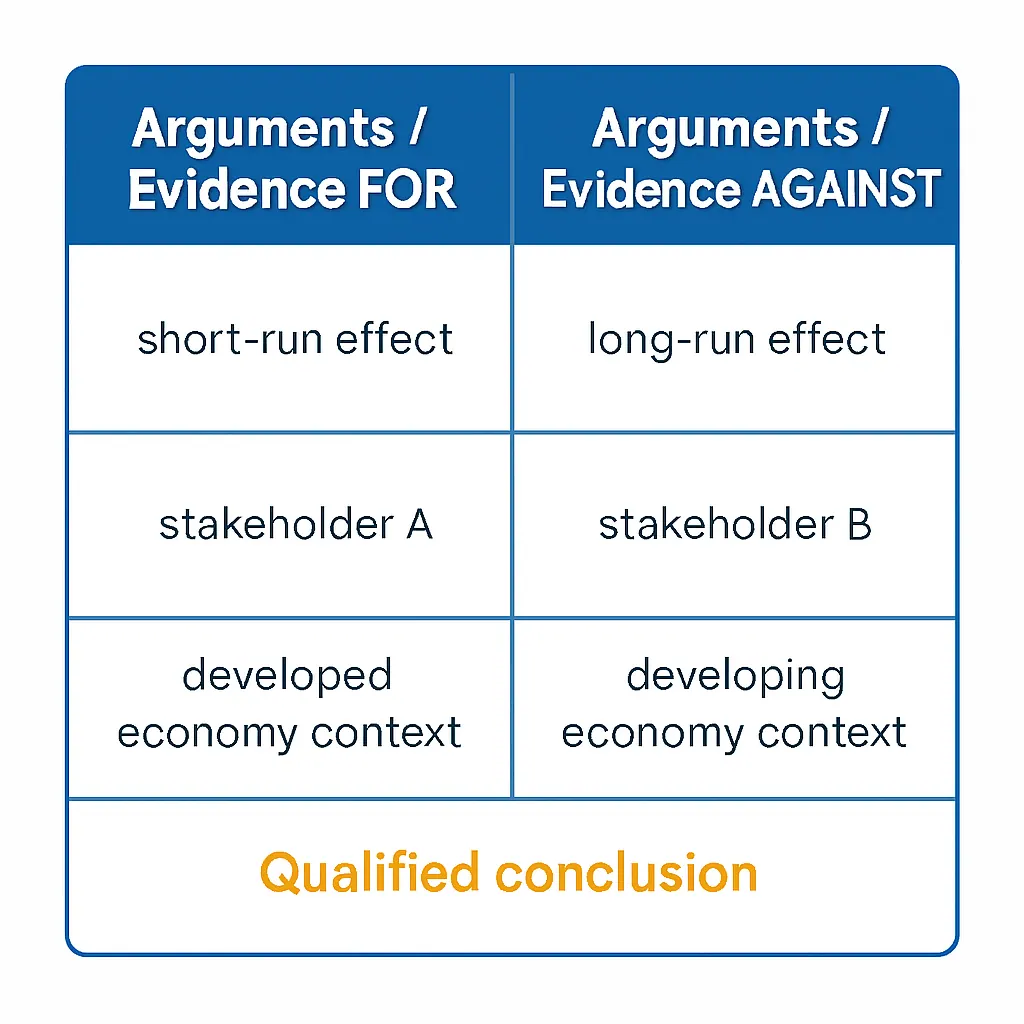
These are not beginner errors. They appear in scripts that already show strong knowledge but fall just short of a 7, often because structure collapses under exam pressure.
Habit 1: Undefined terms. Writing "price elasticity of demand is when price changes" signals to an examiner that you know the phrase but not the concept. Every IB Economics essay should open with a precise, concise definition of the central concept, covering the economic relationship, the direction of effect, and any relevant ceteris paribus condition.
Habit 2: Unlabelled diagrams. A supply-and-demand diagram without labelled axes, named curves, and a marked equilibrium shift earns partial credit at best. Practise drawing five core diagrams from memory until the labelling is automatic: AD-AS, PPC, supply and demand, market failure (negative externality or public good), and a cost curve. The counter-intuitive gotcha here is that a missing axis label on an otherwise correct diagram can cost you marks across multiple marking criteria, not just one.
Habit 3: Single-perspective analysis. Evaluating only government failure without acknowledging market failure, or describing only short-run effects, produces analysis rather than evaluation. Before writing, sketch a two-column plan: for / against, short-run / long-run, developed economy / developing economy. This forces genuine balance and gives the examiner what the mark scheme is looking for.
Habit 4: Ignoring the stimulus in Paper 2. Writing a generic essay when the paper provides a real-world article wastes the primary source of marks available. Before writing a single sentence, underline three specific data points or quotes in the stimulus, then reference at least two of them explicitly in your answer.
Habit 5: Running out of time before evaluation. Long introductions and detailed description leave only a paragraph for the evaluative part (b), which is where the highest marks sit. For Paper 1, time-box strictly: no more than six minutes on part (a) before moving to part (b). If your introduction runs past a single short paragraph, it is too long.
7. What to Do Next
Grade boundaries shift each session, and a mark that earns a 7 in one sitting might fall short in another. The most reliable route to a 7 in IB Economics is consistent performance across all three papers and the Internal Assessment, not a single strong component covering for weak ones.
This week, do one thing: pull out your most recent timed Paper 1(b) attempt. Apply the two-column evaluative planning structure covered in section 6, rewrite only the evaluation section from scratch, then place it alongside the mark scheme. That single exercise will expose your specific mark-losing pattern far more accurately than re-reading notes.
One counter-intuitive detail worth knowing: students who score well on evaluation rarely write more. They write more precisely. Check whether each evaluative point changes the conclusion, rather than merely adding a qualification.
FAQ
How hard is it to get a 7 in IB Economics?
A 7 is achievable for students who master command-term responses and evaluation technique, but the exact percentage of candidates who score 7 varies by session and is not published as a fixed figure by the IB.
What percentage do you need for a 7 in IB Economics?
The IB sets grade boundaries after each exam session rather than in advance, so there is no fixed raw-mark percentage that guarantees a 7 - boundaries shift depending on overall cohort performance.
How do I get a 7 in IB Economics Paper 1?
Paper 1 rewards precise definitions, fully labelled diagrams, and - critically - two-sided evaluative answers in part (b) that reach a reasoned, qualified conclusion rather than simply listing arguments.
How do I get a 7 in IB Economics at HL versus SL?
HL students face the additional challenge of Paper 3, which tests quantitative application and policy analysis using unfamiliar data, so HL candidates need stronger diagram fluency and calculation practice on top of the essay skills required at SL.
How does the IB Economics IA affect my final grade?
The Internal Assessment portfolio contributes 30% of the final grade at SL and 20% at HL, meaning a weak IA cannot easily be offset by strong exam scores - detailed economic analysis and explicit diagram explanation are the key to maximising IA marks.
What are the most important IB Economics command terms to know?
Higher-order command terms - evaluate, discuss, examine, and 'to what extent' - are the ones that determine whether an answer scores in the 6 or 7 band, because they require two-sided analysis and a reasoned conclusion, not just description or explanation.
References
- DP passing criteria - International Baccalaureate® - https://ibo.org/about-the-ib/what-it-means-to-be-an-ib-student/recognizing-student-achievement/about-assessment/dp-passing-criteria