How to Get a 7 in IB Physics: A Realistic Guide
By Michael Thompson · Education Specialist; 10 years teaching the IB at Bromsgrove School · Published 4 September 2026 · Updated 4 October 2026
Getting a 7 in IB Physics is achievable, but it requires understanding exactly how marks are distributed across papers, where the boundary typically sits, and what examiners are looking for in the answers that separate a 6 from a 7. Physics is one of the more demanding Group 4 subjects, and many students lose marks not because they lack understanding but because they answer questions in ways that don't match the command term. This guide covers the paper structure and weightings, the internal assessment, a two-year revision framework, and the specific habits that drain marks - so you can direct your effort where it actually counts.
Key Takeaways
- Grade boundaries move each session: The IB sets boundaries by reviewing candidate work against grade descriptors, so there is no fixed percentage that guarantees a 7 - understanding the mechanism matters more than chasing a number.
- Command terms are the examiner's instructions: Words like 'deduce', 'derive', and 'evaluate' each demand a different type of response; confusing them is one of the most common ways to drop a mark on a question you actually understand.
- The Internal Assessment counts for 20% of your final grade: It is marked on four criteria worth 6 marks each - Research design, Data analysis, Conclusion and Evaluation - and most students leave marks on the table in Evaluation, not in the raw data collection.
- Past-paper practice by topic beats timed full mocks in year one: Working through questions grouped by topic builds the pattern recognition you need before you start doing timed papers end-to-end.
- Five recurring habits account for the majority of avoidable mark loss: Omitting units, skipping significant figures, writing vague evaluations, misreading command terms, and neglecting the data booklet are each fixable with deliberate practice.
- A structured last twelve weeks: Splitting revision into topic consolidation, paper-by-paper drilling, and full timed mocks in sequence gives you the best chance of performing at your ceiling on exam day.
In This Article
- What a 7 in IB Physics Actually Requires
- Command Terms: the Gap Between a 6 and a 7
- IB Physics IA: Where Students Leave Marks on the Table
- IB Physics Hardest Topics and How to Prioritise Them
- A Realistic Two-Year Revision Structure
- Five Mark-Losing Habits and How to Fix Them
- What to Do Next
1. What a 7 in IB Physics Actually Requires
Knowing how to get a 7 in IB Physics starts with understanding what that grade actually represents inside the diploma's structure. The IB grades each subject on a scale of 1 to 7, with 7 as the highest, and the diploma maximum is 45 points: six subjects at 7 points each, plus 3 core points from TOK and the Extended Essay combined. Physics sits in Group 4 and can be taken at Standard Level or Higher Level. Both carry identical weight in your points total, which surprises many students who assume HL is worth more.
The assessment structure differs by level:
| Component | SL | HL | Weighting |
|---|---|---|---|
| Paper 1 (Paper 1A multiple choice plus Paper 1B data-based questions) | Yes | Yes | 36% (SL and HL) |
| Paper 2 (short-answer and extended-response) | Yes | Yes | 44% (SL and HL) |
| Internal Assessment (IA) | Yes | Yes | 20% (SL and HL) |
HL students sit longer versions of the same two papers, which include the additional higher level content. The IA accounts for a fixed 20% regardless of level, which means a weak IA caps your ceiling before you sit a single exam.
Grade boundaries are set each session by the IB reviewing actual candidate work against grade descriptors, not by applying a fixed percentage. The mark required for a 7 therefore shifts between May and November sessions. SL and HL boundaries are set separately, and HL candidates are being examined on a wider syllabus, so direct percentage comparisons between the two levels are not meaningful.
The one non-obvious implication: because boundaries move, consistently performing above the descriptors for grade 6 is more reliable than chasing a specific raw-mark target.
2. Command Terms: the Gap Between a 6 and a 7
IB Physics questions are built around command terms drawn directly from the IB Physics subject guide. Each term signals not just what to write, but how much cognitive work the examiner expects. Ignoring this is the single most consistent difference between a 6 and a 7.
The terms group into three demand levels:
- Lower demand: state, define, identify, list. One or two precise lines. No explanation needed.
- Mid demand: explain, calculate, sketch, outline. Mechanism or working must be shown.
- Higher demand: deduce, derive, evaluate, justify. Reasoning, evidence, and a supported conclusion are all required.
The 'evaluate' trap is the most common mark-sink at the top end. Consider this prompt: "Evaluate the use of a spring-mass system as a model for simple harmonic motion."
A grade-6 answer identifies that the model works when the spring obeys Hooke's law and the mass is ideal. Accurate, but one-sided.
A grade-7 answer does the same, then weighs the limitations: real springs have non-negligible mass, damping is ignored, and the restoring force becomes non-linear at large amplitudes. It closes with a supported verdict on when the model is and is not reliable.
The difference is not more knowledge. It is structure: both sides, then a conclusion.
'Deduce' catches students in a different way. It does not mean "recall a relevant formula." It means: use the data or relationships already given in the question to reach a conclusion through logical steps. A student who writes down a memorised equation without connecting it to the given information will lose the mark even if the final answer is numerically correct.
Practical habit: before writing anything, underline the command term and ask yourself what it is specifically demanding. Not "what do I know about this topic," but "what does this word require me to do."
3. IB Physics IA: Where Students Leave Marks on the Table
The Internal Assessment contributes 20% of your final IB Physics grade at both SL and HL. In the course first examined in 2025 it is marked on four criteria, each worth 6 marks, for a total of 24: Research design, Data analysis, Conclusion and Evaluation. That weighting matters. A well-executed IA can absorb a slightly weaker performance in Paper 1 or Paper 2, which is a cushion worth building deliberately rather than leaving to chance.
Research design sets the ceiling for the other three criteria. A focused research question names the independent and dependent variables and the range you will test, and the method has to be justified, not just listed: why this range, why these controls, why this equipment. A vague question weakens your Conclusion and Evaluation too, because you cannot judge whether a result answers something that was never precisely defined.
Evaluation is worth 6 of the 24 marks, and it is the criterion most consistently underperformed. Phrases like "human error could have affected the results" earn nothing. What the criteria require is specific, quantified discussion: name the systematic error, estimate its magnitude, explain its directional effect on your data, and propose a realistic improvement. A counter-intuitive point worth knowing: students who find an anomaly in their data and analyse it rigorously often outscore students with cleaner results, because the Evaluation criterion rewards depth of reasoning, not tidiness.
For topic selection, prioritise experiments where the dependent variable is measurable with a calibrated instrument and can be varied across a meaningful range. Qualitative or observational designs make strong Data analysis marks structurally difficult to achieve.
Read the IB's published subject-specific guidance and the official assessment criteria directly. Third-party templates reflect someone else's interpretation of those criteria, and that interpretation may be out of date.
4. IB Physics Hardest Topics and How to Prioritise Them
Not all topics carry equal risk. Some appear repeatedly in higher-demand questions and trip up even well-prepared students; others are more accessible and should be secured first.
Start with mechanics and kinematics. These topics reward systematic formula application and appear across all papers. Students who are shaky on projectile motion or Newton's laws bleed marks that are genuinely recoverable with focused practice. Consolidate these before moving to harder content.
The topics that most consistently generate dropped marks in extended-response questions are:
- Fields (gravitational, electric, magnetic): students muddle field lines with equipotentials and mix up inverse-square relationships
- Waves and interference: path difference, phase, and the conditions for superposition are regularly misapplied
- Quantum and nuclear physics: conceptual precision matters more than calculation here; vague answers on wave-particle duality or radioactive decay are rarely rewarded
Uncertainty and error analysis is the highest-value skill in the course. It appears in both papers, especially the data-based questions in Paper 1B, and inside the IA. The specific gotcha: propagating uncertainty through a calculation (absolute vs percentage, and when to add vs multiply) is a distinct skill from knowing significant figures, and examiners treat them separately.
For HL students, HL-only content such as thermodynamics and electromagnetic induction is examined in both papers, often in extended-response questions. Targeted preparation on HL-only material can move a grade boundary more efficiently than re-revising shared content.
Work through IB Physics questions by topic, grouped rather than full-paper, so you identify your weak areas before you meet them under timed conditions.
5. A Realistic Two-Year Revision Structure
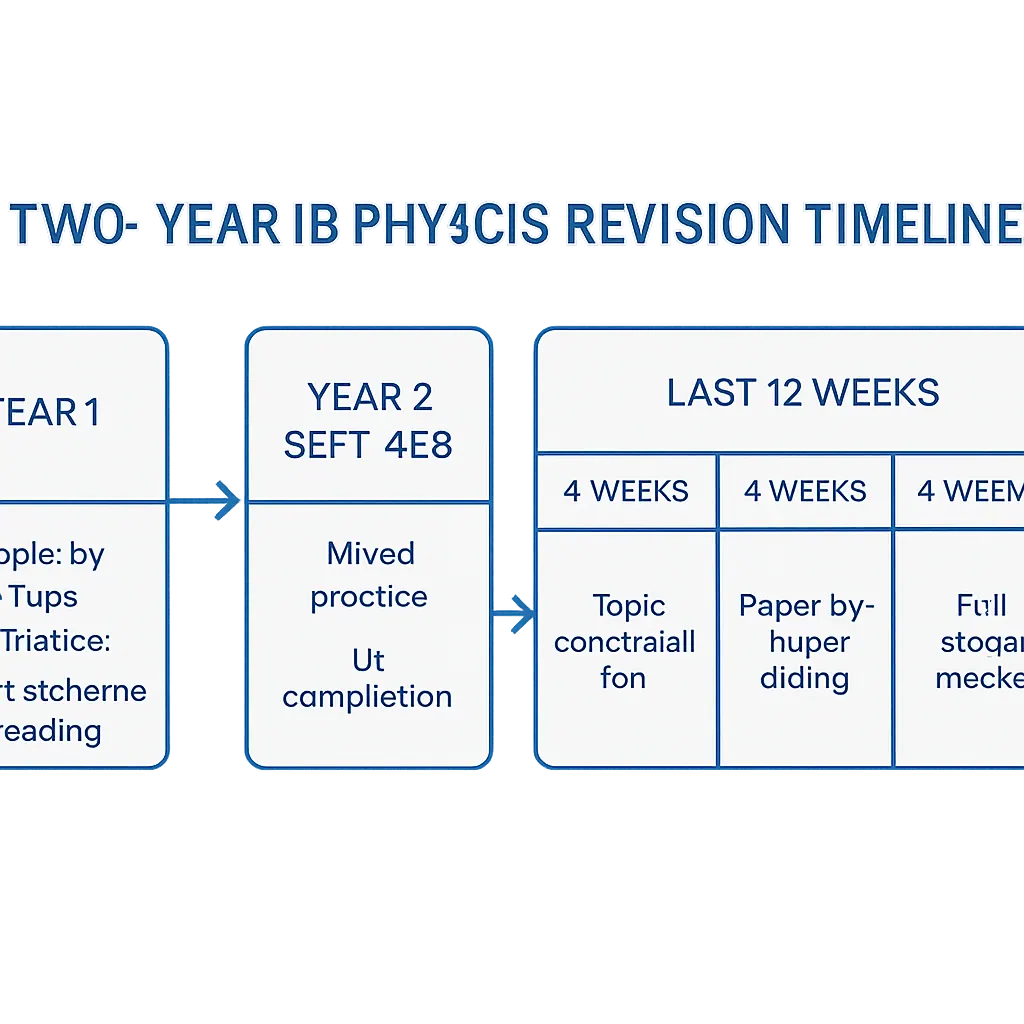
Most students treat IB Physics revision as something that starts in Year Two. That single habit is responsible for more grade boundaries missed than any topic gap.
Year One, first six months
Work through each topic as it is taught in class, then practise IB-style questions by topic immediately afterwards. Full past papers come later. Topic-by-topic drilling at this stage does something specific: it forces you to use the command-term register (describe, explain, deduce, evaluate) while the content is fresh, so the phrasing stops feeling foreign before the pressure is on.
Year One, second six months
Begin cumulative review alongside current teaching. Go back to the earliest topics and work through them again with mark schemes open. The habit to build here is analytical mark-scheme reading: not checking whether you got the right answer, but noting the exact language that earned each mark. A mark scheme that says "states that acceleration is proportional to displacement directed towards the equilibrium" is telling you the precise vocabulary the examiner expects. Write that down.
Year Two, September to February
Run mixed-topic past-paper questions by topic. Use this period to target the weak areas you identified in Year One. Finish the IA well before February. An IA that spills into March will cost you exam revision time that cannot be recovered.
The final twelve weeks (March to May)
| Weeks | Focus |
|---|---|
| 1-4 | Topic consolidation: every topic, mark-scheme checking throughout |
| 5-8 | Paper-by-paper drilling: Paper 1 MCQ timing and elimination, Paper 2 extended-response structure |
| 9-12 | Full timed mocks under exam conditions, followed by detailed error logging |
Error logging is non-negotiable. Keep a dedicated notebook or document. For every question you get wrong, record what you wrote, what the mark scheme required, and why the gap existed. This is the highest-return tool in the final weeks because it converts vague "I need to review waves" feelings into a specific, shrinking list of fixable mistakes. Students who skip this tend to repeat the same errors across multiple mocks without realising it.
6. Five Mark-Losing Habits and How to Fix Them
These are not obscure mistakes. They appear on mark schemes constantly, and they cost marks that have nothing to do with whether you understand the physics.
Habit 1: Omitting or wrong units. The IB mark scheme for a numerical answer almost always awards the unit separately. Write the unit at every step of your working, not just the final line. If you drop a unit mid-calculation, you are more likely to carry forward a dimensionally wrong answer.
Habit 2: Wrong significant figures. Three significant figures is a safe default, but the real rule is to match the precision of the data given in the question. A four-figure answer to two-figure data will cost the mark. Check sig figs before you write the final answer, not after.
Habit 3: Vague evaluation language. "Human error could have affected the results" is the single most useless phrase in IB Physics. The mark scheme wants the specific source (for example, parallax error when reading a ruler scale), the direction of effect (would it cause the measured value to be higher or lower than the true value?), and a concrete improvement. Name the error, state its direction, fix it.
Habit 4: Misreading the command term. A confident explanation earns zero if the question said "deduce." Underline the command term before writing anything. This takes three seconds and prevents a surprisingly common way to lose marks even when your physics is correct.
Habit 5: Not using the data booklet. The IB data booklet is provided in every physics exam. It contains formulae, constants, and equations of motion. Students who try to recall rather than locate waste time and introduce transcription errors. Practise with the booklet open from day one so that finding the permeability of free space takes five seconds, not thirty.
7. What to Do Next
The gap between a 6 and a 7 in IB Physics is rarely about missing content. It is almost always a cluster of recurring, fixable mistakes that appear on every paper you sit.
This week, pull up the mark scheme for a past IB Physics paper you have already attempted. Go through every question where you dropped marks, but not to check whether your answer was right. Instead, identify the cause: a misread command term, a missing unit, a sign error in a multi-step derivation, an explanation that described what happened rather than why. That diagnosis is more useful than re-reading any topic.
Most students find the same two or three habits account for the majority of their lost marks. Find yours now, name them, and target them deliberately in your next timed practice session.
FAQ
How hard is it to get a 7 in IB Physics HL?
IB Physics HL has broader and deeper content than SL, and the grade 7 boundary is set each session by IB examiners reviewing work against grade descriptors, so difficulty varies - but with consistent past-paper practice, strong IA marks, and command of the higher-demand question types, a 7 is achievable for students who prepare systematically.
How many people get a 7 in IB Physics?
The IB publishes subject-level grade distributions annually; the proportion of candidates awarded a 7 in Physics varies by session and level, so check the IB's statistical bulletin for the most recent figures rather than relying on anecdotal estimates.
What are the IB Physics grade boundaries for SL and HL?
Grade boundaries are set fresh each session by the IB and are not fixed percentages; after results are released, candidates can view their own lower and upper grade boundaries via candidates.ibo.org, and historical boundaries can be found through the IB's published statistical resources.
How does the IB Physics IA affect my final grade?
The Internal Assessment counts for 20% of your final IB Physics grade at both SL and HL and is marked out of 24 on four criteria worth 6 marks each - Research design, Data analysis, Conclusion and Evaluation - with Evaluation being the criterion where most students underperform relative to their potential.
Which IB Physics topics are the hardest?
Fields (gravitational, electric, magnetic), waves and interference, quantum and nuclear physics, and - at HL - electromagnetic induction and thermodynamics are the topics where students most often drop marks in higher-demand questions; uncertainty and error analysis is a cross-cutting skill that affects both papers and the IA.
Can I get a 7 in IB Physics SL more easily than HL?
SL has a narrower syllabus and the grade boundary is set separately from HL, so the content load is lower - but a 7 at SL still requires the same command of command terms, mark-scheme language, and IA criteria as HL; the path is shorter, not easier in terms of exam technique.
References
- DP passing criteria - International Baccalaureate® - https://ibo.org/about-the-ib/what-it-means-to-be-an-ib-student/recognizing-student-achievement/about-assessment/dp-passing-criteria
- Assessment FAQ - International Baccalaureate® - https://ibo.org/programmes/diploma-programme/assessment-and-exams/getting-results/assessment-faq