IB Grade Boundaries by Subject: What a 7 and a 4 Take, and How They Are Set
By Michael Thompson · Education Specialist; 10 years teaching the IB at Bromsgrove School · Published 21 May 2026 · Updated 6 October 2026
IB grade boundaries are the minimum raw mark needed to achieve each grade in a given examination session - and the IBO does not publish them in advance, nor does it release a single universal table after results day. That surprises many students who expect a fixed scale, like 70% for a 7. In practice, boundaries are set fresh each session by Grade Award meetings that weigh statistical evidence alongside expert judgement, which means the mark required for a 7 in Chemistry HL in May 2024 may differ from the mark required in May 2025. This guide explains the mechanism behind that process, shows the typical ranges you can expect across subjects, and tells you exactly where to find session-specific boundary data.
Key Takeaways
- No universal published table: The IBO does not release official grade boundary tables to the public after each session - boundaries are confidential to IB Coordinators and appear in subject reports.
- Fresh boundaries every session: Grade Award meetings set new boundaries for every May and November session, so marks from one year cannot reliably predict what you need in the next.
- A 7 typically requires 75-85% of raw marks: Across most IB Diploma subjects, the boundary for a grade 7 falls roughly in the 75-85% range, though outliers exist in both directions.
- Statistical and judgement factors both matter: Boundaries reflect cohort performance data, senior examiner review of scripts, and grade descriptor matching - not a simple percentage formula.
- Subject reports are the best public source: IB subject reports, released a few months after each session, often include or reference boundary information; schools receive them through the IB's Programme Resource Centre, so ask your coordinator.
- Lower boundaries don't mean an easier exam: A lower boundary usually signals a harder paper that year, not a more lenient standard - the underlying level of achievement being rewarded stays constant.
In This Article
- IB Grade Boundaries by Subject: Typical Grade 7 and Grade 4 Thresholds
- What Are IB Grade Boundaries?
- How IB Grade Boundaries Are Set: Grade Award Meetings
- Why IB Grade Boundaries Shift Session to Session
- IB Theory of Knowledge and Extended Essay Grade Boundaries
- Where to Find IB Grade Boundary Data
- IB DP Grade Boundaries 2024 and 2025: What We Know
- How to Use Grade Boundary Information in Your Revision
- Common Misconceptions About IB Grade Boundaries
- Where to Go From Here
1. IB Grade Boundaries by Subject: Typical Grade 7 and Grade 4 Thresholds
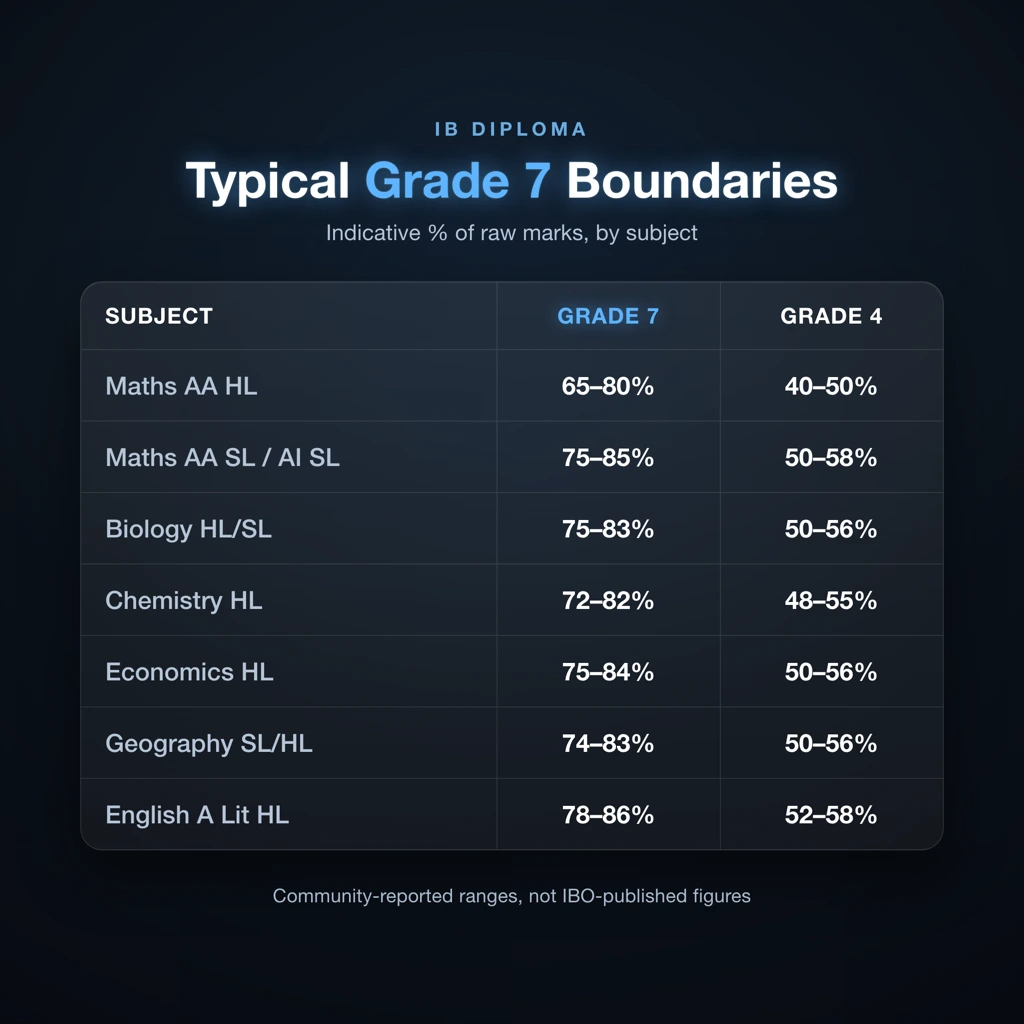
Grade 7 boundaries vary considerably across IB Diploma subjects, but a useful working range for most subjects is roughly 75-85% of available raw marks. That range narrows or widens depending on how the cohort performed and how difficult the papers turned out to be in a given session.
The counter-intuitive detail that surprises many students: in a particularly hard Maths Analysis and Approaches HL session, the grade 7 boundary can fall below 70%. A paper that is genuinely difficult across the cohort pulls the boundary down, so a raw score that would earn a grade 5 in an easier session can become a 7. This is why raw mark targets set in advance of results are unreliable guides.
The grade 6 boundary typically sits around 8-12 percentage points below the grade 7 threshold for the same subject and paper. Grade 4, which many universities treat as a pass, often falls somewhere in the 50-55% region, though sciences and mathematics subjects can sit slightly lower in harder sessions.
The table below shows indicative ranges drawn from community-reported data across multiple sessions. These are not IBO-published figures and should be read as approximate patterns rather than guarantees.
| Subject | Typical grade 7 boundary | Typical grade 4 boundary |
|---|---|---|
| Maths AA HL | 65-80% | 40-50% |
| Maths AA SL / AI SL | 75-85% | 50-58% |
| Biology HL/SL | 75-83% | 50-56% |
| Chemistry HL | 72-82% | 48-55% |
| Economics HL | 75-84% | 50-56% |
| Geography SL/HL | 74-83% | 50-56% |
| English A Literature HL | 78-86% | 52-58% |
One structural quirk worth noting: because some subjects carry a significant coursework component, the overall grade boundary is a composite of component boundaries, not a single percentage of a written exam. The IBO sets a boundary for each component separately, then applies a weighting formula. Focusing only on the written paper percentage can therefore mislead you about the overall mark you need.
Treat these ranges as orientation, not targets. The actual figures for any given session are only confirmed at grade award meetings held shortly before results day.
TOK and the Extended Essay are graded A to E rather than 1 to 7; their boundaries and the core points matrix are on TOK and EE grade boundaries. To see what a set of grades adds up to, use the IB score predictor.
2. What Are IB Grade Boundaries?
IB grade boundaries are the minimum raw marks a student must score to achieve each grade from 1 to 7 in a specific subject, at a specific level, in a specific exam session. They are not fixed percentages. There is no universal rule in the IB Diploma Programme where, say, 70% of available marks guarantees a 7. The boundary for a grade 7 in HL Economics in the May session will differ from the boundary for a grade 7 in SL Geography in the November session, and both will likely shift from one year to the next.
The IBO does not publish a single, universal grade boundary table covering all subjects. Boundaries vary across subject, level (Higher Level or Standard Level), and session (May or November). This is meaningfully different from how A-Level results work in England, where exam boards such as AQA and OCR, overseen by Ofqual, publish grade boundary data publicly after results day.
The non-obvious gotcha: a student who scores 70% in one session may earn a 6, while the same raw percentage in a different session earns a 7. The paper's difficulty, not a fixed scale, drives the outcome. That means any revision resource promising "you need X% for a 7" is, at best, a rough historical estimate and, at worst, actively misleading.
3. How IB Grade Boundaries Are Set: Grade Award Meetings
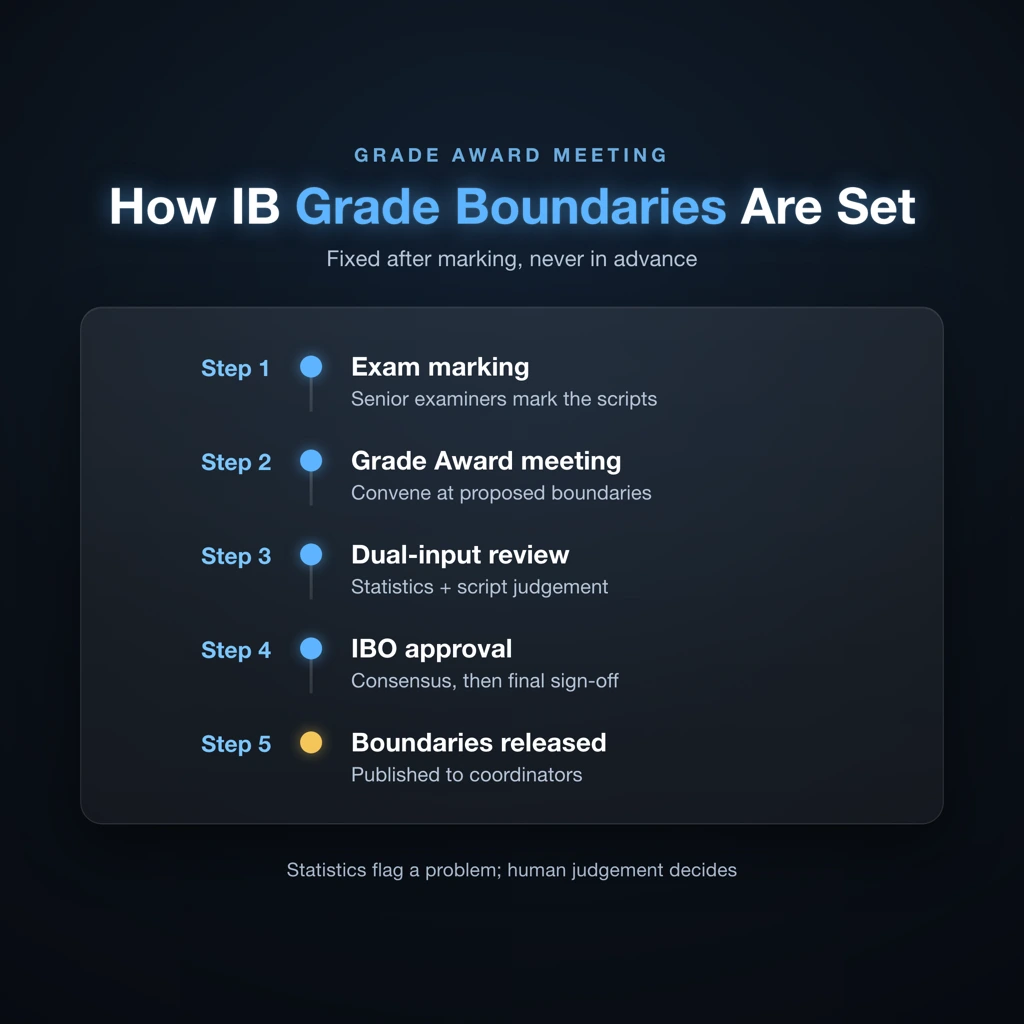
IB grade boundaries are not fixed in advance. They are set after marking is complete, through a structured process called a Grade Award meeting.
Once senior examiners have finished marking a session's scripts, they convene to review student work at the proposed boundary marks. The process draws on two distinct inputs:
- Statistical data. Examiners compare the current cohort's raw score distribution against prior-year performance to check whether the difficulty of the paper has shifted. A noticeably harder paper should, in principle, produce a lower boundary.
- Judgemental review. Examiners read actual scripts sitting at the proposed boundary mark and ask whether those scripts match the IBO's published grade descriptors. If the work at a candidate mark looks like solid Grade 6 performance rather than Grade 7, the boundary moves.
The chief examiner and the grade award team reach a consensus, and the IBO gives final approval before boundaries are published. Neither input alone determines the outcome. Statistical data can flag a problem; human judgement decides what to do about it.
One non-obvious consequence: a boundary can fall on a mark that looks arbitrary from the outside but reflects a genuine cluster in the score distribution, where relatively few students sit. Moving the line one mark in either direction could capture or exclude a disproportionate number of candidates, so examiners treat those clusters carefully.
This dual-input model is standard psychometric practice. Ofqual-regulated awarding bodies in England, including AQA and OCR, use comparable procedures, and Ofqual has confirmed that boundaries are never set in advance, even for long-established qualifications. The IB system operates independently under its own rules, but the underlying logic is the same.
4. Why IB Grade Boundaries Shift Session to Session
IB grade boundaries are not fixed targets. The IBO adjusts them each session in response to several factors, which means a boundary table from May 2023 tells you little about what May 2025 will look like.
Paper difficulty is the main driver. If a May examination paper turns out harder than the chief examiner intended, the grade award panel will lower the boundary for that paper. A candidate who demonstrates a Grade 6 standard of understanding should receive a 6 regardless of whether the paper was unusually tricky. A lower boundary in one session is not evidence that the standard dropped; it is evidence that the paper was harder.
Several other factors feed into the same decision:
- Cohort composition. The global pool of IB candidates shifts year to year. A session with a disproportionate share of well-prepared candidates from high-performing schools can push statistical evidence in one direction; a weaker cohort pushes it the other way.
- Curriculum or mark-scheme changes. When the IBO revises a syllabus or adjusts the internal assessment weighting, examiners recalibrate boundaries to maintain comparability across the transition.
- November versus May sessions. November candidature is smaller and skewed toward students retaking specific subjects or sitting exams from Southern Hemisphere schools on a different academic calendar. That different statistical profile routinely produces different boundaries for the same subject and paper.
The counter-intuitive consequence worth knowing: a year when boundaries fall sharply across several subjects is not a "generous" year. It usually signals that the papers were harder, meaning candidates who sat that session faced a tougher test to reach the same grade.
5. IB Theory of Knowledge and Extended Essay Grade Boundaries
TOK and the Extended Essay sit outside the standard 1-7 grading scale entirely. Both are graded A to E, where A is the highest, and their own separate award meetings set the boundaries using the IBO's published grade descriptors for each component. The familiar percentage-to-grade logic that applies to IB subjects does not transfer here.
What makes this consequential is the TOK and EE bonus points matrix. The IBO combines your TOK and EE grades to award 0, 1, 2, or 3 additional points toward your 45-point maximum. The less obvious part: the matrix is not linear. A student with an A in TOK and a C in the Extended Essay earns 2 bonus points, but a student with a C in both earns only 1. Small differences in those letter grades produce real differences in your total diploma score.
The high-stakes gotcha is at the bottom of the scale. A D in both TOK and EE produces 0 bonus points, which alone would not end your diploma attempt. But an E in either component triggers an automatic diploma failure condition, regardless of how well you performed in your six subjects. A student who scores 40 points across their subjects but receives an E in TOK does not receive the diploma.
Practically, this means the letter-grade boundaries for TOK and EE deserve the same attention as your subject score boundaries, not an afterthought.
6. Where to Find IB Grade Boundary Data
The official and unofficial routes lead to very different levels of reliability, so it is worth knowing which is which before you start searching.
The official route is through your school's IB Coordinator. After results are released each session, coordinators can access the full boundary tables for that session through the IB's secure systems, IBIS and My IB. Students do not have direct access to these portals, but your coordinator is entitled to retrieve the complete boundary table and share it with you. Asking them directly on or shortly after results day is the fastest path to accurate data.
Subject reports are the next best source. The IB releases these to schools through its Programme Resource Centre, typically a few months after each exam session, so ask your coordinator for them. They are written by the chief examiners and often reference boundary information alongside commentary on how candidates performed. A useful but underused detail: subject reports also explain why boundaries landed where they did, which makes them more instructive than a raw number alone.
Community-compiled databases on third-party revision sites aggregate boundaries reported by students from their coordinators or result slips. These can be a reasonable starting point for historical patterns, but they are unofficial and sometimes incomplete, particularly for smaller or less common subjects.
Avoid PDFs circulating on social media claiming to show official boundaries. These are frequently inaccurate, mislabelled by session, or simply fabricated. The IB does not publish raw boundary tables as public PDFs.
The practical step: contact your IB Coordinator after results day and ask for the boundary table specific to your session and subject. That single conversation will give you more reliable information than any third-party database.
7. IB DP Grade Boundaries 2024 and 2025: What We Know
The IBO does not publish session-specific grade boundaries publicly. There is no official May 2024 or May 2025 PDF available for general download, which means any file circulating on forums or file-sharing sites is either incomplete, unverified, or both.
Community reports following the May 2024 session suggested that boundaries in several sciences and mathematics subjects sat within ranges consistent with prior sessions. That said, individual paper difficulty varied by component, and a consistent overall boundary does not mean every paper within a subject behaved the same way. A paper 2 can shift noticeably relative to paper 1 within the same session, even when the final grade boundary looks stable.
For the 2025 sessions, treat any prediction with caution. Each paper is marked and reviewed fresh at a grade award meeting, and the examiner panel sets boundaries based on the actual script standard seen that year, not on what happened in 2024. Assuming boundaries will be higher because a session felt difficult, or lower because it felt straightforward, is not a reliable strategy.
The more productive approach: understand the typical raw-mark range for your specific subject (covered in section 1), then focus on accumulating marks across every component. One non-obvious implication of how boundaries work is that a mark gained on a weaker component, where you are below the grade boundary, is often worth more to your final outcome than an extra mark on a component where you are already comfortably above it.
8. How to Use Grade Boundary Information in Your Revision
Knowing that boundaries exist is one thing. Knowing how to build them into a revision plan is another.
Set a raw mark target, not a percentage comfort zone. Grade boundaries are published as raw marks out of the paper's total, and that total varies by subject and paper. A student aiming for "around 80%" is working with an abstraction. A student aiming for "74 marks out of 100 on Paper 2" has something to practise against.
Use past papers as your primary calibration tool:
- Complete a past paper under timed, exam conditions.
- Mark your script against the IBO's published mark scheme, not your own estimate of what deserves credit.
- Record the raw mark and compare it against historical boundary ranges for that subject and level.
- Track the gap between your current raw mark and the typical grade 7 boundary for that paper.
Don't target the grade 7 boundary exactly. Because the IBO sets boundaries after each exam sitting based on that session's paper difficulty, you have no way of knowing in advance whether your session's boundary will sit at the low or high end of the historical range. Build in a buffer of 5 to 8 marks above the typical boundary. That margin absorbs a harder-than-usual paper without costing you the grade.
One non-obvious gotcha: for subjects where internal assessment marks are scaled before being combined with exam paper marks (several sciences do this), a raw exam score alone does not tell you your final subject total. Understand the weighting before you interpret any boundary figure.
Your IB Coordinator is a practical resource here. Subject reports, which the IBO publishes after each session, often contain commentary on where candidates lost marks. Coordinators familiar with those reports can give you guidance on the specific subjects you are sitting, including where examiners typically draw the line between a 6 and a 7.
9. Common Misconceptions About IB Grade Boundaries
Five misunderstandings about IB grade boundaries circulate every results season. Each one can lead students to misread their chances or misplace their revision effort.
"The IBO releases grade boundaries publicly after results day." It does not. Boundaries remain confidential and are communicated only through official IB coordinator channels at schools. What appears on forums or aggregator sites is student-reported data, not an IBO release.
"Lower boundaries mean the exam was easier or the IBO went lenient." The opposite is true. When a paper is harder, students score fewer raw marks across the board, so the IBO sets a lower cut-off to maintain the same standard. Lower boundaries signal a tougher paper, not a more forgiving one.
"IB grade boundaries stay fixed for a given subject." They reset every session. A boundary that applied in the May 2024 sitting has no guaranteed relationship to May 2025. Planning your revision around a previous session's figures is treating a snapshot as a rule.
"If I score 75% on a paper, I'll get a grade 7." No fixed percentage threshold exists. Raw mark totals differ between papers, and the boundary is set after the exam is taken, not before. A 75% raw score might land anywhere from a 5 to a 7 depending on the session.
"Community-reported boundaries are official IB grade boundaries." They are self-reported by students, not published or checked by the IB. Treat them as a rough indication of paper difficulty, not as verified IBO data.
10. Where to Go From Here
The most underused resource available to IB students is the subject report, published by the IBO after each exam session. These reports contain examiner commentary on where candidates lost marks, and experienced IB teachers use them precisely because they reveal the implicit mark expectations behind the boundaries, not just the numbers themselves.
This week, contact your IB Coordinator and ask for the subject reports from the most recent session for each of your HL and SL subjects. Your school receives access to these through the IBO's secure portal. Read the examiner remarks for any component where you are close to a grade boundary.
If you want to put boundary data into context for university applications, run your predicted grades through our free IB Points Calculator - it totals your six subjects, applies the TOK/EE matrix, and converts the result to UCAS Tariff points - or read how predicted IB points are set in the first place.
Two related pages:
- IB Results 2026 Statistics: Key Figures Explained
- IB Exam Schedule 2027: May Dates, Session Times and Results
FAQ
What are IB grade boundaries?
IB grade boundaries are the minimum raw marks needed to achieve each grade from 1 to 7 in a specific subject, level, and examination session - they are set fresh each session and not published publicly by the IBO.
Do IB grade boundaries change every year?
Yes - boundaries are reset for every May and November session based on paper difficulty and cohort performance, so marks from one year's session cannot reliably predict the next.
How are IB grade boundaries set?
Senior examiners convene in Grade Award meetings after marking, reviewing scripts at proposed boundary marks and weighing statistical cohort data against IB grade descriptors before the IBO approves the final boundaries.
Where can I find IB grade boundaries?
Official boundaries are accessible to IB Coordinators through the IBO's secure systems; students can ask their Coordinator for the boundaries and for the subject reports, which schools access through the IB's Programme Resource Centre, after results day.
Why are some IB grade boundaries lower than expected?
Lower boundaries reflect a harder examination paper that session - examiners lower the threshold so that students demonstrating the same level of ability still receive the same grade, maintaining consistency of standard.
When are IB grade boundaries released?
Boundaries become available to IB Coordinators around the time results are released (July for May sessions, December for November sessions); subject reports referencing boundaries typically follow a few months later.
References
- Grade boundaries: the problems with predictions - The Ofqual blog - https://ofqual.blog.gov.uk/2017/02/03/grade-boundaries-the-problems-with-predictions/