IB Business Management IA: Structure, Criteria & Tools
By Michael Thompson · Education Specialist; 10 years teaching the IB at Bromsgrove School · Published 4 September 2026 · Updated 4 October 2026
The IB Business Management IA is a research project in which you investigate a real business problem using the analytical tools of the course. SL and HL students complete the same task, a business research project capped at 1,800 words, and both are marked by your teacher and then externally moderated by IB examiners. Get the research question wrong and no amount of polished writing will rescue the mark - so the question is where to start.
Key Takeaways
- SL and HL do the same task: Both write a business research project of up to 1,800 words; only the weighting differs (30% at SL, 20% at HL), and both are internally assessed and externally moderated.
- 1,800 words is the hard limit: The research project word count is fixed; examiners stop reading at the limit, so every word must earn its place.
- The research question must be focused and organisation-specific: A strong question names one real business, uses a command term from the course, and centres on a real business issue or decision.
- Tools must be applied, not just described: Examiners penalise SWOT analyses or ratio calculations that appear without linking back to the research question with supporting evidence.
- Supporting documents matter: Most of your information must come from three to five supporting documents, attached to the project and referenced in the body; they don't count toward the word limit.
- The first assessment under the current syllabus was 2024: If you started the DP from 2022 onwards, your IA is assessed under this framework, so check that any exemplars you read match the current guide.
In This Article
- What the IB Business Management IA Actually Is
- Research Question: What Makes One Work
- IB Business Management IA Structure and Word Count
- Assessment Criteria and What the Top Band Requires
- Choosing and Applying Business Management Tools in Your IA
- Common Mistakes Examiners Flag
- Where to Go from Here
1. What the IB Business Management IA Actually Is
The IB Business Management IA is an internally assessed research project, marked first by your subject teacher and then externally moderated by IB examiners. According to the International Baccalaureate, SL and HL students complete the same task, a business research project; only its weighting in the final grade differs. Both sit within the same Business Management course, which covers human resource management, finance and accounts, marketing, and operations management.
One quirk worth noting early: the IA is not a standalone exercise disconnected from course theory. The IB expects you to apply one of the course's four key concepts - change, creativity, ethics or sustainability - to a real organisation, as the conceptual lens for the whole project. An IA that ignores these concepts and reads purely as a business report will score below its potential under the current assessment criteria.
The current syllabus, with first assessment in 2024, is the operative framework. Any exemplar or mark scheme predating the 2022 curriculum revision may reflect different criteria, word counts, or weighting. Before using any sample IA as a reference point, check its publication date.
2. Research Question: What Makes One Work
A strong IB Business Management IA research question passes three tests simultaneously.
Test 1: Analytical, not descriptive. The current guide allows a question that looks forward to a decision or back at one already taken, but either way it must demand analysis and judgement, not a historical description. "How has Company X performed over the last five years?" invites a narrative. "To what extent should Company X..." demands analysis and judgement.
Test 2: Organisation-specific. Name one real business. A question framed around an unnamed or hypothetical firm cannot be assessed against real primary data, and examiners will notice immediately.
Test 3: Answerable with course tools. The question should be resolvable using Business Management frameworks: SWOT, Ansoff, the marketing mix, financial ratios, and so on. If answering it would require tools entirely outside the syllabus, refocus it.
Weak vs Strong: A Worked Comparison
| Label | Example |
|---|---|
| Weak | "How does marketing affect sales?" |
| Strong | "To what extent should Greenleaf Bakery introduce a loyalty programme to improve customer retention in its UK market?" |
The weak question is generic, has no named organisation, and could be answered without any Business Management tool. The strong version names a real business, identifies a specific strategic decision, and signals which tools are relevant.
The Double-Barrelled Trap
Avoid building two questions into one. The IB's previous extended essay guidance flagged this directly, giving the example: "Does Company X practice monopolistic behaviours and, if so, how does it help the firm to increase revenues?" That structure splits your analysis in two directions and reduces the depth available for each criterion. One question, one strategic problem.
Command Terms Matter
The Business Management syllabus uses specific command terms: "to what extent", "evaluate", and "recommend" all signal higher-order thinking. Build one of these into the question itself. It commits you to a structured line of argument rather than a descriptive summary, and it aligns the question naturally with the higher mark bands from the outset.
Practical tip: Choose an organisation you can approach directly. Primary data, whether through interviews, surveys, or questionnaires, significantly strengthens the IA. A local SME, a family business, or an employer a parent works for is far more accessible than a FTSE 100 company whose press office will not respond.
3. IB Business Management IA Structure and Word Count
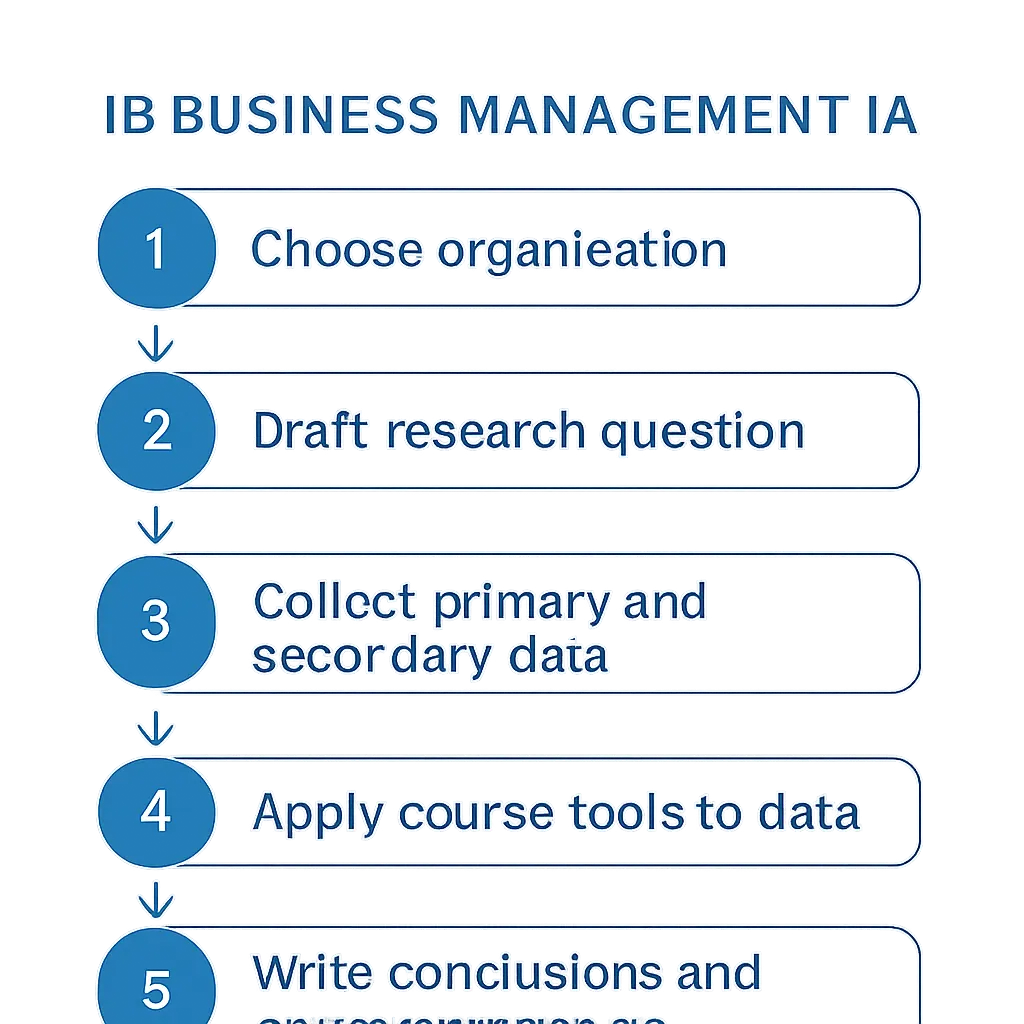
The IB business research project has a 1,800-word limit at both SL and HL. That limit covers the body of the project. Supporting documents, the bibliography, citations and references, the contents page, tables of statistical data, diagrams, and equations and calculations are excluded; definitions and quotations in the body count. Students routinely lose words they cannot afford by writing out data in prose that could sit in a table, so treat the exclusions as a structural tool, not a loophole.
A workable section order for the ib business management ia is:
- Introduction (including the research question)
- Methodology
- Findings and analysis
- Conclusion (answering the research question)
- References
- Supporting documents (three to five, attached)
A rough word budget that reflects where the marks actually sit:
| Section | Suggested word allocation |
|---|---|
| Introduction (incl. research question) | ~150 words |
| Methodology | ~150 words |
| Findings and analysis | ~1,000 words |
| Conclusion | ~300 words |
| References | Not counted |
| Supporting documents | Not counted |
The analysis section takes roughly 55% of your total allowance for good reason: assessment criteria weight applied analysis far more heavily than framing or method description.
Supporting documents are evidence, not overflow paragraphs. Your three to five supporting documents, such as an interview transcript, survey results, financial statements or a company report, are attached to the project and do not count toward the word limit. They must be recent: the guide asks for documents published no more than three years before the project is submitted to the IB. Reference them in-body with a short call-out rather than embedding the content in the text. The counter-intuitive gotcha here is that any analysis that only exists in an attachment will not earn marks. Every analytical point must stand in the main body; the supporting documents simply provide the evidence trail.
4. Assessment Criteria and What the Top Band Requires
The business research project is the same task at SL and HL, and it is marked against the same criteria at both levels. According to the IB, internal assessments are marked by subject teachers and then externally moderated by IB examiners. The marks below come from the IB's Business management guide (first assessment 2024).
The seven criteria, 25 marks in total:
- A: Integration of a key concept (5 marks). Assesses how well one key concept (change, creativity, ethics or sustainability) works as the lens for the whole project.
- B: Supporting documents (4 marks). Assesses the three to five supporting documents from which most of your information is drawn.
- C: Selection and application of tools and theories (4 marks). Assesses whether you choose relevant frameworks and apply them correctly to real evidence from your organisation.
- D: Analysis and evaluation (5 marks). Assesses how well you interpret findings, link evidence directly to your question, and weigh competing explanations.
- E: Conclusions (3 marks). Assesses whether your conclusions are consistent with the evidence and explicitly answer the research question.
- F: Structure (2 marks). Assesses whether the project is organised using an appropriate structure.
- G: Presentation (2 marks). Assesses the required elements: title page, accurate contents page, headings and sub-headings, and numbered pages.
What separates the top band from the middle band is usually analysis and conclusions. Many students apply tools competently but then fail to connect findings back to the original question. Top-band analysis treats the tool's output as a starting point, not an end point: it explains what the evidence implies and why an alternative interpretation is less convincing. Top-band conclusions are specific, feasible given the company's evident constraints, and traceable to the analysis rather than imported from generic textbook advice.
One non-obvious gotcha: examiners reward a focused question with limited scope over a broad question with ambitious coverage. A narrow, well-evidenced IA consistently outscores a wide-ranging one that touches every criterion superficially.
On HL vs SL: the task and criteria are the same at both levels; only the IA's weighting differs (30% of the final grade at SL, 20% at HL).
External moderation in practice means IB examiners review a sample of your school's submissions and can raise or lower every teacher-marked score in that sample, not just the individual ones they read. If your school's marks are adjusted, all submitted IAs in the sample move together. This is not a minor administrative step: a school whose teacher consistently over-marks can see the entire cohort's scores pulled down at moderation.
5. Choosing and Applying Business Management Tools in Your IA
Let your research question choose the tool, not the other way around. A student who picks SWOT because it feels familiar, then retrofits a question to match, will produce analysis that feels mechanical. The examiner can tell.
A more reliable approach: draft the research question first, then ask which tool most directly answers it.
| Research question focus | Most appropriate tool |
|---|---|
| Should the business enter a new market segment? | Ansoff matrix |
| Is the company financially healthy compared to competitors? | Ratio analysis (liquidity, profitability, efficiency) |
| Which product line should be cut or invested in? | BCG matrix |
| Should the business buy new equipment or lease it? | Decision tree |
| What are the strategic options after a major internal change? | SWOT analysis |
The counter-intuitive gotcha here: a SWOT is one of the harder tools to score well on, precisely because it looks easy. Examiners penalise any SWOT that reads like a generic template. Every strength, weakness, opportunity, and threat must be grounded in specific evidence about the named organisation, with a source or primary data point attached to it.
The textbook-explanation trap is the single most common tool-related error. Spending a paragraph defining what a BCG matrix is costs you words and criterion marks. Define briefly, then apply immediately.
Primary vs secondary data
Both have a place, and both require proper referencing.
- Primary data (a structured interview with the owner, a short customer survey) adds credibility because it is unique to your IA. It also demonstrates the research skills the criterion rewards.
- Secondary data (annual reports, industry association figures, news coverage) provides context and benchmarks. It cannot substitute for engagement with the actual organisation.
A workable combination: use secondary data to frame the industry context, then primary data to test how that context applies to your specific business.
HL students: use the full syllabus
According to the IB, several topics are restricted to HL only, including budgets (Unit 3.9) and organisational planning tools (Unit 1.7). If your research question touches financial planning or workforce structure, these units are available to you and can differentiate your analysis from an SL project covering similar ground. Do not default to SL-level tools when a more precise HL framework fits.
6. Common Mistakes Examiners Flag
These problems appear repeatedly across IB Business Management IA submissions, and most of them stem from the same root cause: students write about the business rather than analysing it against the research question.
Description instead of analysis is the most penalised pattern. Summarising what a company did in a given year is background, not analysis. Examiners want to know why it happened and what it means for the specific decision your research question examines.
Tools used as filler. A SWOT analysis that runs to several pages but never connects its findings to the research question scores poorly, regardless of how thorough it looks. The counter-intuitive point here is that a shorter, tightly linked SWOT outperforms a detailed one that drifts. Every tool output must feed directly into your argument.
A weak or absent conclusion. Many students exhaust their word count on context and arrive at the conclusion with room only for vague remarks. The IB rubric requires conclusions that are consistent with your evidence and explicitly answer the research question, not a summary. Your conclusion must answer the exact research question stated in the introduction, not a slightly simplified version of it. Question drift, where the conclusion quietly shifts scope, is a specific red flag examiners note.
Poor sourcing. Relying on a single company website or one interview respondent, without acknowledging the limitations that creates, signals thin research methodology.
Word count imbalance. Spending the first third of your word count on company history leaves too little space for the analysis sections that actually determine your grade.
7. Where to Go from Here
The structure, criteria, and tool selection all feed into one decision you need to make soon: your research question. Once that is locked, the rest of the IA follows a predictable path.
One non-obvious point worth flagging: the criteria changed with the course first assessed in 2024, so a past student's IA feedback sheet from the older course may not match what your cohort is assessed against.
This week, ask your teacher for the current authorised subject guide and check your draft plan against the seven criteria and their marks. Get the source document rather than relying on third-party summaries.
FAQ
What is the IB Business Management IA?
The IB Business Management IA is an internally assessed business research project, the same task at SL and HL, in which you investigate a real business problem using course tools and concepts, marked by your teacher and moderated by IB examiners.
How many words is the IB Business Management IA?
The business research project has a 1,800-word limit at both SL and HL; text beyond this limit is not read by examiners, and supporting documents, the bibliography, citations and references, tables, diagrams and calculations do not count toward the total.
How is the IB Business Management HL IA marked?
The business research project, the same task at SL and HL, is marked out of 25 against seven criteria: integration of a key concept (5 marks), supporting documents (4), selection and application of tools and theories (4), analysis and evaluation (5), conclusions (3), structure (2) and presentation (2).
What makes a good research question for the IB Business Management IA?
A strong research question names one specific, real organisation, uses a command term from the Business Management syllabus (such as 'to what extent' or 'evaluate'), centres on a real business issue or decision, and is narrow enough to be answered with primary and secondary data within 1,800 words.
Which business management tools should I use in my IA?
Choose tools that match your research question - SWOT for strategic decisions, ratio analysis for financial questions, decision trees for investment choices, BCG matrix for product portfolios - and apply each tool to real data about your chosen organisation rather than presenting it as a generic textbook model.
What is the difference between the HL and SL IB Business Management IA?
There is no difference in the task: SL and HL students both complete a business research project of up to 1,800 words, marked against the same criteria and then externally moderated; the IA is worth 30% of the final grade at SL and 20% at HL.
References
- DP business and management - International Baccalaureate® - https://ibo.org/programmes/diploma-programme/curriculum/individuals-and-societies/business-and-management