IB Business Management: The Complete Subject Guide
By Michael Thompson · Education Specialist; 10 years teaching the IB at Bromsgrove School · Published 21 May 2026 · Updated 6 October 2026
IB Business Management is a Diploma Programme subject that examines how organisations make decisions across finance, marketing, human resources, and operations. Its old name, IB Business and Management, is still widely used; it is the same subject. Offered at Standard Level (SL) and Higher Level (HL), it is one of the most widely taken Group 3 subjects in the IB. The 2024 syllabus refresh updated unit content, embedded a concept-based curriculum, and changed how the Internal Assessment is structured. This guide covers everything you need to understand the course - assessments, units, formulas, and how to approach each exam paper.
Key Takeaways
- Five core units: The course is built around Introduction to Business Management, Human Resources, Finance and Accounts, Marketing, and Operations Management.
- Four key concepts: Change, Creativity, Ethics, and Sustainability run across all units and must appear in extended responses.
- Paper 1 has a pre-released statement: About three months before the exam you get research topics and the opening of the case study; the full case study is unseen until the exam.
- Paper 3 is HL only: It focuses on a social enterprise scenario and is worth 25% of the HL final mark.
- Internal Assessment word count: The IA research project has a strict 1,800-word limit at both SL and HL, excluding the research question and bibliography.
- Formula booklet is provided: A formula sheet is given in the exam, so the priority is understanding when and how to apply each formula, not memorising notation.
In This Article
- What Is IB Business Management
- The 2024 Syllabus and Five Core Units
- The Four Key Concepts and Concept-Based Curriculum
- Paper 1: How to Prepare for the Pre-Released Case Study
- Paper 2: Data Response Questions Explained
- Paper 3: The HL Social Enterprise Paper
- The Internal Assessment: Research Project on a Real Organisation
- The IB Business and Management Formula Sheet
- IB Business Case Study Tips and Tricks
- Where to Go From Here
1. What Is IB Business Management
IB Business Management is a Diploma Programme subject in Group 3 (Individuals and Societies), the IB's social sciences group. It sits alongside Economics, Geography, and Global Politics, but unlike most of those subjects, it centres on real organisations: how they make decisions, how they raise and spend money, and how they respond to change.
The subject runs at Standard Level (SL) and Higher Level (HL). HL students cover additional content, sit a third exam paper focused on social enterprise, and complete the same internal assessment as SL students. The non-obvious trade-off: HL is not simply "more content" piled on top of SL. The HL curriculum introduces genuinely distinct concepts, so students who underestimate the step up often find the third paper catches them off guard.
Students are drawn to IB Business Management for three concrete reasons. First, the course uses named companies and real financial statements rather than invented scenarios. Second, it builds a practical toolkit of financial ratios, break-even analysis, and decision-making frameworks. Third, those tools transfer directly into economics, law, or social-science degrees, making the subject a credible academic choice rather than a soft option.
2. The 2024 Syllabus and Five Core Units
The IB Business Management syllabus is built around five units, studied by both SL and HL students. HL students cover all the same content but go deeper in several units and sit an additional paper. Here is what each unit contains and where the SL/HL split sits.
Unit 1 - Introduction to Business Management covers types of organisations, business objectives, stakeholders, and the external environment. It sets the conceptual vocabulary the other four units assume.
Unit 2 - Human Resource Management addresses organisational structure, motivation theory, leadership styles, and industrial relations. The 2024 refresh removed some older motivation models and tightened the focus on contemporary workforce topics such as remote working and flexible contracts.
Unit 3 - Finance and Accounts is where the formula sheet earns its place. Students work through financial statements, investment appraisal, and ratio analysis. This unit is the most calculation-heavy and is assessed across both papers.
Unit 4 - Marketing covers market research, the marketing mix, and sales forecasting. The 2024 update added more explicit treatment of digital marketing tools, replacing some older print-based examples.
Unit 5 - Operations Management looks at production methods, quality management, supply chain, and sustainability. HL students extend this unit with additional operations strategy content not assessed at SL.
| Level | What they study |
|---|---|
| SL | Units 1-5, standard depth |
| HL | Units 1-5 plus HL-only topics in human resources, finance, marketing and operations |
One counter-intuitive point worth noting: Unit 1 carries less direct exam weight than its position implies, but it supplies the framing language, such as the concepts of ethics and sustainability, that examiners expect to see woven through answers on every other unit. Neglecting it costs marks elsewhere.
3. The Four Key Concepts and Concept-Based Curriculum
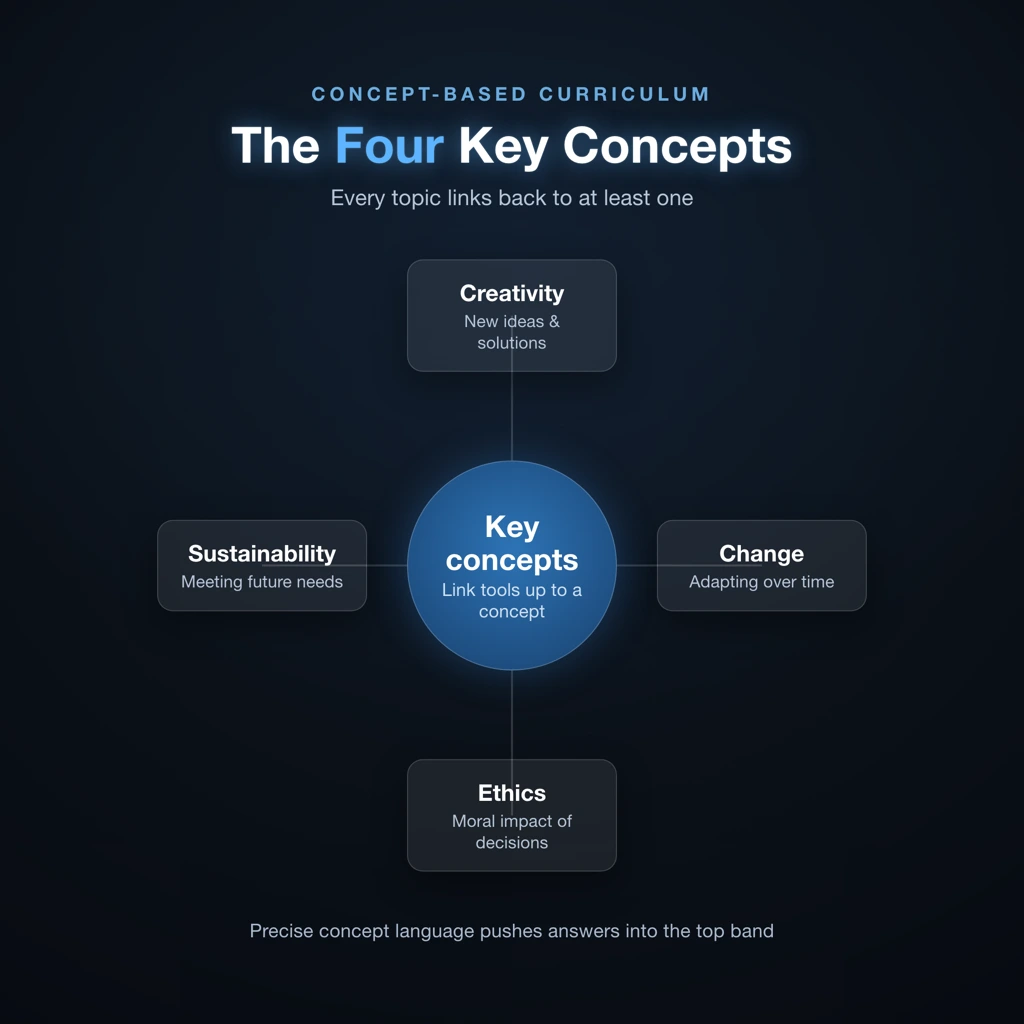
The IB frames its business management course around four concepts that sit above the individual tools and theories. Every topic you study connects back to at least one of them:
| Concept | Core question it asks |
|---|---|
| Change | How and why do businesses adapt over time? |
| Creativity | How do new ideas and approaches help a business solve problems or create value? |
| Ethics | What are a business's obligations beyond profit? |
| Sustainability | Can the business meet present needs without harming its future, society or the environment? |
"Concept-based" means the IB expects you to move in both directions: from a business tool upward to a concept, and from a concept downward to a specific example. Using a SWOT analysis to identify a threat is fine at lower mark bands. Explicitly linking that threat to the concept of Change and explaining what it implies for long-term strategy is what pushes a response into the top band.
The non-obvious gotcha: examiners are looking for concept language used with precision, not as decoration. Writing "this relates to ethics" at the end of a paragraph scores little. Writing "the decision reflects a tension between short-term profitability and the ethical concept of stakeholder responsibility" demonstrates the connection as reasoning, which is what the mark scheme rewards.
In Paper 1 Section B and Paper 2 extended answers, weave the relevant concept into your argument early, then return to it in your conclusion.
4. Paper 1: How to Prepare for the Pre-Released Case Study
Paper 1 is the same for SL and HL, and only part of it is released in advance. About three months before the exam, the IB publishes a pre-released statement with two elements: a small number of topics to research (about five hours of work) that set the context, and roughly the first 200 words of the case study. The full case study, about 800 to 1,000 words, is unseen until the exam (IB business management updates).
The structure splits into two distinct parts:
- Section A (20 marks): answer all the structured questions on the case study.
- Section B (10 marks): choose one of two extended-response questions on the case study.
Most of the case is new to you on the day, so any answer you draft in advance and memorise will not fit. Practising "what to write" rather than "how to think about this company" is the single most counterproductive preparation habit for this paper.
What to do with the pre-release instead:
- Research each pre-released topic properly. The topics are chosen because the guide could not anticipate them, and they set the context for the unseen case.
- Read the opening of the case closely for the organisation's type, aims and setting, and note which unit areas it is likely to draw on: finance, HR, marketing, operations or the external environment.
- Map which IB Business Management tools genuinely apply. A cash-flow heavy organisation calls for ratio analysis and working capital discussion; a startup-style case almost always invites Ansoff Matrix and investment appraisal.
- Practise on past Paper 1 case studies, writing short context-specific paragraphs that link a tool to named details in the case. Generic theory with no reference to the actual company scores poorly in both sections.
5. Paper 2: Data Response Questions Explained
Paper 2 is based on unseen stimulus material with a quantitative focus, presented in parts: you read each part and answer its question before moving on. In Section A you answer all the structured questions; in Section B you choose one of two questions, each combining structured parts with an extended response. The stimulus mixes quantitative data (financial statements, graphs, market-share figures) with qualitative information (business scenarios, stakeholder viewpoints).
SL and HL sit different versions of the paper. SL candidates have 1 hour 30 minutes for 40 marks; HL candidates have 1 hour 45 minutes for 50 marks, and the HL paper also covers the HL-only topics.
Approaching quantitative questions
The non-obvious trap here is that the marks are split between calculation and interpretation. Writing a correct figure with no context scores only part of the available marks; a wrong figure with correct method and a sensible contextualised comment will often outscore it.
When you hit a numerical question:
- State the formula you are using before substituting numbers.
- Show each step of working on a separate line.
- Round consistently and note units (%, $000s, ratios).
- Write one sentence connecting the result to the business in the stimulus: "A current ratio of 0.8 suggests the company cannot cover its short-term liabilities from current assets, which is a concern given the seasonal cash-flow pattern described."
The formula booklet
The IB provides a copy of the formulae in the exam, so rote memorisation is not the point. What the examiner is testing is whether you can select the right formula for the scenario and say something meaningful about what the output means for that specific organisation. Practise that interpretation step separately; it is where most marks are dropped.
6. Paper 3: The HL Social Enterprise Paper
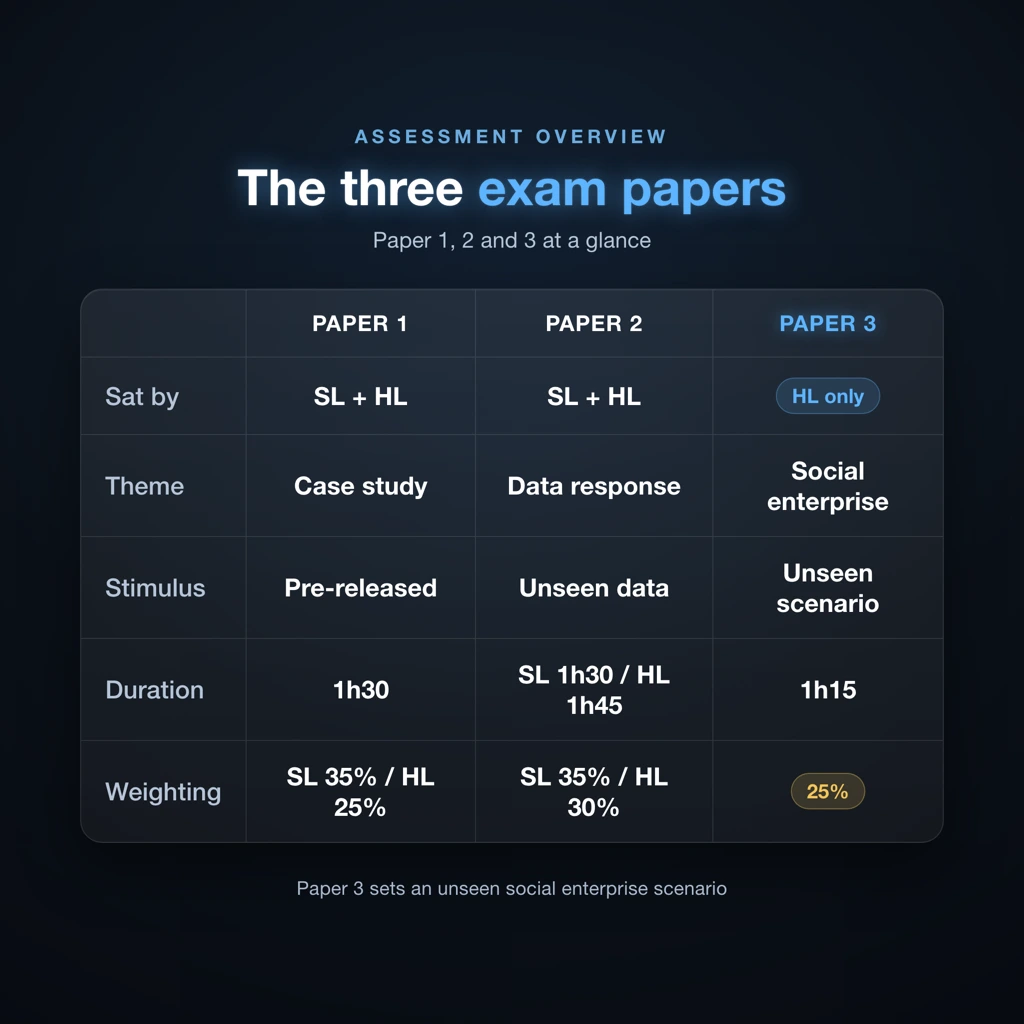
Paper 3 is HL-only, lasting 1 hour 15 minutes for 25 marks. It presents an unseen social enterprise scenario and asks you to apply standard business tools to an organisation whose primary goal is social or environmental, not profit maximisation. The paper carries 25% of the total HL mark, so it is not a minor add-on. You describe the human need the enterprise is trying to meet, explain the challenges facing the social entrepreneur, and finish with a decision-making document that includes a business recommendation.
The most common preparation mistake is treating social enterprises as simply "nicer" commercial businesses. The IB expects you to recognise genuine structural differences:
- Social enterprises generate revenue but reinvest surplus to pursue a social mission rather than distributing profit to shareholders.
- Charities typically rely on donations and grants and are governed by distinct legal frameworks.
- Commercial businesses pursue profit for shareholders or owners as the primary objective.
Examiners look for this distinction in your analysis. Applying a straightforward profit-maximisation argument to a social enterprise without qualifying it will cost you marks.
Unit 1 (Introduction to business management) is where social enterprises, objectives and stakeholders are taught, so it underpins Paper 3, although the paper can draw on all five units. Practise applying stakeholder mapping, mission versus objectives analysis, and operations efficiency concepts specifically within a non-profit or hybrid context.
The tone expected in Paper 3 answers differs from Papers 1 and 2. You are not evaluating competitive strategy or growth for its own sake. The question is whether business decisions align with a social mission under resource constraints. Framing your evaluation around that tension is what separates a strong response from a generic one.
7. The Internal Assessment: Research Project on a Real Organisation
The IB Business Management internal assessment is a written research project in which you investigate a real organisation using a single, focused research question. It is not a report about a company. It is an analytical piece that applies business management tools to reach conclusions and make recommendations.
Word count: 1,800 words maximum, for both SL and HL. Supporting documents, the bibliography, citations and references, the contents page, tables of statistical data, diagrams, and equations and calculations do not count toward this limit; definitions and quotations in the body do. That is a tighter ceiling than most students expect, and the constraint matters: every paragraph needs to earn its place.
Internal assessment criteria
The internal assessment is the same task at SL and HL, marked out of 25 against seven criteria: A, integration of a key concept (5 marks), using one of change, creativity, ethics or sustainability as the lens for the project; B, supporting documents (4), three to five of them; C, selection and application of tools and theories (4); D, analysis and evaluation (5); E, conclusions (3); F, structure (2); and G, presentation (2).
Analysis and evaluation is where most of the difference between projects shows. Examiners are looking for reasoned judgement, not description. A student who writes four pages on a company's history and one paragraph on a SWOT matrix will score poorly even if the research is thorough.
One counter-intuitive point: Criterion C rewards the appropriate use of tools, not the number of tools used. A focused SWOT and a well-constructed break-even analysis applied rigorously will outscore five half-applied frameworks.
Choosing an organisation
The best subjects for the IA are organisations where you can collect primary data: a local SME, a family business, or a social enterprise. An interview with an owner or manager gives you primary evidence that feeds directly into your analysis. Large multinationals make poor subjects precisely because you cannot access people or unpublished data, so your sources default to press releases and annual reports.
The IBO's own professional development resources for business management teachers, including workshops specifically focused on the internal assessment, reinforce this emphasis on generating original evidence rather than recycling publicly available material (IBO Professional Development Catalogue).
The most common pitfall
Students describe when they should analyse. A paragraph that explains what a SWOT analysis is, or summarises a company's history, does not satisfy Criterion C or D. The tool must be applied to specific evidence from your organisation, and the output must feed into your evaluation. If your SWOT does not appear again in your conclusions, it was not integrated; it was decorated.
Choose a narrow research question. "Should Bakehouse on Brook Street introduce a loyalty card scheme to improve customer retention?" is workable. "How successful is Bakehouse on Brook Street?" is not.
8. The IB Business and Management Formula Sheet
A formula booklet is provided in every IB Business and Management exam paper, so you are never expected to memorise formulas. That said, arriving at the exam unfamiliar with the sheet will cost you time you cannot afford.
The booklet covers four main categories:
- Financial ratios - profitability (gross profit margin, net profit margin, return on capital employed), liquidity (current ratio, acid test ratio), and efficiency (inventory turnover, debtor days, creditor days)
- Break-even analysis - contribution per unit, break-even quantity, margin of safety
- Investment appraisal - payback period, average rate of return (ARR), and net present value (NPV), including discount factor tables
- Cash flow and contribution - net cash flow, opening and closing balances, total contribution
The non-obvious gotcha: NPV is the formula students most often apply correctly but interpret badly. Calculating a positive NPV and then stopping there earns partial credit at best. Examiners want to see you explain what that figure means for the decision-maker, whether the project is worthwhile given the discount rate, and what assumptions might weaken the result.
Practise on real data sets, not isolated formula drills. Work through past-paper financial statements, state the result, and then write one sentence explaining what it signals to a manager. A wrong calculation with a well-reasoned interpretation is penalised less heavily than a correct number with no contextual comment. The formula sheet hands you the maths; the marks come from the analysis.
9. IB Business Case Study Tips and Tricks
Command terms are the most under-used mark-scheme signal in IB Business Management. The IBO assigns each term a specific cognitive demand, and examiners mark to that demand precisely:
| Command term | What the examiner wants |
|---|---|
| Define | A precise, one-sentence explanation of the term - no more |
| Explain | The definition plus the mechanism (why or how it works) |
| Analyse | Break the concept into parts, show cause and effect, stay balanced |
| Discuss | Arguments for and against, linked to the stimulus or case |
| Evaluate | Everything in 'discuss', plus a reasoned, evidence-based judgement |
The non-obvious gotcha: writing a full analysis when a question says 'explain' wastes time and earns no extra marks. The command term sets the ceiling, not just the floor.
Use definitions as anchors. Every extended answer should open with a precise definition of the central tool or concept, for example the Boston Consulting Group matrix or Ansoff's growth model. This signals to the examiner that your argument is built on a shared technical vocabulary.
For structuring extended responses, the ABRACA framework works well: make a point, apply it to the business in the stimulus, bring in real-world context, and link back to a concept (such as change, ethics, or sustainability). That concept link is where marks are routinely dropped.
Revise by unit, not chronologically. Working through past papers topic by topic (Unit 1 questions only, then Unit 4 only, and so on) forces you to consolidate the tools for each unit before combining them under timed conditions. Chronological practice papers can mask gaps behind strong areas.
10. Where to Go From Here
Your most useful next action is practical: download the official IB Business Management subject guide from the IBO's programme resource centre and check the first assessment date listed for the current syllabus version. That date determines which paper structure, IA criteria, and formula sheet apply to your exams - an easy detail to miss when teachers or unofficial resources are still referencing an older edition.
One non-obvious check worth making: confirm whether your school's DP coordinator has registered for a Category 1 or Category 2 Business Management workshop through the IBO, since schools transitioning to the revised syllabus sometimes lag on updated IA guidance.
For deeper reading, the sections on the formula sheet and Paper 1 case study preparation on this site are worth revisiting once you have the official guide open in front of you. Download the subject guide this week.
More on IB Business Management:
- IB Business Management IA: Structure, Criteria & Tools
- Business Management Extended Essay: The Complete IB Guide
- How to Get a 7 in IB Business Management
FAQ
What is IB Business Management?
IB Business Management is a Group 3 Diploma Programme subject that teaches students how organisations operate, covering finance, marketing, human resources, and operations at both Standard and Higher Level.
What are the key concepts in IB Business Management?
The four key concepts are Change, Creativity, Ethics, and Sustainability; students must connect these explicitly to their analysis in extended exam responses, and the Internal Assessment uses one of them as its conceptual lens.
What is the IB Business Management IA word count?
The Internal Assessment has a maximum word count of 1,800 words at both SL and HL; supporting documents, the bibliography, citations, the contents page, tables, diagrams and calculations do not count toward this limit.
What is IB Business Management Paper 3?
Paper 3 is an HL-only exam based on an unseen social enterprise scenario; it accounts for 25% of the HL final grade and tests students' ability to apply business tools in a non-profit or social business context.
How should I prepare for the IB Business Management Paper 1 case study?
Research the topics in the pre-released statement, read the opening of the case closely, and practise applying business tools to past case studies - do not write pre-prepared answers, because the full case study is unseen until the exam.
Is a formula sheet provided in IB Business Management exams?
Yes, an IB Business Management formula booklet is provided in all examination papers, so revision should focus on applying and interpreting formulas in context rather than memorising notation.
References
- DP Subject: Individuals and Societies - 2025-2026 Catalogue - https://catalogue.ibo.org/en/professional-development/dp-subject-individuals-and-societies
- Business management updates - International Baccalaureate - https://www.ibo.org/university-admission/latest-curriculum-updates/business-management/