IB Economics IA: Structure, Criteria and Common Mistakes
By Michael Thompson · Education Specialist; 10 years teaching the IB at Bromsgrove School · Published 4 September 2026
The IB Economics IA is a portfolio of three commentaries, each up to 800 words, that together count towards your final Economics grade. Unlike the external exams, this component is written at home over your two years in the Diploma Programme - which sounds like an advantage until you realise most marks are lost to avoidable structural errors rather than gaps in economic knowledge. This guide covers the exact portfolio rules, how each commentary is marked, what examiners flag most often, and how to use the 800-word limit well. Nothing here is a guarantee of any particular grade; the aim is to make sure you understand the rules before you start writing.
Key Takeaways
- Three commentaries, one per syllabus section: Per the IB, both SL and HL students must produce a portfolio covering microeconomics, macroeconomics, and the global economy, each based on a published news article.
- 800 words per commentary is a hard ceiling: Examiners stop reading at 800 words, so anything written beyond that limit will not be marked.
- Five criteria are assessed per commentary: Diagrams, terminology, application, analysis, and evaluation are each marked separately; a strong diagram can contribute meaningfully to your total, but only if it is fully labelled and linked to the article.
- Article choice is more consequential than most students expect: An article that describes only one economic event leaves you almost nothing to evaluate; you need an article with a policy decision, a trade-off, or a market outcome that can be contested.
- Grade boundaries shift each session: The IB does not publish fixed boundaries; the mark needed for each level is set after marking is complete, so raw totals alone cannot predict your final grade.
- The most common examiner complaint is generic diagrams: A textbook supply-and-demand diagram copied without labelling the specific market from the article, the direction of the shift, or the resulting price change is a common reason marks are dropped.
In This Article
- What the IB Economics IA portfolio looks like
- IB Economics IA marking criteria explained
- Choosing articles for your IB Economics IA commentaries
- The diagram requirement: what earns marks and what does not
- IB Economics IA grade boundaries
- Mistakes examiners see most - and how to fix them within 800 words
- Where to go from here
1. What the IB Economics IA portfolio looks like
The IB Economics IA is a portfolio of three commentaries, each one analysing a different published news article through an economics lens. According to the International Baccalaureate, both SL and HL students complete the same portfolio structure: one commentary on microeconomics, one on macroeconomics, and one on the global economy.
Each commentary has an 800-word limit. That limit applies to the written analysis only. The cover sheet, diagrams, and references sit outside the count, which matters more than it sounds: a well-labelled diagram can do the analytical work that 150 words of rushed explanation cannot.
Your source article must come from published news media. Academic journals and textbooks are not eligible, and the IB requires you to submit the original article alongside your commentary.
One structural requirement that catches students off guard: every commentary must engage with the course's nine key concepts as an analytical lens. The IB lists these as scarcity, choice, efficiency, equity, economic well-being, sustainability, change, interdependence, and intervention. You do not need to reference all nine in a single commentary, but your article choice should make at least one or two central to your argument rather than bolted on as an afterthought.
The practical upshot: treat the portfolio as three short, focused pieces of writing, each built around a news story that makes the economics obvious enough to diagram but contested enough to analyse.
2. IB Economics IA marking criteria explained
Each commentary in the IB Economics IA is marked against five criteria: diagrams, terminology, application, analysis, and evaluation. The marks available per criterion vary, but each commentary is worth up to 14 marks. Across a portfolio of three commentaries, the total is 45 marks, which is assessed internally by your teacher and then moderated externally by the IB. The full rubric, including the exact mark allocations per criterion, is published in the official Economics subject guide, accessible through the IB's My IB portal at ibo.org.
Both SL and HL students are marked against the same five criteria. The distinction is that the IA contributes a different percentage weighting to the overall Diploma grade at each level. Check the subject brief PDFs, available via ibo.org, for the precise figures for your level.
Evaluation is the highest-tariff criterion, and the one most commentaries underperform on. The confusion is understandable: students often write a solid explanation of how a policy works and assume that counts as evaluation. It does not. Evaluation means weighing trade-offs (a carbon tax may reduce emissions but disproportionately affects lower-income households), acknowledging the limitations of a model (the demand-supply diagram assumes ceteris paribus, which rarely holds in a real news story), and making a supported judgement about policy effectiveness rather than restating how the policy operates.
A concrete gotcha: examiners distinguish between analysis that follows the logic of an economic model and evaluation that steps outside it to question the model's assumptions. A student who only does the former will hit a ceiling on the evaluation criterion regardless of how technically accurate their diagram or terminology is.
3. Choosing articles for your IB Economics IA commentaries
Per the IB, the IA portfolio must be based on published extracts from news media. Newspapers, news websites, and magazines qualify. Academic papers, textbooks, and government statistical releases do not, even if they contain strong economic content.
The IB sets a date range for acceptable articles, and your school's submission deadline will push that range earlier than you expect. Confirm the exact window with your teacher before you start searching - an article that falls outside the permitted period is unusable, regardless of how well it fits your commentary.
What makes a strong article for an IB Economics IA commentary:
- It reports a policy decision, a market event, or a measurable economic outcome, not just a situation.
- It contains an identifiable cause and at least one consequence you can diagram and evaluate.
- It is specific enough to analyse within 800 words. An article about global inflation trends is too broad; an article about a specific government subsidy or price cap gives you something to work with.
Article traps to avoid:
- Descriptive pieces that narrate a problem but name no policy or mechanism. Without a mechanism, there is nothing to evaluate.
- Opinion columns that already embed the economic analysis, leaving you no original argument to make.
- Data-heavy statistical releases with no narrative context, which make it hard to construct the 800-word argument the commentary requires.
One non-obvious trap: a fascinating article about a topic that straddles two syllabus sections. Examiners will not award marks for analysis that belongs to a different section than the one claimed on your cover sheet, so confirm the fit to micro, macro, or the global economy before you commit.
Reliable sourcing ground includes BBC News, The Economist, the Financial Times, Reuters, and The Guardian, all of which publish economics-relevant reporting consistently enough to make regular searching worthwhile.
4. The diagram requirement: what earns marks and what does not
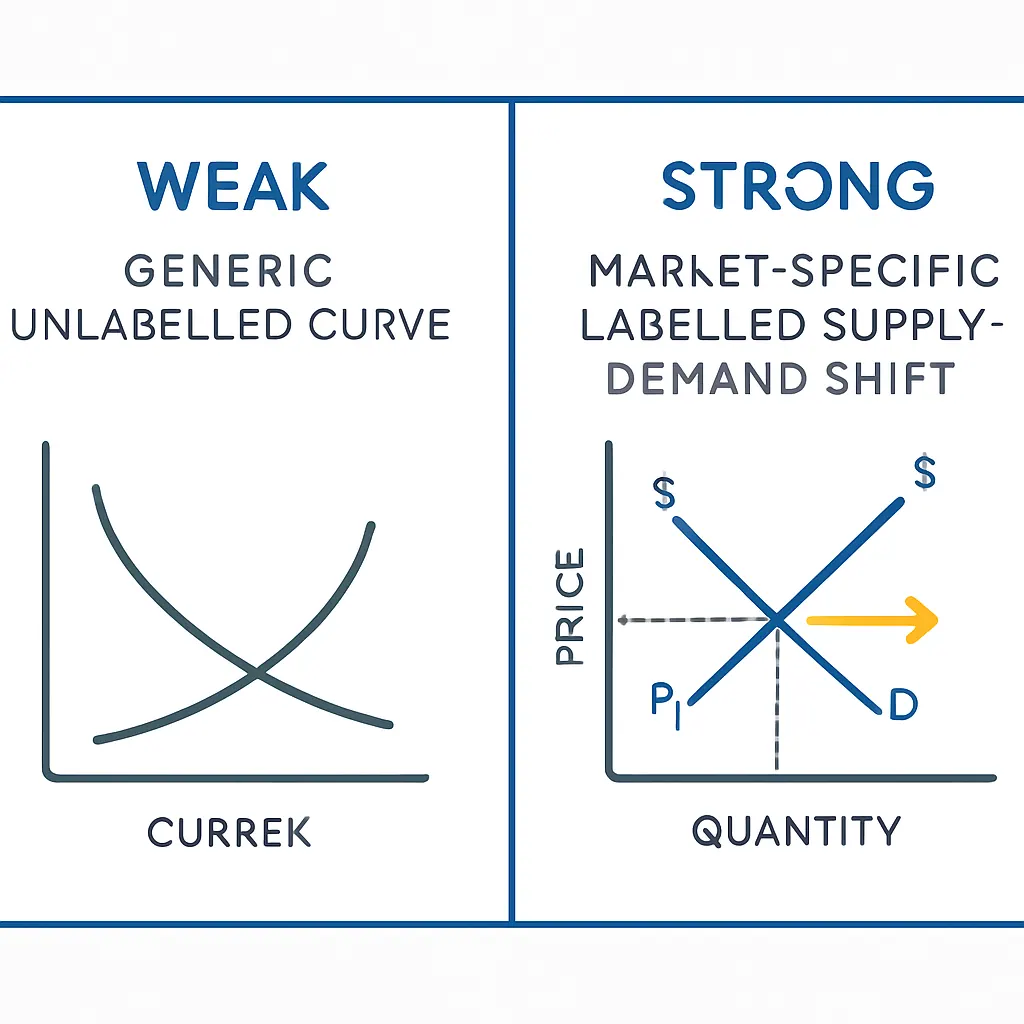
Diagrams are assessed as a discrete criterion in the IB Economics IA rubric. That matters in practice: even a brilliantly written commentary cannot score full marks on the diagram criterion if the diagram is missing, generic, or unlabelled.
What a high-scoring diagram must include:
- Axes labelled with economically precise terminology ("Price (£/unit)" and "Quantity (thousands of units per month)", not just "P" and "Q")
- Every curve or line named (Supply, Demand, MPC, MSC, and so on)
- Arrows showing the direction of any shift
- Before and after equilibrium points marked distinctly, typically P1, P2, Q1, Q2
- A title naming the specific market from the article ("Market for wholesale gas in the UK", not "Supply and demand diagram")
The template trap. A generic supply-and-demand diagram copied from a textbook, with no indication of which curve shifts or why, scores low because it demonstrates reproduction, not application. Examiners can tell immediately when a diagram has been drawn before the article was read and then attached afterwards.
One non-obvious gotcha: students often draw the shift correctly but forget to delete the original equilibrium label, leaving two "E" points on the graph with no distinction between them. This reads as an error, not an omission, and costs marks.
Reference your diagram in the text. An unreferenced diagram is treated as decoration. Write something like: "As shown in Figure 1, the inward shift of supply from S1 to S2 raises the equilibrium price from P1 to P2, consistent with the cost increases described in the article." That sentence is doing analytical work.
The IB does not specify an exact number of diagrams per commentary. Most high-scoring commentaries include at least one diagram tied directly to the article's core economic mechanism. Hand-drawn diagrams are fully acceptable; accuracy of labels matters more than whether you used software.
5. IB Economics IA grade boundaries
The IB Economics IA portfolio is marked out of 45 by your teacher, then externally moderated by the IB. That portfolio mark is combined with your external examination scores to produce a final Economics grade on the 1-7 scale used across all DP subjects.
Grade boundaries are not fixed. The IB sets them after each examination session, so the raw mark needed for a 6 or 7 will differ between May and November and will shift from year to year. The IB publishes boundaries after results are released via its results system; your school's IB coordinator can access the figures for recent sessions.
The moderation risk is the detail most students miss. If your school's internal marking is found to be consistently generous relative to the IB standard, every student's portfolio mark in that cohort will be adjusted downward, not just the outliers. The reverse applies if marking is consistently strict. You have no control over this, but it has a direct implication for how you approach the ib economics ia portfolio.
- Do not rely on one high-scoring commentary to carry the portfolio. Moderation applies to the whole portfolio mark, so a weak third commentary cannot simply be offset.
- Aim for consistent quality across all three commentaries. A steady 13-14 out of 15 per commentary is a safer target than a 15, a 15, and an 8.
- Ask your teacher to show you marked exemplars so you understand the standard they are applying before you submit.
6. Mistakes examiners see most - and how to fix them within 800 words
These six errors appear repeatedly across IB Economics IA portfolios. Each one is fixable before you submit.
Mistake 1: Retelling the article. The examiner has read the news extract. Spending half your word count summarising what happened wastes space that should carry economic theory. Start your first sentence with the concept at play ("This article illustrates a negative externality of production") and treat the article as evidence, not content.
Mistake 2: Generic diagrams. Covered in section 4, but worth naming again because it is the most frequently cited concern in IB examiner reports. A diagram that could belong to any market in any commentary scores close to zero. Label the specific market (the UK petrol market, Brazilian coffee exports), show the shift with an arrow, and mark both equilibria clearly.
Mistake 3: Missing evaluation. Many commentaries read as description plus analysis, then stop. The rubric rewards weighing trade-offs, questioning model limitations, and assessing whether a policy actually achieves its goal. A practical fix: reserve at least 150-200 words for evaluation. Use explicit signposting phrases such as "however", "in the long run", and "a limitation of this model is" so the examiner cannot miss it.
Mistake 4: Ignoring the key concept. The IB Diploma Programme Economics course is built around nine key concepts: scarcity, choice, efficiency, equity, economic well-being, sustainability, change, interdependence, and intervention. Each commentary is expected to be written through one of these concepts. Failing to name and apply one is a direct miss on the rubric. State the concept on the cover sheet and reference it at least once in the body, showing how it connects to the article's economic mechanism.
Mistake 5: Word count mismanagement. The counterintuitive fix here is to draft in reverse. Write the evaluation paragraph first, before you have written anything else. This forces you to commit to the argument you are making and ensures the highest-mark content is not squeezed by background material written early when momentum was high.
Mistake 6: Article mismatch. An article that straddles two syllabus sections, covering both a firm's costs and a government subsidy policy, splits your analysis and makes the commentary feel unfocused. Before you commit to an article, ask one question: "Is the primary economic mechanism here micro, macro, or global?" If the answer is uncertain, find a different article.
> Quick-reference fix list > - Open with the economic concept, not the news event. > - Label every diagram element to the specific market. > - Write evaluation first; aim for 150-200 words minimum. > - Name the key concept on the cover sheet and in the body. > - Draft in reverse order to protect evaluation word count. > - Test every article against one syllabus section before writing.
7. Where to go from here
Before you shortlist a single article, open the IB Economics subject brief this week and confirm which of the nine key concepts (scarcity, choice, efficiency, equity, economic well-being, sustainability, change, interdependence, intervention) you will anchor each commentary to. The non-obvious point: choosing the concept first, then hunting for a matching article, is faster and safer than doing it the other way round. Most article-mismatch problems start from finding an interesting headline and retrofitting a concept to it afterwards.
For session-specific deadlines and moderation submission dates, contact your school's IB coordinator directly. Those dates are set internally and will not appear on the IBO website.
Check the subject brief now, and confirm your three key concepts with your teacher before you open a news tab.
FAQ
What is the IB Economics IA?
The IB Economics IA is a portfolio of three commentaries, each up to 800 words, based on published news articles covering the three syllabus sections - microeconomics, macroeconomics, and the global economy - and assessed against five criteria including diagrams, terminology, application, analysis, and evaluation.
How is the IB Economics IA structured?
The portfolio contains one commentary per syllabus section (microeconomics, macroeconomics, global economy), each responding to a different news article, with each commentary capped at 800 words and accompanied by at least one original, labelled diagram.
What is the word count for the IB Economics IA?
Each commentary has a maximum of 800 words; examiners do not read beyond this limit, and the cover sheet, diagrams, and bibliography are excluded from the count - giving you the full 800 words for your written analysis.
How do I choose articles for my IB Economics IA?
Choose articles from published news media that contain a clear policy decision, market event, or economic outcome you can diagram and evaluate; avoid articles that only describe a situation without a mechanism, as these leave you little to analyse or evaluate within the word limit.
What are the IB Economics IA grade boundaries?
The IB sets grade boundaries after each examination session and they are not fixed in advance; your school's IB coordinator can access the most recent session's boundaries through the IB's results system, and marks are subject to external moderation.
Is IB Economics HL harder than SL?
HL students sit three external examinations compared to two for SL students, but both complete the same IA portfolio structure; the additional HL exam papers cover the same syllabus sections in greater depth and breadth.
References
- Economics in the DP - International Baccalaureate® - https://ibo.org/programmes/diploma-programme/curriculum/individuals-and-societies/economics
- DP passing criteria - International Baccalaureate® - https://ibo.org/about-the-ib/what-it-means-to-be-an-ib-student/recognizing-student-achievement/about-assessment/dp-passing-criteria