IB Economics: The Complete Guide for Students
By Michael Thompson · Education Specialist; 10 years teaching the IB at Bromsgrove School · Published 21 May 2026 · Updated 6 October 2026
IB Economics is a two-year Diploma Programme course that teaches students to analyse real-world economic problems using theory, data, and diagrams. It runs at Standard Level (SL) and Higher Level (HL), with HL students covering additional content and sitting a third paper on economic policy. The course is built around nine key concepts, and your final grade depends on a mix of written papers and three Internal Assessment commentaries. Whether you are choosing your subjects or already mid-course, this guide covers the full syllabus structure, assessment breakdown, and the mistakes that cost students marks.
Key Takeaways
- Four units frame the whole course: Introduction to Economics, Microeconomics, Macroeconomics, and The Global Economy - each one connects to the nine key concepts that run through the syllabus.
- HL adds content and a third paper: Higher Level students study additional topics in each unit and sit Paper 3, a policy paper that combines calculations and data questions with a written policy recommendation.
- Internal Assessment is three commentaries: Each commentary analyses a different unit using a current news article; together they are worth 30% of your final grade at SL and 20% at HL.
- Diagrams must be labelled correctly: Unlabelled or mislabelled diagrams are one of the most common reasons students lose marks - every axis, curve, and point needs a clear label.
- Real-world data strengthens answers: Examiners reward responses that reference specific countries, policies, or statistics rather than purely theoretical descriptions.
- Free revision resources exist: Platforms such as ZNotes and subject-specific YouTube channels provide structured notes and worked examples aligned to the current IB Economics syllabus.
In This Article
- What Is IB Economics
- The Four Units of the IB Economics Syllabus
- The Nine Key Concepts That Frame the Syllabus
- SL vs HL: Additional Content and Paper 3
- IB Economics Assessment: Papers 1, 2, and 3 Explained
- The Internal Assessment: Three Commentaries on Real News
- Key Formulas and Calculations in IB Economics
- Common Mistakes That Cost IB Economics Marks
- Revision Resources: ZNotes, Past Papers, and IB Economics YouTube Channels
- Where to Go From Here
1. What Is IB Economics
IB Economics is a Diploma Programme subject offered by the International Baccalaureate at Standard Level (SL) and Higher Level (HL). It covers four units, ranging from microeconomics and macroeconomics to international economics and development economics, and it organises all of that content around nine key concepts that recur throughout the course.
The structure is worth understanding from day one. Most school economics courses ask students to learn definitions and reproduce them. IB Economics does something different: it asks you to take economic models, apply them to real news events, and evaluate the likely trade-offs. That analytical habit is built into every assessment component, including the internal assessment, which requires three commentaries on articles from the real press.
The one counter-intuitive thing many students miss early on: the nine key concepts are not a separate topic to revise. They are the lens through which every unit is taught. Arriving at an exam knowing your models but not seeing how the concepts connect them is a common source of lost marks.
The course is a natural fit for students heading towards economics, business, politics, or social science degrees at university, where the same habit of evidence-based analysis is expected from the first term.
2. The Four Units of the IB Economics Syllabus
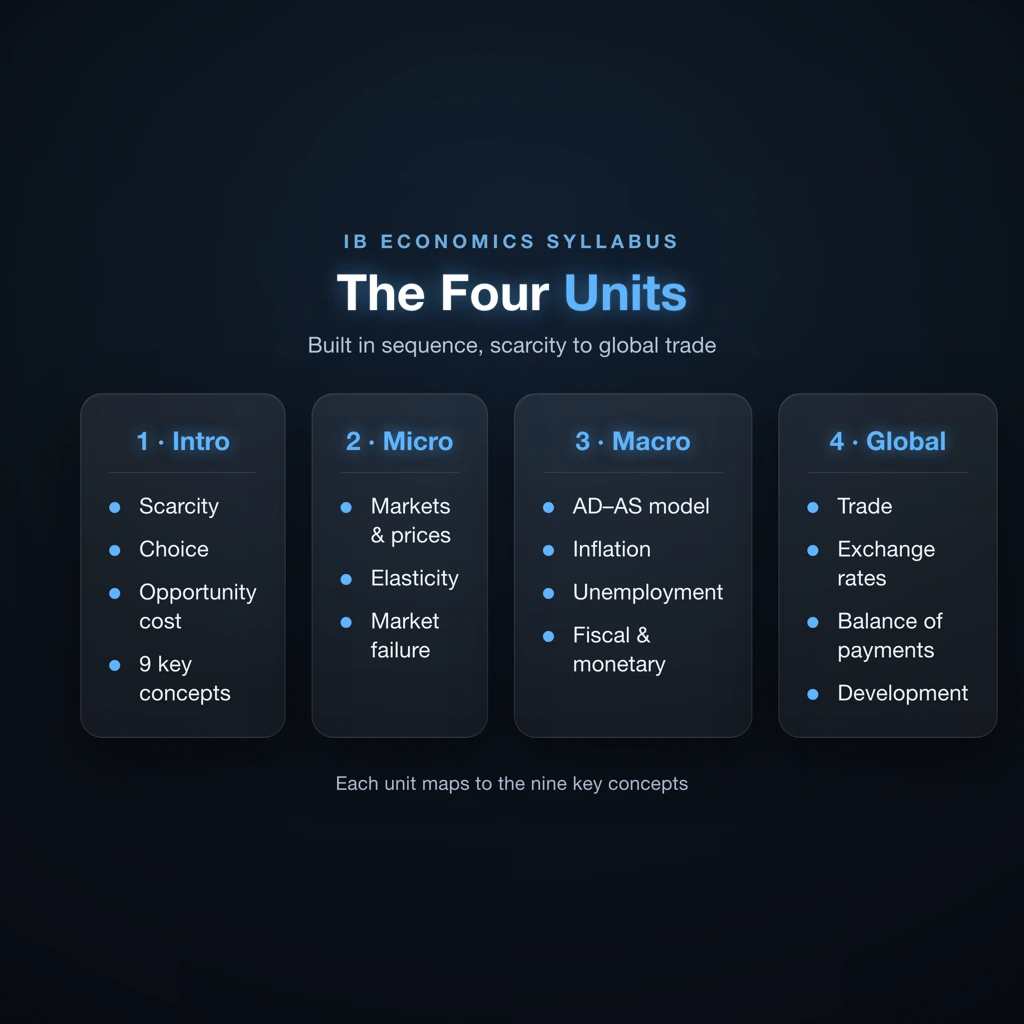
The IB Economics syllabus is built around four units, each mapped to real-world economic problems rather than abstract theory. The IB Diploma Programme structures them in a deliberate sequence: you build from scarcity and choice outward to global trade and development.
| Unit | Title | Core focus |
|---|---|---|
| 1 | Introduction to Economics | Scarcity, choice, opportunity cost, the nine key concepts |
| 2 | Microeconomics | Markets, price mechanisms, elasticity, market failure |
| 3 | Macroeconomics | National income, business cycle, inflation, unemployment, fiscal and monetary policy |
| 4 | The Global Economy | Trade, exchange rates, balance of payments, economic development |
Unit 1 is relatively short. Its main job is to frame the nine key concepts (covered in section 3) that reappear as the lens for every subsequent topic. Students who skim this unit often write analytically shallow essays later, because the real-world framing is the IB's substitute for a purely theoretical approach.
Unit 2 (Microeconomics) covers the price mechanism, consumer and producer surplus, market failure, and a full suite of elasticity measures. That suite includes cross-price elasticity of demand (XED), which tests whether two goods are substitutes or complements, a concept that trips up students because the sign of the coefficient matters as much as the magnitude. In IB Economics, a positive XED signals substitutes; a negative XED signals complements.
Unit 3 (Macroeconomics) is the largest unit and the most heavily assessed across Papers 1 and 2. It covers aggregate demand and supply, the Keynesian multiplier, inflation, unemployment, and both fiscal and monetary policy. Expect to spend proportionally more revision time here than anywhere else.
Unit 4 (The Global Economy) extends the analysis outward to trade theory, exchange rate systems, and the balance of payments. The development economics component introduces foreign direct investment (FDI) as one mechanism by which capital flows from high-income to lower-income countries, with both potential benefits and documented risks around profit repatriation and dependency.
3. The Nine Key Concepts That Frame the Syllabus
The IB Economics course is organised around nine key concepts. These are not decorative themes. They are the lens through which the IB expects every unit to be taught - and each of your three IA commentaries must use a different key concept as its analytical lens.
The nine key concepts are:
- Scarcity - resources are finite while wants are not, forcing choices at every level of the economy
- Choice - every economic decision means selecting between alternatives, with opportunity costs attached
- Efficiency - how well resources are allocated and used, and what is lost when they are not
- Equity - fairness in the distribution of income, wealth, and opportunity
- Economic well-being - living standards and quality of life beyond raw output figures
- Sustainability - meeting present needs without compromising future generations
- Change - economies, institutions, and technology evolve, and models must keep up
- Interdependence - economic actors and countries affect one another through markets and trade
- Intervention - the rationale for - and limits of - government action in markets
The non-obvious point: the same concept can appear across multiple units, and that is intentional. Sustainability, for example, maps onto negative externalities in Unit 2 (Microeconomics) but reappears in Unit 4 (The Global Economy) when discussing the environmental consequences of growth and trade. Inequality links naturally to Unit 4 development topics, but it also threads through Unit 3 (Macroeconomics) when analysing the distributional effects of fiscal policy.
In Paper 1 extended responses, a strong answer does not just define a concept correctly. It anchors the argument to a key concept and a real-world context and explains why the theoretical prediction holds or breaks down there. Students who treat the key concepts as background decoration, rather than as part of the analytical structure, consistently lose marks on the final part of essay questions.
4. SL vs HL: Additional Content and Paper 3
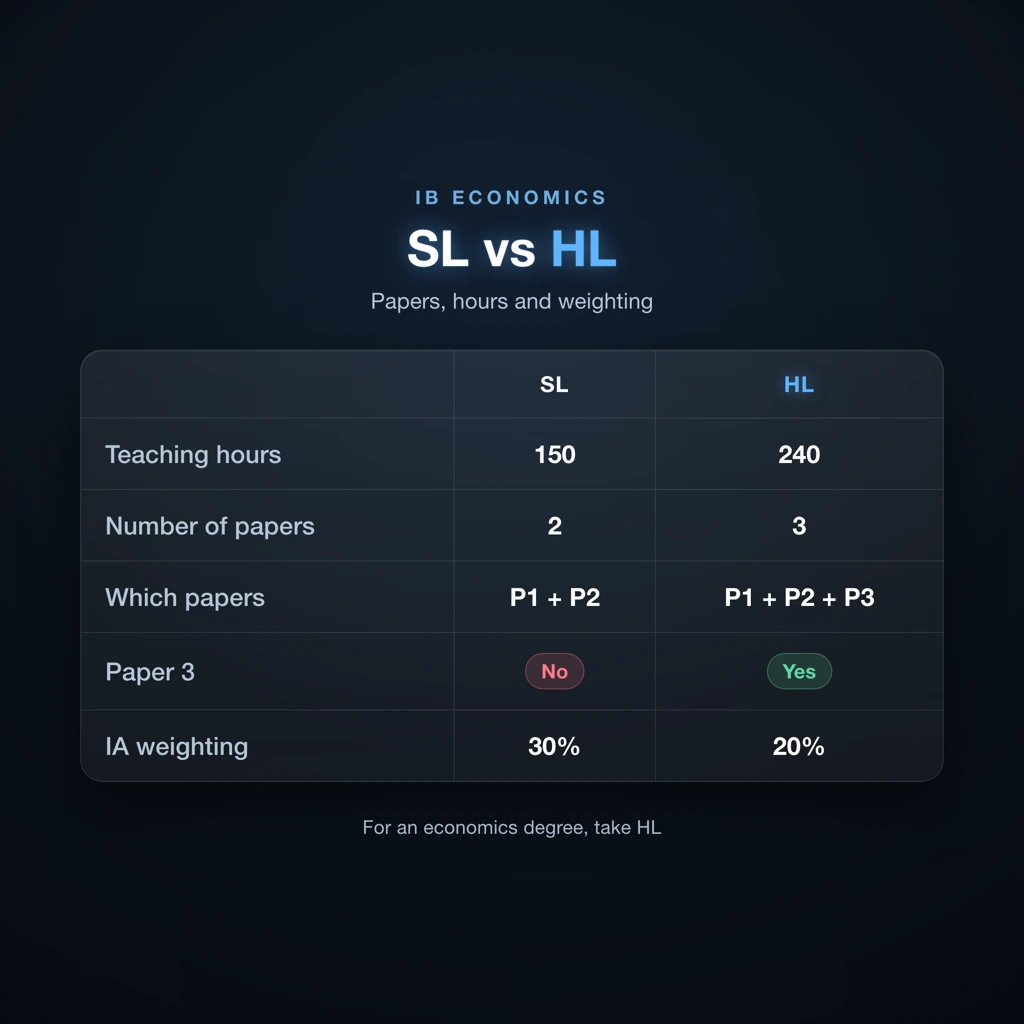
SL students complete 150 hours of teaching; HL students complete 240 hours. That extra 90 hours is not padding - it funds genuinely additional content across all four units, not just deeper treatment of SL material.
HL-only topics include:
- Microeconomics: theory of the firm (cost curves, profit maximisation, market structures in detail)
- Macroeconomics: the Keynesian vs monetarist debate, including the short-run and long-run Phillips curve
- Global Economy: the full structure of the balance of payments accounts, including the capital and financial account
- The Development unit adds quantitative depth to poverty and inequality analysis
The one component SL students never sit is Paper 3, which is HL only. It is a policy paper of two compulsory questions, each with structured, data-based parts worth 20 marks (calculations, labelled diagrams and short explanations) followed by a 10-mark part asking you to recommend a policy. Typical calculation types include the Keynesian multiplier, price elasticity of demand and supply, cross-price elasticity (XED), national income accounting, and exchange rate movements. The counter-intuitive catch: a student who can write excellent essays for Papers 1 and 2 can still drop a grade band in Paper 3 if they have not practised the mechanical steps under timed conditions. The calculations themselves are not complex, but the formatting requirements (showing working, labelling axes correctly) are strictly marked.
The HL workload is heavier, but the subject knowledge it builds maps directly onto first-year university economics. Coventry University's BSc Economics covers Intermediate Microeconomics and Intermediate Macroeconomics in Year 2, and Kent's degree opens with Principles of Microeconomics and Principles of Macroeconomics in Year 1 alongside Mathematics for Economics. Students who have covered HL theory of the firm and the balance of payments arrive at those modules with a running start.
If you are considering an economics degree, take HL. If economics is a supporting subject, SL is sufficient.
5. IB Economics Assessment: Papers 1, 2, and 3 Explained
IB Economics is assessed through two or three written papers depending on your level, plus an internal assessment. Understanding what each paper actually tests is more useful than memorising the structure, because the skills required are genuinely different across them.
Paper 1 is the same format for SL and HL. You choose one question from a choice of three, and each question has two parts. Part A asks you to define a term and draw a correctly labelled diagram, worth around 10 marks. Part B asks for extended evaluation, typically 15 marks, where a diagram alone is not enough - you need to weigh arguments, consider context, and reach a supported conclusion. The paper runs for 1 hour 15 minutes. The non-obvious gotcha: many students treat Part A as a quick warm-up and underwrite it. A diagram with unlabelled axes or a missing shift arrow can drop marks faster than a weak Part B argument.
Paper 2 is a data response paper, built around an unseen case study with statistics and short extracts. SL and HL students sit the same paper and answer one question from a choice of two. The skill being tested is application - taking IB Economics theory and connecting it to real data you have never seen before. Lifting definitions from the extract without applying a model is one of the most penalised patterns in this paper.
Paper 3 is HL only. It is a policy paper: structured questions test calculations (elasticity formulae, multiplier calculations, exchange rate effects) and diagrams, and each question ends with a policy recommendation. You cannot blag the calculations with well-written prose.
SL vs HL weighting
| Component | SL weighting | HL weighting |
|---|---|---|
| Paper 1 | 30% | 20% |
| Paper 2 | 40% | 30% |
| Paper 3 | Not assessed | 30% |
| Internal Assessment | 30% | 20% |
At HL the internal assessment counts for 20%, against 30% at SL, which means the three HL papers collectively carry 80% of the final grade. Getting Paper 3 wrong is expensive.
6. The Internal Assessment: Three Commentaries on Real News
The Internal Assessment is worth 30% of your final IB Economics grade at SL and 20% at HL. It consists of three commentaries, each written in response to a different published news article, and each covering a different unit of the syllabus (microeconomics, macroeconomics and the global economy; the introductory unit cannot be used). The 800-word limit per commentary excludes diagrams, the article itself, and your reference list, so every word of your written analysis counts.
Each commentary must do three things: apply economic theory to the real-world context the article describes, include at least one correctly labelled diagram that is directly relevant to your argument, and reference the article explicitly rather than using it as a loose backdrop.
The unit-coverage requirement is the structural constraint most worth understanding early. You must spread your three commentaries across three distinct units. A student who writes two microeconomics commentaries, even excellent ones, has already failed to meet the requirement before a teacher reads a word. Map your units at the start, not after you have found articles you like.
Practical guidance on article selection:
- Use articles published no more than a year before you write the commentary, and a different source for each one. Both are rules in the guide, and breaking them costs marks under the rubric requirements criterion.
- Prioritise articles that describe a specific, bounded economic event, such as a price ceiling introduced by a named government, a central bank rate decision, or a tariff imposed on a named good. Broad opinion pieces about whether capitalism is working give you almost nothing to diagram or analyse at 800 words.
- Avoid articles that are primarily about a statistic with no underlying policy or market mechanism to explain. Numbers are useful evidence; they are not the economic event itself.
The counter-intuitive pitfall here is article length. A short, specific 300-word news report often gives you more to work with than a 2,000-word feature, because it describes one event cleanly. The feature tempts you to summarise rather than analyse, which is where marks are lost.
Write your diagram first. If you cannot draw a supply-and-demand shift, a Keynesian AD-AS diagram, or a trade diagram that clearly illustrates the article's event, the article is probably the wrong choice.
7. Key Formulas and Calculations in IB Economics
IB Economics expects you to do more than recall a formula. Examiners at every level want you to state the calculated value, identify what it means, and link it to a real consequence for firms, consumers, or governments.
The core calculations
| Formula | What it measures |
|---|---|
| PED = % change in Qd / % change in price | Price sensitivity of demand |
| PES = % change in Qs / % change in price | Price sensitivity of supply |
| YED = % change in Qd / % change in income | Whether a good is normal, inferior, or luxury |
| XED = % change in Qd of Good A / % change in price of Good B | Relationship between two goods |
| Multiplier = 1 / (1 - MPC) or 1 / MPW | Amplified effect of an injection on national income |
| % change in national income = (change in Y / original Y) x 100 | Scale of economic growth or contraction |
| Terms of trade = (export price index / import price index) x 100 | A country's relative trade purchasing power |
| Current account balance = exports of goods and services - imports of goods and services + net income + net transfers | External sector position |
XED in detail
XED is the calculation students most often misinterpret. A positive XED indicates the two goods are substitutes: a rise in the price of Good B shifts demand toward Good A. A negative XED indicates complements: a rise in the price of Good B reduces demand for Good A alongside it. A value close to zero suggests the goods are largely unrelated. The sign matters more than the magnitude when drawing a conclusion.
The gotcha examiners rely on
Many students correctly calculate a PED of -2.5 and then stop. The mark scheme rewards the next step: recognising that demand is price elastic, that a price cut will therefore increase total revenue, and explaining why that matters for the firm's pricing decision. A bare number without interpretation will not reach the top mark band, whether the question appears on Paper 1, Paper 2, or the HL-only Paper 3. Paper 3 is the only paper that tests these calculations numerically with data; Papers 1 and 2 may present a value and ask you to explain its implications qualitatively. Both routes require interpretation, not just arithmetic.
8. Common Mistakes That Cost IB Economics Marks
These errors appear across Papers 1, 2, and 3. Fixing them is less about knowing more IB economics and more about exam technique.
Unlabelled diagrams lose marks automatically. Every axis, curve, and equilibrium point needs a label. An unlabelled supply-and-demand diagram with a correctly described shift still attracts a mark deduction. The counter-intuitive quirk: labelling the price axis "P" without specifying what P represents (e.g. "Price of wheat, USD per tonne") is treated as incomplete by many IB examiners.
Outdated examples signal shallow preparation. Referencing a country-specific, recent event carries more weight than a generic textbook example. An example tied to a named economy and approximate timeframe reads as genuine engagement with the real world.
Missing evaluation on 15-mark questions. Description of how a policy works is not evaluation. You must weigh short-run against long-run effects, compare impacts on different stakeholders (consumers vs producers, domestic firms vs exporters), and reach a supported judgement. Many students describe and stop.
Command terms are not interchangeable. The IB's own markscheme treats "analyse" and "evaluate" as distinct tasks. "Evaluate" requires a judgement call; "analyse" requires you to break down the mechanism. Read the command term before you plan your answer.
Confusing microeconomics and macroeconomics. Applying a firm-level concept like price elasticity of demand to an economy-wide policy question, or vice versa, is a clear marker red flag in IB economics.
One-policy answers. Recommending interest rate cuts for every macroeconomic problem, without acknowledging limitations (for instance, the lower bound on nominal rates, or time lags in monetary transmission), signals the kind of narrow thinking that caps answers at the mid-band.
9. Revision Resources: ZNotes, Past Papers, and IB Economics YouTube Channels
Three platforms cover most of what you need for IB Economics revision, and each serves a different purpose.
ZNotes IB Economics offers free, syllabus-aligned summary notes organised by unit. They are concise enough to work through the night before a paper and detailed enough to catch gaps in understanding. Use them to check coverage rather than as your primary learning tool.
XtremePapers hosts a community forum alongside an archive of past papers and official mark schemes. The mark schemes are where real revision happens: reading how examiners award points for evaluation reveals the answer structure far more clearly than any textbook can.
IB Econ videos on YouTube suit students who find diagram-heavy topics, such as exchange rate determination or game theory at HL, easier to absorb visually. Several channels produce unit-by-unit breakdowns that map directly to the current syllabus.
A non-obvious gotcha: pre-2020 past papers follow a different syllabus structure, with different unit boundaries and command terms in some cases. They are not useless, but answers written to the old mark scheme can reward analysis that the current rubric scores differently. Use post-2020 papers first, and treat older ones as diagram and calculation practice only.
Timed past-paper practice under exam conditions remains the single most effective revision method for IB Economics. Reading the mark scheme afterwards is not optional, it is the point.
10. Where to Go From Here
Download the current IB Economics subject guide from the IBO website this week. Open the section listing the nine key concepts and map each of your revision topics to at least one concept before your next class. This is not busywork: each IA commentary must use a different key concept as its lens, and students who cannot connect a concept like cross-price elasticity of demand to a named real-world context routinely lose the application marks that separate a 5 from a 7.
If you are targeting a UK economics degree, check entry requirements carefully on the relevant UCAS course pages. Requirements differ by HL versus SL and by points threshold. For example, the University of Kent's BSc Economics with a Year in Industry lists an IB Diploma range of 26 to 30 points with a Maths GCSE grade 5 requirement. Check your target universities' UCAS pages now, then confirm with your IB coordinator which subjects you are taking at HL.
More on IB Economics:
- IB Economics Paper 3: The HL Policy Paper Explained
- IB Economics IA: Structure, Criteria and Common Mistakes
- Economics Extended Essay: The Complete IB Guide
- How to Get a 7 in IB Economics: A Realistic Guide
FAQ
What is IB Economics?
IB Economics is a two-year Diploma Programme subject that teaches students to analyse real-world economic problems at Standard Level (150 hours) or Higher Level (240 hours), assessed through written papers and three Internal Assessment commentaries.
Is IB Economics hard?
IB Economics is considered moderately to highly demanding: SL is manageable for students comfortable with logical argument and graph work, while HL adds quantitative rigour through Paper 3 and significantly more content in each unit.
How long is IB Economics Paper 1?
IB Economics Paper 1 is 1 hour 15 minutes at both SL and HL; students answer two-part questions - a shorter definition and diagram part, and a longer 15-mark evaluation.
How long is IB Economics Paper 3?
IB Economics Paper 3 is an HL-only paper lasting 1 hour 45 minutes; it focuses on quantitative and policy reasoning, including calculations using elasticity formulae, the multiplier, and exchange rates.
How do I write an IB Economics Internal Assessment commentary?
Each IA commentary must be up to 800 words, based on a published news article from a different unit, and must include a correctly labelled diagram and economic theory applied directly to the article's real-world context.
How should I study for IB Economics?
The most effective approach combines learning all required diagrams with labels, practising past paper questions under timed conditions, and building a bank of recent real-world examples for each unit - resources like ZNotes and XtremePapers support all three.
References
- Economics | Coventry University | UCAS - https://www.ucas.com/explore/courses/68b8d847-bb61-b12f-9f58-dfe9602ca5db/course?studyYear=2027
- Economics with a Year in Industry | University of Kent | UCAS - https://www.ucas.com/explore/courses/fb7ad95f-286b-772f-00bc-a3906386156b/economics-with-a-year-in-industry?optionId=7e93a955-0ed5-45c1-874d-4b2a4bb60fd8