IB Physics: The Complete Guide (Current Syllabus)
By Michael Thompson · Education Specialist; 10 years teaching the IB at Bromsgrove School · Published 21 May 2026 · Updated 6 October 2026
IB Physics is a two-year Diploma Programme course assessed at Standard Level (SL) or Higher Level (HL), and the 2025 syllabus marks the biggest structural change to the subject in over a decade. The old core-plus-options model is gone; in its place are five interconnected themes - Space, Time and Motion through to Nuclear and Quantum Physics - that run across both levels. That shift affects which topics appear on which paper, how much extra content HL students cover, and what the Internal Assessment now looks like. This guide explains how the course is built, what the exams test, and what you actually need to do to prepare.
Key Takeaways
- Five themes replace the old core + options model: The 2025 IB Physics syllabus organises content into Themes A-E, covering mechanics through nuclear and quantum physics, with no separate 'options' paper.
- Both levels sit two papers - there is no Paper 3: SL and HL share the same Paper 1 (multiple choice plus data-based) and Paper 2 structured-response format; the HL papers are longer and assess the extra HL content.
- The Data Booklet is provided in every exam: You do not need to memorise formulae - the IB Physics Data Booklet contains all equations, constants, and values used across the course.
- The Scientific Investigation (IA) is worth 20% of your final grade: It is an individual practical report of no more than 3,000 words, assessed by your teacher and moderated externally by the IB.
- A graphical display calculator (GDC) is required, not optional: The IB mandates a GDC for all Physics papers; specific models are permitted or prohibited, and you must check the IBO approved list.
- The Collaborative Sciences Project is a compulsory group task: It is a shared investigation across two or more science subjects, but it carries no marks; your IA mark comes from the Scientific Investigation alone.
In This Article
- What Is IB Physics
- The 2025 IB Physics Syllabus: Themes A to E
- SL vs HL: Paper Structure and Exam Length
- The IB Physics Data Booklet: What Is Provided in Exams
- Calculator Policy for IB Physics
- The Scientific Investigation: IB Physics Internal Assessment
- The Collaborative Sciences Project
- IB Physics Past Papers, Grade Boundaries, and Study Resources
- How Hard Is IB Physics - and How to Study It
- What to Do Next
1. What Is IB Physics
IB Physics is a two-year Diploma Programme (DP) science course offered by the International Baccalaureate Organisation at Standard Level (SL) and Higher Level (HL). It sits within Group 4 of the IB Diploma, alongside Biology and Chemistry, and students typically take one Group 4 subject as part of their six-subject diploma package.
The course is designed for students who want a rigorous grounding in physical science, whether they intend to study physics, engineering, or a related discipline at university, or simply need a strong scientific qualification. HL requires more teaching hours than SL and covers additional material in greater depth, but both levels share the same core themes and are assessed at the end of the two-year programme.
The version currently in use is the 2025 specification. First assessment took place in May 2025, replacing the previous syllabus entirely. That earlier version remains available for practice through tools such as IB Questionbank, which lists both "DP Physics (last assessment 2024)" and "DP Physics (first assessment 2025)" as separate, searchable subject sets. The distinction matters: questions from the old syllabus do not map cleanly onto the new themes, so checking the specification year before using past material is worth the extra minute.
2. The 2025 IB Physics Syllabus: Themes A to E
The revised IB Physics syllabus, first examined in 2025, is organised into five themes that run from classical mechanics through to quantum physics. This replaced the previous model, which split content between a shared core and a set of optional topics that schools chose from a menu. Under the old structure, two students sitting IB Physics could have studied quite different material; under the new one, every IB Physics student covers the same five themes.
The five themes are:
- Theme A - Space, Time and Motion - kinematics, forces, momentum, energy, and an introduction to special relativity
- Theme B - The Particulate Nature of Matter - thermal physics, gas laws, and the structure of matter
- Theme C - Wave Behaviour - wave properties, light, sound, and interference phenomena
- Theme D - Fields - gravitational, electric, and magnetic fields
- Theme E - Nuclear and Quantum Physics - radioactive decay, fission, fusion, and quantisation
Both Standard Level and Higher Level students study all five themes. The difference is depth, not coverage. HL includes additional sub-topics and greater mathematical rigour within each theme, rather than a separate set of HL-only topics bolted on at the end. This is worth flagging early: students sometimes assume SL and HL diverge into different content entirely, but the boundary is more about how far each theme is taken.
A concrete example of what Theme C contains: Young's double slit experiment appears here, used to demonstrate the wave nature of light through interference patterns. It is one of the more mathematically precise experiments in the syllabus and is commonly assessed in both Paper 1 and Paper 2, making it a reliable area to master early.
3. SL vs HL: Paper Structure and Exam Length
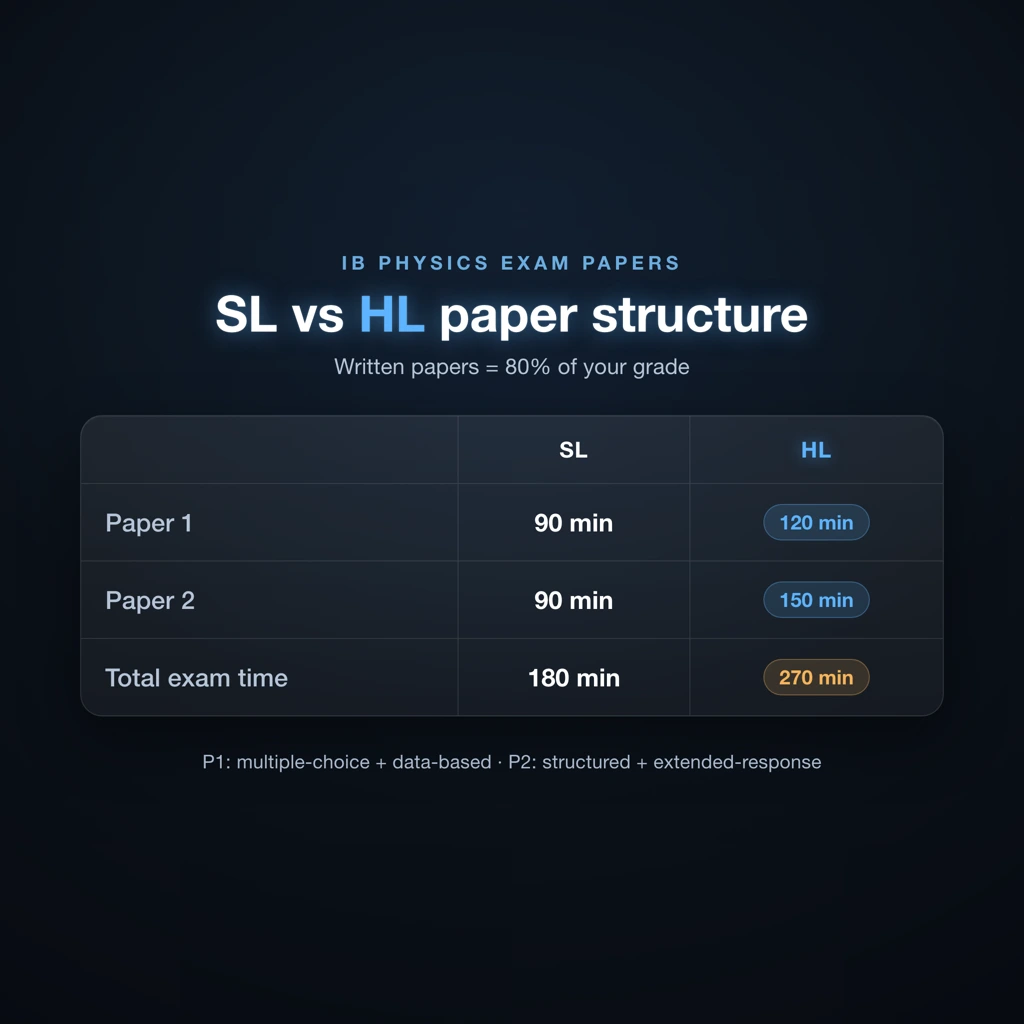
The IB assesses Physics externally through written papers that make up 80% of your final grade. The remaining 20% comes from internal assessment. Whether you sit Standard Level or Higher Level, the paper format is quite different - and the gap is larger than most students expect.
Standard Level: two papers
| Paper | Format | Duration |
|---|---|---|
| Paper 1 (1A + 1B) | Multiple-choice + data-based | 90 min |
| Paper 2 | Structured + extended response | 90 min |
Paper 1 combines multiple-choice questions (booklet 1A) with data-based questions (booklet 1B). Paper 2 mixes data-based questions, short-answer responses, and at least one extended-response question requiring a longer, connected argument.
Higher Level: two longer papers
| Paper | Format | Duration |
|---|---|---|
| Paper 1 (1A + 1B) | Multiple-choice + data-based | 120 min |
| Paper 2 | Structured + extended response | 150 min |
HL Paper 2 runs for 150 minutes against 90 at SL. That extra time is not slack; the questions are longer, the data sets more involved, and the extended responses reward deeper physical reasoning rather than recall.
One structural change worth knowing: the 2025 syllabus removed the old options paper (previously also called Paper 3) that allowed students to specialise in topics such as astrophysics or engineering physics. The additional compulsory HL material is now assessed within the longer HL papers instead. If you are using legacy resources or past papers from before the 2025 reform, the options content is no longer assessed - be careful not to study a topic that no longer appears.
Question types across both levels
- Data-based questions present experimental results and ask you to extract, analyse, or critique.
- Short-answer questions test specific concepts, typically worth 2-6 marks each.
- Extended-response questions require a structured argument, often linking two or more areas of the syllabus.
The non-obvious gotcha: multiple-choice on Paper 1 is not pure recall. Many questions at both SL and HL require a short calculation or a conceptual inference, so timing discipline matters as much as content knowledge.
4. The IB Physics Data Booklet: What Is Provided in Exams
Every IB Physics candidate, SL and HL alike, receives a copy of the Data Booklet at the start of each written exam. It is issued automatically. You do not need to request it or memorise whether to bring it.
The booklet covers all five themes of the IB Physics syllabus and contains:
- Equations for every theme, from mechanics and fields to wave behaviour (including the path-difference conditions underlying Young's double slit experiment) and quantum physics
- Physical constants: the speed of light in a vacuum, Planck's constant, the elementary charge, the gravitational constant, and others
- Unit conversions and SI prefixes
- Mathematical identities: standard trigonometric relations, logarithm rules, and geometric formulae
Because the IBO provides the booklet in every session, exam questions are designed to test whether you can select the right equation, identify the relevant constant, and apply both to an unfamiliar situation. Formula recall is not what IB Physics exams reward.
The non-obvious gotcha: the booklet lists many more equations than most students ever use, arranged by theme rather than by difficulty or frequency. Under time pressure, flipping through an unfamiliar layout to find the right relation costs marks. The IBO publishes a clean version of the Data Booklet alongside teaching materials, and most teachers annotate a working copy during the course. That annotated copy cannot go into the exam. The discipline worth building is practising with a clean copy from early in Year 1, so that locating, say, the relativistic momentum expression or the Stefan-Boltzmann law takes seconds rather than half a minute of stressed page-turning.
5. Calculator Policy for IB Physics
A graphical display calculator (GDC) is compulsory for IB Physics exams. A standard scientific calculator is not acceptable, even a high-specification one. The IBO maintains an approved calculator list, and students must use a model from that list.
The key restriction to know: calculators with a built-in Computer Algebra System (CAS) are prohibited. Some GDC models exist in both CAS and non-CAS versions with near-identical branding, for example the Texas Instruments TI-Nspire CX and the TI-Nspire CX CAS. Buying the wrong variant by mistake is a common and avoidable error. Check the model number against the IBO's current permitted calculator list before purchasing, and check again before each exam series, as the approved list is updated periodically.
Because IB Mathematics also requires a GDC, most students taking the standard Diploma Programme combination already own one. If you are studying IB Physics alongside IB Maths, you almost certainly have a compliant calculator already.
A few practical checks before your first IB Physics exam:
- Confirm your model appears on the current IBO permitted list.
- Verify it is the non-CAS version if your model has a CAS equivalent.
- Bring fresh batteries. The IBO does not permit exam rooms to supply replacements.
6. The Scientific Investigation: IB Physics Internal Assessment
The IB Physics internal assessment is formally called the Scientific Investigation. It is an individual piece of work of no more than 3,000 words, and it counts for 20% of your final IB Physics grade. That weighting makes it worth taking seriously from the start of the course, not in the final term.
The report follows a fixed structure:
- Introduction and research question - the phenomenon you are investigating and why it is worth investigating
- Methodology - how you will test the question, including variables and controls
- Data collection and processing - raw measurements, tables, graphs, and any statistical treatment
- Analysis and evaluation - what the data shows, uncertainties, and where the method fell short
- Conclusion - a direct answer to the research question, with reference to accepted physics
Your teacher marks the work against the IBO's published criteria. The IB then externally moderates a sample of scripts from each school, which can shift marks up or down.
Topic choice is yours, but the research question must be approved by your teacher before you begin collecting data. It has to be testable in a school lab environment and grounded in physics content from the syllabus. Picking something genuinely narrow is harder than it sounds.
The three pitfalls that cost marks most reliably:
- A research question too broad to investigate in a single experiment (asking about "the effect of temperature on conductivity" across fifteen materials, for instance, produces thin data on everything)
- An insufficient range of data points, which makes trend analysis guesswork
- Weak error analysis, where uncertainties are noted but never propagated through calculations
The non-obvious trap: a technically impressive experiment with poor error analysis scores lower than a simple experiment with rigorous uncertainty treatment. The IB is assessing scientific thinking, not laboratory ambition.
7. The Collaborative Sciences Project
The Collaborative Sciences Project (CSP) is a group investigation in which students from two or more Group 4 science subjects work together on a shared research question. Under the 2025 IB syllabus revision, it replaced the older Group 4 Project requirement. In practice, this means your IB Physics cohort might team up with Chemistry or Biology students to investigate an environmental, engineering, or materials science problem where disciplinary boundaries genuinely blur.
The cross-disciplinary framing is the point. A group measuring microplastic contamination in local water sources, for example, draws on Physics for instrumentation and measurement uncertainty, and on Chemistry for analytical techniques. Neither subject alone owns the question.
A few things worth knowing before you start:
- The CSP is not examined. It is a compulsory part of the course, completed in school.
- It carries no marks. Your internal assessment mark comes from your individual Scientific Investigation alone, so the CSP is not a second IA in the grading sense.
Coordinate with your Group 4 teachers early to agree on a research question that gives each subject a substantive, not decorative, contribution.
8. IB Physics Past Papers, Grade Boundaries, and Study Resources
The most important thing to know about past papers: the 2025 syllabus is a genuine break from its predecessor. Legacy papers (last assessment 2024) are still useful for practising individual concepts, but the theme structure, paper format, and question style all differ from the current specification. Treat them as topic drills, not mock exams.
For official IB Physics past papers aligned to the 2025 syllabus, the primary source is the IB Questionbank. It is produced by the IB itself and sold exclusively through the Follett IB Store. A licence must be purchased after registering a free account, though a time-limited demo account is available with a reduced question set. Both the legacy course (DP Physics, last assessment 2024) and the current course (DP Physics, first assessment 2025) are listed as available subjects, which makes it straightforward to separate old-format questions from new ones.
Free community resources
- ZNotes offers concise topic summaries for IB Physics, produced by students and widely used for quick revision.
- Several YouTube channels cover IB Physics content in depth. Quality varies, so cross-check worked solutions against the official markscheme rather than assuming the method shown will earn full marks.
Grade boundaries and subject reports
The IB publishes grade boundaries after each exam session. A 7 in HL Physics typically requires somewhere in the 70-80% range, but the threshold shifts each session based on overall cohort performance, so there is no single reliable target figure.
The detail most students miss is the IB subject report, published after each session alongside boundaries. Subject reports identify the specific questions where marks were most commonly lost, which is more actionable than a boundary percentage on its own. Check these through your school's IB coordinator or the IB's programme resource centre.
9. How Hard Is IB Physics - and How to Study It
IB Physics HL is widely regarded as one of the most demanding HL courses the Diploma Programme offers. It combines abstract theory, from quantum and wave phenomena to gravitational fields, with consistent mathematical rigour across all five themes. You are expected to manipulate equations, interpret graphs, and construct arguments from data, often within the same exam question.
SL is more manageable in scope, but confident algebra and graph interpretation are still non-negotiable. A common mistake at SL is treating the course as descriptively lighter than it is. Examiners at both levels award marks for precision, not general explanation.
The counterintuitive study trap with the Data Booklet: because every equation is provided, many students underinvest in understanding what the symbols mean and when each equation applies. Work through Data Booklet equations in context, using past paper questions to build the habit of selecting the right relationship under time pressure, rather than rehearsing derivations you will never be asked to write out.
For the Internal Assessment, build your error analysis skills early. Propagation of uncertainty is a specific IB physics skill that takes time to apply correctly, and examiners look for it throughout the write-up, not just in the conclusion.
On YouTube, several free video series cover the 2025 themes in depth. Before committing to any channel, cross-reference its content against the IBO's published subject guide, which is the definitive reference for what the syllabus actually requires. Third-party resources vary in how closely they follow the current specification, and an otherwise excellent video series may still use outdated theme or command-term definitions.
10. What to Do Next
Download the official IB Physics subject guide for first assessment 2025 from the IBO's Programme Resource Centre this week. If you do not have direct access, ask your IB coordinator to pull it for you. Open it alongside your class notes and check every topic you have covered against the Theme A to E structure. The non-obvious gotcha: teachers sometimes sequence topics from different themes together for pedagogical reasons, which can make it look like you are ahead when a full theme has gaps.
If you are writing your Extended Essay in physics, treat it as a separate project from the Internal Assessment: the EE is marked against its own criteria and rewards a research question narrow enough to answer in 4,000 words.
If you are in Year 1, start a shortlist of at least three potential Internal Assessment research questions now. Teacher approval, ethics sign-off, and equipment availability checks eat more time than most students expect, and narrowing down late forces rushed methodology decisions that are hard to recover from.
Check your school's access to the Programme Resource Centre, then open the 2025 subject guide and map your current syllabus position against Theme A to E this week.
More on IB Physics:
FAQ
What is IB Physics?
IB Physics is a Group 4 science course within the IB Diploma Programme, studied over two years at Standard Level or Higher Level, with first assessment under the redesigned 2025 syllabus beginning in May 2025.
How hard is IB Physics HL?
IB Physics HL is considered one of the most demanding HL courses because it combines conceptual depth across five themes with significant mathematical content and a 20% internal assessment component.
How long is IB Physics HL Paper 2?
IB Physics HL Paper 2 is 2 hours 30 minutes long and contains structured short-answer and extended-response questions covering all five themes of the 2025 syllabus.
What is IB Physics Paper 1?
Paper 1 is sat in two booklets - Paper 1A multiple choice (30 questions at SL, 40 at HL) and Paper 1B data-based questions - lasting 1 hour 30 minutes in total at SL and 2 hours at HL, testing knowledge and understanding across the five syllabus themes.
Is a formula sheet provided in IB Physics exams?
Yes - the IB Physics Data Booklet, which contains all required equations, physical constants, and data, is provided to every candidate in every examination paper at both SL and HL.
What is IB Physics Paper 3?
There is no Paper 3 under the 2025 syllabus: both SL and HL sit only Paper 1 (multiple choice plus data-based) and Paper 2, with the additional Higher Level content assessed through longer versions of those papers. The old options-based Paper 3 from the previous specification was removed.
References
- IB Questionbank - https://questionbank.ibo.org/