Imperial Medicine Interview 2026-27: Format, Dates, Rates
By Michael Thompson · Education Specialist; 10 years teaching the IB at Bromsgrove School · Published 26 October 2026 · Updated 28 October 2026
Imperial College London interviews for Medicine MBBS/BSc with multiple mini interviews (MMI). Interviews typically run in January and February, with invitations sent on a rolling basis from December. On the most recent figures released (2023 UCAS cycle), 29% of applications led to an interview and 65% of interviewees received an offer. This page sets out the Imperial medicine interview from the University's own course page and published figures: who is shortlisted, the format and timing, what the interviewers assess, how Imperial compares with other UK medical schools, and the questions applicants have reported.
Key Takeaways
- Format: multiple mini interviews (MMI); online or in person.
- Dates: interviews typically run in January and February, with invitations sent on a rolling basis from December.
- Numbers: 29% of applications led to an interview; 65% of interviewees were offered a place.
In This Article
- The Imperial medicine interview at a glance
- Who is invited
- The format: stations, timing and interviewers
- What Imperial assesses
- How Imperial compares
- Questions reported at Imperial medicine interviews
- How this page was built
- What to do next
1. The Imperial medicine interview at a glance
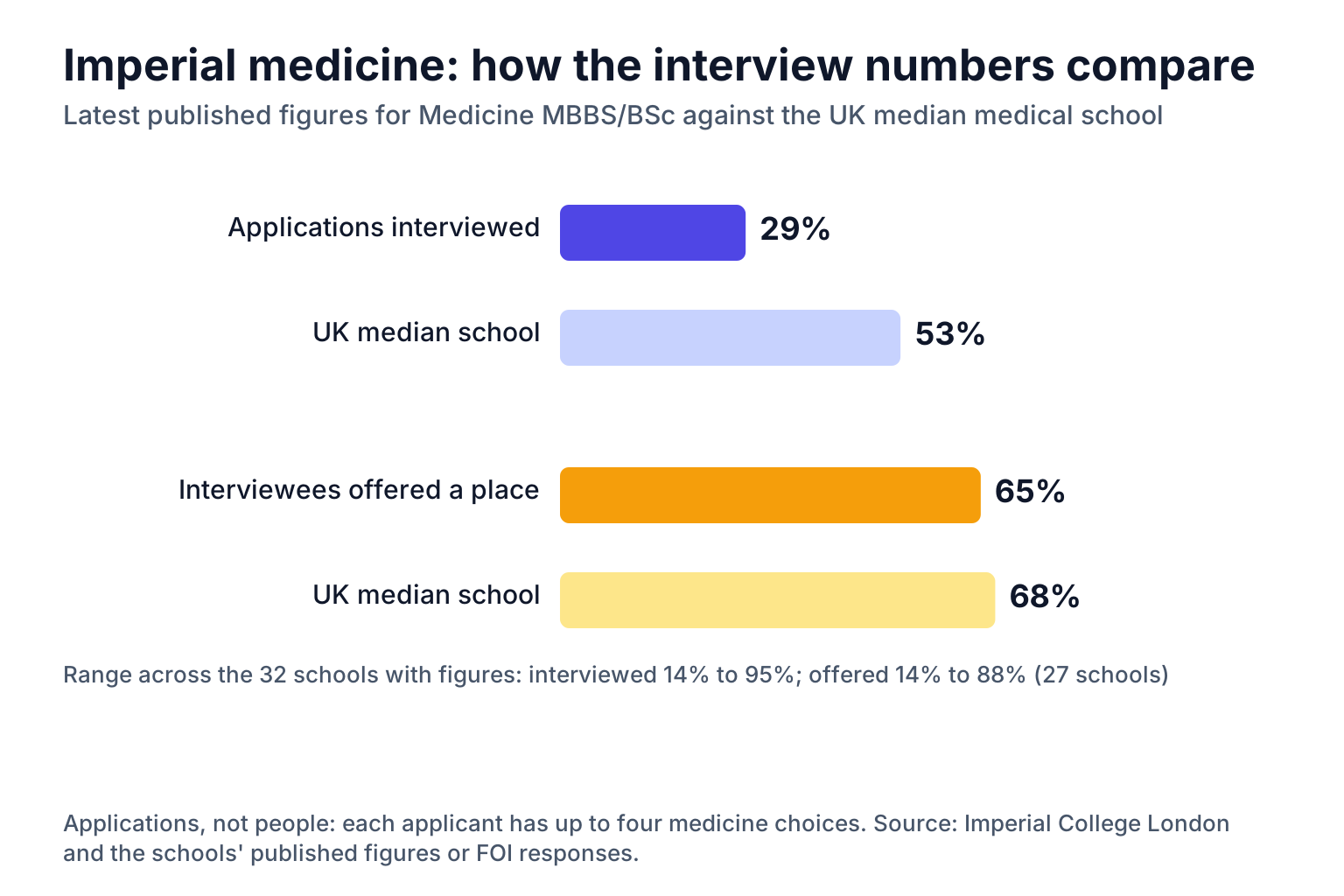
Imperial College London interviews for Medicine MBBS/BSc with multiple mini interviews (MMI). Interviews typically run in January and February, with invitations sent on a rolling basis from December. In the 2023 UCAS cycle, 29% of applications led to an interview (975 of 3,382), and 65% of those interviewed received an offer. These are the latest figures Imperial has released. That puts Imperial among the more selective UK medical schools at the interview stage: the median school interviews 53% of its applications.
Everything on this page is what Imperial College London publishes on its course and admissions pages or has released under freedom of information, read on 18 October 2026. The page on medicine interview dates by school puts Imperial beside every other school, and medicine interview rates compares the figures.
2. Who is invited
How Imperial chooses who to interview, as its pages describe it:
- Applicants meeting the minimum academic requirements, shortlisted by UCAT (taken that year)
- Normally the top third of applicants, invited on a rolling basis from December
- A contextualised UCAT cut-off for widening-participation applicants, declared carers and Imperial outreach participants (contextual Home applicants meeting AAA and the contextual threshold are guaranteed an invite)
The other steps it describes:
- The UCAT, taken in the year of application, is used with academic screening to shortlist, and is not the sole factor
- Personal statement may be referred to at interview
- After an offer: Occupational Health questionnaire, vaccinations and blood-borne virus tests
- You must be 18 by the start of the course
3. The format: stations, timing and interviewers
| What the course page says | |
|---|---|
| Format | multiple mini interviews (MMI) |
| Length | five minutes per station |
| Mode | online or in person |
| Interviewers | academic staff involved in undergraduate education and experienced healthcare professionals |
| At the interview | data interpretation station (listed among the main station topics) |
| Dates | typically January to February (invitations rolling from December) |
The course page does not state whether there is a task before the interview.
An MMI is a circuit: you move from station to station, each with its own interviewer and its own task, and each is scored on its own, so a poor station does not follow you to the next.
4. What Imperial assesses
Imperial College London lists the qualities the interview assesses:
- Commitment to NHS Constitution values
- Motivation and understanding of medicine
- Empathy
- Work experience and community activities
- Leadership
- Teamwork
Station topics include ethics and breaking bad news and data interpretation. The marking is out of six for content and four for communication.
These are the criteria the stations score against, and the reason to prepare examples from your own experience that show each one, rather than a speech about wanting to be a doctor.
5. How Imperial compares
| Imperial | Lowest UK school | Median UK school | Highest UK school | |
|---|---|---|---|---|
| Share of applications interviewed | 29% | 14% | 53% | 95% |
| Share of interviewees offered a place | 65% | 14% | 68% | 88% |
The comparison is across the 32 UK medical schools that publish or have released interview counts for their standard-entry course (27 of them also give offers); the figures are applications, not people, because every applicant has up to four medicine choices. The nearest schools by interview share are Kent and Medway (29%) and Oxford (29%).
6. Questions reported at Imperial medicine interviews
No question reported at Imperial can be traced to a university page or a first-hand account; our dataset holds 135 attributed to Imperial by preparation companies, which are not reproduced for that reason. The station types are the same across UK MMIs, so the sourced examples on MMI questions and medicine interview questions are the ones to practise with.
7. How this page was built
The format, timing, dates, shortlisting and assessment criteria come from the Imperial College London Medicine MBBS/BSc course page, and the applications, interviews and offers from the school's freedom of information response. Each page was read on 18 October 2026 and the figures exported on 21 October 2026; nothing is estimated, and where the school does not publish a figure the page says so. Interview arrangements change between cycles, so the course page is the final word and this page is the comparison.
8. What to do next
Check the dates and the notice Imperial gives, then prepare for the format named above and nothing else: five-minute stations reward a clear first sentence and an example, not a build-up. Work through the assessment list and write one example from your own experience against each criterion. Then practise out loud and timed, with someone who will play the interviewer. The guide to how to get into medicine covers the UCAT and the four-choice rule, and the hub page on Oxbridge and medicine interviews 2026 links every interview page on this site.
FAQ
What is the Imperial medicine interview format?
Multiple mini interviews (MMI); online or in person. The course page gives the length: five minutes per station.
When are Imperial medicine interviews?
Interviews typically run in January and February, with invitations sent on a rolling basis from December.
What percentage of applicants get a medicine interview at Imperial?
In the 2023 UCAS cycle, 29% of applications led to an interview, and 65% of those interviewed received an offer.
What does Imperial look for at interview?
Imperial College London says the interview assesses commitment to NHS Constitution values, motivation and understanding of medicine, empathy, work experience and community activities, and leadership, among other qualities.
References
- Imperial College London: Medicine MBBS/BSc course page - https://www.imperial.ac.uk/study/courses/undergraduate/medicine/
- Imperial College London: medicine admissions figures - https://www.whatdotheyknow.com/request/medicine_course_a100_admission_s_6