Unusual University Degrees UK: A Guide to Niche Courses
By Michael Thompson · Former IB Diploma Programme coordinator; 10 years at Bromsgrove School · Published 5 July 2026
Unusual university degrees are more numerous - and more seriously taught - than most people assume. Across UK universities you can earn an accredited BSc in Ethical Hacking and Cybersecurity, a BA in Viking Studies, or a degree in Brewing and Distilling, each with a genuine graduate pathway. The challenge is that niche courses are scattered across hundreds of institutions, entry requirements vary far more than standard A-level tariffs suggest, and the label 'unusual' covers two quite different things: a surprising subject and a surprising structure. This guide groups real UK degrees by what you're interested in, explains what you'd actually study, flags realistic outcomes, and shows how non-standard routes such as degree apprenticeships or flexible combined degrees open up options that a conventional three-year course search would miss.
Key Takeaways
- Niche does not mean non-competitive: Some unusual degrees, such as Oxford's BA in Human Sciences or Cambridge's Anglo-Saxon, Norse, and Celtic, are among the most selective courses in the country.
- Subject and structure are separate questions: A conventional subject studied via a degree apprenticeship or integrated master's can be just as non-standard a route as an unusual subject studied in the traditional three-year format.
- IB students often have a natural fit: Interdisciplinary and self-designed degrees tend to reward a broad Higher Level profile, but some technical niche degrees still require a specific HL subject - check early.
- Entry requirements vary widely: Always check the current grade or tariff requirement directly on the university course page, since niche courses update their entry criteria regularly.
- Outcomes depend on transferable skills: Graduates of unusual degrees often enter industries adjacent to their subject, so research the career pathways - not just the degree title - before applying.
- The UK has more than 50,000 undergraduate courses: Per UCAS, the breadth of provision means genuinely unusual programmes exist across institutions of every size and type - the challenge is knowing where to look.
In This Article
- What counts as an unusual degree - and why the distinction matters
- If you like technology and security: ethical hacking and beyond
- If you like history and languages: Viking studies and ancient worlds
- If you like food, drink, and craft: brewing, baking, and culinary science
- If you like the outdoors and the sea: surf science, adventure, and conservation
- If you like making things: puppetry, embroidery, and craft degrees
- Unusual structures: the routes that look ordinary but aren't
- What to do next
1. What counts as an unusual degree - and why the distinction matters
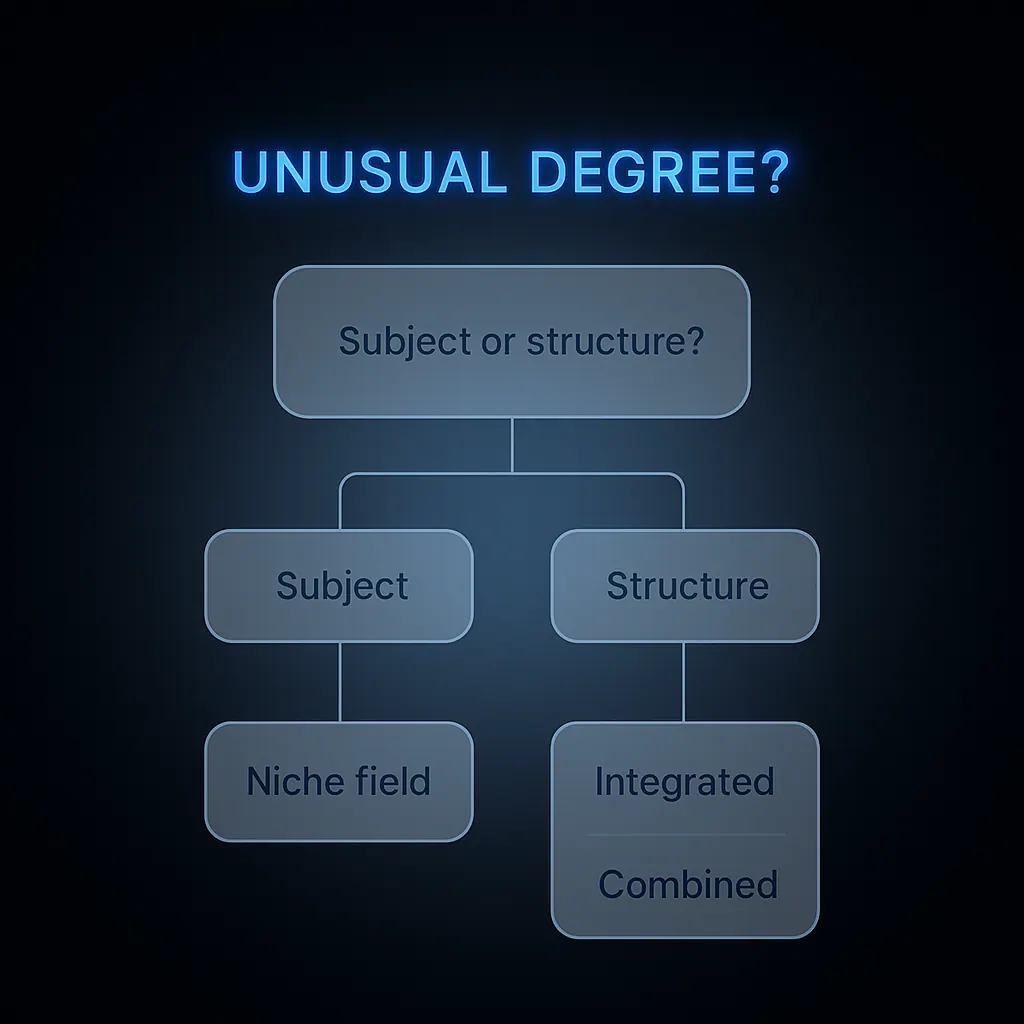
Unusual university degrees split into two distinct categories, and most media coverage only notices one of them. The first is unusual subject matter: programmes like Puppetry, Viking Studies, or Surf Science that simply study something outside the standard arts-and-sciences menu. The second is unusual structure: degree apprenticeships, integrated master's qualifications (MEng, MMath), years in industry, or self-designed combined degrees that bundle subjects in ways conventional courses don't.
Both categories represent genuinely non-standard routes. Focusing only on exotic subject names means missing a large part of the picture, because a student taking a standard-sounding "Business" degree through a degree apprenticeship is having a radically different experience from a campus-based counterpart.
The scale of provision surprises most people. UCAS lists more than 50,000 undergraduate courses across 395+ UK universities and colleges, so niche provision runs considerably deeper than annual "weird degrees" press round-ups imply.
One important boundary: some things labelled degrees in online articles are short modules, CPD certificates, or summer schools. This guide covers only awarded degrees from recognised UK institutions. If it doesn't appear on UCAS, it's out of scope here.
2. If you like technology and security: ethical hacking and beyond
Ethical Hacking and Cybersecurity is a fully accredited BSc at Abertay University in Dundee, one of the first UK institutions to award a degree with "hacking" in the title. Students work through penetration testing, network security, and digital forensics, often using purpose-built labs where they attack systems legally, with permission, to find weaknesses before malicious actors do. The counter-intuitive detail worth knowing: the degree is formally certified by GCHQ and the National Cyber Security Centre, which means graduates enter a talent pipeline that is actively shortage-driven rather than competitive in the usual graduate-market sense.
Esports degrees have also moved beyond novelty. UK programmes cover game design, competitive play analysis, team management, and broadcast production. Graduates move into management, platform operations, and production roles across the esports and streaming industries.
The direction of travel for digital environments in higher education is broader still. In August 2024, the University of Essex psychology department launched a Minecraft laboratory where students design and run studies inside the game, led by Dr van Tilburg. That development is a sign of how digital spaces are entering mainstream academic research, not just vocational training.
Entry requirements vary widely across these programmes. Check the live course page at the relevant university; some technical degrees specify a computing or science subject at A-Level or, for IB applicants, at Higher Level.
3. If you like history and languages: Viking studies and ancient worlds
The counterintuitive thing about these degrees is that the most specific-sounding ones are often housed inside broader titles. Knowing where to look matters.
Viking Studies at the University of the Highlands and Islands is one of the few places you can take a dedicated BA in the subject as a standalone undergraduate degree. The curriculum covers Old Norse language, Norse mythology, Scandinavian archaeology, and medieval Scandinavian history, drawing on the university's location in a region with genuine Viking-age material culture on its doorstep.
At Cambridge, the BA (Hons) in Anglo-Saxon, Norse, and Celtic is a selective standalone degree covering early medieval languages, literatures, and cultures of Britain and Ireland. It is also accessible via a Foundation Year pre-degree course before progressing to the full BA, which matters if your school-leaving qualifications don't meet the direct entry profile.
A less obvious Cambridge route: the Archaeology BA (Hons) contains specialisations in Assyriology, Egyptology, Akkadian (the ancient Mesopotamian language), and Coptic. You apply for Archaeology and find the specialism inside it, so searching only for unusual degree titles by name will cause you to miss these entirely.
Oxford's BA in Human Sciences, created in 1969, is unusual in structure rather than subject label, spanning biological and social sciences within a single undergraduate programme.
Realistic outcomes for this cluster of subjects include heritage management, archiving, museum curation, postgraduate research, and the civil service fast-stream, where strong analytical and language skills carry weight.
IB angle: a broad humanities Higher Level profile suits these degrees well. Check the individual course page for any specific language or humanities HL requirement before finalising your subject choices.
4. If you like food, drink, and craft: brewing, baking, and culinary science
Food and drink degrees split into two distinct tracks, and choosing the wrong one is a common mistake.
Heriot-Watt University in Edinburgh offers a BSc in Brewing and Distilling, one of the few dedicated programmes of its kind in the UK. Students study fermentation science, sensory analysis, distillation engineering, and the commercial side of the drinks industry. The non-obvious detail: a significant portion of the curriculum is chemistry and microbiology, not hospitality. Students who expect a glorified tour of breweries tend to find the analytical workload a surprise.
Culinary science degrees, such as those at Sheffield Hallam University or University College Birmingham, sit closer to food technology than professional cooking. A culinary arts or baking and pastry arts programme focuses on technique, production, and menu development. A culinary science degree focuses on the chemistry of food: why bread proves, how emulsification works, what drives shelf life. Both are legitimate routes, but they lead to different roles.
Realistic graduate destinations across both tracks include:
- Product development and recipe innovation in food manufacturing
- Quality assurance and sensory evaluation roles
- The growing craft brewing and distilling sector
- Food entrepreneurship and small-batch production
Entry requirements vary significantly. Some programmes accept a broad tariff and welcome students from any subject mix. Others, particularly science-facing brewing or culinary science degrees, ask for chemistry or biology at A-level. For IB students, biology or chemistry at Higher Level is often the cleaner route into those programmes. Always check the current entry requirements directly on the university course page, as these details change year to year.
5. If you like the outdoors and the sea: surf science, adventure, and conservation
Cornwall College offers a Surf Science and Technology degree with modules including Wave Mechanics, Board Anatomy, and the Value of Surfing to Society. That last module is worth noting: it covers economics, tourism, and coastal community impact, not just riding waves. Students who expect a purely technical programme are sometimes surprised by how much social and environmental analysis the course contains.
Beyond surfing, UK universities offer degrees in Adventure Sports Coaching and Countryside and Environmental Management, among others. These programmes combine field-based learning with theory around ecology, land use, and risk management.
Realistic graduate destinations include:
- Surf industry roles: product development, coaching certification, brand management
- Outdoor education instruction at schools, activity centres, or youth organisations
- Marine and coastal conservation work with environmental charities or government bodies
- Event management for outdoor sports competitions and festivals
One trade-off worth understanding: location shapes the degree. A surf science programme based in Cornwall gives you Atlantic swells and a working surf industry on the doorstep. A conservation degree near Snowdonia or the Scottish Highlands offers different field sites entirely. Where the institution sits affects what fieldwork is actually possible, not just convenient.
Entry requirements vary between institutions, so check the current requirements directly on each university's course page before applying.
6. If you like making things: puppetry, embroidery, and craft degrees
Two of the most specialised making-focused degrees in the UK sit at opposite ends of the craft spectrum, but share one important quality: tiny cohorts and serious professional expectations.
The Royal School of Needlework offers what it describes as "the only full time BA (Hons) Degree programme specialising in hand embroidery in Europe," based at Hampton Court Palace. The RSN's professional track record gives the degree its credibility: the organisation has hand-stitched robes and clothing for five coronations since 1902. That history signals exactly the kind of outcome the degree targets, specifically conservation, heritage textiles, couture, and ceremonial commissions, rather than hobbyist craft.
Puppetry degrees, such as the BA in Puppetry at Central School of Speech and Drama (part of the University of the Arts London), cover fabrication, performance, and both screen and stage work. Graduates move into theatre, television production, arts education, and exhibition design.
The counter-intuitive trade-off with both routes: because cohorts are so small, admissions competition per available place can be considerably sharper than the courses' relatively low public profiles suggest. A degree nobody has heard of is not the same as a degree nobody wants.
7. Unusual structures: the routes that look ordinary but aren't
Not every unusual degree is unusual because of its subject matter. Some are structurally different from a standard three-year BSc or BA, and students often miss them entirely.
Degree apprenticeships combine full degree-level study with paid employment. The employer covers tuition costs, so you graduate without conventional tuition debt. They exist across fields including cybersecurity, nursing, and accountancy. The trade-off is real: you are an employee as well as a student, and your schedule is set partly by the employer, not just the university.
Integrated master's degrees (MEng, MChem, MMath, MSci) run for four or five years and award a master's qualification directly, without a separate postgraduate application. The non-obvious gotcha: UCAS Tariff offers for an integrated master's and the equivalent BSc at the same university are often identical, but the degree classification boundaries and exit requirements differ. Read the programme specifications carefully before accepting.
Self-designed or open degrees let you combine subjects that don't appear as a named joint degree. Cambridge, for example, offers a BA (Hons) in Environment, Law, and Economics as a named degree, and describes its courses as covering subjects "very broadly in the initial years" before specialisation. Some institutions go further, allowing students to build combinations themselves.
This matters for IB students with a broad Higher Level profile spanning sciences and humanities. Flexible combinations can suit that profile well. Check, however, whether a specific HL subject is required for the science or professional component before assuming any combination is open to you.
Takeaway: if no named degree covers your interest, search for open or self-designed degree routes at your target institutions before concluding the subject can't be studied at undergraduate level.
8. What to do next
If a course title caught your attention while reading, act on that this week rather than leaving it in a browser tab. Open the Course Finder and search by a specific subject keyword, such as 'brewing', 'cybersecurity', or 'Viking'. Shortlist two or three courses, then go directly to each university's own course page to read the entry requirements. Do not rely on a summary elsewhere. Entry requirements for niche courses can differ sharply from what you'd expect: a puppetry degree may ask for a portfolio where a history degree would not, and a surf science BSc may list geography or biology at A-level rather than PE.
If you are an IB student, check the Higher Level subject requirements on each shortlisted course page before the UCAS application window opens. Some unusual undergraduate degrees specify HL science or mathematics combinations that are easy to miss at this stage.
For readers who want to step back before narrowing down, explore the full range of a subject area first, then return to the Course Finder with a clearer focus. Check at least one university course page before the end of this week.
FAQ
Are unusual university degrees worth it for graduate employment?
Outcomes depend on the specific degree and the skills it builds - niche technical degrees like Ethical Hacking and Cybersecurity feed directly into high-demand sectors, while craft or performance degrees lead to more varied paths that typically require the graduate to articulate transferable skills clearly to employers.
What are some genuinely weird university degrees you can study in the UK?
Real awarded UK degrees include BSc Ethical Hacking and Cybersecurity, BA Viking Studies, BSc Brewing and Distilling, BSc Surf Science and Technology at Cornwall College, and the BA (Hons) in Hand Embroidery at the Royal School of Needlework - all confirmed as current degree programmes by their institutions.
Do unusual degrees have lower entry requirements than traditional subjects?
Not always - some niche degrees such as Oxford's BA in Human Sciences and Cambridge's Anglo-Saxon, Norse, and Celtic are among the most competitive in the UK, while others have broader entry criteria; always check the current requirement on the university course page.
Can IB Diploma students apply for unusual or interdisciplinary UK degrees?
Yes, and IB students often suit interdisciplinary or self-designed degrees well given a broad Higher Level profile, but some niche science or technical degrees require a specific HL subject such as biology or chemistry, so checking HL requirements early in the application process is essential.
What is the difference between an unusual subject and an unusual degree structure?
An unusual subject means studying something niche like puppetry or Viking history in a conventional three-year format, while an unusual structure means taking a standard or niche subject via a degree apprenticeship, integrated master's, or self-designed combined degree - both categories open up non-obvious options.
References
- Why study in the UK? | UCAS - https://www.ucas.com/international/international-students/applying-to-university-as-an-international-student/why-study-in-the-uk
- Taylor Swift, Minecraft and other unique university courses - BBC Newsround - https://www.bbc.co.uk/newsround/articles/cn8lxnm0j82o
- Subject A-Z | Undergraduate Study - https://www.undergraduate.study.cam.ac.uk/courses/search
- Our Vision | Institute of Human Sciences - https://www.ihs.ox.ac.uk/our-vision