Liberal Arts Degree UK: What It Is and Whether It Suits You
By Michael Thompson · Former IB Diploma Programme coordinator; 10 years at Bromsgrove School · Published 5 July 2026
A liberal arts degree is a broad, multi-disciplinary programme that combines arts, humanities, sciences, and social sciences - and it is far less common in the UK than in the US. Most UK universities still expect you to pick one subject at application and stick with it for three or four years, so a true liberal arts programme is a deliberate exception to the norm. A handful of institutions, including King's College London, the University of Glasgow, and the University of Southampton, do offer structured liberal arts degrees, but they sit alongside a landscape of thousands of single-honours courses. This guide sets out how liberal arts degrees work in the UK, who they suit, and what the honest trade-offs are.
Key Takeaways
- Broad by design: A liberal arts degree lets you combine subjects from different disciplines - history alongside politics, literature alongside philosophy - rather than committing to one field from day one.
- Rare in the UK: Only a limited number of UK universities offer a true liberal arts programme; early single-subject specialisation remains the norm, unlike in the US or Canada.
- Entry requirements vary by institution: Programmes range from ABB at Glasgow to AAA at King's College London - check each current course page, as requirements change annually.
- IB students are well-placed to apply: The IB Diploma's six-subject breadth and compulsory core mirror the liberal-arts philosophy, and universities assessing liberal arts entry read a broad IB profile positively.
- Employer reception is mixed but improving: Over half of graduate jobs have no specific subject requirement, according to towerhamlets.gov.uk, but some vocational and accredited routes such as medicine, engineering, and law still require single-honours study.
- Flexibility is the main upside: Liberal arts suits undecided students or those with genuinely interdisciplinary interests; students who already know their career path often gain more from a focused single-honours degree.
In This Article
- What Is a Liberal Arts Degree and How Does It Work in the UK
- Liberal Arts Degree vs Single-Honours: A Direct Comparison
- Liberal Arts Degrees in the UK: Entry Requirements and Programme Structure
- The IB Diploma and Liberal Arts: A Natural Fit
- Who Should - and Shouldn't - Choose a Liberal Arts Degree
- What to Do Next
1. What Is a Liberal Arts Degree and How Does It Work in the UK
A liberal arts degree is a broad, multi-disciplinary undergraduate programme that combines study across arts, humanities, sciences, and social sciences rather than fixing you to a single subject from day one. It is far more common in the United States than in the UK, where single-honours degrees remain the norm.
Most UK students encounter the liberal arts model first through American culture: the system where you declare a major and minor, satisfy general education requirements across multiple disciplines, and only specialise fully in your final years. That flexibility is the default in the US. In the UK, it is the exception.
British universities typically ask you to name one subject at application, and that subject shapes your entire degree. Liberal arts programmes break this pattern deliberately. Instead of arriving as a historian or a philosopher, you arrive as a student who will spend the first year sampling subjects before narrowing down.
A small number of UK universities offer genuine liberal arts programmes. King's College London offers a three-year BA across arts, humanities, and social sciences on its Strand Campus, with major options ranging from Classical and Hellenic Studies to Politics and Film Studies. The University of Southampton runs a three-year BA where students pick a primary pathway from Arts, Humanities, Languages, or Social Sciences, then add two supplementary subjects at the end of Year 1. The University of Glasgow offers a four-year MA Liberal Arts with a secondary pathway such as Comparative Literature, History, or Philosophy.
That last point is worth noting. Scottish MA degrees run four years, not three, because Scottish higher education includes a broader first year by design. An English BA liberal arts degree and a Scottish MA liberal arts degree can look similar on paper but differ in length and academic structure.
2. Liberal Arts Degree vs Single-Honours: A Direct Comparison
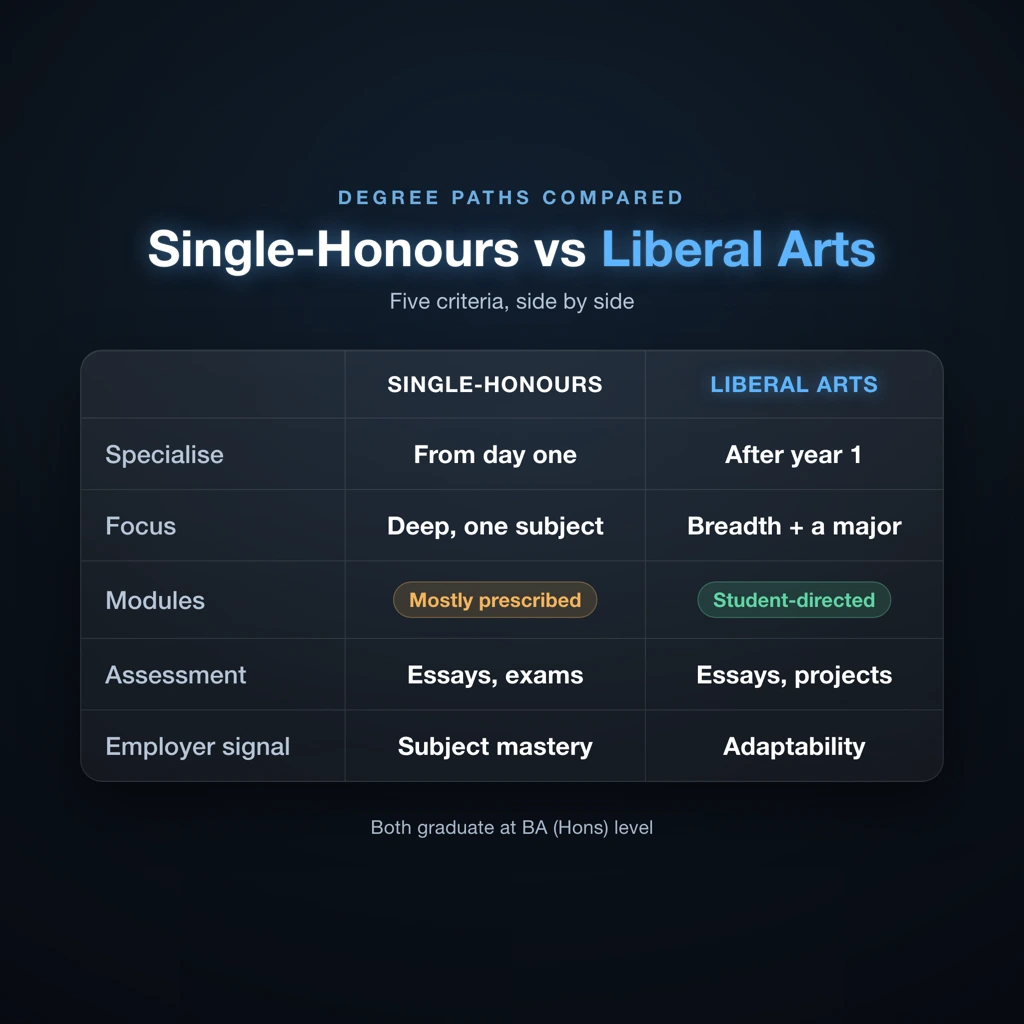
The structural difference between a liberal arts degree and a conventional single-honours degree is starker than most school leavers realise. Single-honours students spend all three years deepening expertise in one subject. Liberal arts students spend those same three years moving across disciplines while building toward a chosen focus.
| Single-Honours UK Degree | Liberal Arts / Broad Degree | |
|---|---|---|
| When you specialise | From day one | After an exploratory first year |
| Breadth vs depth | Deep in one subject | Breadth across humanities and social sciences, with a defined major |
| Module freedom | Limited, mostly prescribed | High, often student-directed |
| Typical assessment | Essays, exams, practicals (subject-dependent) | Essays, interdisciplinary projects, presentations |
| How it signals to employers | Subject mastery, relevant to vocational and technical fields | Adaptability and transferable reasoning across domains |
The liberal arts major definition matters here. A major is not a second degree; it is a chosen primary discipline within the broader programme. At King's College London, major subject options include English, History, Philosophy, Politics, Film Studies, Geography, Comparative Literature, and others. You still graduate with a BA (Hons), at the same bachelor of arts degree level as any single-honours student, but your transcript reflects cross-disciplinary study alongside that anchor subject.
The employer-signalling trade-off is worth naming plainly. A chemistry single-honours degree tells a pharmaceutical recruiter exactly what you can do. A liberal arts degree does not do that. Where it performs well is in roles where analytical flexibility matters more than a single technical credential. Over half of graduate jobs carry no subject requirement, which gives liberal arts graduates more room than the single-honours framing might suggest.
3. Liberal Arts Degrees in the UK: Entry Requirements and Programme Structure
The three most-established liberal arts degree programmes in the UK differ more than you might expect, both in grade requirements and in how much you specialise, and when.
Entry requirements at a glance
| University | Award | Duration | A-level offer | IB points | UCAS Tariff |
|---|---|---|---|---|---|
| King's College London | BA (Hons) | 3 years | AAA | 36 | Not accepted |
| University of Glasgow | MA (Hons) | 4 years | ABB-BBB | Not specified | Not accepted |
| University of Southampton | BA (Hons) | 3 years | AAB | Not specified | Not accepted |
**None of the three programmes accepts UCAS Tariff points**, which catches some applicants off guard. Check each current course page before applying, because grade requirements change annually.
One quirk worth knowing about KCL: the offer is AAA with no mathematics or science requirement. Students applying for the Music major, however, need A-level Music or Grade 6 Music Theory, and Grade 8 on their principal instrument by the end of Year 1.
Southampton offers an alternative route: ABB plus grade A in the EPQ, which rewards independent research before you even arrive.
How the programmes are structured
This is where a liberal arts degrees list reveals real differences between programmes, not just surface variation in names.
KCL's BA sits firmly within arts and humanities. Subject options run from Classical and Hellenic Studies through to Theology and Religious Studies. There is no science or mathematics strand, so if cross-disciplinary means "arts meets computing" for you, this is not that programme.
Glasgow's MA works differently. You are admitted to a named pathway, choosing one secondary subject at application from Comparative Literature, Film and Television Studies, English Literature, History, Philosophy, or Theatre Studies. The four-year Scottish MA structure then gives more time to develop depth alongside breadth.
Southampton offers the widest spread as liberal arts degrees examples go. Students pick one primary pathway from Arts, Humanities, Languages, or Social Sciences at entry, then select two supplementary subjects at the end of Year 1 once they know what has caught their interest. Year 3 ends with a self-directed dissertation on any topic the student chooses. That late-binding structure is useful if you arrive unsure about a second discipline, but it does mean your first year is partly exploratory rather than settled.
If you are comparing programmes, the primary-pathway model is the structural detail that matters most. Confirm which subjects sit within your chosen pathway before you apply.
4. The IB Diploma and Liberal Arts: A Natural Fit
The IB Diploma Programme is structured around six subject groups: language and literature, language acquisition, individuals and societies, sciences, mathematics, and the arts. Add the compulsory core of Theory of Knowledge (TOK), the Extended Essay, and Creativity Activity Service (CAS), and you have a qualification whose architecture mirrors the breadth-first philosophy that liberal arts programmes are built on. This is not a coincidence - it is exactly why IB graduates tend to read as strong candidates for these courses.
Admissions tutors on liberal arts and liberal arts humanities degree programmes are looking for evidence of cross-disciplinary curiosity. An IB student who has combined, say, History and Biology at Higher Level - then written an Extended Essay in Philosophy - has already demonstrated that profile on paper. The Extended Essay and TOK also develop the analytical and independent-research habits that liberal arts programmes build on from day one, so the transition is less abrupt than it is for students arriving from a single-subject A-level track.
One concrete implication: King's College London requires 36 IB points for its Liberal Arts BA. Check the current KCL course page for the latest figure before you apply, since entry requirements can change between cycles.
The less obvious point is this: IB students who feel genuinely undecided about a subject area are among the best-placed applicants for a UK liberal arts degree. Their transcript already shows breadth - they do not need to justify it.
5. Who Should - and Shouldn't - Choose a Liberal Arts Degree
A liberal arts degree suits some students very well and genuinely doesn't suit others. The honest version of this question is worth working through before you apply.
You are probably a good fit if:
- You have strong interests across several disciplines and find single-subject study artificially narrow. Wanting to combine politics with literature, or history with film studies, is a real intellectual position, not indecision.
- You have not yet settled on a graduate career path and want to keep options open. According to towerhamlets.gov.uk, over half of graduate jobs have no subject requirement at all. Many employers want evidence of a degree-level education, critical thinking, research ability, and clear written communication, not a specific subject on your transcript.
You are probably better served by single-honours if:
- You already know you want a professionally accredited or vocational route. Medicine (MBBS), engineering (BEng), and law (LLB) are subject-specific by design and cannot be substituted by a broad degree.
- You want postgraduate depth in a technical field where employers look for subject-specific knowledge at undergraduate level. A liberal arts graduate degree is a real option, but it works best when the student already has breadth and wants a specialist master's to add focus, not the other way around.
One non-obvious trade-off: teaching routes in England (PGCE, School Direct) are allocated by subject specialism. A liberal studies degree for teaching is not automatically a barrier, but liberal arts graduates will need to demonstrate strong subject knowledge in their chosen teaching subject at interview, and may need bridging study to meet the standard. If secondary teaching in a specific subject is the goal, a single-honours degree in that subject removes that friction.
The transferable skills argument for liberal arts is legitimate: graduates typically leave with practice in synthesis across disciplines, research design, and extended analytical writing. But those skills only become a selling point when a student can also point to real academic depth in at least one or two areas, which is why the quality of the programme's concentration or track structure matters as much as its breadth.
6. What to Do Next
If you've decided a liberal arts degree is worth pursuing, the most useful thing you can do this week is open the UCAS course pages for KCL, Glasgow, and Southampton side by side and compare their current entry requirements. The three programmes differ in ways that matter: KCL requires AAA and 36 IB points, Glasgow accepts ABB-BBB, and Southampton offers an ABB route if you submit an EPQ alongside three A levels. Each programme also structures its pathways differently, and requirements shown in third-party sources can fall behind what universities publish directly.
One non-obvious check: if you are considering the Music major at KCL, the Grade 8 instrument requirement applies by the end of Year 1, not at application. Confirm that timeline suits you before submitting.
Search liberal arts and broad degrees on the Course Finder to compare further options. Open all three UCAS pages now and note any requirement changes before the 13 January 2027 equal consideration deadline.
FAQ
What does a liberal arts degree qualify you for?
A liberal arts degree does not lead to a single prescribed career - it qualifies you for a wide range of graduate roles requiring critical thinking, research, and communication, and can be followed by a specialist postgraduate qualification in law, journalism, teaching, or other fields.
Is a liberal arts degree good for law school?
Yes - UK law schools and the Graduate Diploma in Law (GDL) conversion route accept graduates from any undergraduate discipline, so a liberal arts degree is a legitimate route into law as long as you meet the GDL provider's entry requirements.
How long is a liberal arts degree in the UK?
Three years for an English BA (as at King's College London and the University of Southampton) and four years for a Scottish MA (as at the University of Glasgow).
Do UK employers take a liberal arts degree seriously?
More than half of graduate jobs have no specific subject requirement, so a liberal arts degree is acceptable for the majority of graduate roles, though professionally accredited or technical positions may still prefer a subject-specific degree.
What is a liberal arts major?
In UK liberal arts programmes, a major (or primary pathway) is the principal discipline you study most intensively within the broader programme - for example, Philosophy or History within King's College London's Liberal Arts BA.
Can IB students apply to UK liberal arts degrees?
Yes - the IB Diploma's six-subject breadth aligns well with the liberal-arts model, and programmes such as King's College London's Liberal Arts BA list a specific IB points requirement on their current course page.
References
- Liberal Arts | King's College London, University of London | UCAS - https://www.ucas.com/explore/courses/16c28ad1-de1b-a261-8c41-b84b5a138b33/liberal-arts?studyYear=2027
- Liberal Arts | University of Southampton | UCAS - https://www.ucas.com/explore/courses/436df9a1-45f9-477d-a429-fd60bdcbe8e4/course
- Liberal Arts with Comparative Literature | University of Glasgow | UCAS - https://www.ucas.com/explore/courses/a2257bd9-353e-4b71-a021-2ba0073925cd/liberal-arts-with-comparative-literature?studyYear=2027
- Options after sixth form or college - https://www.towerhamlets.gov.uk/lgnl/jobs_and_careers/employment_and_training_initia/Workpath/Options_after_sixth_form_or_college.aspx