Most Employable Degrees in the UK (2026 Guide)
By Michael Thompson · Former IB Diploma Programme coordinator; 10 years at Bromsgrove School · Published 5 July 2026
The most employable degrees in the UK are medicine, nursing, education, engineering, and computing - subjects that route graduates directly into named professions with structured hiring pipelines. That said, 'employable' means different things depending on whether you measure who has any job or who is in a graduate-level role. According to the Department for Education's Graduate Labour Market Statistics, 87.6% of working-age graduates were in employment in 2024, but only 67.9% were in high-skilled employment - the gap matters more than the headline figure. Vocational degrees dominate the top of any ranked list simply because they have a single obvious destination; broader degrees in humanities, social sciences, or creative subjects often catch up once graduates gain experience or complete postgraduate study. The right question is not just which subject gets people hired fastest, but which subject suits your strengths, interests, and long-term goals.
Key Takeaways
- Medicine and engineering lead on graduate pay: ONS data shows graduates with degrees in medicine or engineering are among the most likely to be employed and have the highest average gross annual pay.
- 87.6% graduate employment rate in 2024: That DfE figure covers any employment - only 67.9% of graduates were in high-skilled roles, which is a more meaningful measure of graduate-level outcomes.
- Vocational degrees show their value immediately: Nursing, medicine, and education route straight into a named profession, which inflates their headline employment rate compared with broader subjects.
- Broad degrees often require more time or postgraduate study: Humanities and social science graduates can reach equivalent outcomes, but the path is less linear and the early employment rate looks lower in raw comparisons.
- IB entry requirements matter for high-employment vocational courses: Medicine and nursing typically require specific Higher Level subjects - usually Chemistry and/or Biology - so your subject choices at IB Diploma stage shape your options.
- Employability is one axis, not the whole decision: Interest, academic strength, and earnings trajectory should weigh alongside employment rate when you choose a degree subject.
In This Article
- What 'most employable' actually means - and why the headline rate misleads
- Ranked: most employable degrees by graduate outcomes
- Most employable healthcare degrees: medicine, nursing, and allied health
- Most employable engineering degrees UK: which branches lead to work fastest
- Most employable business and economics degrees
- Most employable humanities and creative degrees - and how to read their numbers honestly
- Most employable master's degrees UK: when postgraduate study changes the outcome
- How to choose: employability as one factor, not the whole decision
- Where to go from here
1. What 'most employable' actually means - and why the headline rate misleads
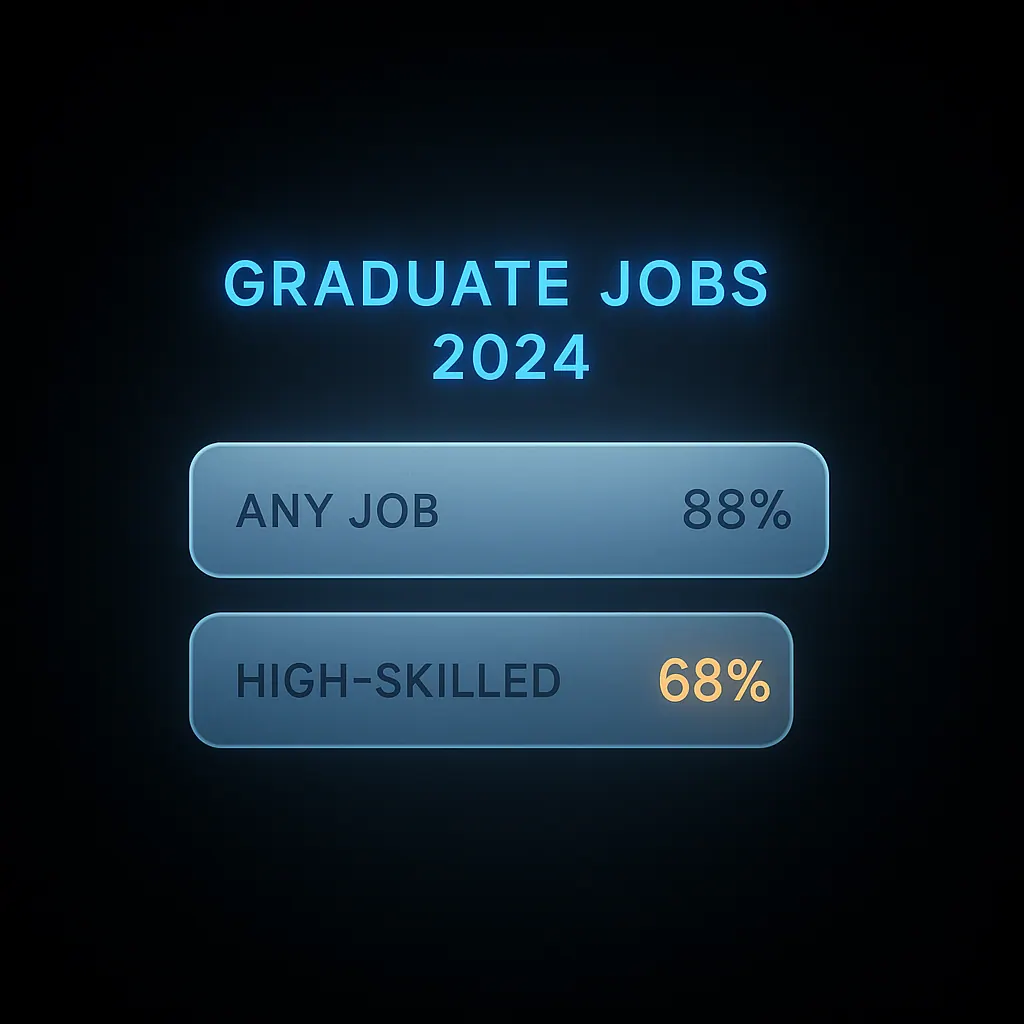
The phrase "most employable degrees" sounds straightforward until you look at how employment is actually measured. According to the Department for Education's Graduate Labour Market Statistics 2024, 87.6% of working-age graduates were in employment in 2024. That number gets quoted a lot. It is also, on its own, close to useless for comparing degrees.
The reason: that 87.6% counts any paid work. A philosophy graduate stacking shelves and a medicine graduate in their foundation year both register as "employed." The more revealing figure is high-skilled employment, defined as occupations in SOC codes 1 to 3 (managers, professionals, and associate professionals). On that measure, only 67.9% of graduates were in high-skilled roles in 2024. The gap between 87.6% and 67.9% represents graduates who are working but not in graduate-level roles.
That gap is where subject choice shows up most clearly. Degrees with near-total high-skilled employment rates pull the 67.9% figure up; degrees where non-graduate work is common drag it down.
One more number worth holding onto before the subject breakdowns: postgraduates reach 90.0% employment and 79.0% high-skilled employment, compared to 67.9% for undergraduates. Completing a master's does not just signal more study; the data suggests it materially shifts where graduates end up working.
The ranked sections below use high-skilled employment rates where the data allows, not headline employment, because that is the number that actually answers the question you are asking.
2. Ranked: most employable degrees by graduate outcomes
The table below orders broad subject groups by employment outcomes, drawing on two main sources: ONS Labour Force Survey data and the DfE Graduate Labour Market Statistics 2024. Where exact subject-level employment rates are not published in either source, the table describes outcomes qualitatively rather than inventing figures.
| Subject group | Employment pattern | Notes |
|---|---|---|
| Medicine and dentistry | Highest employment rate; highest average gross pay | Named explicitly in ONS 2017 data |
| Engineering | Highest employment rate; highest average gross pay | Named alongside medicine in ONS 2017 data |
| Nursing and allied health | Strong employment; direct occupational pathways | Identified in GOV.UK Pathways to Priority Occupations |
| Education | Strong employment; public sector concentration | ONS 2017: 40% of all graduates work in public administration, education, and health |
| Computing and architecture | Strong employment; priority sector access | Both named in GOV.UK Pathways measure |
| Business and economics | Above-average outcomes; broad sector spread | Subject-level breakdown not published in DfE or ONS sources reviewed |
| Arts, humanities, and creative subjects | Lower raw employment rates than above groups | Subject-level breakdown not published; see section 6 for context |
The overall graduate employment rate across all subjects was 87.6% in 2024, against 68.0% for non-graduates, per DfE Graduate Labour Market Statistics 2024. That gap is real, but it tells you nothing about the spread within the graduate population.
One counter-intuitive detail: the GOV.UK Pathways to Priority Occupations measure does not rank degrees by salary alone. It tracks whether graduates reach jobs in the UK Industrial Strategy's priority sectors, which is why architecture appears alongside medicine and computing. A degree can score well on that measure and still sit mid-table on raw pay.
These are population-level patterns. When looking at the most employable degrees, the table describes what happened to large cohorts, not what will happen to any individual. Outcomes within every subject group vary by university, year of graduation, and choices made after enrolment.
3. Most employable healthcare degrees: medicine, nursing, and allied health
Healthcare degrees sit at one end of the employability spectrum for a simple structural reason: medicine and nursing route almost entirely into a single destination. You graduate, you work as a doctor or nurse, almost without exception. That near-100% employment rate reflects a profession with a guaranteed pipeline, not a degree that somehow beats every other subject on merit.
The demand is real and growing. GOV.UK identifies medicine and nursing among its Pathways to Priority Occupations, and an estimated 1.8 million additional skilled workers will be needed in Construction and Health and Social Care combined by 2035. That shortage makes both subjects a safe bet for graduate employment well into the next decade.
On earnings, medicine is exceptional. IFS research cited by GOV.UK puts medicine alongside economics as the highest-earning degree, offering up to £400,000 in increased lifetime salary compared to a similar non-graduate peer.
One non-obvious gotcha for IB students: UK medical schools typically require Chemistry HL and Biology HL as a baseline, plus a strong score in either UCAT or, for some schools, BMAT. Nursing programmes usually require Biology HL. The important point is that these HL selections lock in at the start of the Diploma. A student who takes Chemistry and Biology at Standard Level, then decides in Year 13 to apply for medicine, cannot easily correct that choice.
The high employment rate should not obscure what medicine actually involves: a minimum five-year undergraduate programme, Foundation training, and years of specialty training beyond that. A strong employment outcome is no substitute for genuine motivation.
4. Most employable engineering degrees UK: which branches lead to work fastest
Engineering sits alongside medicine as the degree subject where graduates are most likely to be employed and earn the highest average pay, according to ONS labour market data. The GOV.UK labour market value report also identifies STEM subjects, including engineering, as consistently associated with higher lifetime earnings.
Not all branches are equal in how quickly they connect graduates to employment.
Large graduate employer pipelines: Civil, mechanical, and electrical engineering are taught at most UK universities and are recruited for actively by large graduate schemes in infrastructure, manufacturing, defence, and utilities. Employers in these sectors hire in volume and often run sponsored placement years.
Highly specialist routes: Chemical engineering and aerospace engineering have strong outcomes but narrower employer pools. A chemical engineering graduate with a good degree from a Russell Group university is well placed, but the pipeline depends heavily on the energy and pharmaceutical sectors, which cycle with investment.
Computing overlap: Software and electronic engineering occupy territory between pure engineering and computer science. Many graduate roles in tech will accept either, which broadens the job search but also increases competition.
One non-obvious detail for IB students: UK engineering programmes typically require Mathematics: Analysis and Approaches HL, and many also ask for Physics HL. Mathematics: Applications and Interpretation HL is not accepted by most engineering faculties, even though it counts equally in total IB points. Check individual course requirements before finalising subject choices.
Architecture is also identified in the GOV.UK Pathways to Priority Occupations measure, with construction needing a large number of additional skilled workers by 2035. For students considering engineering-adjacent routes, this broader picture matters.
Engineering is also one of the higher-value subjects in further education for male learners, per the same GOV.UK report, though that reflects a distinct vocational pathway rather than a degree route.
5. Most employable business and economics degrees
Economics stands apart from the broader business category. GOV.UK research via the IFS identifies economics and medicine as the two highest-earning degree subjects, with graduates earning up to £400,000 more over their lifetime compared to a similar non-graduate. That figure puts economics in a different tier from most business degrees, not just slightly ahead.
**Accounting and finance** sit closest to economics in outcome quality. Both lead into structured graduate schemes at the big accountancy firms, where the entry path is well-defined and salaries are published. General business management shows considerably more variation: the same degree title covers programmes ranging from highly quantitative finance tracks to broadly vocational management courses, and their graduate outcomes reflect that spread.
The counter-intuitive point worth knowing is this: a business degree is rarely a formal barrier to a graduate scheme. Cambridge Careers data confirms that the majority of graduate recruiters accept students from any degree discipline. A business student is not uniquely advantaged over, say, a history graduate applying to the same scheme.
Where business degrees do face a structural headache is volume. Graduate intakes are large, which means competition for the top-tier schemes is intense even when the headline employment rate looks healthy. Studying economics, accounting, or finance gives you a more specific technical signal; "business management" on its own requires more deliberate signalling through internships, placements, and extracurricular experience to stand out in that crowd.
6. Most employable humanities and creative degrees - and how to read their numbers honestly
Humanities and creative degrees sit lower in raw employment-rate tables not because their graduates fare badly, but because there is no single named profession waiting at the exit. Medicine counts a graduate as employed the moment they take an NHS post. English or History graduates scatter across law, journalism, publishing, the civil service, and dozens of other sectors, so the headline rate looks fragmented even when outcomes are strong.
The measurement reflects the destination spread, not the degree's quality.
The graduate recruiter picture is more favourable than league tables suggest. Cambridge's careers data notes that the majority of graduate recruiters accept students from any degree discipline. Writing, critical analysis, and structured argument are the skills that make humanities graduates competitive in those roles, precisely because those recruiters are not looking for subject-specific knowledge.
The financial risk is real, but it is mostly an institution story, not a subject story. GOV.UK's analysis confirms that some degree subjects offer little to negative financial return compared to a similar non-graduate, and that pattern is more pronounced at lower-ranked institutions than it is for subject choice alone. A History degree from a research-intensive university and a History degree from a poorly-resourced one are not the same product, even if the transcript looks identical.
Postgraduate study often completes the picture. Humanities and creative graduates who add a conversion master's or a PGCE move into a graduate population where postgraduates reach 79.0% in high-skilled employment, compared to 67.9% for undergraduates. That gap is the clearest argument for treating postgraduate study as part of the plan from the start, not as a fallback.
One non-obvious point for IB students: History HL, English HL, or Philosophy HL are not just acceptable entry routes for law, PPE, and social science degrees at selective UK universities, they are often preferred. Admissions tutors at those programmes value the extended analytical writing that HL subjects demand, which means an IB humanities student can arrive with a genuine edge, not a deficit.
The honest framing: a humanities or creative degree is not a low-employability degree. It is a degree that typically requires more active career navigation and, at many institutions, benefits from a clear postgraduate plan.
7. Most employable master's degrees UK: when postgraduate study changes the outcome
The gap between undergraduate and postgraduate outcomes is real and measurable. Graduate Labour Market Statistics 2024 show postgraduates have a 90.0% employment rate and a 79.0% high-skilled employment rate, compared with 87.6% and 67.9% for undergraduates. The salary difference is equally sharp: median nominal pay of £47,000 for postgraduates versus £42,000 for undergraduates in 2024.
Those headline figures, though, describe the stock of all postgraduates, not the effect of adding a master's to any specific undergraduate degree. The more useful question is whether a particular qualification opens a door that would otherwise stay shut.
Conversion master's degrees are where the arithmetic most often works. A humanities or social science graduate who completes a computing MSc, a law conversion (GDL/SQC), or a finance MSc is not simply signalling more study: they are meeting a formal entry requirement that their undergraduate degree cannot satisfy. GOV.UK's Pathways to Priority Occupations names computing specifically among the degree subjects that feed into the UK Industrial Strategy's priority sectors, making a computing MSc an accessible postgraduate route for science or maths graduates who did not take a CS undergraduate degree.
The counterintuitive gotcha: LEO data shows that 88.6% of first degree graduates are in sustained employment, further study, or both five years after graduation. Many graduates who miss graduate-level roles at 21 or 22 move into them within five years anyway, without a master's. That matters because postgraduate study adds both cost and time, and the decision to pursue the most employable master's degrees UK has to offer should hinge on whether the specific qualification unlocks a specific role, not on treating it as a generic fallback when undergraduate job applications stall.
8. How to choose: employability as one factor, not the whole decision
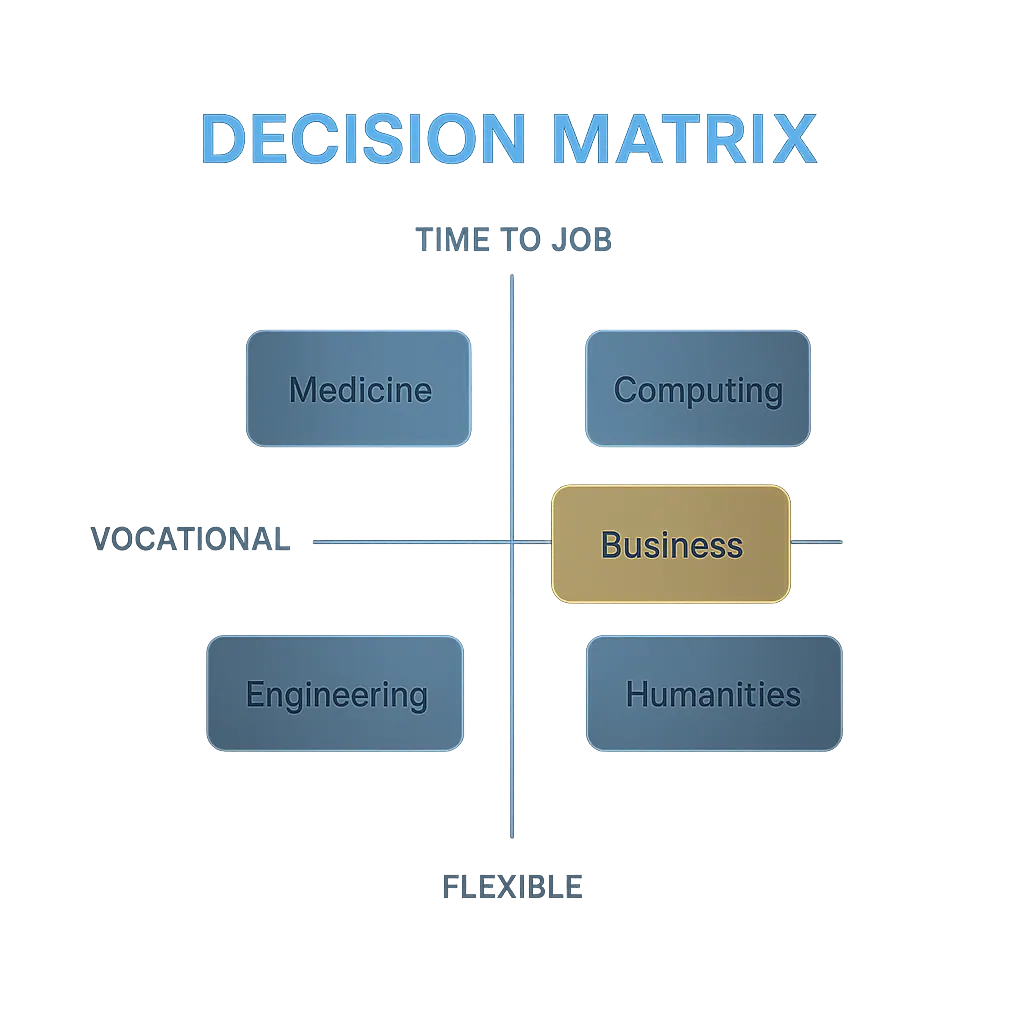
Employment rate is one input, not the verdict. The more useful decision matrix has five components: graduate employment rate, earnings trajectory, your academic aptitude for the subject, genuine interest in it, and how much flexibility the degree gives you if your plans change.
On earnings, the spread is wide. IFS research cited by GOV.UK finds that graduates earn on average around £100,000 more over their lifetime than non-graduate peers with similar backgrounds, after taxes and student loan repayments. But medicine and economics can reach up to £400,000 more, while some subjects offer little to negative financial return compared to a similar person who skipped university altogether. That gap makes subject choice genuinely consequential, not just a lifestyle preference.
University selectivity also matters in ways that are easy to overlook. More academically selective institutions are associated with higher earnings value-add, but they remain disproportionately less accessible to students from lower socio-economic backgrounds, which means the headline figures for "top university" outcomes partly reflect intake, not the teaching itself.
One counter-intuitive finding worth noting: grade attainment within your subject moves the needle more than most applicants realise. GOV.UK reports that women who achieve a first-class degree earn 3.5% more than those with a 2:1, and men with a first earn 7% more.
On recruiter access, the majority of graduate recruiters accept any degree discipline, which means for most professional paths, what you do alongside your degree, internships, societies, and projects, shapes outcomes as much as the subject label on your transcript.
The practical implication: picking something you find genuinely interesting makes consistent effort more likely, which directly affects your grade, your extracurriculars, and ultimately your outcomes, more so than a marginally higher population-level employment rate for a subject you find hard to motivate yourself through.
9. Where to go from here
Entry requirements vary more than most applicants expect. Two universities offering the same degree title can demand entirely different A-level subjects or IB Higher Level combinations, and discovering that mismatch after you've committed to your subject choices costs you a year.
This week, search undergraduate courses by subject and entry requirements using the Course Finder, filter by the subject area you're weighing up, and open the individual course pages to check the specific HL subject requirements listed there. Pay particular attention to whether a required subject must be taken at HL rather than SL, since many engineering and healthcare programmes specify this and it is non-negotiable at application stage.
Check at least three universities for the same course before you finalise anything. Requirements differ, and the Course Finder makes that comparison straightforward.
FAQ
What are the most employable degrees in the UK?
Medicine, nursing, engineering, education, and computing consistently produce the highest rates of graduate-level employment - medicine and engineering also lead on earnings, per ONS and DfE data - though vocational subjects dominate partly because they route into a single named profession.
Which degrees are most in demand by UK employers?
The government's Pathways to Priority Occupations measure identifies medicine, nursing, architecture, and computing as leading to jobs in the UK Industrial Strategy's priority sectors, with construction and health and social care projected to need around 1.8 million additional skilled workers by 2035.
Is it better to do a vocational or a general degree for employability?
Vocational degrees (medicine, nursing, education, engineering) show higher headline employment rates because graduates enter a named profession immediately, while broad degrees in humanities or social sciences often reach equivalent outcomes more slowly or after postgraduate study - neither is inherently 'better', but the path is different.
Does doing a master's degree significantly improve your employment prospects?
Yes - postgraduates had a 90.0% employment rate and 79.0% high-skilled employment rate in 2024, compared with 87.6% and 67.9% for undergraduates, and a median nominal salary of £47,000 versus £42,000, per DfE Graduate Labour Market Statistics.
Are humanities degrees employable?
Humanities graduates have lower raw employment rates immediately after graduation, but many graduate recruiters accept any degree discipline, and outcomes improve significantly with postgraduate study or a few years of experience - the degree's value often shows over time rather than at the first graduate job.
What IB subjects do you need for the most employable degree courses?
High-employment vocational courses carry specific IB Higher Level requirements: medicine and nursing typically require Chemistry HL and Biology HL, engineering requires Mathematics: Analysis and Approaches HL and often Physics HL, so IB students should confirm entry requirements before finalising their subject choices.
References
- Release home - Graduate labour market statistics - Explore education statistics - GOV.UK - https://explore-education-statistics.service.gov.uk/find-statistics/graduate-labour-market-statistics/2024
- Graduates in the UK labour market - Office for National Statistics - https://www.ons.gov.uk/employmentandlabourmarket/peopleinwork/employmentandemployeetypes/articles/graduatesintheuklabourmarket/2017
- ‘Choose carefully’: new data shows degree choice drives earnings - GOV.UK - https://www.gov.uk/government/news/choose-carefully-new-data-shows-degree-choice-drives-earnings
- Careers and graduate prospects | Undergraduate Study - https://www.undergraduate.study.cam.ac.uk/courses/graduate-prospects-careers
- Release home - Graduate labour market outcomes (LEO) - Explore education statistics - GOV.UK - https://explore-education-statistics.service.gov.uk/find-statistics/graduate-labour-market-outcomes-leo/2022-23