Computer Science Degree Entry Requirements: UK Guide
By Michael Thompson · Former IB Diploma Programme coordinator; 10 years at Bromsgrove School · Published 5 July 2026
Computer science degree entry requirements in the UK hinge on one subject above all others: A-level Mathematics. Almost every university lists Maths as a required or essential subject, and the most selective courses set offers at A*AA or higher. What surprises many applicants is that a Computing or Computer Science A-level is rarely required and barely figures in most offers. This guide covers the A-level and IB routes, the admissions tests used at Oxford and Cambridge, and the foundation-year pathways available if your Maths grade falls short.
Key Takeaways
- A-level Mathematics is non-negotiable: Almost every UK computer science course lists Maths as a required subject; the most selective universities expect at least grade A.
- Further Mathematics is strongly preferred at top universities: Oxford data shows 96% of students offered places on its Computer Science courses had taken Further Maths to A-level, though alternative offers exist for schools that do not teach it.
- A Computing A-level is not required: No major UK university lists Computer Science or Computing as a required A-level for entry, so applicants without it are not disadvantaged.
- Admissions tests apply at Oxford and Cambridge: Oxford uses the MAT, and Cambridge colleges use the TMUA, each with a separate registration deadline that falls before the UCAS deadline.
- The IB route requires HL Mathematics (Analysis and Approaches): Universities including Edinburgh and Clare College Cambridge specify Higher Level Maths Analysis and Approaches, not Applications and Interpretation.
- Foundation-year routes exist for those who miss the Maths grade: Integrated foundation programmes give applicants without the required Maths grade a structured way into a computer science degree.
In This Article
- Why A-level Mathematics Is the Entry Requirement That Matters
- The Myth That You Need a Computer Science A-level
- Entry Requirements at Selective UK Computer Science Courses
- Admissions Tests: MAT, TMUA, and the Cambridge Assessment
- The IB Route: HL Mathematics Analysis and Approaches
- Foundation Years and Alternative Qualifications
- GCSE Requirements and Other Entry Conditions
- What to Do Next
1. Why A-level Mathematics Is the Entry Requirement That Matters
Computer science degree entry requirements vary across UK universities, but one condition appears on almost every offer letter: A-level Mathematics. It is the closest thing to a universal prerequisite in this subject area, required rather than merely preferred at selective and non-selective institutions alike.
The distinction between required and preferred matters here. Further Mathematics sits in the preferred column at most universities, meaning admissions tutors want to see it but will not automatically reject you without it. At Cambridge, however, the position is firmer: the university describes Further Mathematics as "essential" for Computer Science applicants. Oxford stops short of that language but notes that 96% of A-level students offered places on Computer Science courses between 2022 and 2025 had taken Further Mathematics. That figure makes "preferred" feel closer to "expected" in practice.
The non-obvious gotcha: not being taught Further Mathematics at school does not automatically close the door to Cambridge. The university explicitly directs students in England whose schools do not offer Further Mathematics to the Advanced Mathematics Support Programme, a free national scheme that provides tuition outside normal school hours.
The practical takeaway: confirm whether your school offers Further Mathematics this term. If it does not, contact the Advanced Mathematics Support Programme before your Year 12 timetable is finalised.
2. The Myth That You Need a Computer Science A-level
No major UK university requires Computing or Computer Science at A-level as a condition of entry to a computer science degree. Clare College Cambridge states this directly: Computing A-level is not required. The same is true across the sector.
This matters practically, because the Computing A-level slot is often better spent elsewhere. Cambridge's undergraduate admissions guidance recommends that Computer Science applicants pick three A-levels from Biology, Chemistry, Physics, Mathematics, and Further Mathematics. Taking Computing instead of, say, Physics narrows that profile without adding any formal advantage in the admissions process.
The counter-intuitive trade-off: universities teach programming from scratch. Clare College's Part IA, for instance, covers functional and object-oriented programming using OCaml and Java, alongside Operating Systems and Discrete Mathematics. Prior coding experience is not assumed. What they cannot teach easily in Year 1 is mathematical maturity, which is why Maths and Further Mathematics carry so much weight.
One specific thing to avoid: Cambridge flags vocational A-levels such as Business, Media Studies, and Performing Arts as less useful for science and maths courses, and does not count Critical Thinking or Key Skills as a full A-level at all. Keep all three subject choices within the facilitating subjects list.
3. Entry Requirements at Selective UK Computer Science Courses
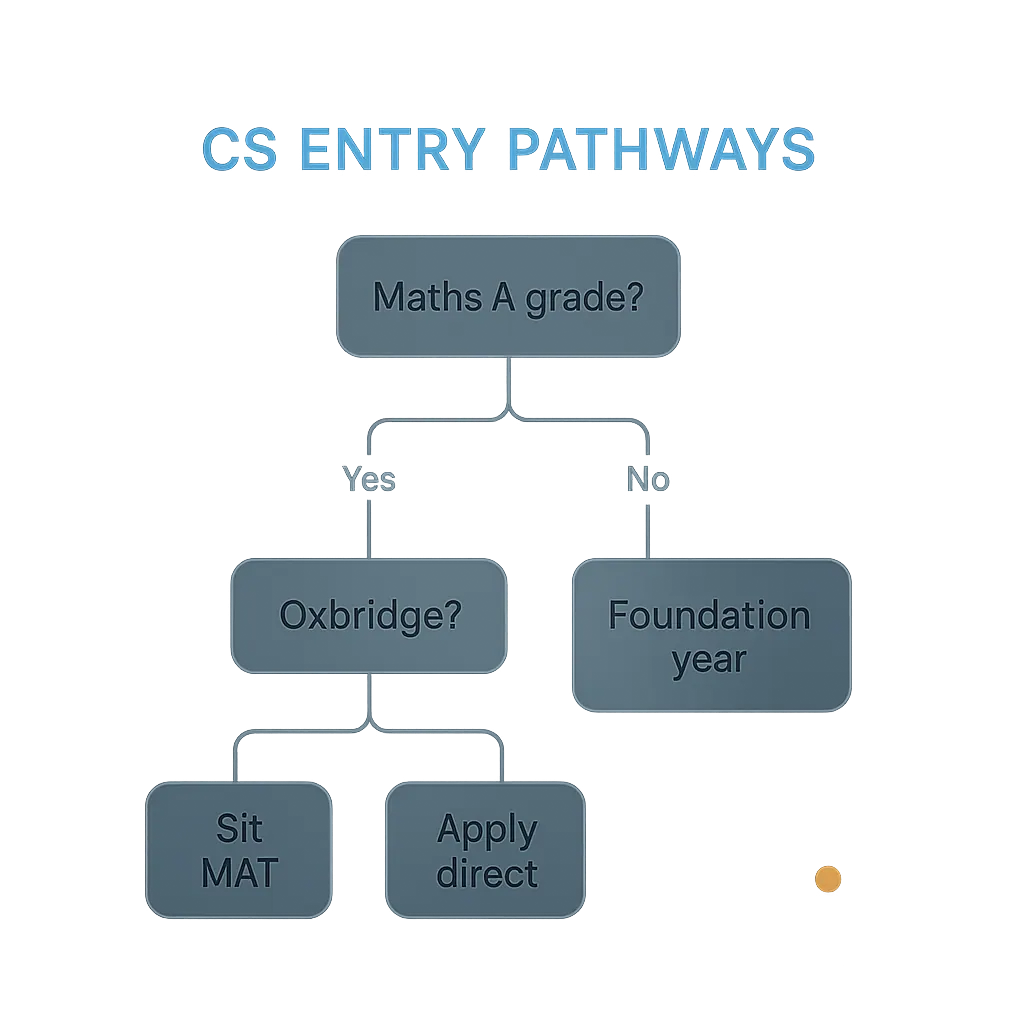
The table below covers four courses that sit at different points on the selectivity spectrum. Read it alongside the notes underneath, which carry the details that column headers cannot hold.
| University / Course | Typical A-level offer | Further Maths detail | IB HL Maths (Analysis and Approaches) | Admissions test |
|---|---|---|---|---|
| Oxford Computer Science | A\AA, A\ in Maths, FM, or CS | Strongly expected; A minimum if taken | Not specified in source | MAT (required) |
| Cambridge (Clare College) Computer Science | A\A\A | Essential at A-level or IB HL | 7 7 6 HL; 42+ overall; AA required | TMUA (required) |
| Edinburgh Computer Science | AAB to A\A\A\*, Maths at A | Not separately specified | 34-43 points; HL AA at 6; SL English at 5 | None listed |
| King's College London Computer Science | A\A\A, Maths or FM at A | Counts toward the A\* requirement | Not specified in source | None listed |
Three things the table does not show:
- Oxford's Further Maths expectation is effectively a requirement in practice. Oxford's own admissions data shows that 96% of A-level students offered places on Computer Science courses between 2022 and 2025 had taken Further Maths. The formal offer lists it as one option for the A\*, but applicants without it are a very small minority of those who succeed.
- Edinburgh does not accept UCAS Tariff points for this course, and meeting the top of the stated grade range does not guarantee an offer. Edinburgh also requires that A-level grades be achieved in a single sitting, which rules out using resits to make up a shortfall.
- Cambridge's TMUA registration closes 28 September for October 2026 UCAS entry, with the test sat between 12 and 16 October 2026. Missing that window rules out Clare College entirely, regardless of predicted grades.
If you are comparing these four courses, the honest summary is that Edinburgh's wide grade range reflects a contextual admissions policy, not a lower academic bar at the top end. Aim for the ceiling of any range, not the floor.
4. Admissions Tests: MAT, TMUA, and the Cambridge Assessment
Oxford and Cambridge both require admissions tests for Computer Science, and the registration deadlines for those tests arrive before the 15 October UCAS early deadline. Missing a test registration is a hard stop on your application, so these dates need to be in your calendar before anything else.
Oxford requires the Mathematics Admissions Test (MAT) for Computer Science and all joint courses. The standard offer is A\*AA, with the A\* required in Mathematics. The MAT has its own registration window that is separate from UCAS, and the deadline falls in early October, before the 15 October UCAS cut-off. Check the Oxford admissions page for the exact date in your cycle.
Cambridge colleges, including Clare, require the TMUA (Test of Mathematics for University Admission). For October 2026 UCAS entry, the TMUA registration deadline is 28 September and the test window runs 12-16 October 2026. That means you must register before your UCAS application is even submitted.
One non-obvious quirk: the TMUA tests mathematical reasoning and proof rather than A-level syllabus recall, so strong predicted grades do not automatically translate into a strong TMUA score. Separate preparation matters.
Both test formats and their deadlines change annually. Always verify the current requirements directly on the relevant university admissions page before your application cycle opens.
5. The IB Route: HL Mathematics Analysis and Approaches
IB applicants face one requirement that catches many off-guard: universities do not just ask for Higher Level Mathematics. They specify which HL Mathematics course they will accept, and for computer science, that almost always means Analysis and Approaches (AA), not Applications and Interpretation (AI).
The distinction matters because both courses sit at HL and look equivalent on a transcript. They are not treated as equivalent by admissions teams. AI is designed around statistics and modelling; AA covers proof, algebra, and calculus in the style universities expect from a future computer scientist.
Two examples from the research sources:
- Clare College Cambridge requires 7 7 6 at IB HL with 42 or more points overall. IB applicants must take HL Analysis and Approaches if that course is available at their school. The minimum offer mirrors A\A\A at A-level. (Clare College)
- Edinburgh accepts 34 to 43 IB points, with HL Mathematics (Analysis and Approaches only) at grade 6 and SL English at grade 5. Edinburgh's listing explicitly excludes AI from the accepted options. (UCAS/Edinburgh)
The practical gotcha: HL AI is not automatically a disqualifier everywhere, but you cannot assume it is accepted. Some institutions list no preference; others list an explicit exclusion. If you are an IB student who has already chosen AI at HL, check each university's current prospectus entry individually before you apply, because a blanket assumption either way will mislead you.
6. Foundation Years and Alternative Qualifications
Not meeting the standard Maths grade first time around does not close the door on computer science. Foundation-year and integrated-foundation programmes exist precisely to bridge that gap, and several selective universities also accept vocational qualifications on equal footing with A-levels.
Oxford accepts BTEC alongside A-level Maths in two configurations, per the Oxford Department of Computer Science:
- BTEC Level 3 National Extended Diploma (any subject, minimum DDD) accepted with an A\* in Maths A-level; Further Maths A-level at grade A is strongly recommended.
- BTEC Level 3 National Diploma (any subject, minimum DD) accepted with an A\* in Maths A-level.
The non-obvious point: the BTEC subject does not need to be Computing or Science. A DDD in Business Studies plus A\* Maths meets the published threshold.
King's College London accepts the Access to HE Diploma as an alternative route, with specific conditions. Per UCAS, applicants need 60 credits in total, with 45 at Level 3 (42 at Distinction, 3 at Merit), in a relevant subject such as Computing, Mathematics, or Science, and at least 15 Level 3 credits in Mathematics at Distinction.
Published entry requirements vary considerably between institutions. Use the course directory at /courses to compare real, current conditions before choosing where to apply.
7. GCSE Requirements and Other Entry Conditions
GCSE conditions rarely separate candidates, but a few specific rules can catch applicants off guard.
Edinburgh requires GCSE English at grade C/4 as a minimum condition. Scottish applicants must hold National 5 English at grade C. Neither is a differentiator, but both are hard gates. Edinburgh also imposes a currency rule on Mathematics qualifications: they must have been achieved no more than two academic years prior to entry, across all qualification types. If you sat Maths A-level two years before your planned start date and then took a gap year, that qualification may no longer satisfy the condition. Check the timeline carefully before banking on older results.
At Oxford, where science A-level practical components form part of the offer, a pass in the practical is expected. This is easy to overlook when the headline offer is expressed purely in letter grades.
Most other universities set no GCSE subject requirements beyond English and Mathematics at grade 4 or above. Treat these as administrative thresholds, not academic ones.
8. What to Do Next
If you are applying to Oxford or Cambridge for 2026 entry, one deadline overrides everything else right now: TMUA registration opens 28 September, which falls before the 15 October UCAS deadline. Most applicants miss this because they focus on the UCAS form first. Register for the TMUA before you submit your application, not after.
For every other course, compare real published entry requirements across UK universities through the course directory at /courses rather than relying on department websites, which are not always updated promptly.
When you are ready to go deeper on subject choices, predicted grades, and course structure, explore the Computer Science subject hub at /subjects. Check the TMUA registration window this week if Cambridge or a TMUA-using university is on your list.
FAQ
What A-levels do you need for a computer science degree?
A-level Mathematics is required by almost every UK computer science course; Further Mathematics is strongly preferred at selective universities, and no university requires a Computing or Computer Science A-level.
Do you need a Computer Science A-level to study computer science at university?
No - Computer Science or Computing at A-level is not required by any major UK university for entry to a computer science degree, and applicants without it are not disadvantaged.
What are the entry requirements for computer science at Oxford?
Oxford's standard offer for Computer Science is AAA with the A in Maths, Further Maths, or Computer Science, and all applicants must sit the Mathematics Admissions Test (MAT).
What IB subjects do you need for a computer science degree?
Most UK computer science courses require Higher Level Mathematics, and universities including Edinburgh and Clare College Cambridge specify Analysis and Approaches rather than Applications and Interpretation.
Can you get into a computer science degree without the right Maths grade?
Yes - integrated foundation-year routes and some universities' alternative qualification pathways (such as BTEC plus A* in Maths at Oxford) provide structured routes for applicants who do not initially meet the standard Maths requirement.
What subjects are needed for computer science beyond Maths?
No second subject is universally required, but Cambridge strongly recommends choosing from Biology, Chemistry, Physics, Mathematics, and Further Mathematics for its Computer Science course, and vocational A-levels are treated as less useful.
References
- How to choose A levels or high school subjects | Undergraduate Study - https://www.undergraduate.study.cam.ac.uk/apply/before/choosing-high-school-subjects
- Department of Computer Science, University of Oxford - https://www.cs.ox.ac.uk/admissions/undergraduate/why_oxford/offers.html
- Computer Science | Clare College - Cambridge University - https://www.clare.cam.ac.uk/admissions-outreach/undergraduate-study/applying-to-clare/subjects/computer-science
- Computer Science | The University of Edinburgh | UCAS - https://www.ucas.com/explore/courses/b05b4517-874b-1ee2-1c14-d63e806df2a7/computer-science
- Computer Science | King's College London, University of London | UCAS - https://www.ucas.com/explore/courses/8c81bed8-70bc-a5db-6b38-0c26564aee1b/computer-science