Degree Apprenticeship vs University: Which Is Right for You?
By Michael Thompson · Education Specialist; 10 years teaching the IB at Bromsgrove School · Published 5 July 2026 · Updated 4 October 2026
A degree apprenticeship and a traditional university degree both award a full bachelor's or master's qualification - but how you get there, who pays, and what your daily life looks like are completely different. With a degree apprenticeship you are employed from day one, your tuition is funded by your employer and the apprenticeship levy, and you graduate with no tuition-fee debt. With a traditional degree you have far more choice of subject and institution, a richer campus experience, and more flexibility to change direction later. Neither path is objectively better - the right answer depends on what you want to study, where you live, and how you learn best.
Key Takeaways
- No tuition debt on an apprenticeship: Your employer and the apprenticeship levy cover course fees, so you pay nothing toward tuition and are not eligible for a student loan.
- You are an employee from day one: Degree apprentices work at least 32 hours a week and receive a salary while studying, spending roughly 80% of their time in the workplace.
- Far fewer vacancies than university places: Degree apprenticeships are scarce - availability is uneven by region and subject, with the highest concentration in the North West and North East of England.
- IB Diploma is accepted: Most employers express entry requirements as UCAS tariff points or grade equivalents, so IB applicants can read them directly alongside A-level requirements.
- You can apply for both at the same time: Degree apprenticeships have no fixed UCAS cycle, so you can pursue employer applications and your five UCAS choices in parallel without one affecting the other.
- The qualification is the same on paper: Both routes can award a BSc, BA, or master's degree - but the experience, network, and career trajectory that follow can differ considerably.
In This Article
- What Is a Degree Apprenticeship and How Does It Differ from a University Degree?
- Degree Apprenticeship vs University: Head-to-Head Comparison
- How Degree Apprenticeship Funding Works - and Why There Is No Tuition Debt
- How to Apply: Employer Routes vs UCAS
- IB Diploma and Entry Requirements: How to Read Apprenticeship Offers
- Honest Trade-Offs: Prestige, Flexibility, Social Life and Career Paths
- What to Do Next
1. What Is a Degree Apprenticeship and How Does It Differ from a University Degree?
The degree apprenticeship vs university question comes down to one core structural difference: in a degree apprenticeship, you are an employee first and a student second. A degree apprenticeship is a Level 6 (undergraduate) or Level 7 (master's) programme that awards the same degree titles as a conventional university course - BSc, BA, LLB and others - while you remain on an employer's payroll throughout.
The time split is the defining feature. Roughly 80% of your time is spent in workplace training; the remaining 20% is off-the-job study delivered at a university partner, either as one or two days per week or in concentrated block weeks. The counter-intuitive part: that university partner is often the same institution a full-time student attends for the same subject, sitting some of the same modules.
A traditional university degree inverts this entirely. You are primarily a student, with the full range of campus life, society membership, free module choice, and the ability to change direction mid-course. The employer relationship comes after graduation.
One practical gotcha: degree apprenticeships last three to six years depending on level, so a Level 6 route can take longer than a standard three-year undergraduate degree. That extended timeline is worth factoring in before you apply.
2. Degree Apprenticeship vs University: Head-to-Head Comparison
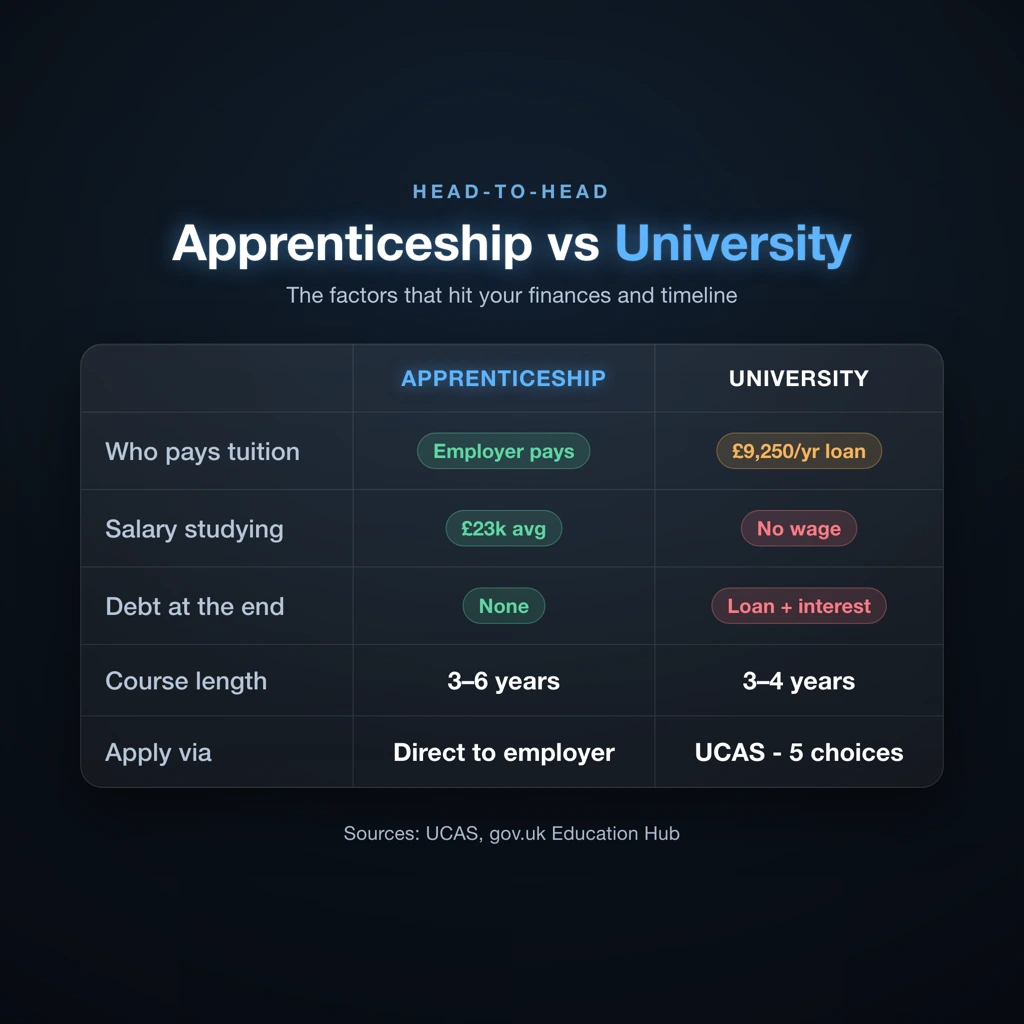
The table below puts degree apprenticeship vs university side by side across the factors that matter most to your finances and career timeline.
| Factor | Degree Apprenticeship | University |
|---|---|---|
| Who pays tuition | Employer and apprenticeship levy - apprentice pays nothing (UCAS) | You, via student loan of up to £10,050 per year in 2027/28 (England) (UCAS) |
| Salary while studying | Yes - average £23,000; minimum £7.55/hour (UCAS) | No wage; living costs come from maintenance loan or savings |
| Debt at the end | None - apprentices are not eligible for student loans (UCAS) | Tuition loan plus interest accumulates throughout study |
| Course length | 3 to 6 years depending on level (UCAS) | 3 to 4 years full-time for a bachelor's; 1 to 2 years for a master's (UCAS) |
| Qualification awarded | Full undergraduate (Level 6) or master's (Level 7) degree (Education Hub) | Bachelor's or master's degree from the awarding university |
| Application route | Directly with employers; no fixed cycle, deadlines vary per vacancy (UCAS) | Through UCAS, up to five choices, fixed annual cycle |
| How competitive | Highly competitive - employer filters before university offers a place | Competitive, but a single application reaches five universities at once |
One detail that surprises most people: because apprentices apply directly to employers rather than through UCAS, you can apply for degree apprenticeships and a traditional university place at the same time (UCAS). Running both processes in parallel is not just allowed, it is sensible - apprenticeship hiring rounds often close months before A-level results day, so keeping a UCAS application live gives you a fallback without any conflict.
The degree awarded at the end is identical in name and level to a university degree. A BSc from a degree apprenticeship carries the same classification framework as one from a campus-based course.
3. How Degree Apprenticeship Funding Works - and Why There Is No Tuition Debt
The funding model is the structural difference that shapes everything else about the degree apprenticeship vs university choice.
Degree apprenticeship tuition fees are paid through the apprenticeship levy, a payroll tax that large employers contribute to and draw down to fund training. The apprentice pays nothing toward course fees, per UCAS. This is not a scholarship or a waiver - it is how the system is built.
Because degree apprentices are employees, they are not eligible for student loans. That matters beyond the obvious: it means no tuition fee loan and no maintenance loan. You cannot apply for one as a top-up if your wages fall short of what you need to live on.
Compare that with the university route. Tuition fees in England run up to £9,790 a year in 2026/27 and £10,050 in 2027/28, typically covered by a tuition fee loan, and most students also take a maintenance loan to cover rent and living costs. Both must be repaid once you earn above the repayment threshold.
The non-obvious trade-off is on the living costs side. An apprentice wage needs to stretch across real monthly outgoings - rent, travel, food - without the safety net a maintenance loan provides. UCAS puts the minimum apprentice wage at £7.55 per hour, though many employers offer a starting salary of at least £20,000 per year. Whether that covers your cost of living depends entirely on where you are based and whether you can live at home.
In short: no tuition debt, but no maintenance loan either. Run the numbers for your specific location before treating "earn while you learn" as a straightforward financial win.
4. How to Apply: Employer Routes vs UCAS
University applications run through UCAS on a fixed annual cycle: you submit up to five choices, hit the January deadline for most courses, and wait for decisions in a predictable sequence. Degree apprenticeships work nothing like that.
Applications for degree apprenticeships go directly to employers, with no central clearing house and no fixed cycle. Vacancies open and close throughout the year. You apply with a CV and cover letter, much like any job application, rather than writing the single personal statement you'd send through UCAS. You can search live vacancies on the Find an Apprenticeship website or through UCAS.
The practical consequence of these different timelines is that you can run both applications in parallel without one undermining the other. Applying for apprenticeships while you also hold UCAS offers is low-risk. If an employer makes you an offer before results day, you can still hold your university places until you decide.
One thing to go in with realistic expectations about: the choice is not symmetric. UCAS lists over 30,000 undergraduate degree options in the UK. Degree apprenticeship vacancies are far fewer, concentrated in sectors like engineering, finance, law, and nursing, and uneven by region. A student in a large city with major employers nearby has meaningfully more options than someone in a rural area. Checking the Find an Apprenticeship site early tells you quickly whether relevant vacancies actually exist where you are, before you factor the route heavily into your planning.
5. IB Diploma and Entry Requirements: How to Read Apprenticeship Offers
Degree apprenticeships accept the IB Diploma alongside A-levels. Most employers express entry thresholds as UCAS tariff points or named grade bands, which IB applicants can translate directly using the UCAS tariff table. An IB score of 30 points, for example, maps to 360 UCAS tariff points, comparable to three B grades at A-level.
One non-obvious gotcha: the UCAS tariff counts the six subject grades plus up to three bonus points for Theory of Knowledge and the Extended Essay, but some employers specify a points threshold based on A-level grades only. If an advert is ambiguous, contact the recruiter and ask explicitly whether the full IB tariff (including TOK and EE points) counts toward their threshold.
Level 6 apprenticeships also carry baseline GCSE requirements:
- A minimum of five GCSEs at grades 9-4 (A*-C under the old scale), including English and maths
- A minimum age of 18 at the start of the apprenticeship
There is no upper age limit, so a career-changer in their forties meets the age criterion as easily as a school leaver.
When reading a vacancy on Find an Apprenticeship or UCAS, search for the specific entry criteria field rather than assuming the tariff headline covers everything. Some employers add degree-specific requirements, such as a science Higher Level subject for engineering or biomedical science programmes, that sit alongside the general points threshold.
6. Honest Trade-Offs: Prestige, Flexibility, Social Life and Career Paths
The degree apprenticeship vs university decision is not just about money or credentials. The structural differences shape your daily life, your career options and your ability to change direction.
Social and campus life is largely absent. With roughly 80% of time spent in the workplace, apprentices attend university one or two days a week or in block weeks. Societies, independent living, spontaneous peer networks, the rhythm of a campus year - these are mostly not part of the experience. That is not a criticism, but it is a real difference worth naming honestly.
Switching direction mid-programme is difficult. You are hired into a specific employer and sector from day one. If you decide finance is not for you in year two, there is no equivalent of transferring courses or changing your UCAS choices. University gives you more flexibility to pivot, at the cost of more debt.
Availability is uneven by subject and location. Degree apprenticeships are concentrated in engineering, business, IT, nursing, law and finance. Per Office for Students data, the highest density of places is in the North West and North East; London has the lowest proportion relative to total placements. If you live outside those regions or want to study history or fine art, your options narrow sharply.
On prestige, the picture is mixed. Both routes award an accredited degree. An apprenticeship employer brand can carry real weight with recruiters, and graduates arrive with several years of sector-specific experience already on their CV. That is a genuine structural advantage in competitive hiring. However, some postgraduate programmes and selective graduate schemes still filter informally by awarding institution.
One point that catches people out: not all apprenticeships are degree-equivalent. Only Level 6 and Level 7 apprenticeships award a full bachelor's or master's degree. Level 5 higher apprenticeships result in a foundation degree, HNC or HND, which is a different qualification with different entry value for further study. Check the level on any vacancy before applying.
7. What to Do Next
If you are still undecided, the most practical move is to apply for both routes at the same time. UCAS confirms that applicants can pursue degree apprenticeships and traditional university courses simultaneously, so there is no penalty for keeping options open.
The non-obvious gotcha: apprenticeship deadlines are set by individual employers, not by a central cycle, and Level 6 vacancies in competitive fields like finance, engineering, and law can close within weeks of opening. Check the Find an Apprenticeship service or the UCAS apprenticeship search this week to see which vacancies are live in your subject area and region.
To compare degree and degree apprenticeship options side by side, use our course and apprenticeship finder. Start your search there, then open Find an Apprenticeship and register for vacancy alerts in your chosen sector.
FAQ
Is a degree apprenticeship better than university?
Neither is objectively better - a degree apprenticeship gives you a salary, no tuition debt, and built-in work experience, while university offers broader subject choice, campus life, and more flexibility to change direction; the right choice depends on your subject, location, and how you learn.
Do degree apprentices end up with less debt than university graduates?
Yes - degree apprenticeship tuition is funded by the employer and the apprenticeship levy, so apprentices pay nothing toward course fees and are not eligible for a student loan, meaning they graduate without tuition-fee debt.
Can I apply for a degree apprenticeship and university at the same time?
Yes - degree apprenticeship applications go directly to employers on rolling timelines and are completely separate from UCAS, so you can pursue both in parallel without either process affecting the other.
What is the difference between a higher apprenticeship and a degree apprenticeship?
A higher apprenticeship is typically Level 4 or 5 and awards a foundation degree, HNC, or HND equivalent - not a full bachelor's degree; only Level 6 and Level 7 apprenticeships are equivalent to an undergraduate or master's degree.
Does a degree apprenticeship accept the IB Diploma?
Yes - employers generally accept the IB Diploma alongside A-levels and express entry requirements as UCAS tariff points or grade thresholds that IB students can convert directly; some roles also require five GCSEs at grades 9-4 including English and maths.
Are degree apprenticeships available everywhere in the UK?
Availability varies significantly - the highest concentration is in the North West and North East of England, and Scotland calls them Graduate Apprenticeships while Northern Ireland offers Higher Level Apprenticeships; subject and employer coverage is also uneven, concentrated in engineering, IT, business, nursing, and law.
References
- Degree apprenticeships: How you could get a degree for free – The Education Hub - https://educationhub.blog.gov.uk/2024/02/degree-apprenticeships-how-you-could-get-a-degree-for-free
- Degree apprenticeships - Learn more here - https://www.ucas.com/apprenticeships/degree-apprenticeships
- Traditional degree or degree apprenticeship? | UCAS - https://www.ucas.com/applying/before-you-apply/what-and-where-to-study/study-options/traditional-degree-or-degree-apprenticeship
- Apprenticeships vs University | UCAS - https://www.ucas.com/connect/blogs/apprenticeships-vs-university
- New data shows profile of degree apprentices - Office for Students - https://www.officeforstudents.org.uk/news-blog-and-events/press-and-media/new-data-shows-profile-of-degree-apprentices