How to Choose a University Course: A Complete Guide
By Michael Thompson · Former IB Diploma Programme coordinator; 10 years at Bromsgrove School · Published 5 July 2026
How to choose a university course is one of the most consequential decisions you will make as a student - and most people approach it backwards, starting with a job title and working back, or picking whatever subject they enjoyed most at school without checking whether the course itself suits them. A UK single-honours degree typically runs for three or more years with very limited room to switch once you have started, so the stakes of a poor fit are real. The method that works best starts wide, runs three parallel filters - genuine interest, demonstrated strength, and career or earning outcome - and then narrows hard on the actual content of the course rather than its name. This guide walks you through each stage, including how to read a UCAS entry, how IB Higher Level choices gate certain degrees, and how to judge whether a course is a safe or stretch pick.
Key Takeaways
- Three-axis framework: Weigh genuine interest, demonstrated aptitude, and career or earning outcome against each other before committing - a course that scores well on all three is far more durable than one that tops only one.
- Single-honours durability test: UK degrees typically lock you into one subject for three or more years, so stress-test your interest before applying - ask whether it holds up under exam pressure, independent reading, and a second year with no fresh topics.
- Start wide, then filter: Begin from broad interest families, then cut by required entry subjects, realistic grade targets, and the actual module list - not the course title.
- Read the course structure, not the name: Two identically named degrees can differ sharply on optional modules, exam-versus-coursework ratio, placement years, and whether they carry professional accreditation.
- IB HL choices gate specific degrees: UK universities specify total IB points plus named HL grades for entry, so the HL subjects you sit now can open or close degree options before you even apply.
- Check live UCAS entries for grade requirements: Tariff points and grade thresholds change each cycle - always verify current figures on the official UCAS or university course page, not a third-party summary.
In This Article
- The three-axis framework for choosing the right degree
- Stress-testing your interest before you commit
- Start wide, then narrow: finding the right degree for you
- How to read a course structure rather than its name
- Choosing a university subject with the IB Diploma in mind
- Judging whether a course is a stretch, on-target, or safe
- Degree subject career prospects and earning outcomes in the UK
- What to do if you have changed your mind about your university course
- Picking university subjects: common pitfalls to avoid
- What to do next
1. The three-axis framework for choosing the right degree

Knowing how to choose a university course gets easier once you stop treating it as a single question and break it into three separate ones. Most students fixate on one axis, usually interest, and ignore the other two until a problem forces their attention. The framework below gives you a structure for weighing all three at once.
The three axes are:
- Genuine interest - sustained curiosity across a whole subject area, not the enjoyment of one good lesson or one engaging teacher. If your interest evaporates when the topic gets difficult or abstract, it may not be interest in the subject itself.
- Demonstrated aptitude - evidenced by grades, written feedback from teachers, and performance under exam conditions, not by self-belief alone. The distinction matters because a subject can feel natural in class and still produce poor results under timed pressure.
- **Career and earning outcome** - this covers both salary range and day-to-day work type. A degree in a well-paid field leads somewhere specific: knowing what a typical Tuesday looks like in that career is as important as the headline graduate salary.
When the axes conflict, a simple scoring method helps. Rate each axis from 1 to 5 for a given course, then look at the gaps rather than the total. A score of 5-5-2 (high interest, high aptitude, weak career fit) is a different problem from 2-5-5 (low interest, strong aptitude, strong career fit). Each gap points to a specific risk.
The counter-intuitive point most advisers understate: high aptitude with low interest is a stronger dropout predictor than low aptitude with high interest. A student who struggles but cares tends to persist; one who finds the work easy but resents it often leaves in year two. No single axis is sufficient on its own.
2. Stress-testing your interest before you commit
A UK single-honours degree typically locks you into one subject for three or more years. Unlike the US liberal-arts model, there is very little structural room to pivot once you have enrolled. Most transfers between courses require starting again from year one, and some departments will not accept transfers at all. That makes the quality of your interest matter more than the intensity of it.
Surface interest and durable interest are not the same thing. Enjoying a good A-level teacher, or finding a documentary gripping on a Sunday afternoon, tells you something. It does not tell you enough. Durable interest has a different texture: you read around the subject without being asked to, you returned to it after a difficult mock-exam week rather than avoiding it, and you find the dry or technical parts at least tolerable rather than alienating.
The non-obvious gotcha here is the inspiring teacher problem. A brilliant A-level teacher can make contract law or organic chemistry feel electric. That teacher does not come with your university place. First-year university modules are often taught by researchers whose priority is their research, not undergraduate enthusiasm.
Practical ways to stress-test before you commit:
- Find an actual first-year reading list. Most UK universities publish module handbooks publicly. Read 20 pages of one of the set texts cold, without a teacher framing it.
- **Watch an open-day lecture, not just a highlights tour.** Recorded taster lectures are often on departmental YouTube channels.
- Talk to a second-year student, not a fresher. Freshers are still in the honeymoon period. A second-year will tell you which parts of the course feel nothing like the prospectus.
3. Start wide, then narrow: finding the right degree for you
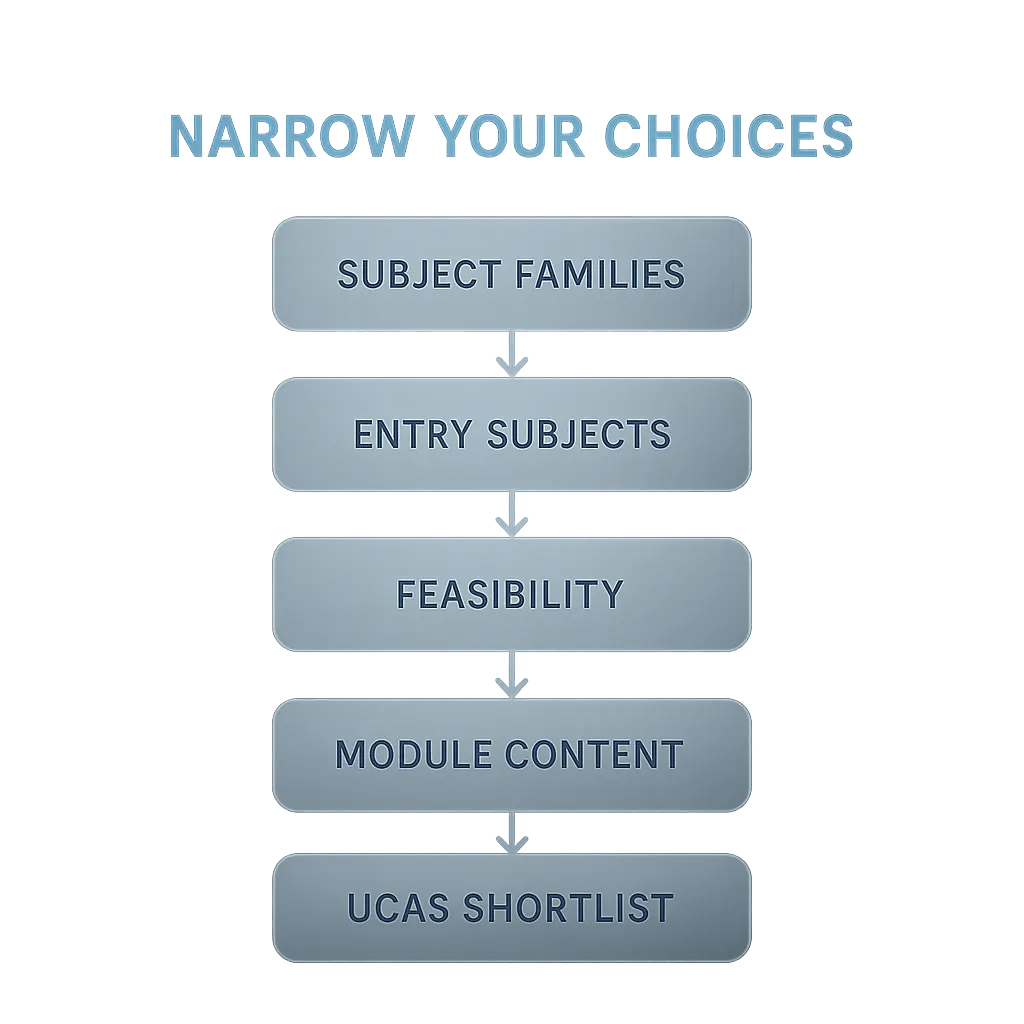
Most students approach the search backwards: they fixate on a course name before checking whether that course matches their subjects, grades, or actual interests. The start-wide method reverses that sequence.
Begin by placing yourself in a broad interest family, not a department catalogue:
- Sciences (biology, chemistry, physics, mathematics, computer science)
- Engineering and technology
- Social sciences (economics, psychology, sociology, politics)
- Humanities (history, philosophy, languages, literature)
- Creative arts and design
- Professional programmes (medicine, law, architecture, nursing)
These families act as a first sieve, not a final answer.
**First filter: required entry subjects.** Some pathways close entirely if you did not sit the right qualification. Engineering at almost every UK university requires A-level or IB Higher Level Mathematics. Medicine requires Chemistry, usually alongside at least one other science. Missing a prerequisite is not a gap you can paper over with a strong personal statement. Check UCAS entry requirements for each course before spending time on it.
Second filter: entry feasibility. Look at the grade range your current trajectory puts you in. A note worth making: this is about realistic planning, not a ceiling. Students who flag a grade gap early enough have time to address it.
Third filter: actual course content. A course title tells you almost nothing. "Business Management" at one university may be heavily quantitative; at another, it reads like applied sociology. Read the year-one, year-two, and year-three module lists. The non-obvious gotcha: optional modules in year three often define what a degree actually trains you to do, yet most students ignore them entirely at the shortlisting stage.
Browse UK degrees by subject area to run this filter across disciplines in one place.
4. How to read a course structure rather than its name
Two courses called "Psychology BSc" are not the same course. One university might require a statistics module every year; another might let you avoid quantitative methods almost entirely. The name tells you the subject. The course structure tells you what you will actually spend three years doing.
Four dimensions worth comparing before you apply:
- Compulsory versus optional modules. Some courses lock you into a fixed curriculum; others give you significant choice from year two onwards. Check whether the modules you find interesting are compulsory or merely listed as options that might not run every year.
- Assessment split. A course that is 80% coursework suits a different kind of learner than one that is 80% end-of-year exams. Neither is objectively better, but the mismatch between your working style and the assessment format is a common source of regret.
- Placement year or year abroad. These are sometimes optional, sometimes compulsory, and sometimes unavailable. A placement year adds a fourth year to your degree and can affect your loan entitlement.
- **Professional accreditation.** This is the one dimension students most often overlook. A psychology degree accredited by the British Psychological Society (BPS) is a prerequisite for graduate membership and clinical training routes. A surveying degree without Royal Institution of Chartered Surveyors (RICS) accreditation may require extra conversion study later. For law, check whether the university offers a clear Graduate Diploma in Law (GDL) pathway or an exempting qualifying law degree.
Where to find this information:
- The UCAS course search lists individual course entries, including entry requirements and course details links.
- The university's own course finder page carries the full module list and assessment breakdown.
- Key Information Set (KIS) data, embedded on most course pages, shows the percentage of time in lectures, seminars, and independent study, plus the assessment split.
Practical exercise: open the same-named course at three universities side by side and fill in a simple grid with five columns: compulsory modules, assessment split, placement availability, accreditation status, and one optional module you would want to take. Differences that looked invisible from the course titles will become obvious within twenty minutes.
5. Choosing a university subject with the IB Diploma in mind
Your IB Higher Level subject choices can close off UK degree programmes before you have written a single word of your UCAS personal statement. That makes HL selection one of the earliest and most consequential steps in choosing a university course.
The gate problem is specific, not general. Selective universities commonly require HL Mathematics (Analysis and Approaches, not Applications and Interpretation) for Economics, Engineering, and Computer Science. Medicine and related programmes typically require HL Biology or HL Chemistry, or both. Choosing the wrong Mathematics course at HL is a frequent, avoidable mistake: HL Applications and Interpretation satisfies very few of these requirements even though it carries the same credit on paper.
UK universities publish IB offers as a total Diploma points threshold combined with minimum grades in named HL subjects, for example a points total alongside a minimum grade in a specific HL. These figures change year to year, so always verify them on the individual university course page or through UCAS rather than relying on secondhand summaries.
Map your three-axis analysis to your HL choices now. If your interests point toward life sciences but your current HL selection includes no science subjects, that is a constraint to resolve at option-choice stage, not in Year 2 when your timetable is fixed.
Two further components catch students off guard:
- Theory of Knowledge and the Extended Essay together contribute up to three bonus points to the overall Diploma score. Some universities specify minimum grades in these components on individual course pages, so a weak TOK essay can pull an offer out of reach even if your HL grades are strong.
- Standard Level subjects are not merely padding. Some programmes, particularly in modern languages and area studies, require evidence of a subject at SL even when HL coverage is not demanded. Check the full entry requirements, not just the headline HL ask.
6. Judging whether a course is a stretch, on-target, or safe
UCAS tariff points translate qualifications from different systems (A-levels, BTEC, IB Diploma, SQA Highers, and others) into a single numerical scale, making it easier to compare offer levels across courses. Universities typically publish offers as either a tariff-point total or as specific grade requirements. Because entry requirements shift each cycle, always check the figure directly on the official UCAS course search or the university's own course page rather than relying on notes from a previous year.
Once you have your predicted grades converted to tariff points, you can sort your five choices into three planning categories:
- Stretch - your predicted grades fall below the typical published offer. You might still get in, but you are relying on a strong personal statement, contextual admission, or the course having vacancies after the main cycle.
- On-target - your predicted grades meet the typical offer. This is where most of your choices should sit.
- Safe - your predicted grades comfortably exceed the typical offer. A genuine safety net, not a course you would resent attending.
Per UCAS, applicants are limited to five choices in total. A balanced list spreads those choices across all three categories rather than concentrating them at one end.
One non-obvious wrinkle: contextual offer schemes can mean the stated grade requirement is not the real floor for every applicant. Some universities lower their standard offer by one or two grades for students from under-represented backgrounds or low-progression areas. These adjustments are not always prominently advertised, so it is worth checking the admissions or widening-participation page of each university individually.
Filling all five slots with stretch choices is a common mistake, as it leaves no fallback if predicted grades slip. The opposite error, choosing only safe courses when your grades could reach higher, is just as limiting.
7. Degree subject career prospects and earning outcomes in the UK
Career outcome is one of the three axes when thinking about how to choose a university course, but it is easy to read it incorrectly. The first thing to separate is accreditation-dependent degrees from transferable-skills degrees, because they work through entirely different mechanisms.
Some degrees are professional gatekeepers. Medicine, architecture, and veterinary science come with accreditation that is a legal requirement for practice. Skipping or switching mid-degree has real consequences for registration. Law is a partial case: an LLB or law degree gives exemption from some conversion steps, but a non-law graduate can still enter the profession via the SQA-accredited conversion route or the Solicitors Qualifying Examination.
Most humanities, social science, and science degrees do not lead to one profession. A history or philosophy graduate is not locked out of finance, policy, or media. What changes is the route in, which typically requires more proactive signalling of skills through internships, further study, or vocational qualifications.
On salary data: GOV.UK and HESA publish graduate outcome surveys that break down employment and earnings by subject. These figures shift year to year, so any ranking you read in a newspaper article is likely already out of date. Check the primary surveys directly before drawing conclusions.
Earnings are also only one measure. Job availability, career progression speed, work environment, and whether a role demands further postgraduate training all affect the real cost-benefit of a subject. A well-paid field with a five-year postgraduate pipeline (clinical psychology, for instance) looks different once training costs are factored in.
One counter-intuitive pattern worth knowing: a first degree in one subject followed by a targeted master's in another is a recognised pivot route, not a failure of planning. Choosing the right master's degree is a separate decision that follows naturally from this framework once you have more professional context.
8. What to do if you have changed your mind about your university course
When you change your mind matters as much as the change itself. The options available at each stage are different, and a few have hard cutoff dates.
**Before you submit your UCAS application**, you have complete flexibility. Swap courses, swap universities, change your personal statement - nothing is locked until you hit submit.
After submitting but before accepting offers, the key rule is: course, campus, or year-of-entry changes go directly to the university, not UCAS. The institution contacts UCAS if it agrees. One counter-intuitive gotcha: you can substitute a university choice within 14 days of your UCAS welcome email, but each choice can only be substituted once, and no substitutions are permitted after 30 June.
**After accepting your firm or insurance offer**, any course change is entirely at the admissions team's discretion. Contact them directly and ask whether an internal transfer to a different programme is possible before enrolment, because options narrow sharply once term starts.
After enrolment, an internal transfer is harder but not impossible. Most universities allow it most easily in the first few weeks of term one, before you fall behind on a syllabus you never intended to follow.
One route worth knowing: UCAS Extra is a free service available between 26 February and 1 July 2026 for applicants who used all five choices and hold no offers. It lets you apply to one course at a time, without losing your existing application history.
9. Picking university subjects: common pitfalls to avoid
These mistakes show up repeatedly, and most are avoidable with a small amount of early checking.
- Choosing by name, not content. Two degrees both called Business Management can share almost no modules. One may be quantitative and economics-heavy; the other may be case-study and management-theory led. Always read the full year-one module list, not just the title.
- Following friends or family without a personal check. A subject that suits someone else's interests and strengths may not suit yours. Run the three-axis check from section 1 against your own profile before you commit.
- Missing entry subject requirements. Some courses, including medicine, engineering, and economics at many Russell Group universities, specify required A-level or IB Higher Level subjects. Discovering this in Year 13 is too late to change your IB HL or A-level choices. Check requirements at the shortlisting stage, not the application stage.
- Treating predicted grades as a ceiling. Predicted grades are a starting estimate. They can move up or down. Build your list around where your grades could realistically land, not where they sit today.
- Confusing institutional prestige with course fit. A highly ranked university in the wrong subject is a worse outcome than a well-structured course at a less prominent one. The counter-intuitive gotcha: league table rankings are often calculated at university level, so a top-ten institution can still run a weak department in your chosen subject. Check subject-level rankings separately.
10. What to do next
This week, run the three-axis scoring exercise on the two or three subjects you are already considering: score each one for genuine interest, demonstrated aptitude, and career prospects in the UK. Be honest about the aptitude column. A subject you love but have never excelled at formally is a different proposition from one where your predicted grades already meet the entry requirements.
Once you have your shortlist, open the UCAS course pages for those subjects and check the current entry requirements and module lists. Admission tutors assess subject knowledge and attitude to learning, so the module list tells you what you are actually signing up for, not just the course name.
Then browse UK degrees by subject area to catch any adjacent fields you may have overlooked, or use our Course Finder to filter by entry requirements and career outcomes.
FAQ
How do I choose a university course in the UK?
Start by mapping three factors - genuine interest, demonstrated aptitude, and career or earning outcome - then filter a long list of possible subjects by required entry qualifications, realistic grade targets, and the actual module content of the course, not just its name.
What if I choose the wrong university course?
Options depend on timing: before submitting you can change UCAS choices freely; after submission, course changes must be agreed directly with the university; after enrolment, internal transfer is possible but subject to institutional rules and is easiest in the first weeks of term.
How do I choose the right undergraduate degree if I am not sure what career I want?
Focus on the aptitude and interest axes first - choose a subject you perform well in and find genuinely engaging, since degrees that develop transferable skills (analytical writing, data interpretation, structured argument) keep career options open rather than closing them.
How do IB Higher Level choices affect which UK degrees I can apply for?
UK universities state IB offers as a total points score plus minimum grades in named HL subjects, so subjects like HL Maths or HL Chemistry can be a hard requirement for engineering, economics, or medicine - check each course's live UCAS entry to confirm current requirements.
How do I know if a course is a stretch or a safe choice?
Compare your predicted grades against the typical offer stated on the UCAS or university course page - if your predicted grades fall below the stated requirements the course is a stretch, if they meet them it is on-target, and if they comfortably exceed them it is a safe choice.
How many university courses can I apply to on UCAS?
UCAS undergraduate applications are limited to five choices in total; if you hold no offers after using all five, the Extra service opens on 26 February 2026 and allows you to apply to one course at a time until 1 July 2026.
References
- Learn all about filling in your UCAS application for uni - https://www.ucas.com/applying/applying-to-university/filling-in-your-ucas-application
- Dates and deadlines for uni applications | UCAS - https://www.ucas.com/applying/applying-to-university/dates-and-deadlines-for-uni-applications
- Making changes to your UCAS Undergraduate application - https://www.ucas.com/applying/after-you-apply/making-changes-to-your-application-after-you-apply