What Degree Should I Study? A UK Student's Guide
By Michael Thompson · Former IB Diploma Programme coordinator; 10 years at Bromsgrove School · Published 5 July 2026
Choosing what degree to study is one of the most open-ended decisions you will face - and the sheer scale of choice makes it harder, not easier. With over 50,000 undergraduate courses across more than 395 UK universities and colleges, there is no shortage of options, but that breadth can leave you frozen. The most useful thing to know upfront: you do not need a job title in mind. Most students who find the right course do so by identifying an interest pattern - the kind of thinking or doing they find absorbing - and working outward from there. This guide maps those patterns to realistic degree families, flags the subject requirements that can quietly close doors, and gives you a method for narrowing down even if you currently like everything or nothing.
Key Takeaways
- Interest patterns beat job titles: Starting from what you find genuinely engaging - rather than a career label - opens up more degree options and leads to better fits.
- Many degree subjects are new at university: Law, economics, computer science, criminology, and psychology are rarely taught at school, so not having studied them before does not block entry.
- Subject gates are real but specific: Certain degree families require particular A-levels or IB Higher Levels - always confirm current requirements on the UCAS course page or university site before ruling yourself in or out.
- IB students have a natural edge for interdisciplinary degrees: A broad IB profile suits combined honours and social-science degrees, while HL Maths and HL Chemistry open specific technical and medicine-adjacent routes.
- The 'I like everything / nothing' problem has a fix: Ruling out what you would refuse to do day-to-day is faster and more reliable than trying to rank what you enjoy.
- Degree apprenticeships are a parallel route worth comparing: For some career paths, a degree apprenticeship offers the same qualification with employer salary and no tuition fees - the trade-offs are real and worth weighing.
In This Article
- What Degree Should I Study? Start Here
- Map Your Interests to a Degree Family
- Degrees You Can Study Without Doing Them at School
- Subject Gates: What Silently Blocks a Degree Family
- IB Students: How Your HL Choices Open or Close Degree Families
- Most Employable Degrees in the UK: What the Evidence Says
- Degree Apprenticeships vs University: Choosing the Right Route
- The 'I Like Everything' and 'I Like Nothing' Problem
- Choosing a University Course: What to Check Before You Apply
- What to Do Next
1. What Degree Should I Study? Start Here
Deciding what degree should I study is, for most UK applicants, less a search problem and more a filtering problem. UCAS lists over 50,000 undergraduate courses across more than 395 universities and colleges. The raw number of options is not helpful. What is helpful is a method for ruling things out quickly and confidently.
The reframe that makes this easier: stop matching job titles to degree names and start matching thinking patterns to degree families. Someone who enjoys pulling apart arguments does well in Law, Philosophy, or History. Someone who wants to build physical things is drawn to Engineering or Architecture. The fit is about the type of work a degree asks you to do every day, not what it says on a graduate's LinkedIn profile five years later.
One non-obvious gotcha: UK degrees are heavily specialised from day one. Unlike US liberal-arts programmes, there is no general first year to experiment in. Picking the wrong family costs real time.
This guide moves through: mapping interests to degree families, hidden subject gates, how IB Higher Level choices open or close options, the degree apprenticeship route, and a practical narrowing method.
2. Map Your Interests to a Degree Family
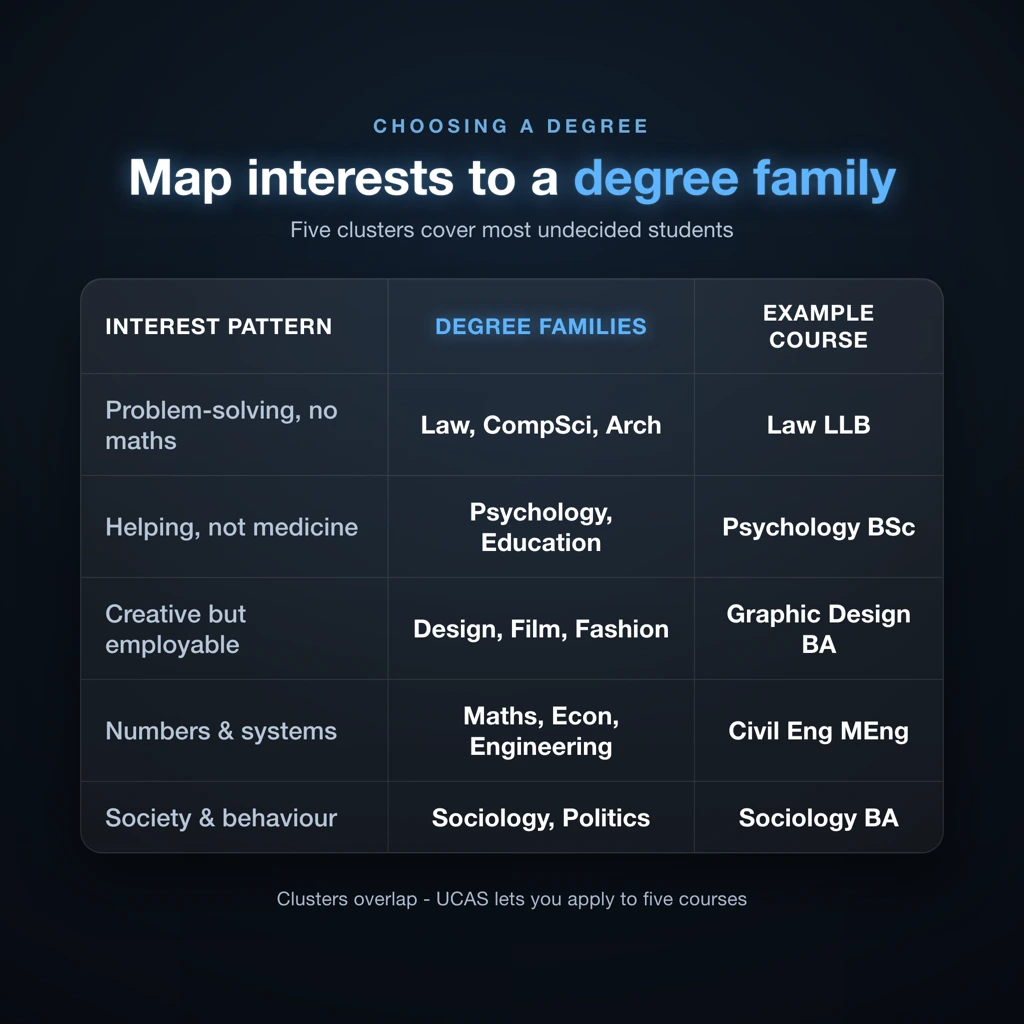
Most students don't know what degree to study because they're thinking about subjects rather than patterns. The question isn't "do I like biology?" - it's "what kind of thinking do I actually enjoy doing?" Five broad interest clusters cover the majority of undecided students, and each maps cleanly to several degree families.
| Interest Pattern | Degree Families | Example Subjects |
|---|---|---|
| Problem-solving without pure maths | Law, Computer Science, Architecture, Philosophy | Law LLB, Software Engineering, Architecture BA, PPE |
| Helping people without medicine | Psychology, Social Work, Education, Speech and Language Therapy | Psychology BSc, Childhood Studies, Education Studies |
| Creative but employable | Design, Film and Media, Fashion, Music | Graphic Design BA, Film Production, Fashion Communication |
| Numbers and systems | Economics, Maths, Engineering, Accounting and Finance | Mathematics BSc, Civil Engineering MEng, Economics BSc |
| Understanding society and behaviour | Sociology, History, Politics, Anthropology | Sociology BA, International Relations, Human Geography |
A few things worth knowing before you treat this as a fixed grid.
First, the clusters overlap more than they appear to. PPE (Philosophy, Politics and Economics) sits across at least three of them. Cambridge's Human, Social and Political Sciences deliberately combines history, politics, psychology, sociology, and economics into a single undergraduate programme. Natural Sciences does the same across biology, chemistry, physics, and earth sciences. These aren't unusual edge cases - they're explicit recognition that real questions rarely stay inside one discipline.
Second, UCAS allows you to apply to up to five courses, so you don't have to commit to a single cluster at application stage. Students in the "numbers and systems" cluster often apply to both mathematics and economics, treating the A-level results as the deciding factor.
Third, the counter-intuitive gotcha: "creative but employable" degrees vary enormously in their vocational structure, and the course title is almost no guide to this. Two universities can both offer Film Studies BA and deliver entirely different balances of theory and production practice, with different links to industry. Cambridge notes that courses with identical titles at different universities differ in compulsory modules, fieldwork, and work experience. For creative subjects especially, checking the actual module list matters more than the cluster.
Use the table above to identify two or three clusters that fit, then cross-reference against section 4 (subject gates) before you start shortlisting courses.
3. Degrees You Can Study Without Doing Them at School
Most A-level and IB students assume they should study a subject they already take. That assumption is worth dropping. A large number of the most popular university degrees simply do not exist at school level.
Subjects you cannot study at A-level or IB HL but can study at degree level include:
- Law (entry typically via humanities or essay-based A-levels)
- Economics (often via A-level Maths, though not always required)
- Computer Science (Maths A-level is the standard entry signal)
- Criminology
- Psychology
- Sociology
- Philosophy
- Anthropology
- Architecture
- Actuarial Science (Maths and Further Maths A-levels are the entry route)
Universities are not expecting you to arrive with prior knowledge of these subjects. They are expecting you to arrive with the analytical or quantitative foundations the subject builds on. A law applicant is assessed on their humanities A-levels and their performance at interview or admissions test, not on having studied law before.
Cambridge makes this explicit, noting that subjects unavailable at A-level, including Chemical Engineering and Biotechnology, can be studied there. The degree is the first time most students encounter the material properly.
The non-obvious gotcha here is actuarial science. Students routinely overlook it because it has no school equivalent, but it has strong graduate outcomes and the entry requirement is almost entirely Maths-based, not subject-specific knowledge. If you enjoy Maths but cannot picture yourself as a mathematician, it is worth looking at before settling on a degree family.
The practical takeaway: when choosing a university course, search by the subjects you are good at, then look at which degree families those subjects unlock, including ones you have never studied.
4. Subject Gates: What Silently Blocks a Degree Family
Some degree families are gated by specific subjects, not just grades. You can have three A-grades and still be ineligible if you took the wrong A-levels or IB Higher Levels. These are hard requirements, not preferences.
Common gates by cluster:
- Medicine and dentistry: Chemistry is almost universally required at A-level or IB HL, with Biology expected by most medical schools. Missing either one closes this route entirely, regardless of grades.
- Engineering: A-level or IB HL Mathematics is standard. Most courses also require a second science, typically Physics. Maths at Standard Level (IB) is not an acceptable substitute at the majority of universities.
- Economics: The counter-intuitive one. Economics is rarely taught at GCSE or A-level, so universities cannot demand it. Maths, however, is either required or strongly preferred at most institutions, particularly for quantitative or mathematical economics programmes.
- Nursing and physiotherapy: A biological science, usually Biology or Human Biology, is expected by most providers. Some accept a health-related BTEC alongside it.
One specific gotcha worth knowing: a student who takes IB HL Geography instead of HL Biology, intending to keep medicine open, will find that most UK medical schools do not accept Geography as a science subject for entry purposes. The IB science requirement is interpreted narrowly.
Grade thresholds and subject requirements change year to year. Always confirm current requirements directly on the course page via UCAS or the university's own site before committing to your subject choices.
One structural point worth noting before you apply: UCAS allows up to five course choices, but medicine, dentistry, veterinary medicine, and veterinary science have a cap of four applications between them. If you apply to Oxford or Cambridge, you can choose only one of the two, not both.
Check your subject combination against your target courses now, before your A-level or IB option choices are locked in.
5. IB Students: How Your HL Choices Open or Close Degree Families
The IB Diploma's six-subject structure is genuinely useful for interdisciplinary degrees, but your Higher Level (HL) choices function as subject gates just as much as A-level choices do. Picking the wrong three HLs in Year 1 of the Diploma can close off a degree family before you have properly considered it.
The non-obvious quirk worth knowing: many UK universities specify not just HL Maths, but HL Mathematics: Analysis and Approaches in particular. HL Mathematics: Applications and Interpretation is increasingly accepted, but for economics, engineering, computer science, and actuarial science, Analysis and Approaches is the safer choice if those fields interest you. Check before you start the course, not after.
Use this table as a starting map:
| HL Subject | Degree families it tends to open |
|---|---|
| Maths: Analysis & Approaches | Economics, engineering, computer science, actuarial science |
| Chemistry | Pharmacy, biochemistry, biomedical science; required (usually with Biology) for medicine |
| Biology | Life sciences, environmental science, some medicine-adjacent routes |
| History or Literature | Law, history, politics, humanities |
| Two sciences + Maths | Medicine (most UK medical schools require HL Chemistry alongside at least one other HL science) |
The IB's breadth across two languages, a science group, humanities, and maths maps well onto combined-honours structures. Degrees like PPE, HSPS (at Cambridge), or Natural Sciences draw on exactly the kind of cross-group thinking the Diploma builds. UCAS notes that combined honours programmes cover several subjects within a single degree, which suits students whose IB profile does not fit neatly into one discipline.
IB-specific points thresholds and HL subject requirements vary by university and change year to year. Always confirm requirements on the university's current course page before you apply.
6. Most Employable Degrees in the UK: What the Evidence Says
Degree choice materially affects lifetime earnings, but the range within a subject can be as wide as the range between subjects.
Government data published in June 2026 shows that medicine and economics are among the highest-earning degrees, offering up to £400,000 in increased lifetime salary. At the other end, some subjects return little to nothing financially compared to non-graduates of similar background and attainment.
The same data introduced a measure called Pathways to Priority Occupations, which identifies medicine, nursing, architecture, and computing as top subjects for jobs in the UK Industrial Strategy, Construction, and Health and Social Care sectors. An estimated 1.8 million additional skilled workers will be needed across those sectors by 2035. This measure will also determine subject eligibility for a targeted maintenance grant from the 2028-2029 academic year onward.
The counter-intuitive detail worth noting: university choice interacts with subject choice in ways the raw subject rankings obscure. Russell Group graduates earn around 40% more on average five years after graduation than graduates of other universities, even when studying comparable subjects. And even two students on the same course at the same university can see earnings diverge by around 10% based on household income background alone.
What this means practically:
- High-earning subjects are often gated. Medicine requires strong sciences at A-level or IB HL. Economics at competitive universities typically wants A-level Maths. The earnings data is only relevant if you can reach the course.
- Financial return is one signal, not a decision rule. Strong earnings data for a subject you have no aptitude for, or that requires school subjects you have not taken, is not a reason to apply.
- The most employable degrees in the UK 2026 lists tend to feature medicine, economics, engineering, and computing, but your outcome within any of those subjects still depends on institution, placement activity, and choices you make during the degree itself.
7. Degree Apprenticeships vs University: Choosing the Right Route
A degree apprenticeship lets you work for an employer, earn a salary, and graduate with a full bachelor's or master's degree, typically without paying tuition fees. The employer and government cover the costs between them.
Supply is growing. The government is investing a record £3.3bn in apprenticeships in 2026, targeting 50,000 additional apprenticeship starts for young people by 2029. That matters when you're deciding which route to pursue, because more starts means more competition for places, not less demand.
Where degree apprenticeships are well-established: engineering, software and digital technology, chartered surveying, accountancy, nursing, and law. Outside those fields, provision is patchy. If you want to study history, philosophy, or fine art, the route simply doesn't exist yet.
The honest trade-off looks like this:
| Factor | Degree apprenticeship | University |
|---|---|---|
| Tuition fees | Usually none | Up to £9,535/yr (England) |
| Income while studying | Yes, employer salary | Loan only |
| Subject range | Narrow, employer-led | Broad |
| Flexibility to change direction | Low - tied to one employer | Higher |
| Campus/social experience | Limited | Full |
One counter-intuitive point: degree apprenticeships are more competitive to enter than many university courses. A single engineering apprenticeship at a large employer can attract hundreds of applicants for a handful of places, and you're assessed like a job candidate, not a student applicant.
If no employer in your area offers the apprenticeship you want, the route isn't available to you regardless of your grades. That geographic constraint is worth checking early.
8. The 'I Like Everything' and 'I Like Nothing' Problem
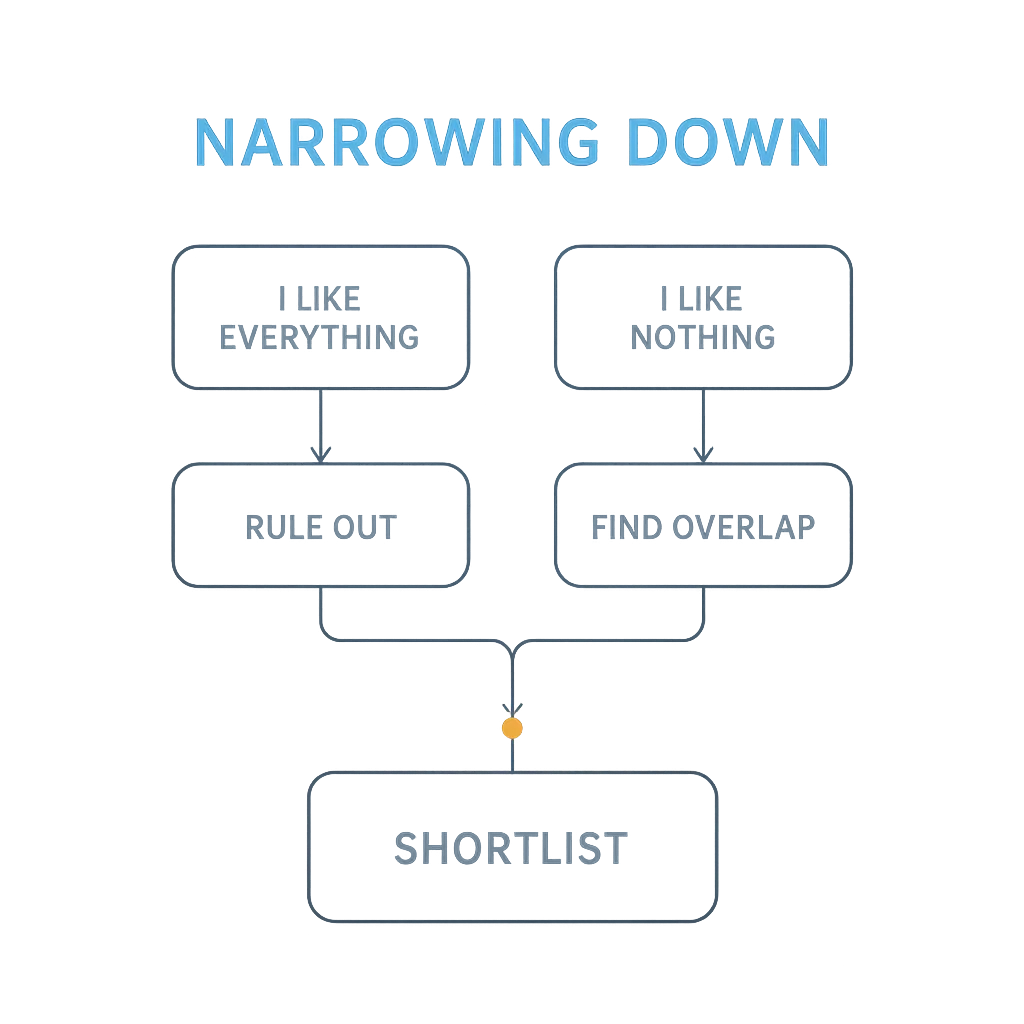
Neither state means something is wrong with you. They just need different tactics.
If you like everything
The trap is treating every subject as equally valid and never narrowing down. The practical fix is to stop ranking interests and start looking at overlap. Go back to the interest-pattern table in Section 2 and identify which degree family maps onto the most school subjects you are already studying. That cluster is your path of least resistance for entry requirements. Liking history, English, and politics already? That overlap points toward humanities and social sciences, where your existing subject combination opens most doors without extra work.
The counter-intuitive gotcha: UCAS allows you to apply to up to five courses at once, typically in similar subjects. "I like everything" can actually cost you here, because a scattered five choices across biology, film studies, law, and architecture will read as unconvincing to every admissions team.
If you like nothing
Try the ruling-out method. Instead of searching for what excites you, list what you would refuse:
- "I would not sit at a desk all day" - eliminates accounting, most law programmes, software engineering
- "I would not want to study pure maths for three years" - eliminates mathematics, physics, actuarial science
- "I could not do a placement in a hospital" - eliminates medicine, nursing, midwifery, physiotherapy
Each refusal shrinks the field. You do not need enthusiasm to start; you need a shorter list.
If nothing survives that filter, two structural solutions exist. Foundation years, sometimes called "year zero", delay specialism by a full year and are designed precisely for this situation. Combined honours degrees cover several subjects within a single course, letting you test multiple disciplines before committing to one. Both are legitimate routes, not fallback options.
9. Choosing a University Course: What to Check Before You Apply
Two courses with the same title at different universities can differ substantially in what you actually study. As Cambridge notes, compulsory modules, research opportunities, fieldwork, and work experience all vary between institutions even when the degree name is identical. A "Psychology" degree at one university might be 80% coursework; at another, it could be predominantly written exams.
Before you apply to any course, check:
- Compulsory modules in year one (not just the optional ones listed to make the course look broad)
- Assessment split between exams and coursework
- Whether a sandwich year or placement year is available, since UCAS confirms not all bachelor's degrees include one
- Contact hours per week, which vary sharply between arts and science courses
- Research or fieldwork components, especially relevant for geography, biology, and archaeology
Course structures worth knowing:
| Structure | What it means | Best suited to |
|---|---|---|
| Single honours | One subject throughout | Clear vocational or academic focus |
| Joint honours | Two subjects, roughly equal weighting | Genuine dual interest |
| Combined honours | Several subjects, often more flexible | Undecided degree options |
| Integrated master's | Undergraduate plus a postgraduate year, common in engineering and science | Students certain about postgraduate-level study |
The counter-intuitive gotcha: integrated master's degrees (MEng, MPhys, MChem) are awarded at undergraduate level, so they attract undergraduate tuition fees for the extra year rather than postgraduate rates.
UCAS course pages are the canonical source for entry requirements and course content. Use them alongside individual university prospectuses, not instead of them.
10. What to Do Next
Pick up the interest-pattern table from section 2 this week. Work through it honestly, note which cluster scores highest, then open UCAS Course Search or our course finder and filter by that degree family alongside your actual subject combination. That pairing matters more than most students expect: UCAS's subject filters will quietly exclude courses whose entry requirements conflict with what you're taking at A-level, IB, or SQA Higher, so you surface only realistic options, not aspirational ones.
One non-obvious step worth doing right now: check whether any course on your shortlist carries a named A-level or HL requirement that isn't listed on the headline entry page. Programme-level requirements often sit one click deeper, inside the department's own admissions pages. Find those before you finalise your choices, not after. Use the course finder to cross-check your cluster against real entry requirements.
FAQ
What degree should I study if I don't know what career I want?
Start from your interest pattern rather than a job title - identify what kind of thinking or activity you find absorbing, map that to a degree family using the clusters in this guide, and use ruling-out to eliminate families you would refuse to spend three years in.
What degree should I study to become a lawyer?
Law is an undergraduate degree in its own right and you do not need to have studied it at school - entry is typically based on strong humanities or essay-based A-levels or IB Higher Levels, but confirm subject and grade requirements on the UCAS course page; note that in the UK, law also requires further postgraduate qualification before practice.
What degree should I study to become a data analyst or data scientist?
Computer science, mathematics, statistics, and economics are the most common undergraduate routes into data roles - HL Maths (IB) or A-level Maths is typically expected, and confirm specific requirements on each university's course page.
What degree should I study to become a software engineer?
Computer science is the most direct route, and is available as a degree even if you have not studied it at school - entry usually requires A-level or IB HL Maths; some universities also accept physics or further maths, so check the UCAS course page for each institution.
What is the difference between degree apprenticeships and university?
A degree apprenticeship combines full-time employment with studying for a degree - you earn a salary and pay no tuition fees, but subject choice is narrower and you are employer-dependent; university offers a wider range of subjects, more flexibility to change direction, and the full campus experience.
What are the most employable degrees in the UK?
Government data identifies medicine, nursing, architecture, and computing as top subjects for jobs in priority sectors, with medicine and economics among the highest-earning degrees - but employability varies significantly by university, and subject fit and entry-requirement gates should be weighed alongside earnings data.
References
- Why study in the UK? | UCAS - https://www.ucas.com/international/international-students/applying-to-university-as-an-international-student/why-study-in-the-uk
- How to choose a course | Undergraduate Study - https://www.undergraduate.study.cam.ac.uk/courses/choosing-degree-course
- How to choose the right undergraduate course for you - https://www.ucas.com/applying/you-apply/what-and-where-study/choosing-course
- ‘Choose carefully’: new data shows degree choice drives earnings - GOV.UK - https://www.gov.uk/government/news/choose-carefully-new-data-shows-degree-choice-drives-earnings
- The degrees that make you rich... and the ones that don't - BBC News - https://www.bbc.co.uk/news/education-41693230