Is University Worth It in the UK? An Honest Guide
By Michael Thompson · Former IB Diploma Programme coordinator; 10 years at Bromsgrove School · Published 5 July 2026
Is university worth it in the UK? For most graduates, yes - but the honest answer depends on the course, the institution, and what you plan to do afterwards. The graduate earnings premium is real and well-documented, but it varies enormously by subject and university selectivity, which means the more useful question is not whether to go, but where and to study what. This guide sets out the current costs, what the earnings data actually shows, and how the alternatives compare, so you can make the decision on evidence rather than anxiety.
Key Takeaways
- The graduate earnings premium is significant but uneven: Government research shows HE attendance is associated with 19% higher earnings for men and 24% higher earnings for women after controlling for personal characteristics, but STEM, law, and economics outperform arts and humanities by a wide margin.
- Tuition fees in England rose to £9,535 in 2025: Fees are set to rise again to £9,790 in August 2026 and will then increase annually in line with RPIx, making total debt at graduation around £47,730 on average for those who became liable to repay in April 2026.
- Repayment is income-contingent, not a conventional loan: Graduates repay 9% of earnings above the threshold (frozen at £29,385 from April 2027 for three years), and any unpaid balance is written off after 30 years - so most graduates never clear the full nominal debt.
- Institution selectivity matters as much as subject: Government analysis finds more academically selective universities deliver higher earnings value-add; less selective universities show lower returns, so where you study affects the premium almost as much as what you study.
- Degree apprenticeships are a genuine alternative: They combine a full bachelor's degree with a salary and employer-paid fees across fields including engineering, architecture, marketing, and IT - worth serious comparison before committing to a traditional full-time degree.
- For IB applicants, strong results open higher-premium courses: Because competitive IB scores meet the entry requirements of more selective, higher-returning courses, the decision for strong IB candidates shifts from whether to go to university to which course and institution to choose.
In This Article
- What Does 'Worth It' Actually Mean?
- What a UK Degree Costs Right Now
- How Student Loan Repayment Actually Works
- Graduate Earnings Premium: What the Data Shows by Subject
- The Real Alternatives: Degree Apprenticeships and Direct Employment
- If You're an IB Student: The Decision Shifts
- What to Do Next
1. What Does 'Worth It' Actually Mean?
Asking whether university is worth it turns out to be four separate questions dressed up as one. The financial return, the career access, the personal development, and the social experience each have a different answer, and the right answer for a prospective nurse looks nothing like the right answer for someone eyeing a degree apprenticeship at a Big Four accountancy firm.
Public confidence in the answer has shifted sharply. According to the British Social Attitudes survey cited by the BBC, 34% of people in 2025 agreed that university "just isn't worth the amount of time and money," up from 14% in 2005, the highest level recorded in 20 years. That same survey found the share of people who believe university leaves graduates "a lot better off" in the long run fell from 50% in 2005 to 36% in 2025.
The counterintuitive point worth holding onto: those shifting attitudes do not mean university has stopped working. They mean it works very differently depending on subject, institution, and what you compare it against.
This guide will not give you a flat yes or no. It will give you the numbers, the trade-offs, and the framework to reach the right answer for your situation.
2. What a UK Degree Costs Right Now
The headline figure most prospective students see is tuition fees. But fees are only part of the cost, and often not the largest part.
Tuition fees in England and Wales rose to £9,535 per year from August 2025, rising again to £9,790 in August 2026, then increasing annually in line with RPIx (the Retail Price Index excluding mortgage interest) going forward, per BBC News. Northern Irish students at Northern Irish universities pay £4,855 per year. Scottish students studying in Scotland pay nothing.
Living costs are where the numbers get uncomfortable. Hepi estimated students need £61,000 over three years (£77,000 in London) for a minimum socially acceptable standard of living, excluding tuition. Average weekly costs in 2023-24 were £260 without rent and £418 including rent.
The maximum maintenance loan for 2026-27 is £10,830 for students living away from home outside London, according to the Student Loans Company via BBC News. That works out to roughly £903 per month over a 12-month year, against average rent costs that already consumed most of it in many cities. The gap between loan and actual living costs is not a rounding error.
The counterintuitive quirk worth knowing: average graduate debt has fallen recently, not risen. Graduates in England who became liable to repay in April 2026 held an average debt of £47,730, down from £53,000 the prior year, per the Student Loans Company. The main reason is that fees were frozen for several years before the 2025 rise, compressing total borrowing for recent cohorts compared to earlier ones.
That gap between loan and reality shows up in behaviour. BBC News reports that 65% of full-time undergraduates worked in paid employment during term time in 2026, up from 45% in 2022. For many students, paid work during term is not a lifestyle choice but a financial necessity.
3. How Student Loan Repayment Actually Works
The headline debt figure sounds alarming. The repayment mechanism is far more forgiving than it looks.
UK student loans are income-contingent, meaning you repay 9% of everything you earn above a threshold, not a fixed monthly sum. If you earn nothing, you repay nothing. This makes it function much more like a graduate contribution tied to your income than a conventional bank loan.
Per BBC News, that threshold is due to be frozen at £29,385 from April 2027 for three years. Here is what that means in practice:
- Earnings of £35,000 put you £5,615 above the threshold.
- 9% of £5,615 = roughly £42 a month in repayments.
- That is less than most people spend on a phone contract and streaming subscriptions combined.
The freeze matters because it quietly pulls more of your salary into repayments over time, but even so, the monthly sums stay modest for median earners.
The non-obvious gotcha is interest accrual. One graduate tracked by BBC News, Gemma, saw her debt grow from £34,105 at graduation in 2016 to £41,908 by 2026, despite making repayments throughout. Because interest compounds on the nominal balance regardless of what you repay, many graduates will never clear the full amount. That is, by design, fine: any unpaid balance is written off after 30 years, cleared by the taxpayer.
Repayment rules changed in 2023, extending the repayment period for current and future students (Plan 5) compared to those on the earlier Plan 2 cohort. Students who took out loans between 2012 and 2023 under Plan 2 still have the 30-year write-off, but newer borrowers face the same write-off point from a later start date.
The practical takeaway: for most graduates, the question is not "will I repay this debt" but "how much of my monthly income will this claim for 30 years." That is a different, and often smaller, question than the nominal balance suggests.
4. Graduate Earnings Premium: What the Data Shows by Subject
The average graduate premium is real, but the headline figure masks enormous variation by subject, institution, and degree classification. Understanding that variation is what makes the question "is university worth it" answerable in any useful way.
According to a February 2023 report from the Social Mobility Commission and GOV.UK, HE attendance is associated with 19% higher earnings for men and 24% for women after controlling for personal characteristics. By age 29 those gaps widen: men who attended HE earn 25% more than peers who left with five GCSEs and did not go to university; for women the figure is 50% more.
Subject groupings matter more than the headline
| Subject grouping | Relative earnings premium |
|---|---|
| STEM, law, economics | High |
| Business, social sciences | Medium |
| Arts, humanities, creative subjects | Lower |
These are relative bands, not absolute salary figures. A law graduate from a less selective university may still earn less than a computer science graduate from a highly selective one, because institution selectivity is an independent variable in the data: more academically selective universities show higher value-add; less selective ones show lower value-add. Picking a subject and ignoring where you study it gives you an incomplete picture.
Degree classification is a smaller but real factor
A first-class degree is associated with 7% higher earnings for men and 3.5% for women compared to a 2.1 with otherwise similar characteristics. The men's figure is roughly double the women's, which is a counter-intuitive gap the data does not fully explain.
The structural inequality in the numbers
The premium figures above describe averages. What they obscure is a documented access problem: students from disadvantaged backgrounds are disproportionately less likely to attend selective universities or enrol in high-earning subjects, even when their grades are comparable to wealthier peers. The graduate earnings premium is therefore not uniformly available to everyone who holds a degree. Subject choice and institutional selectivity compound existing advantage rather than cancel it out.
If you are comparing graduate vs non-graduate earnings as a reason to apply, check where the subject you want to study sits in that table, and at which institutions you are likely to be accepted.
5. The Real Alternatives: Degree Apprenticeships and Direct Employment
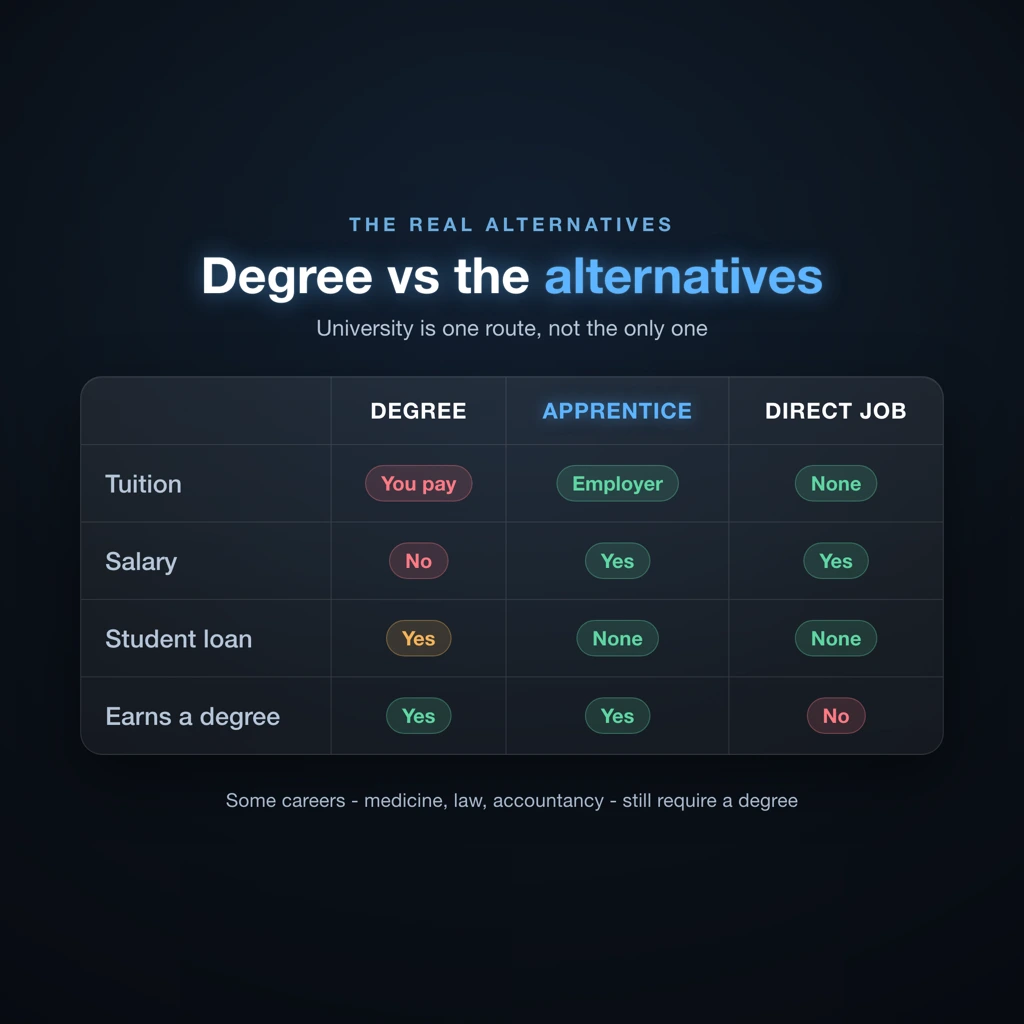
University is not the only route to a well-paid career, and treating the alternatives as fallback options is a mistake.
Degree apprenticeships are the most direct structural competitor to a traditional degree. The employer pays the tuition fees and the apprentice earns a salary throughout, covering fields including architecture, engineering, marketing, and IT. You graduate with a full honours degree and no student loan. The trade-off is real: you typically need to live near your employer, and the full-time campus experience, the three years of open-ended intellectual time, largely disappears. The counter-intuitive gotcha is that degree apprenticeship places are often more competitive than university admissions for the same employer, because the company is committing salary and tuition simultaneously.
At lower levels, the earnings data supports apprenticeships too. Intermediate and advanced apprenticeships show a positive earnings effect compared to classroom-based vocational qualifications at equivalent levels, according to a Social Mobility Commission summary report published in February 2023.
Direct employment is viable in specific fields. Journalism, some creative industries, and parts of the tech sector hire on portfolio and demonstrable skill rather than degree classification. Traineeships, diplomas, and certificates can build transferable professional skills for these routes.
Gap years attract an estimated 200,000 to 250,000 people each year in the UK. A purposeful gap year is not lost time, but every year out of the labour market delays earnings accumulation, which compounds across a career.
One hard constraint worth noting: some professions gate entry on a degree as a formal prerequisite. Medicine, most solicitor training pathways, and chartered accountancy routes often require an undergraduate qualification before professional study begins. If your target career sits in that category, the question of whether university is worth it has largely already been answered.
6. If You're an IB Student: The Decision Shifts
For strong IB candidates, the question is rarely whether to go to university. A score of 38 or above typically meets entry requirements for selective universities and high-premium subjects such as medicine, law, engineering, and economics. Those subjects are consistently associated with higher earnings than most others, according to GOV.UK's summary of labour market returns to qualifications. The real decision is which course at which institution, not whether to go at all.
The IB Diploma's structure matters here. Theory of Knowledge, the Extended Essay, and CAS give admissions tutors at selective universities something A-level transcripts often cannot: evidence of independent research and analytical range. Some graduate employers in law and finance read these the same way.
One non-obvious gotcha: IB students on the borderline of a high-premium course sometimes default to accepting a lower-selectivity place rather than rethinking their options. The earnings data argues against this. GOV.UK research finds that more academically selective universities produce measurably higher earnings value-add, while less selective institutions produce lower value-add. If your predicted points fall short of a high-returning course, it is worth weighing a resit or a subject pivot before accepting a place that may not deliver equivalent returns.
Map your realistic points against the entry requirements for high-premium subjects before you commit.
7. What to Do Next
The question of whether university is worth it has no universal answer, but it does have a personal one, and the data to answer it exists right now.
One non-obvious gotcha: two courses with the same title at different institutions can produce graduate earnings that differ by tens of thousands of pounds over a career. The institution matters as much as the subject. Many applicants shortlist by entry requirements and never cross-reference outcomes.
Fix that this week. Open the Course Finder, pull up every course on your shortlist, and compare the graduate outcomes data. Then run the same search for a degree apprenticeship in the same field. If the earnings gap is narrow and the apprenticeship carries no tuition debt, that comparison alone may be the most useful hour you spend on this decision.
FAQ
Is university worth it in the UK in 2026?
For most graduates it still delivers a positive earnings premium over non-graduates, but the return varies significantly by subject and institution - STEM, law, and economics at selective universities show the strongest returns, while less selective institutions and lower-earning subjects narrow the advantage considerably.
Is university worth the debt in the UK?
Student loan repayment is income-contingent (9% of earnings above the threshold, frozen at £29,385 from April 2027), and any unpaid balance is written off after 30 years, so the debt functions more like a graduate tax than a conventional loan - the risk is lower than the headline £47,730 average debt figure suggests.
Is a degree worth it anymore?
Government research from February 2023 shows HE attendance is still associated with 19-24% higher earnings after controlling for personal characteristics, but public confidence has fallen - the British Social Attitudes survey found 34% of people in 2025 believed university wasn't worth the time and money, up from 14% in 2005.
Is university worth it for computer science?
STEM subjects including computer science are among the higher-earning degree categories in government data, but degree apprenticeships in IT are well-established, employer-funded, and increasingly competitive - comparing both routes on salary trajectory and employer recognition is worth doing before choosing.
Is a degree apprenticeship better than university?
Degree apprenticeships pay a salary, carry no tuition fee debt, and deliver a full bachelor's degree, making them a strong alternative in fields where they exist - but they are fewer in number, require working near an employer, and do not replicate the full-time campus experience.
References
- Student loan inquiry begins as a third of people say university degree not worth it - BBC News - https://www.bbc.co.uk/news/articles/c2e29gk73rjo
- How much are tuition fees in the UK and is university worth it? - BBC News - https://www.bbc.co.uk/news/articles/cwyegp0dnq9o
- Labour market value of higher and further education qualifications: a summary report - GOV.UK - https://www.gov.uk/government/publications/labour-market-value-of-higher-and-further-education-qualifications-a-summary-report/labour-market-value-of-higher-and-further-education-qualifications-a-summary-report
- The pros and cons of university | UCAS - https://www.ucas.com/applying/before-you-apply/what-and-where-to-study/study-options/the-pros-and-cons-of-university