Engineering Degree Entry Requirements: A Complete UK Guide
By Michael Thompson · Former IB Diploma Programme coordinator; 10 years at Bromsgrove School · Published 5 July 2026
Engineering degree entry requirements in the UK follow a consistent pattern - Maths and Physics at A-level form the baseline for almost every course - but the details vary more than most guides admit. The grade range runs from AAA at Oxford down to foundation-year routes for applicants who missed Physics or Further Maths. Admissions tests, IB Higher Level requirements, and accreditation status all affect which degree you should apply for and why. This guide covers the full spread, from the most selective courses to the most accessible, so you can identify the right applications to make.
Key Takeaways
- Maths and Physics are the double gate: Almost all UK engineering degrees require both A-level Mathematics and Physics; missing either usually makes an application non-competitive unless you take a foundation year.
- *Average A-level offer is AAB*: Per UCAS, the average entry requirement across undergraduate engineering and technology degrees is AAB, with Scottish Highers averaging AAAAB.
- Oxford and Cambridge set their own admissions tests: Oxford requires the ESAT (Engineering and Science Admissions Test) and demands AAA including Maths and Physics; Cambridge's Engineering course also uses the ESAT and typically offers 41-42 IB points.
- MEng versus BEng matters for your career: Only an MEng (or a BEng plus a separate Master's) normally satisfies the academic requirements for Chartered Engineer status through the Engineering Council.
- IB applicants need HL Maths: Analysis and Approaches: For courses requiring Mathematics, Cambridge specifies IB Higher Level Analysis and Approaches; most selective universities follow the same rule.
- Foundation years open the door if you lack Physics: Engineering foundation-year routes exist specifically for applicants who do not hold the required Physics or Further Maths A-level and need an extra year to meet progression requirements.
In This Article
- The Maths and Physics Double Gate: Core Subject Requirements
- How Entry Requirements Vary by Engineering Discipline
- Selective University Requirements: Oxford, Cambridge, and Admissions Tests
- The IB Route: Math Requirements for Engineering Degrees
- Engineering Foundation Degree Entry Requirements and Accessible Routes
- Accreditation and Degree Level: BEng vs MEng and Chartered Engineer Status
- Entry Requirements for Engineering Degrees in Scotland
- What to Do Next
1. The Maths and Physics Double Gate: Core Subject Requirements
Engineering degree entry requirements in the UK are built around two subjects above all others: A-level Mathematics and Physics. Missing either puts an application at a serious disadvantage at most universities, regardless of how strong your other grades are. The average A-level entry requirement for undergraduate engineering and technology degrees is *A\AB, and for Scottish Highers it is AAAAB**, according to UCAS.
Those averages are a starting point, not a guarantee. Subject requirements shift by discipline and by university. A few patterns worth knowing:
- Mathematics is non-negotiable across virtually every engineering course in the UK.
- Physics is required or strongly preferred for most branches, including civil, mechanical, and electrical engineering.
- Further Mathematics is preferred or expected at the most selective universities. The counter-intuitive point here: at some highly competitive programmes, an A in Further Maths carries more weight than a high grade in a third unrelated subject.
- Chemistry is typically required or preferred for chemical engineering, and some courses also accept it alongside Physics rather than instead of it.
- Design and Technology is accepted as a supporting subject on some courses, though it rarely substitutes for Physics.
UCAS also notes Computing and Design as useful prior subjects alongside Maths and Physics, which is worth bearing in mind if you are still choosing your A-levels.
The practical takeaway: always check the specific entry requirements on the university's own admissions page or via UCAS Course Search. Averages describe the cohort, not the offer you will receive.
2. How Entry Requirements Vary by Engineering Discipline
The subject requirements shift noticeably between disciplines, even when the grade offer looks the same on paper. Knowing which subjects are genuinely mandatory versus "preferred" can save you from a failed application.
Civil and mechanical engineering almost universally list Maths and Physics as required A-levels. There is very little flexibility here: these two subjects are treated as a double gate across the sector, from Russell Group universities down to post-92 institutions.
Chemical engineering commonly adds Chemistry as a third required subject alongside Maths and Physics. The counter-intuitive detail is that at Cambridge, Year 1 Chemical Engineering and Biotechnology students study Chemistry and Mathematics from the Natural Sciences Part IA timetable, so the subject boundary is genuinely academic, not just an admissions filter. (Cambridge Chemical Engineering and Biotechnology)
Electrical and electronic engineering follows the civil/mechanical pattern in most cases: Maths and Physics, nothing else required.
Software engineering is the outlier. A number of universities accept A-level Computing in place of Physics, recognising that the programming and logical foundations it provides are directly relevant. Check individual admissions pages carefully, as this varies widely.
Biomedical engineering is the most variable discipline. Some universities expect or prefer Biology or Chemistry alongside Maths and Physics, given the life-sciences content in the curriculum.
The UCAS subject guide for Engineering and Technology identifies Maths, Physics, Computing, and Design as the most useful prior subjects across the sector, with the average A-level offer sitting at A\*AB.
The table below shows illustrative patterns. Oxford and Cambridge figures use cited data; all other rows use the UCAS sector average as a baseline and should be treated as directional, not definitive. Always verify against the individual university's admissions page or UCAS Course Search.
| Discipline | Typical A-level subjects required | Typical A-level grade offer | IB HL indication | Admissions test | Degree type |
|---|---|---|---|---|---|
| Civil engineering | Maths, Physics | A\*AB (sector avg) | Maths, Physics at HL | None (most universities) | BEng / MEng |
| Mechanical engineering | Maths, Physics | A\*AB (sector avg) | Maths, Physics at HL | None (most universities) | BEng / MEng |
| Chemical engineering | Maths, Physics, Chemistry | A\*AB (sector avg) | Maths, Chemistry at HL | None (most universities) | BEng / MEng |
| Electrical / electronic | Maths, Physics | A\*AB (sector avg) | Maths, Physics at HL | None (most universities) | BEng / MEng |
| Software engineering | Maths; Physics or Computing | A\*AB (sector avg) | Maths at HL | None (most universities) | BEng / MEng |
| Biomedical engineering | Maths, Physics; Biology or Chemistry preferred at some | A\*AB (sector avg) | Maths, Physics at HL | None (most universities) | BEng / MEng |
| Oxford Engineering Science | Maths, Physics (A\A\A, A\*s in Maths/Physics/Further Maths) | A\A\A | 776 HL, 7 in Maths and Physics, total 40 | ESAT required | MEng (4-year) |
| Cambridge Chemical Engineering | Maths, Physics, Chemistry | A\A\A (typical) | Maths, Chemistry at HL | None specified | BA / MEng |
3. Selective University Requirements: Oxford, Cambridge, and Admissions Tests
Oxford and Cambridge set harder grade conditions than almost every other UK university, and they also require a separate admissions test with its own registration window. Missing the test deadline is an instant disqualification, regardless of predicted grades.
Oxford Engineering Science asks for A\A\A at A-level, with both A\s falling in Mathematics, Physics, or Further Mathematics. A\AA is not enough, even though it sits one grade below. IB applicants need 40 points overall with 776 at Higher Level, including 7s in HL Mathematics and HL Physics specifically. Scottish Advanced Highers applicants need AA or AAB.
Cambridge Engineering awards a BA (Hons) and MEng, with the IB offer sitting at 41-42 points with 776 at Higher Level. Note that some Cambridge colleges require 777 or higher at HL, and individual colleges set their own conditions, so check your shortlisted college directly.
Both universities use the Engineering and Science Admissions Test (ESAT). The ESAT has its own registration deadline that falls before or alongside the UCAS deadline. You must register for it separately; your UCAS form submission does not automatically register you. Check the current registration window for your application year early, as late registration is not permitted.
One counter-intuitive detail worth knowing: if you are predicted A\AA rather than A\A\*A, Oxford may still invite you to interview if admissions tutors consider there are mitigating circumstances, such as school disruption or illness. However, any offer made in those circumstances remains conditional on A\A\A at A-level. The interview is not a route around the final grade requirement.
4. The IB Route: Math Requirements for Engineering Degrees
The most important choice an IB student can make for an engineering application is which Mathematics course they sit at Higher Level. Higher Level Mathematics: Analysis and Approaches is the required course for any Cambridge engineering application, per the University of Cambridge's IB statement. Applications and Interpretation HL will not satisfy the mathematics requirement there, regardless of the grade achieved. This distinction catches IB students who switch courses in Year 12 without realising the downstream effect.
For competitive engineering courses, the headline grade requirements are:
| University | IB total | HL grades | Notes |
|---|---|---|---|
| Cambridge | 41-42 | 776 | Analysis and Approaches HL mandatory; some colleges require 777 or higher |
| Oxford | 40 | 776 | 7s required in both HL Mathematics and HL Physics |
| Imperial College London | 38-40 | 6 or 7 in specified HLs | Both HL Maths courses accepted; some courses state a preference |
Sources: Cambridge, Oxford, Imperial.
Cambridge admissions decisions are made college by college, not centrally. Churchill, Corpus Christi, and Selwyn are among the colleges that typically set requirements above the university minimum, and some require 777 or a grade 7 in a specific subject. Check the individual college statement on the IBO recognition database before listing a college as a preference.
Imperial accepts both HL Maths courses in principle, but some courses specify a preference, so check the course-level entry requirements rather than relying on the faculty-wide statement.
5. Engineering Foundation Degree Entry Requirements and Accessible Routes
Foundation years, sometimes labelled Year 0, exist specifically for applicants who do not meet the standard engineering degree entry requirements. The most common cases are students who studied Maths but not Physics at A-level, or who hold vocational qualifications rather than traditional A-levels.
Two distinct structures matter here, and confusing them costs applicants time.
The first is an integrated foundation year embedded within a named degree programme. Completing it with the required progression mark typically guarantees a place in Year 1 of that programme. No second UCAS application is needed. The second is a standalone foundation degree (FdEng) or HNC/HND, which sits outside the full degree structure. Students who want to continue to a BEng often need to apply separately for a top-up degree, and transfer is not automatic.
Typical A-level grade requirements for integrated foundation routes are lower than for direct entry, often BB or BCC, and some universities ask only for Maths rather than Maths and Physics combined. Always confirm with the specific institution, as thresholds vary.
For vocational applicants, UCAS data shows the average BTEC requirement for engineering and technology is DDD, making BTEC Extended Diploma holders competitive for many foundation and direct-entry routes.
One non-obvious point: because an integrated foundation year leads into a full BEng or MEng programme, the accreditation and chartered engineer pathways covered in the next section apply equally to students who entered via Year 0.
6. Accreditation and Degree Level: BEng vs MEng and Chartered Engineer Status
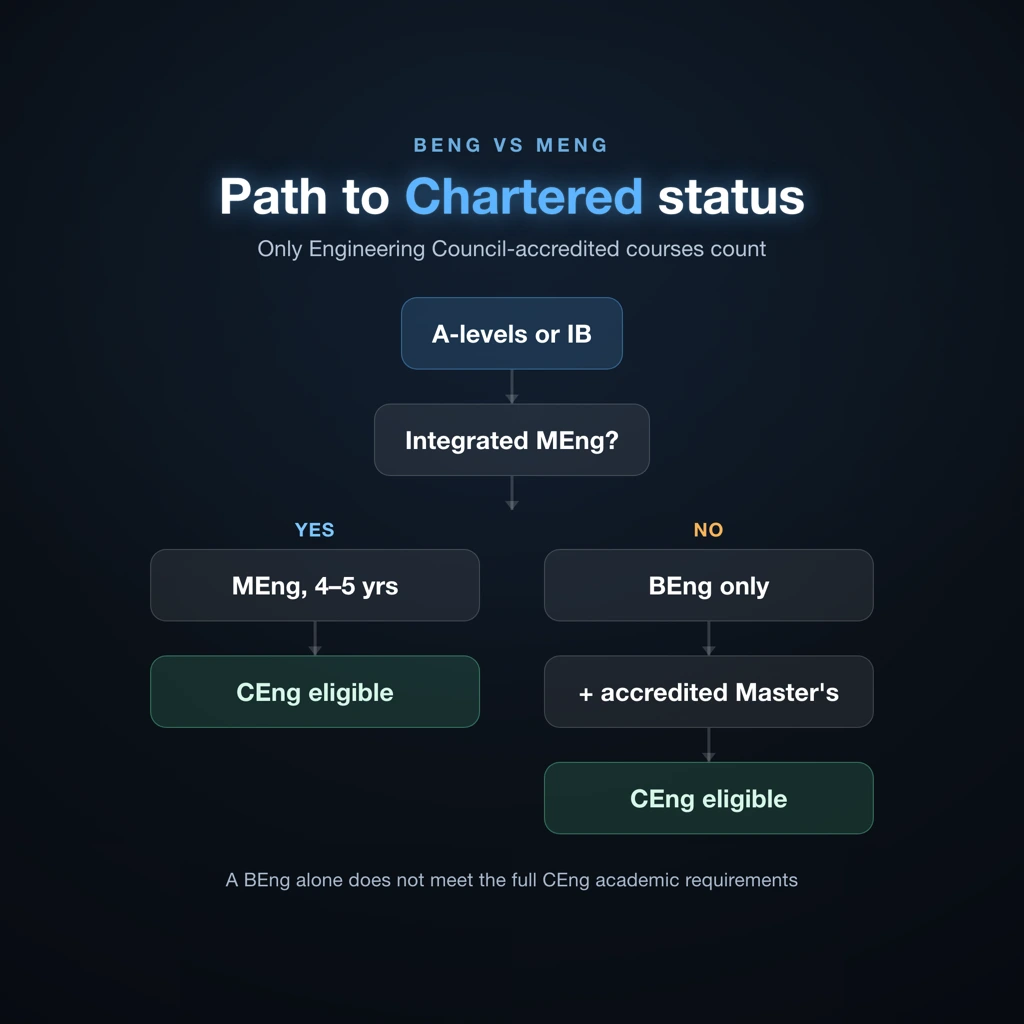
Engineering Council accreditation is the mechanism that connects your degree to professional registration. Only programmes accredited by the Engineering Council count toward the academic requirements for Engineering Technician (EngTech), Incorporated Engineer (IEng), or Chartered Engineer (CEng) status. A well-ranked course at an unaccredited institution gives you no formal shortcut to those titles.
The BEng/MEng distinction matters more than most applicants realise. A BEng alone does not normally satisfy the full academic requirements for CEng status. An integrated MEng (typically four or five years) does, as does a BEng followed by a separately accredited Master's degree. Choosing the wrong degree level at 17 can add an extra postgraduate year and its associated cost later.
Two Cambridge examples show this in practice. The four-year Engineering course leads to both a BA (Hons) and MEng, and is accredited by the Engineering Council alongside multiple professional bodies including IMechE, IET, and ICE. The four-year Chemical Engineering and Biotechnology MEng is accredited by the Institution of Chemical Engineers (IChemE), enabling graduates to apply for CEng status after four years of relevant experience without further exams.
Before making a firm choice, check accreditation directly. Use the Engineering Council's online register, and look for professional body logos on the university course page. Not every course that calls itself an MEng is fully accredited for CEng purposes.
7. Entry Requirements for Engineering Degrees in Scotland
Scottish universities structure engineering differently from their English counterparts. Most offer 5-year integrated MEng programmes, meaning Scottish school leavers enter a broader first year rather than bypassing foundational content the way a gap year or foundation route might.
For Year 1 entry, Scottish Higher applicants typically apply on the strength of Highers alone, though competitive courses may also expect Advanced Highers. The UCAS subject guide for Engineering and Technology puts the average Scottish Highers requirement at AAAAB, with Maths and Physics normally among the named subjects.
The counter-intuitive quirk: sitting Advanced Highers is not always compulsory at Scottish universities, yet it becomes unavoidable if you are applying south of the border or to Oxford. Oxford Engineering Science requires Advanced Highers at AA or AAB, representing the most selective end of the spectrum.
Scottish students applying to Oxford or Cambridge also sit the same admissions tests as English applicants. For Oxford Engineering Science, that means the ESAT, with no exemption for SQA qualifications. Grade conversion between Higher/Advanced Higher and A-level equivalents is not automatic, so check each institution's stated equivalency before submitting your application.
For universities such as Edinburgh, entry requirements for engineering degrees differ from English institutions and should be verified directly on the UCAS Course Directory or the university's own admissions pages, as published requirements can shift between application cycles.
8. What to Do Next
Before you do anything else this week, check whether every course on your shortlist carries accreditation from the Engineering Council. This matters more than most applicants realise: a degree that isn't accredited will not count toward Chartered Engineer (CEng) or Incorporated Engineer (IEng) status later, and switching courses after enrolment to fix that is rarely straightforward. Accreditation status is listed on each university's course page and on the Engineering Council's own register, so it takes minutes to verify.
For broader guidance on subject choices, typical offers, and how different engineering disciplines compare, visit our Engineering subject hub.
When you're ready to compare real course requirements side by side, the Course Directory lists published entry requirements for UK engineering degrees so you can check exact grade conditions against your predicted grades before the UCAS deadline.
FAQ
What A-level grades do you need for an engineering degree?
The average A-level entry requirement across UK engineering and technology degrees is AAB according to UCAS, but the most selective courses (such as Oxford Engineering) require AA*A, while foundation-year routes can accept lower grades - check each course individually.
Do you need Further Maths for engineering at university?
Further Mathematics is not universally required but is expected or preferred at the most selective universities; at Oxford, the two As in the AA*A offer must come from Mathematics, Physics, or Further Mathematics, making it effectively essential for the strongest applications.
Do you have to go to university to become an engineer?
No - degree apprenticeships and HNC/HND routes exist, but reaching Chartered Engineer status through the Engineering Council normally requires an accredited MEng or a BEng plus an accredited Master's, which currently means engaging with higher education at some point.
What IB score do you need for engineering at a UK university?
Requirements vary: Oxford requires 40 points with 776 at Higher Level (including 7s in HL Maths and HL Physics); Cambridge typically requires 41-42 points with 776 at HL; Imperial College London sets a minimum of 38-40 points with 6 or 7 in specified HL subjects.
What is the difference between a BEng and an MEng for entry requirements?
Both routes typically share the same A-level subject requirements, but the MEng is normally a year longer and meets the full academic requirements for Chartered Engineer status on its own, whereas a BEng graduate would need a further accredited Master's degree to reach the same point.
Can I study engineering without A-level Physics?
Yes - engineering foundation-year programmes are specifically designed for applicants who do not hold A-level Physics (or Further Maths), offering a bridging year before progression into a full BEng or MEng, though you should confirm the exact progression requirements with the university.
References
- Engineering & Technology | Subject Guide | UCAS - https://www.ucas.com/explore/subjects/engineering-and-technology
- Chemical Engineering and Biotechnology, BA (Hons) and MEng | Undergraduate Study - https://www.undergraduate.study.cam.ac.uk/courses/chemical-engineering-biotechnology-ba-hons-meng
- Information about the undergraduate course in Engineering Science at the University of Oxford: entry requirements - https://eng.ox.ac.uk/study/undergraduate/applications/entry-requirements
- Engineering, BA (Hons) and MEng | Undergraduate Study - https://www.undergraduate.study.cam.ac.uk/courses/engineering-ba-hons-meng
- University Statement - https://recognition.ibo.org/en-US/university-statements?id=60e5118a-f0a1-ed11-aad1-000d3a85c377&university=University+of+Cambridge&countryID=f4436145-efa1-ed11-aad1-000d3a85c377&country=United+Kingdom&stateID=&state=
- University Statement - https://recognition.ibo.org/en-US/university-statements?flag=&id=1a09f5a7-f0a1-ed11-aad1-000d3a85c377&university=Imperial+College+London&countryID=f4436145-efa1-ed11-aad1-000d3a85c377&country=United+Kingdom&stateID=&state=