Best UK Student Cities 2026: Ranked and Compared
By Michael Thompson · Former IB Diploma Programme coordinator; 10 years at Bromsgrove School · Published 5 July 2026
Choosing the best UK student city shapes your finances, social life, and career start more than most applicants realise. London is globally ranked and has five Russell Group universities, but its costs are well above everywhere else in the UK - the maintenance loan is set higher for London precisely because of this gap. Manchester, Edinburgh, Bristol, Leeds, and a handful of smaller cities each offer a different balance of affordability, culture, and job prospects. This guide scores cities across rent, transport, social scene, and graduate opportunity so you can match a city to your priorities, not just to a league table position.
Key Takeaways
- London ranks highly globally: but its living costs sit well above every other UK city, which is why the government sets a higher maintenance loan rate for London students.
- Manchester and Edinburgh: both scored over 90 points for student mix in the QS Best Student Cities rankings, offering large international communities alongside lower costs than London.
- Rent varies sharply by city: with Liverpool and Plymouth among the cheaper options and London and Brighton among the most expensive, according to UCAS guidance.
- Graduate job prospects: are strongest in cities with large professional services sectors - London, Manchester, Edinburgh, Birmingham, and Bristol - making them worth weighing alongside affordability.
- Factors students often overlook: include the train cost of weekend trips home, whether a city empties over the holidays, and how far most student accommodation sits from campus.
- International students weigh cities differently: prioritising airport links, existing international student communities, and the cost gap between their home country and UK living expenses.
In This Article
- What makes a city good for students: the criteria we used
- How student living costs vary across UK cities
- City comparison table: rent, transport, social scene and graduate opportunity
- Best student cities in the North of England
- Best student cities in Scotland and Northern Ireland
- Best student cities in the Midlands, South and Wales
- Graduate job prospects and part-time work by city
- Factors students overlook when choosing a city
- What international and IB students should weigh up
- Where to go from here
1. What makes a city good for students: the criteria we used
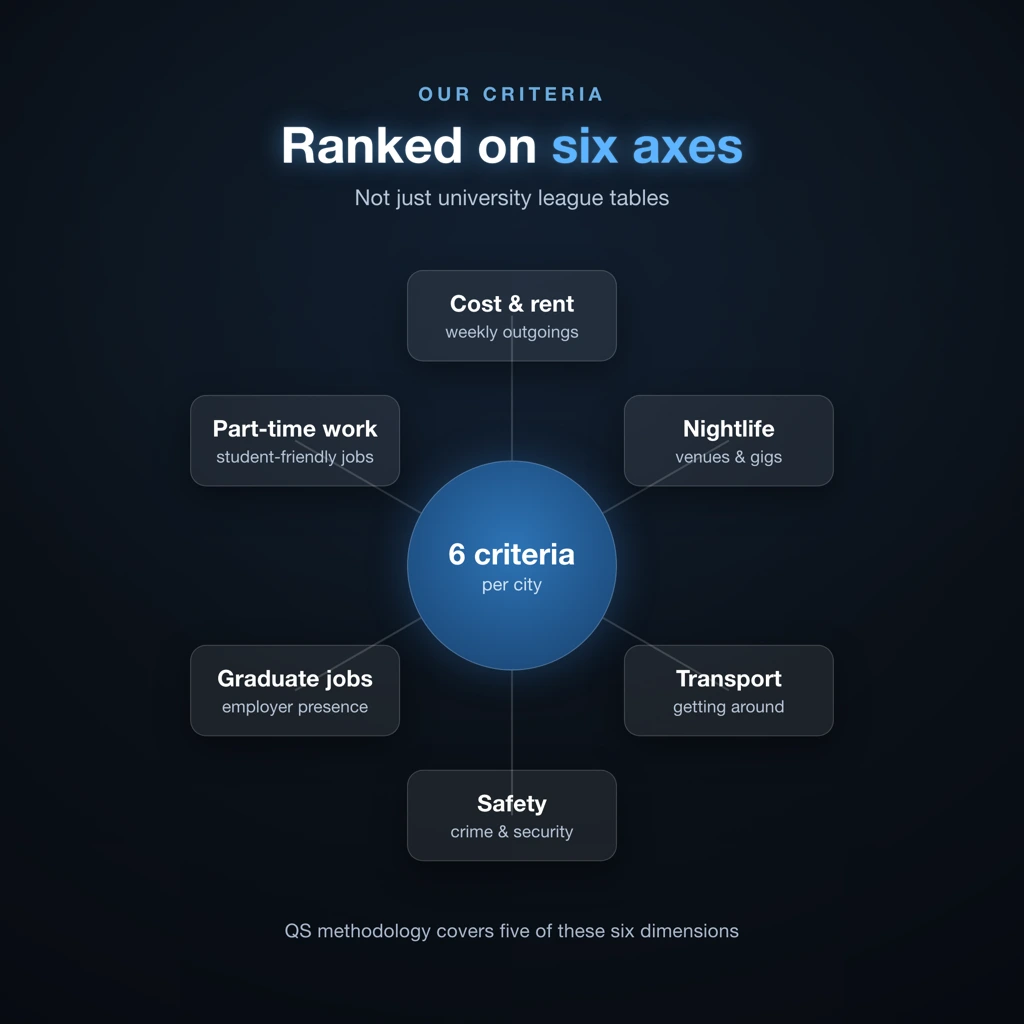
The best UK student cities are not always the ones with the most famous universities. London, for example, scores the maximum 100 points for university rankings in the QS Best Student Cities methodology, yet the same research describes its costs as "eye-watering." That gap between academic prestige and lived experience is exactly why this guide ranks cities across six separate axes rather than treating league tables as a shortcut.
The six criteria used throughout:
- **Cost of living and rent** - weekly outgoings, average room prices, and whether your loan covers the basics
- Nightlife and culture - venues, gig scenes, and what happens outside lecture hours
- Transport links - getting around the city cheaply, and reaching home without a four-hour journey
- Safety - crime rates and how secure students feel day-to-day
- Graduate job prospects - employer presence, graduate schemes, and local labour market strength
- Part-time work availability - the density of student-friendly jobs that fit around a timetable
The QS methodology covers five of these dimensions: institution rankings, student living quality, graduate employability, affordability, and student mix. That last category, which measures international diversity, is one most students never think to check. The counter-intuitive point is that a city can score 90-plus on student mix and still feel socially fragmented if the universities within it are geographically spread out.
Weight these criteria by your own situation. A student funding themselves through part-time work and a mature student choosing a city for post-graduation employment are optimising for completely different things.
2. How student living costs vary across UK cities
The city you choose can matter as much to your finances as the course you pick. Costs diverge sharply across the UK, and the gap between the cheapest and most expensive locations runs to hundreds of pounds a month.
**London is the clear outlier.** The government sets a higher maintenance loan rate for London students precisely because rents and transport eat so much more of a budget there. UCAS confirms that London and Brighton sit at the expensive end of the spectrum, where high demand from both students and non-students pushes landlords and letting agents to charge more. At the other end, Liverpool and Plymouth are among the cheaper options for rent, benefiting from lower local demand.
University accommodation itself ranges from roughly £115 to £175 per week, according to UCAS. En-suite rooms sit toward the top of that band; opting for a shared bathroom corridor is one of the fastest ways to cut accommodation spend without leaving halls entirely. Some halls also reduce fees if you remove your belongings during holiday periods, freeing the room for summer school or international students.
Glasgow is worth singling out as a counterintuitive case. UCAS notes that it is cheaper than London for both rent and public transport, but energy bills run higher because of colder average temperatures. That trade-off is easy to miss when comparing headline rent figures.
Beyond accommodation, the 2023 UCAS Student Lifestyle Report found students spend an average of £219 per week excluding rent, split roughly across essentials, lifestyle, and socialising. That baseline applies regardless of which city you are in, so the real variable when comparing locations is rent and commuting cost, not day-to-day spending.
3. City comparison table: rent, transport, social scene and graduate opportunity
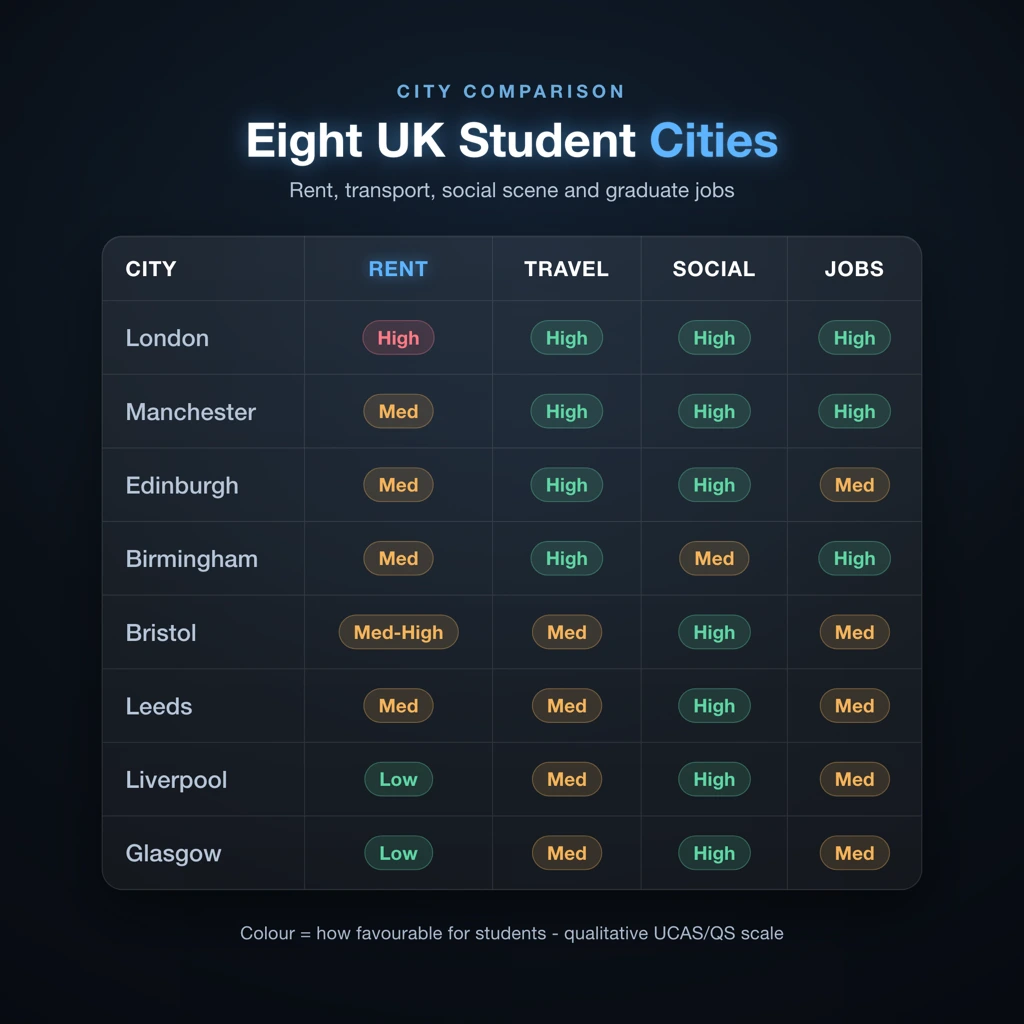
The table below scores eight cities across four axes using a three-point scale (High / Medium / Low). Rent descriptors are grounded in UCAS guidance, which specifically names London and Brighton as high-demand, high-cost cities, Liverpool as a lower-cost alternative, and Glasgow as cheaper than London for both rent and public transport. Social scene and graduate opportunity scores reflect positioning in QS Best Student Cities rankings, where London, Manchester, and Edinburgh each scored above 90 points for student mix.
| City | Rent level | Transport connectivity | Social scene | Graduate opportunity |
|---|---|---|---|---|
| London | High | High | High | High |
| Manchester | Medium | High | High | High |
| Edinburgh | Medium | High | High | Medium |
| Birmingham | Medium | High | Medium | High |
| Bristol | Medium-High | Medium | High | Medium |
| Leeds | Medium | Medium | High | Medium |
| Liverpool | Low | Medium | High | Medium |
| Glasgow | Low | Medium | High | Medium |
One counter-intuitive detail: UCAS notes that Glasgow's lower rent is partially offset by higher energy bills because of colder temperatures, so the headline cost advantage is smaller in winter than it first appears.
> Note: All rent descriptors reflect UCAS guidance and are qualitative. Check current university accommodation pages and local letting listings before using these as a planning figure.
4. Best student cities in the North of England
The North of England holds five Russell Group universities spread across Manchester, Leeds, Liverpool, Sheffield, and Newcastle. That concentration matters: Russell Group membership signals research funding, employer recognition, and graduate recruitment infrastructure that smaller cities rarely match.
Manchester is the North's largest graduate employment hub and the region's most internationally recognised student city. It ranked 25th in the QS Best Student Cities 2018, scoring over 90 for student mix, a figure that reflects the sheer volume and diversity of students across its universities.
Liverpool is one of the cheaper options for rent. UCAS specifically names it as a city where lower demand from non-students keeps rental costs down, making it a useful counterweight to Manchester's higher prices.
Sheffield, Leeds, and Newcastle each carry a distinct character:
- Sheffield is consistently noted for its compact layout, meaning students rarely need to spend much on transport.
- Leeds has a large part-time work market driven by its retail, hospitality, and financial services sectors, all within easy reach of the university campus.
- Newcastle's lower cost of living compared to London makes it one of the more financially manageable Russell Group locations in England.
One counter-intuitive trade-off: part-time work is genuinely easier to find in Manchester and Leeds than in smaller northern towns, but the higher competition for well-paid shifts in those cities can offset the wage advantage. If steady part-time income is a priority, check local hospitality and retail vacancy rates before committing to a city.
5. Best student cities in Scotland and Northern Ireland
Scotland and Northern Ireland run entirely separate student finance systems from England, which changes the cost calculation in ways that catch many applicants off-guard.
Scotland
Both the University of Edinburgh and the University of Glasgow are Russell Group members, giving Scotland two research-intensive universities in the same country. Edinburgh ranked 16th in the QS Best Student Cities 2018, the highest-placed UK city outside London, and 32nd in an earlier QS ranking. That reflects a genuine mix of academic reputation, student life, and cultural offer.
On cost, the practical advantage is real. Scottish university hall rents are frozen, which puts them below the pressure facing English cities. Glasgow specifically is cheaper than London for both rent and public transport, though energy bills run higher because of colder temperatures. That heating cost is the counter-intuitive trade-off students from warmer regions miss.
Scottish domiciled students also pay no tuition fees, but English students studying in Scotland pay the standard fee rate, so the frozen hall rents matter more to them than the fee structure does.
Northern Ireland
Queen's University Belfast is Northern Ireland's only Russell Group institution, making Belfast the region's sole Russell Group city. The cost picture is shifting: Northern Irish maintenance loans are increasing by 40%, a significant jump that improves affordability for students from the region.
As with Scotland, the student finance rules in Northern Ireland differ from England's system, so check the relevant funding body directly before comparing loan amounts with friends applying through Student Finance England.
6. Best student cities in the Midlands, South and Wales
The cities in this region split into two distinct cost tiers. Birmingham and Nottingham sit at the affordable end, while Oxford, Cambridge, Bristol, and Exeter carry price tags closer to London.
Birmingham and Nottingham are the Midlands' two Russell Group host cities. Both offer large graduate employment markets and lower rents than their southern equivalents, which makes them practical choices for students watching their budget. Nottingham has two major universities in close proximity, which keeps the social scene competitive and tends to hold private rental prices down.
Oxford and Cambridge are the counterintuitive cases. Oxford's prestigious reputation often draws students who haven't fully priced up the city. Cambridge is more transparent: the University publishes estimated monthly living costs of £1,305 for 2026-27, covering accommodation, food, and social activities, based on Bank of England inflation forecasts calculated in May 2025. Most Cambridge students walk or cycle rather than use public transport, which keeps that line item low, but the accommodation figure of £865 per month is not negotiable downward in the way a private rental in Birmingham might be.
Bristol and Exeter anchor the South West. Both are Russell Group universities in cities with strong cultural reputations, though Bristol's rent costs have risen sharply in recent years as the city's popularity has grown beyond its student base.
Cardiff is the sole Russell Group member in Wales, offering lower living costs than most English equivalents and a bilingual city environment that some students find genuinely distinctive.
Southampton is a major port city with strong transport connections, a Russell Group university, and proximity to London without London prices.
7. Graduate job prospects and part-time work by city
London dominates the UK graduate jobs market. QS identified London's jobs market as a key ranking factor when placing it first globally in the 2018 Best Student Cities rankings, and that concentration of employers has not thinned since. The trade-off is well documented: QS research director Ben Sowter described London's costs as "eye-watering," so a graduate salary offer that looks generous can erode quickly once rent is factored in.
Outside London, Manchester, Edinburgh, Bristol, Birmingham, and Leeds have the broadest spread of graduate recruiters, covering finance, tech, media, and professional services. Students in smaller cities and market towns often find the part-time term-time job market noticeably thinner, particularly for roles beyond retail and hospitality.
One counter-intuitive trade-off worth knowing: a city with a strong graduate market does not automatically have strong student part-time work. London has both, but a mid-sized university city with one dominant employer sector can leave students competing hard for the same handful of weekend shifts.
If the city's job market feels thin, degree apprenticeships are worth considering as a structural alternative. Per UCAS, they cover tuition fees in full and pay a salary while you study and work inside a company, which removes the city's cost-of-living equation from the calculation almost entirely.
Check the UCAS degree apprenticeships search to see which employers recruit from your preferred city before you apply.
8. Factors students overlook when choosing a city
The ranking criteria that dominate most "best uk student cities" comparisons cover rent and nightlife. These four factors rarely appear in the same conversation, and they can reshape a budget more than a £50 monthly rent difference.
Travel home adds up fast. A student in Glasgow visiting family in London might spend more on train or National Express coach fares across three years than a student who chose a city two stops from home. Price that before accepting an offer, not after.
Some university towns hollow out in summer. Smaller cities where students make up a large share of the population can lose cafes, bars, and even GP appointment availability once term ends. If you plan to stay over holidays for work or resits, check what actually remains open.
Distance from campus erodes cheap rent. A room 40 minutes from lectures that saves £80 a month can cost that back in bus or rail fares, plus the time. Factor in weekly transport before comparing listings side by side.
Northern heating bills are a real line item. UCAS notes that Glasgow is cheaper than London for rent and transport, but energy bills run higher because of colder temperatures. The same applies across northern cities generally.
Check whether the city has a cultural calendar that runs year-round. A city with independent venues, galleries, and a non-student residential population tends to stay livelier when term ends, which matters if you are staying put.
9. What international and IB students should weigh up
City choice carries extra weight if you are arriving from abroad. The financial gap alone is significant: UCAS estimates international students pay around £11,000 per year in tuition fees (some courses reach £30,000) on top of living expenses of £8,000 to £11,000 per year. That total is before you account for flights home.
Airport access is worth mapping before you accept an offer. London Heathrow, Manchester, Birmingham, and Edinburgh are the four main international hubs in the UK. A student based in Newcastle or Exeter may face a two-hour journey just to reach a long-haul departure gate, which adds cost and time every holiday. If you fly home several times a year, the city nearest your route can save you hundreds of pounds.
Social integration is easier in some cities than others. London, Manchester, and Edinburgh all scored above 90 in the student mix category of the QS Best Student Cities rankings, according to the BBC's coverage of the QS list. That reflects a high proportion of international students, which typically means established communities, multilingual services, and a wider range of cuisine.
One detail many students miss: the cost of everyday life can feel steep if you arrive from a lower-cost economy. UCAS puts a meal out at £10 to £20 and a single bar drink at £5 or more. Cheaper cities for rent do not always mean cheaper social spending.
On healthcare, students studying in the UK for six months or more currently receive free NHS treatment, but dental care requires payment regardless. If you need regular specialist or dental treatment, check what is available near your campus before choosing a city.
10. Where to go from here
City choice is one of the few decisions in your application that you control entirely before you submit to UCAS. Most students spend more time debating course modules than they do comparing the cities those courses are in, which is a mistake worth avoiding.
This week, narrow your shortlist to three cities using the comparison table in section 3, weighing the costs, transport links, and graduate markets that matter most to your situation. Then browse the UK Universities directory to filter institutions by city and region, so you can match specific universities to the locations you have already ranked.
One non-obvious step: check whether your preferred city has a high student-to-rental-property ratio. In some mid-sized cities, strong universities sit inside tight private rental markets, which pushes up costs faster than headline averages suggest. Filter by city, read the individual university pages, and shortlist your three before applications open.
FAQ
Which city is best for students in the UK?
There is no single answer - London ranks highest globally in QS Best Student Cities but is the most expensive; Manchester and Edinburgh offer a strong balance of university quality, student community, and lower costs.
Is London a good city for students?
London ranked 1st globally in QS Best Student Cities 2018 and hosts five Russell Group universities, but QS itself described its costs as 'eye-watering', and the government sets a higher maintenance loan rate for London students to partly offset this.
What are the cheapest cities for students in the UK?
UCAS guidance identifies Liverpool and Plymouth as cities where rent costs less due to lower demand, while Scottish university hall rents are frozen, making Glasgow and Edinburgh comparatively affordable.
Where is the safest place to study in the UK?
Smaller university cities and market towns - such as Durham, Exeter, and St Andrews - are generally considered lower-crime environments than large metropolitan centres, though all major UK student cities have areas that are safer than others.
What do international students need to consider when choosing a UK city?
International students should factor in airport links for travel home, the cost gap between their home country and UK living expenses (UCAS estimates living costs at £8,000-£11,000 per year), and whether the city has a large established international student community.
Which UK cities have the best student nightlife?
Manchester, Leeds, Bristol, Edinburgh, and London are consistently cited for nightlife; Manchester and Leeds in particular have large student populations and well-established music and club scenes that remain active year-round.
References
- London ranked top city for students - BBC News - https://www.bbc.co.uk/news/business-44039666
- How much does uni or college cost? | UCAS - https://www.ucas.com/money-and-student-life/money/budgeting/how-much-does-uni-or-college-cost
- Paris beats London to best student city title again - BBC News - https://www.bbc.co.uk/news/education-25008326
- Our universities | Russell Group - https://www.russellgroup.ac.uk/our-universities
- What to do if your student finance isn’t enough | UCAS - https://www.ucas.com/money-and-student-life/money/budgeting/what-to-do-if-your-student-finance-isnt-enough
- Living costs | Undergraduate Study - https://www.undergraduate.study.cam.ac.uk/fees-funding/living-costs
- Moving To The UK For Postgraduate University Courses | UCAS - https://www.ucas.com/postgraduate/international-students/moving-and-living-uk