Studying at University in London: Is It Worth It?
By Michael Thompson · Former IB Diploma Programme coordinator; 10 years at Bromsgrove School · Published 5 July 2026
Studying at university in London puts you in a city of nearly 9 million people, over 400,000 fellow students, and some of the world's most recognisable university brands - but it also puts you in one of the most expensive places to live in the UK. The maintenance loan does pay more for London students, yet average rent for purpose-built student accommodation in London ran to £13,595 in 2024-25, which quickly absorbs the difference. This guide runs an honest comparison across three axes - cost, opportunity, and everyday experience - so you can weigh London against a non-London university city with clear numbers rather than reputation. By the end you should know whether London's advantages apply specifically to you, or whether you'd be paying a premium for things you won't actually use.
Key Takeaways
- Higher maintenance loan, but higher costs too: The London loan band is larger than the standard rate, but average London student accommodation alone cost £13,595 in 2024-25, meaning the extra money rarely closes the gap.
- Employer density is a real advantage during study: London's concentration of employers means internships and part-time roles in your chosen field are more accessible while you're still enrolled, not only after graduation.
- Campus life is more dispersed: Most London universities are spread across multiple sites and central boroughs, so the tight campus-community feel common in smaller cities is harder to replicate.
- International and IB students have particular reasons to choose London: Five airports, established international communities, and globally recognised university names make London the default for many overseas applicants - though the cost premium still applies.
- Graduate earnings differ sharply by region: According to the Office for Students, graduates working in London earn an average of £40,000 compared with £29,000 for those in the north east - though this reflects London's overall wage structure, not a pure London-degree effect.
- Commuter students face a distinct set of trade-offs: Living at home to cut costs can save significantly on rent but adds transport costs, longer days, and reduced access to the social and spontaneous side of university life.
In This Article
- The Core Trade-Off: Cost, Opportunity and Everyday Experience
- London vs a Typical UK University City: The Numbers at a Glance
- London's Genuine Advantages: Employers, Internships and Opportunity During Study
- The Downsides Students Underestimate: Commutes, Costs and Campus Culture
- Why International and IB Students Choose London - and What It Costs Them
- Commuter Student vs Halls Student in London: Two Very Different Experiences
- Where to Go From Here
1. The Core Trade-Off: Cost, Opportunity and Everyday Experience
Studying at university in London is a genuine trade-off, not a straightforward upgrade on studying elsewhere. This article looks at that trade-off across three axes: cost, opportunity, and everyday experience. None of the three can be read in isolation, and the answer to "is it worth it?" depends heavily on which axis matters most to you.
The central tension is this: **London students face higher living costs, and the maintenance loan system only partially compensates for that.** The government does pay a higher maintenance loan to students living away from home in London than to those studying elsewhere, but the gap between the loan and actual living costs remains wide. The Higher Education Policy Institute calculated that students in London need around £77,000 over a three-year degree to reach a minimum socially acceptable standard of living, excluding tuition fees. The national figure is £61,000, a difference of £16,000. BBC News reports both estimates.
The non-obvious part: that £16,000 gap is a floor, not a ceiling. It assumes minimum spending. Students who choose to live in purpose-built accommodation, rather than cheaper private lets, can close or widen that gap quickly depending on which borough they end up in.
The sections below work through each axis with specific numbers and named institutions, so you can assess the decision on your own terms.
2. London vs a Typical UK University City: The Numbers at a Glance
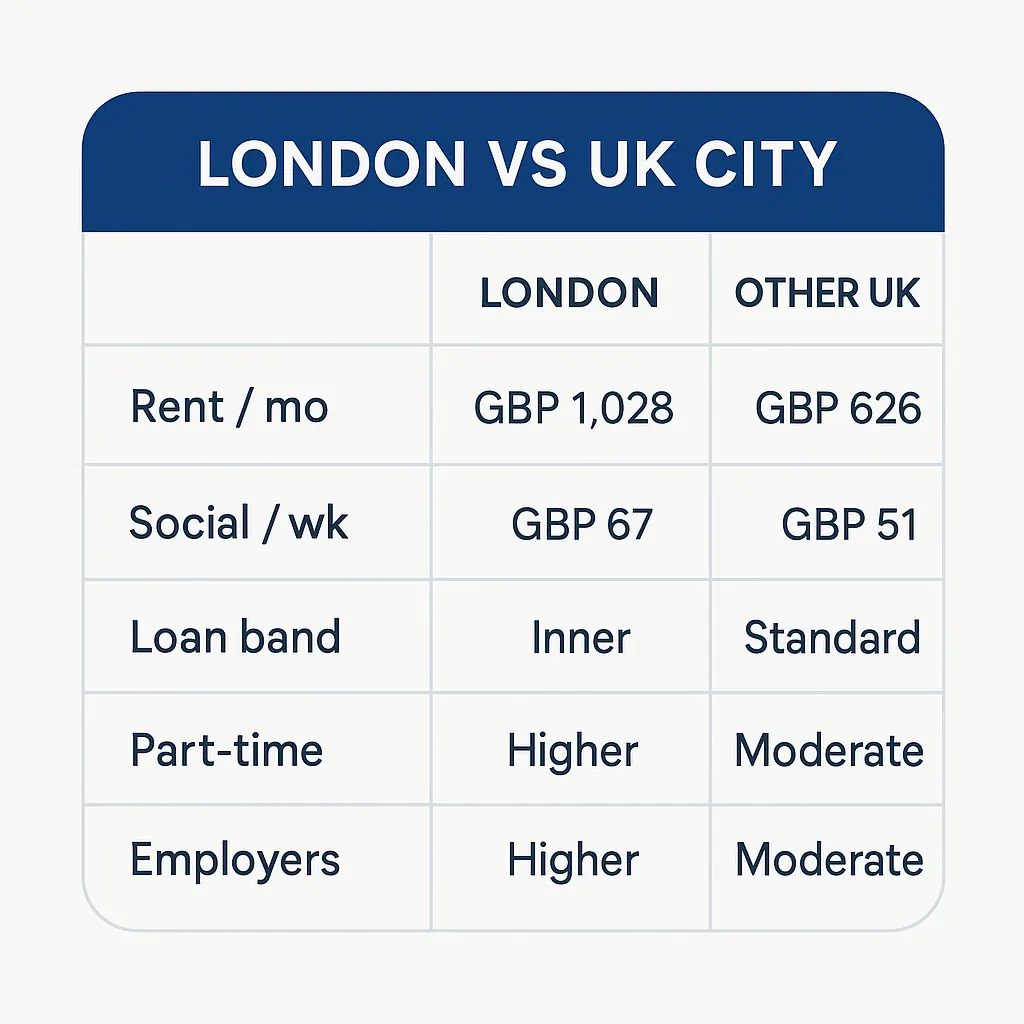
The gap between London and the rest of the UK is bigger than most applicants expect, and it compounds across every spending category at once. A student who budgets carefully in Manchester or Leeds will still spend significantly more doing the same things in London.
| Factor | London | Non-London UK City |
|---|---|---|
| Average student accommodation (annual) | £13,595 (BBC/HEPI) | ~£5,000/yr based on £418/month average rent (UCAS) |
| Weekly living spend (excl. rent) | Higher end of national range | ~£219/week average (UCAS) |
| Maintenance loan band | Higher London rate (check gov.uk for current figure) | Up to £10,830 in 2026-27 (BBC) |
| Part-time work availability | High, but wages often absorbed by costs | Varies; lower costs mean earnings stretch further |
| Internship and employer access | Dense, especially finance, law, media, tech | Strong regionally; fewer head-office roles |
One figure worth sitting with: HEPI calculated that a London student needs £77,000 across a three-year degree for a minimum acceptable standard of living, against £61,000 nationally, both excluding tuition fees (BBC). That £16,000 gap is not explained by nightlife. It is accommodation, transport, and the everyday cost of a high-density city.
The non-obvious trap is the maintenance loan. The government sets a higher London rate precisely because costs are steeper, but the London uplift rarely closes the full gap. Check both figures on gov.uk before assuming the loan covers your shortfall.
3. London's Genuine Advantages: Employers, Internships and Opportunity During Study
The earnings gap between London graduates and those elsewhere is real, but it needs interpreting carefully. Per the Office for Students, graduates working in London earn an average of £40,000 compared with £29,000 for graduates in the north east. That gap reflects London's broader wage geography as much as any prestige attached to a London degree. A graduate from Newcastle who moves to London after finishing their course will access similar salary bands. The practical upside of studying in London is different: you are already there, which matters most during the degree itself.
Proximity to employers is most valuable while you are still a student. Finance, law, media, tech, arts, and public policy are all disproportionately concentrated in London. That concentration means internships, insight days, and part-time roles are accessible by Tube rather than by relocation. A law student at King's College London can attend a City firm open day on a Wednesday afternoon and be home by dinner. The same opportunity for a student in a smaller university city often requires an overnight trip and a train fare.
The non-obvious trade-off: London's employer density also means competition is fiercer. Every first-year at every London university is chasing the same Goldman Sachs spring week.
On course breadth, UCAS profiles for London show students studying AI, Data Science, Law, BSc Nursing, Public Relations, and Graphic and Media Design across institutions including King's College London, University of the Arts London, and Northeastern University London. That range of specialist provision in a single city is unusual.
For international students and those with families abroad, London's five airports (Heathrow, Gatwick, Stansted, Luton, and City) alongside major terminals including St. Pancras and Waterloo make travel significantly more straightforward than from most other UK university cities.
4. The Downsides Students Underestimate: Commutes, Costs and Campus Culture
The social life at most London universities looks different from the quad-and-union model you see in prospectus photos. **Most London institutions are spread across several sites in different boroughs**, so your seminar might be in Bloomsbury, your lab in Whitechapel, and your flatmate's lectures in Elephant and Castle. That fragmentation makes it harder to build the incidental, repeated contact with the same group of people that forms the backbone of social life at a contained campus. Students who haven't experienced it tend to underestimate how much energy it takes to maintain.
Commute time compounds the problem. Even with a reasonable Tube connection, the daily triangle between accommodation, campus, and a part-time job eats into the hours that, elsewhere, students spend in the union bar or the library. The non-obvious gotcha: Oyster pay-as-you-go fares within Zone 1-2 cost more per week than many students budget for when they're modelling their finances before arrival.
The money pressures are real and not evenly distributed. Weekly socialising spend averages £76 nationally, split across eating out, takeaways, and alcohol, according to UCAS. London prices for those same categories run noticeably higher than the national average. Average rent for purpose-built student accommodation in London reached £13,595 for the 2024-25 academic year, according to BBC News, which works out at over £260 per week. Rooms at that price point in London are typically smaller than equivalent costs elsewhere.
Paid work is an increasingly common response. Hepi's 2026 student survey, cited by BBC News, found 65% of full-time undergraduates were in paid employment during term time, up from 45% in 2022. In London, where the financial pressure is particularly acute, that figure is likely higher still. Working term-time hours to cover rent leaves less time for the societies, networking events, and spontaneous experiences that are supposed to define the university years.
5. Why International and IB Students Choose London - and What It Costs Them
For international students, the financial picture is structurally different from the start. UCAS puts average international undergraduate tuition in the UK at around £22,000 per year, with a range of £11,400 to £38,000. International non-EU students are unlikely to qualify for a UK Government student loan, so there is no income-contingent safety net of the kind domestic students rely on.
London still draws a disproportionate share of international applicants, for reasons that are practical as much as reputational. The city is served by five airports: Heathrow, Gatwick, Stansted, Luton, and City Airport, per the UCAS London city guide. No other UK university city comes close for flight connections, which matters when a student from Hong Kong or Lagos is weighing up whether they can realistically get home for term breaks without a £400 connection through Amsterdam.
The brand pull of institutions like UCL, LSE, and King's College London is also real. For families in countries where a handful of university names carry outsized recognition, the perceived risk of choosing an unfamiliar city falls sharply when the institution itself is well-known.
The non-obvious cost problem is the compounding effect. An international student at a London university faces higher-than-average tuition fees AND higher-than-average living costs, with no government loan to bridge either gap. The main mitigations are Chevening Scholarships, which support students with academic potential, and university-specific awards. UCAS notes that scholarships can cover tuition in full or contribute to living costs, but they are competitive and far from guaranteed. Budgeting for London without one means finding a realistic answer to both cost lines before accepting an offer.
6. Commuter Student vs Halls Student in London: Two Very Different Experiences
How you live in London shapes your degree as much as where you study. The split broadly falls into two camps: students living in halls or private rented accommodation close to campus, and students commuting from a family home in outer London or the home counties.
**Commuting cuts your rent bill but trades it for transport costs and time.** TfL Oyster and contactless fares accumulate fast without a railcard or institutional student discount, and a daily Zone 1-3 return can exceed £10 before any other spending. Add two hours of travel and an evening lecture becomes genuinely difficult to attend.
Halls students pay more in absolute terms. Purpose-built student accommodation in London averaged £13,595 for the 2024-25 academic year, according to BBC News, which is roughly £1,133 per month. In return, they get proximity to campus social life, spontaneous study groups, and no real barrier to staying late for events.
The less obvious trade-off: many London universities carry a higher share of commuter students than campus-based universities elsewhere in the UK. That shapes the social dynamic in a specific way. Quieter common rooms after 5pm, fewer spontaneous mid-week gatherings, and a social calendar that clusters around lunchtimes rather than evenings are consistent features of commuter-heavy institutions, regardless of how good the university itself is.
If you are weighing the commuter route, calculate your annual TfL spend before assuming it is the cheaper option.
7. Where to Go From Here
London suits students who will actively use what the city offers during their degree, not those drawn by name recognition alone. A less prominent university in a cheaper city can produce a stronger outcome if you actually show up, get involved, and leave with work experience. The counter-intuitive gotcha: students who commute long distances to a prestigious London address often have less time for the internships and networking that made London attractive in the first place.
This week, open the UK universities directory and shortlist three London universities alongside three non-London alternatives. For each one, map it against the cost and opportunity axes covered in the comparison table above: what does rent realistically cost near that campus, and what sector employers recruit there directly?
Start that shortlist now, before UCAS choices narrow your options.
FAQ
Is studying at university in London worth it?
It depends on your subject and career target - London's employer density and transport links offer real advantages during study for students in law, finance, media, and tech, but the higher cost of living means you pay a premium that only makes sense if you actively use what the city offers.
How much does it cost to study in London?
Average purpose-built student accommodation in London cost £13,595 in 2024-25, and HEPI calculated that London students need around £77,000 over a three-year degree for a minimum standard of living excluding tuition - significantly more than the £61,000 national figure; check gov.uk for current maintenance loan bands.
Does the higher London maintenance loan cover the extra cost of living?
Not fully - the London loan band is higher than the standard rate, but accommodation and transport costs in London are typically high enough that the gap between loan and actual expenditure remains wider than in most other UK cities.
Can international students get financial support to study in London?
International non-EU students are generally not eligible for UK Government student loans, but Chevening Scholarships, Commonwealth Scholarships, and some university-specific bursaries can cover tuition and living costs - UCAS lists the main options at its international finance page.
Which London universities are best for law or medicine?
King's College London, UCL, and the London School of Economics are among the most established for law, while King's College London, UCL, and Imperial College London are leading providers for medicine - the /universities directory lets you compare entry requirements and course details directly.
What is the difference between a London university and the University of London?
The University of London is a federal body that historically grouped institutions such as King's College London, UCL, and LSE under one umbrella; today most of those institutions award their own degrees independently, so 'studying at a London university' and 'studying at the University of London' are no longer the same thing.
References
- How much are tuition fees in the UK and is university worth it? - BBC News - https://www.bbc.co.uk/news/articles/cwyegp0dnq9o
- How much does uni or college cost? | UCAS - https://www.ucas.com/money-and-student-life/money/budgeting/how-much-does-uni-or-college-cost
- Place matters: Inequality, employment and the role of higher education - Office for Students - https://www.officeforstudents.org.uk/publications/place-matters-inequality-employment-and-the-role-of-higher-education
- London student life - UCAS city guides - https://www.ucas.com/study-in/study-in-london
- What finance options are available if I want to study in the UK? | UCAS - https://www.ucas.com/international/international-students/financial-information-for-international-students/what-finance-options-are-available-if-i-want-to-study-in-the-uk