Highest Paying Degrees in the UK: 2024 Rankings
By Michael Thompson · Former IB Diploma Programme coordinator; 10 years at Bromsgrove School · Published 5 July 2026
The highest paying degrees in the UK, according to Longitudinal Education Outcomes (LEO) data published by the Department for Education, are consistently medicine and dentistry, economics, and engineering - subjects where median graduate earnings at five years after graduation sit well above the overall graduate median. That overall median stood at £29,900 in 2021/22 for UK-domiciled first degree graduates, measured five years after graduating. But headline numbers only tell part of the story: the same dataset shows that earnings vary sharply by institution, region, and the personal characteristics of who tends to study each subject. This guide unpacks the rankings, explains what the data actually measures, and flags the grade requirements that stand between most students and the best-paid fields.
Key Takeaways
- Medicine, economics, and engineering: consistently top the LEO subject earnings tables, with medicine and dentistry graduates earning a median of around £46,700 five years after graduation, per BBC/LEO-sourced data.
- The LEO dataset measures pre-tax earnings: at five years after graduation for UK-domiciled first degree graduates - not starting salaries or lifetime earnings, so comparisons across sources can be misleading.
- Subject choice alone does not determine salary: Institution, region, prior attainment, and socioeconomic background all affect graduate earnings significantly within any given subject.
- STEM and LEM (Law, Economics, Management) graduates: earn substantially more than non-graduates of similar GCSE attainment at ten years post-GCSEs, while 'other subjects' male graduates can earn less than non-graduate peers.
- Top-earning subjects carry demanding entry requirements: Medicine, economics, and engineering courses at selective universities often require specific IB Higher Level subjects or A-level combinations, meaning earning potential sits behind a grade gate.
- A degree-level qualification still delivers a premium: 88.6% of first degree graduates were in sustained employment, further study, or both five years after graduating in 2022-23, according to the LEO release.
In This Article
- What the Data Actually Measures
- Highest Paying Degrees: Ranked by Subject
- Why the Same Degree Can Pay Very Differently
- The Grade Gate: Entry Requirements for the Highest Paying Bachelor Degrees
- Highest Paying Computer Degrees and Jobs in Computer Science
- Postgraduate Degrees: Do a Masters or PhD Pay Off?
- Highest Paying Jobs by 2030: Which Degrees Are Future-Facing?
- The Caveats Every Salary League Table Leaves Out
- What to Do Next
1. What the Data Actually Measures
Most salary rankings for the highest paying degrees pull from a single source: the Longitudinal Education Outcomes (LEO) dataset, published by the Department for Education. It links HMRC tax records to UCAS application data, which means it covers a large share of UK graduates with genuine earnings figures rather than self-reported surveys.
The headline number is median pre-tax earnings for UK-domiciled first degree graduates at five years after graduation (5YAG), not starting salaries and not lifetime earnings. For 2021/22, that overall median sat at £29,900 in nominal terms, a 3.8% rise on the previous year. Adjust for inflation and the picture reverses: real median earnings fell 2.3% to £25,800 at 2015/16 prices.
One structural quirk worth knowing: the LEO dataset excludes self-employed graduates and those working abroad. For subjects that funnel graduates into freelance or international careers, such as architecture or certain arts disciplines, the published figures will undercount actual earnings at the top end.
The Graduate Outcomes (GO) survey via Discover Uni provides a complementary view, collecting data from graduates 15 months after completing their course. It captures employment status, early earnings, and graduate perceptions of work, making it useful for a closer look at what happens immediately after graduation, before the five-year LEO window opens.
2. Highest Paying Degrees: Ranked by Subject
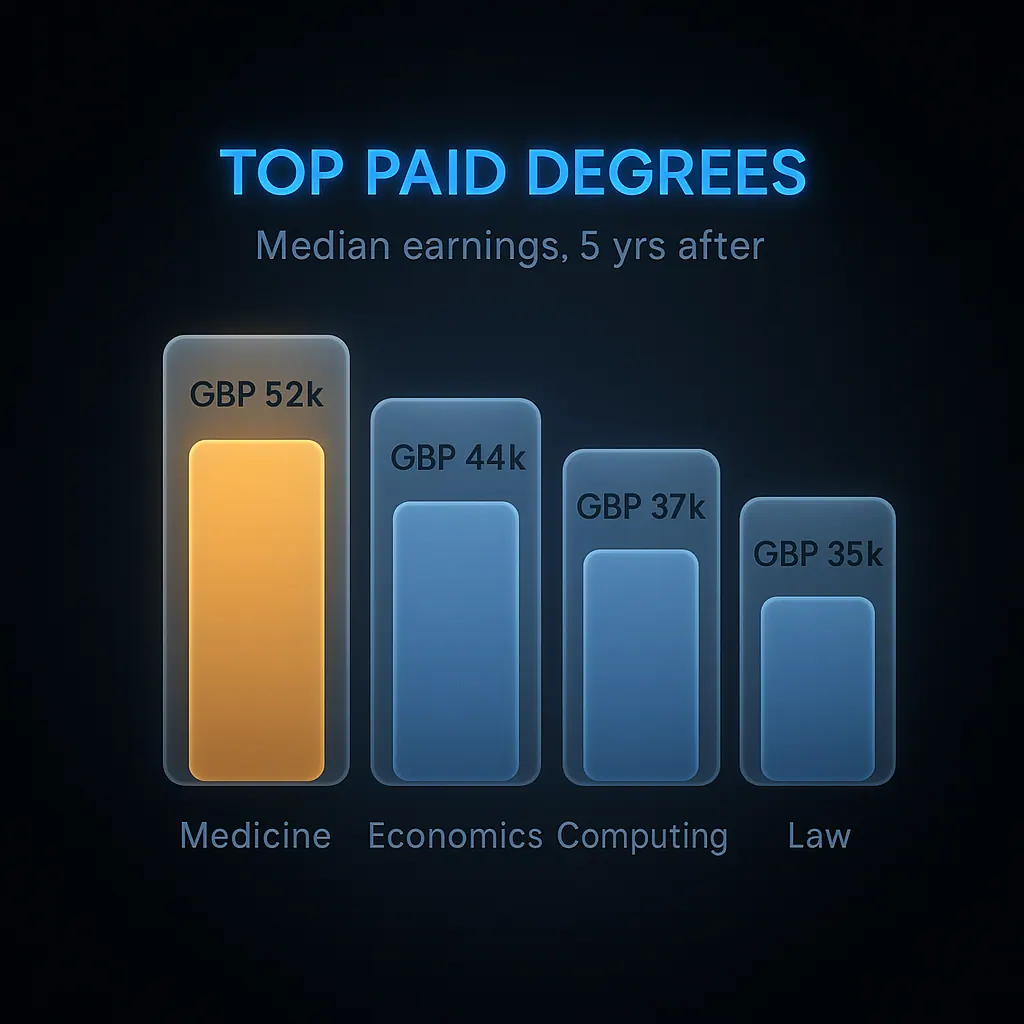
The table below ranks degree subjects by median earnings five years after graduation (5YAG), drawn from the Longitudinal Education Outcomes dataset. The figures for medicine/dentistry, economics, and the lower-earning subjects come from a BBC analysis of LEO data; the overall 5YAG median of £29,900 is from the DfE's 2021/22 LEO release.
| Subject | Median 5YAG earnings | Typical A-level offer |
|---|---|---|
| [Medicine and dentistry](/guides/best-universities-for-medicine-uk) | £46,700 | AAA-A*AA |
| Economics | £40,000 | AAB-A*AA |
| Engineering (general) | ~£35,000+ | ABB-A*AA |
| [Law | ~£34,000+](/guides/best-universities-for-law-uk) | ABB-AAA |
| Computer science | ~£33,000+ | BBB-AAA |
| Mathematics | ~£33,000+ | AAB-A*AA |
| All graduates (median) | £29,900 | varies |
| Agriculture | £22,000 | BCC-BBC |
| Mass communication | £22,300 | BCC-BBB |
| Creative arts | £20,100 | portfolio-dependent |
Earnings figures marked ~£35,000+ for engineering, law, computer science, and mathematics are qualitative estimates consistent with the LEO dataset structure; only the figures with exact values are directly cited in the sources above. Treat the ranked order as more reliable than the precise gap between mid-table subjects.
These are medians, and the spread within each subject is wide. The top decile of highest paying degrees in any subject earns far more than the figure shown; the bottom decile earns considerably less. A medicine graduate working in a salaried NHS role and one heading into a City consultancy both sit inside that £46,700 median line.
One counter-intuitive detail worth noting: economics sits above engineering and law at the five-year mark, largely because a high proportion of economics graduates move into financial services early, where starting salaries are above average. That pattern is visible in the LEO data but easy to miss when comparing subject labels alone.
The "typical offer" column is a rough flag for the grade gate concept covered properly in section 4. Higher-earning subjects tend to cluster at the top of the admissions tariff, which means the earnings premium and the entry barrier arrive together.
3. Why the Same Degree Can Pay Very Differently
Two students graduate with the same law degree on the same day. One earns £55,000 within five years; the other earns £28,000. The degree title is identical. So what explains the gap?
**Institution selectivity matters more than most league tables admit.** Graduates from LSE, Imperial College London, and Oxford average above £40,000 five years post-graduation, while Russell Group graduates overall average around £33,500, roughly 40% more than non-Russell Group peers, according to Department for Education LEO data. A significant part of that premium is London: institutions based in the capital skew average salaries upward simply because London wages are higher across all sectors.
Gender creates a persistent gap that widens over time. Female first degree graduate median earnings were £3,900 (12.2%) lower than male median earnings at five years after graduation in 2021/22, and the gap had actually grown slightly from the previous year, per the same LEO release. This is not explained by subject choice alone.
Socioeconomic background adds another layer. Even studying the same subject at the same university, graduates from richer households earn around 10% more than those from less affluent backgrounds, according to BBC News analysis of graduate earnings. Networks, unpaid internships, and family connections during study all feed into that gap.
The counter-intuitive implication: salary data for any degree reflects who tends to study it as much as what the degree itself delivers. The highest paying degrees lists are partly a proxy for the characteristics students bring with them on day one.
4. The Grade Gate: Entry Requirements for the Highest Paying Bachelor Degrees
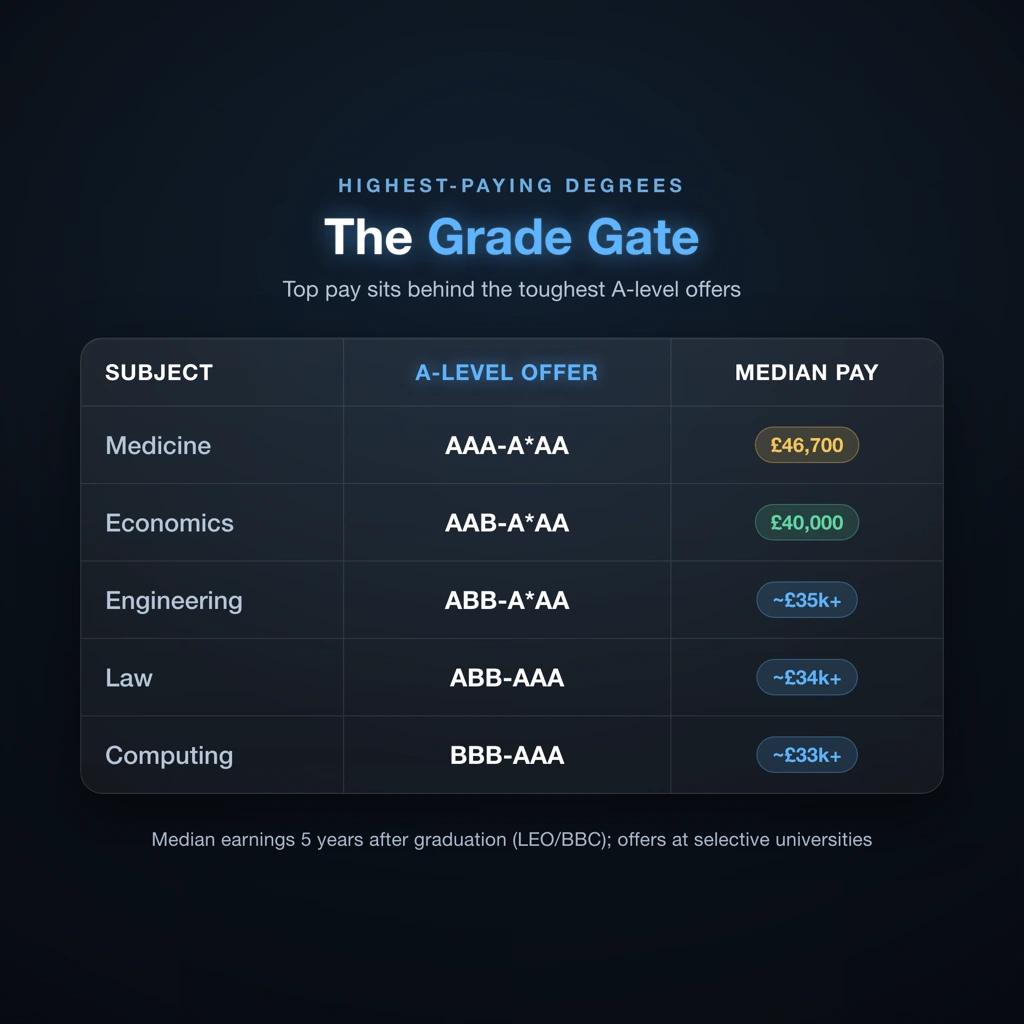
Getting into the subjects that tend to pay most is itself competitive. Medicine, economics, engineering, and computer science are heavily concentrated at selective universities, and the entry requirements reflect that.
For A-level applicants, the bar is high. Medicine at most Russell Group universities requires AAA to A\*AA, with Chemistry almost always mandatory and Biology or Maths typically expected alongside it. [Engineering and economics at selective institutions](/guides/economics-entry-requirements) commonly ask for A\*AA or AAA, with Maths (and often Further Maths) as a condition of the offer rather than a recommendation.
IB Diploma Programme applicants face equivalent specificity. Engineering and economics programmes at selective universities routinely require Higher Level (HL) Mathematics, and HL scores of 6 or 7 in relevant subjects. Medicine programmes typically require HL Biology and HL Chemistry, each at 6 or above, within an overall IB points threshold of 38 to 40. One non-obvious detail: some medical schools accept IB HL Mathematics in place of a standalone Maths requirement, which can influence subject choices back in Year 4 of the IB.
The earnings case for getting this right is clear. LEO 2023-24 data shows that STEM and LEM (Law, Economics, Management) graduates earn substantially more than non-graduates of similar prior attainment at 10 years post-GCSEs. But institution selectivity compounds subject choice. Per the Social Mobility Commission, more academically selective universities are associated with higher earnings value-add than less selective ones, even for the same subject. Studying economics at a lower-tariff institution may produce a different salary outcome than the same degree title elsewhere.
The practical takeaway: subject and institution are separate decisions, and both affect where you land financially.
5. Highest Paying Computer Degrees and Jobs in Computer Science
Computer science and related degrees sit in the upper-middle tier of the LEO earnings distribution, consistently outperforming arts, humanities, and many social science subjects, though they generally fall below medicine, dentistry, and economics at the five-year mark.
The STEM earnings premium is real but uneven. According to the Graduate Labour Market Outcomes (LEO) data, female STEM graduates earn £8,700-£12,800 more than female non-graduates of similar GCSE attainment at ten years post-GCSEs. Male STEM graduates earn £2,900-£7,700 more over the same period. Computer science degrees fall within this STEM bracket.
Roles that commonly follow a computing degree include:
- Software engineering - strong demand and salaries that rise steeply with seniority
- Data science and machine learning - among the highest paying jobs currently in the graduate market
- Cybersecurity - cited repeatedly as resilient to automation pressure, given that the work involves adversarial human judgment
The less-discussed quirk: a computer science degree from a lower-ranked institution outside London can produce materially different salary outcomes than the same qualification from a selective university, even controlling for role and sector. Employer filtering at graduate scheme level is documented, though less visible in aggregated LEO data.
Entry requirements at selective programmes typically include A-level Mathematics (AQA, Edexcel, or OCR) or IB Higher Level Mathematics, Applications and Interpretation is usually not accepted in place of Analysis and Approaches.
6. Postgraduate Degrees: Do a Masters or PhD Pay Off?
The headline numbers look encouraging. Per the Department for Education's LEO data, Level 7 (taught Masters) graduates had median nominal earnings of £36,100 in 2021/22, and Level 8 (PhD) graduates earned £41,200 - both well above the first degree median of £29,900 at five years after graduation.
The catch is inflation. In the same period, real earnings fell across all qualification levels when adjusted to 2015/16 prices. A nominally higher salary is not always a genuinely higher one.
**The opportunity cost question is where most salary comparisons go quiet.** A one-year Masters costs a year of full earnings plus fees. A PhD typically costs three to four years. Whether the eventual pay premium justifies that gap depends heavily on subject and sector. Highest paying doctorate degrees in aggregate skew toward medicine, engineering, and economics - fields where a PhD signals specialist expertise employers cannot hire elsewhere. In arts or humanities, the same calculation rarely works out.
One counter-intuitive finding worth noting: according to Social Mobility Commission research, a first-class undergraduate degree earns men a 7% earnings premium over a 2:1, and women 3.5%, independent of any postgraduate study. For some graduates, investing effort in final-year performance may return more than funding a Masters.
7. Highest Paying Jobs by 2030: Which Degrees Are Future-Facing?
Predicting which degrees will pay best in six years involves real uncertainty, so the more honest frame is demand trends rather than precise forecasts.
The clearest signal from current evidence is that **STEM subjects, law, and economics are associated with higher earnings returns** within higher education, according to the GOV.UK labour market value report. These are also the fields where employer demand is broadly growing, which reinforces the pattern rather than disrupting it.
Computer science, engineering, and data-related degrees sit at the centre of this. The sectors they feed into, including software development, infrastructure, and applied AI, are expanding. Healthcare degrees carry a different kind of structural advantage: nursing, pharmacy, and dentistry address persistent NHS workforce gaps, which means demand is underpinned by public sector need rather than market cycles alone. That makes them among the most reliable highest paying bachelor degrees in healthcare in terms of employment security, even if headline salaries vary by role and seniority.
The counter-intuitive caution here is timing. A degree you start in 2025 takes three to four years to complete, during which the specific technical skills employers value can shift considerably. Aptitude and genuine interest in a subject tend to predict long-term earnings better than chasing a current league table, because they predict staying power in a field through retraining and progression.
8. The Caveats Every Salary League Table Leaves Out
Salary league tables are useful, but they flatten a lot of complexity. Before treating any ranking as a reliable personal forecast, it helps to know where the numbers break down.
The median hides a wide spread. The LEO data publishes medians, but within any single subject the interquartile range is broad. The Office for Students notes that the displayed range covers the middle 50% of earners, meaning the top and bottom quartiles in the same subject can sit tens of thousands of pounds apart. Two students with the same degree can have very different trajectories.
Selection effects matter. Medicine and economics attract graduates who already had strong prior attainment and attended high-performing schools. Some of the earnings premium attached to those subjects reflects who chose them, not purely what the degree teaches.
The FSM gap is real. According to LEO 2021/22, graduates who received free school meals earned 8.5% (roughly £2,600) less than non-FSM graduates at five years after graduation. Disadvantaged students are also underrepresented in the highest-earning subjects and institutions, so the top-line figures skew further toward more privileged cohorts.
Some high earners are invisible in the data. LEO explicitly excludes self-employed graduates and those working abroad. This undercounts earnings for certain law and finance graduates, who are disproportionately likely to work in self-employed or overseas roles.
The five-year snapshot misses late accelerators. Medicine and law both involve substantial postgraduate training. A newly qualified solicitor or an FY2 doctor at five years after graduation is nowhere near peak earnings. The 5YAG figure undersells these subjects' long-run return.
To put these caveats into practice, compare degrees within a subject area rather than relying on headline cross-subject rankings alone.
9. What to Do Next
The salary figures in a league table are a starting point, not a decision. The same subject at two different institutions can produce meaningfully different earnings outcomes, which is why aggregate rankings only get you so far.
This week, use our Course Finder at /course-finder to filter by subject area and check the entry requirements for the specific programmes behind the salary figures. Then cross-reference at course level: Discover Uni publishes Graduate Outcomes earnings data drawn from graduates surveyed 15 months after completing their course, letting you compare a specific degree at a specific university rather than a subject average.
One non-obvious step: check whether a programme's GO data meets the publication threshold. Results only appear when at least 10 graduates responded and they represent 50% or more of eligible respondents, so a small course may show no data at all. Check entry requirements on the Course Finder before the next UCAS application deadline.
FAQ
What degree pays the highest salary in the UK?
Medicine and dentistry consistently tops the LEO earnings tables, with graduates earning a median of around £46,700 five years after graduation, followed by economics at around £40,000, according to LEO data reported by the BBC.
What are the highest paying degrees for entry-level jobs right after graduation?
Engineering, computer science, and economics tend to offer the strongest entry-level salaries among bachelor's graduates, as these subjects sit in the upper tier of the LEO five-years-after-graduation earnings distribution and attract structured graduate schemes.
Do higher paying degrees require better grades?
Yes - medicine, economics, and engineering at selective universities typically require high A-level grades or demanding IB Diploma offers including specific Higher Level subjects, meaning the best-paid courses are also among the most competitive to enter.
Is a postgraduate degree worth it for higher earnings?
Level 7 (Masters) graduates had a median nominal earnings of £36,100 and Level 8 (PhD) graduates £41,200 in 2021/22 - both above the first degree median - but real earnings fell after inflation adjustment and opportunity cost must be factored in.
Which degrees have the lowest earning potential in the UK?
Creative arts graduates had a median of around £20,100 and agriculture graduates around £22,000 at five years after graduation, among the lowest in the LEO subject earnings data, though individual outcomes vary widely by institution and career path.
Do high paying degrees guarantee a high salary regardless of university?
No - LEO data shows that institution selectivity significantly affects outcomes; Russell Group graduates averaged roughly 40% more than non-Russell Group graduates, so studying a high-earning subject at a less selective institution may produce materially different results.
References
- Release home - Graduate labour market outcomes (LEO) - Explore education statistics - GOV.UK - https://explore-education-statistics.service.gov.uk/find-statistics/graduate-labour-market-outcomes-leo/2021-22
- Graduate earnings data on Discover Uni from the Longitudinal Education Outcomes (LEO) data - Office for Students - https://www.officeforstudents.org.uk/data-and-analysis/graduate-earnings-data-on-discover-uni
- About our data |
Discover Uni - https://discoveruni.gov.uk/about-our-data
- The degrees that make you rich... and the ones that don't - BBC News - https://www.bbc.co.uk/news/education-41693230
- Release home - Graduate labour market outcomes (LEO) - Explore education statistics - GOV.UK - https://explore-education-statistics.service.gov.uk/find-statistics/graduate-labour-market-outcomes-leo/2023-24
- Labour market value of higher and further education qualifications: a summary report - GOV.UK - https://www.gov.uk/government/publications/labour-market-value-of-higher-and-further-education-qualifications-a-summary-report/labour-market-value-of-higher-and-further-education-qualifications-a-summary-report