Best UK Universities for Law: 2026 Guide
By Michael Thompson · Former IB Diploma Programme coordinator; 10 years at Bromsgrove School · Published 5 July 2026 · Updated 4 October 2026
Choosing among the best UK universities for law involves more than following a league table. The UK has over 1,500 law courses listed on UCAS, ranging from highly selective research-led faculties at Oxford and Cambridge to specialist institutions such as The University of Law with campuses across England. What separates a good choice from the right one is how well a programme aligns with your entry profile, your intended career route - solicitor, barrister, or academic - and the subjects you want to study alongside law. This guide maps the landscape: entry requirements, LNAT obligations, qualifying degree status, graduate pathways, and standout specialisms.
Key Takeaways
- LNAT is required at selective universities: Oxford, Cambridge, UCL, Bristol, Durham and a handful of others require the LNAT; many strong law schools do not, so checking each course page is essential.
- Most LLBs are qualifying law degrees: An LLB that covers the SRA's foundational subjects is recognised as a qualifying law degree, though the shift to the SQE has reduced the hard requirement for one.
- Two main graduate routes exist: Solicitors qualify via the Solicitors Qualifying Examination (SQE) and a training contract; barristers qualify via the Bar Practice Course and pupillage.
- Entry offers vary significantly: The most selective faculties ask for offers in the A*AA-AAA band; mid-tier universities typically sit in the ABB-AAB range, with contextual offers below standard grades at most institutions.
- IB students should check HL subject requirements: Universities express IB offers in total points (commonly 36-40) plus Higher Level conditions, and essay-based HL subjects such as History or English Literature strengthen applications.
- Combined degrees expand your options: Law paired with business, politics, criminology, psychology or a language can target specific career paths such as corporate law, international law or criminal law.
In This Article
- How UK Law School Rankings Work - and Their Limits
- Featured Law Schools: Comparison Table
- Most Selective Law Degrees: Oxford, Cambridge and the LNAT Universities
- The LNAT: What It Tests, Who Needs It and When to Register
- Qualifying Law Degrees and the SQE: What Has Changed
- Graduate Routes: Solicitor, Barrister and Beyond
- Entry Requirements: From Most to Least Selective
- Combined Law Degrees: Business, Criminology, Psychology and More
- Masters in Law (LLM): Best UK Universities for Postgraduate Study
- What to Do Next
1. How UK Law School Rankings Work - and Their Limits
Picking from the best UK universities for law is harder than it looks, because no single table agrees on the answer. Cambridge sits first in both the Complete University Guide 2026 and the Times University League Tables 2024, yet drops to second place in the Guardian's equivalent list. The same institution, the same courses, different conclusions.
The reason is that each table weights its inputs differently. Teaching quality, research output, student satisfaction scores, and graduate outcomes all feed into the final position, but the formula varies. Shift the weighting on graduate salary data versus entry standards and the order reshuffles.
There is also a timing problem. Rankings reflect data from previous cohorts, sometimes two or three years old, so a department that has recently changed its teaching staff or course structure will not show that yet.
The practical consequence: position in a table is one signal, not a verdict. Course fit, location, and whether a programme tilts toward corporate, criminal, or international law will matter as much as rank when you are actually sitting in lectures.
The scale of the market makes this clearer. UCAS lists over 1,500 law courses at UK institutions, so you are not choosing between five well-known names. The right question is not just "which university ranks highest?" but "which programme suits where I want to practise?"
2. Featured Law Schools: Comparison Table
The table below covers a range of institutions, from the most selective to a more accessible entry point, to give you a realistic picture of where different law schools sit. One non-obvious point: the LNAT is not a universal requirement even among highly ranked universities, which matters if timed admissions tests are not your strength.
| University | Degree | LNAT Required | Qualifying / SQE-aligned | Standout Specialisms | Typical A-level Offer | Typical IB Offer |
|---|---|---|---|---|---|---|
| Oxford | BA Jurisprudence | Yes | Yes | Jurisprudence, public law, comparative law | A\*AA | Not published in available sources |
| Cambridge | BA Law | Yes | Yes | Commercial law, international law, criminal law | A\*AA | Not published in available sources |
| LSE | LLB Law | Yes | Yes | International law, corporate law, human rights | AAA | Not published in available sources |
| UCL | LLB Law | Yes | Yes | International law, European law, criminology | AAA | Not published in available sources |
| Durham | LLB Law | Yes | Yes | Commercial law, corporate law | AAA | Not published in available sources |
| Bristol | LLB Law | No | Yes | Public law, commercial law, law clinics | A\*AA (contextual: AAB) | 38 points, 18 at HL |
| University of Law | LLB Law | No | Yes | SQE preparation, criminal law, business law | BBB | Not published in available sources |
| Northumbria | LLB Law | No | Yes | Criminal law, employment law | BBC | Not published in available sources |
A few things worth noting before you use this table:
- "Qualifying degree" means the LLB satisfies the academic stage requirements connected to the SQE pathway. All eight institutions above offer qualifying law degrees.
- Bristol's accreditation from both the Solicitors Regulation Authority and the Bar Standards Board is typical of well-established law schools, but worth confirming for any university you are seriously considering.
- Oxford's BA Jurisprudence is structured differently from most LLBs, with a stronger emphasis on legal philosophy and theory. That matters if you are comparing curricula rather than just rankings.
- Entry requirement data for LSE, UCL, Durham, University of Law, and Northumbria is not available in the sources provided here; check each university's UCAS course page directly before shortlisting.
3. Most Selective Law Degrees: Oxford, Cambridge and the LNAT Universities
Three universities stand out as the hardest to get into for law in the UK: Oxford, Cambridge, and a group of other highly selective institutions that require the LNAT (National Admissions Test for Law). If you are applying to any of these, your preparation timeline is different from a standard UCAS cycle.
Oxford: BA in Jurisprudence
Oxford's Faculty of Law offers the BA in Jurisprudence as its flagship undergraduate degree, alongside variants including Law with Law Studies in Europe and a Senior Status route for graduates of other disciplines. The Faculty also runs a wide postgraduate portfolio: taught degrees such as the BCL, MJur, MSc in Law and Finance, and MSc in International Human Rights Law, plus research routes including the DPhil in Law and DPhil in Criminology.
What makes Oxford distinctive at the undergraduate level is the breadth of research infrastructure students can draw on. The Faculty hosts the Bonavero Institute of Human Rights, the Centre for Criminology, the Centre for Socio-Legal Studies, the Institute of European and Comparative Law, and the Oxford Intellectual Property Research Centre. For students interested in criminal law or human rights, this means direct exposure to specialist academic work from the first year. The LNAT is required for Oxford applications.
Cambridge: BA Law
Cambridge's BA Law is ranked No. 1 in the UK by The Complete University Guide 2026, and was placed 1st in the Times University League Tables 2024.
The teaching model is the counterintuitive part. Students receive 10-12 lecture hours plus one supervision per paper every two weeks, which means the supervision, not the lecture, is where most learning is interrogated. Assessment is predominantly by end-of-year examinations, with resits not usually permitted. That combination of compressed feedback cycles and high-stakes exams suits some students and wrong-foots others. Before term starts, students complete an online pre-arrival Legal Skills and Methodology course. The Squire Law Library sits within the same David Williams Building as the moot court and seminar rooms. The LNAT is also required for Cambridge.
Bristol: LLB Law
Bristol sits at 9th in the UK and 54th in the world for Law per the Times Higher Education World University Rankings by Subject 2026. The standard A-level offer is A\*AA, with an IB standard offer of 38 points overall including 18 at Higher Level. The LLB is accredited by both the Solicitors Regulation Authority and the Bar Standards Board, and Bristol is one of the top 5 most targeted universities by leading UK employers per High Fliers Research 2025. The UCAS application deadline for equal consideration is 13 January 2027.
If you are applying to Oxford or Cambridge, the UCAS deadline is 15 October (the standard early deadline for Oxbridge), not the January deadline that applies to most other universities including Bristol. Factor LNAT registration into your preparation well before that October date.
4. The LNAT: What It Tests, Who Needs It and When to Register

The LNAT (National Admissions Test for Law) assesses aptitude for legal reasoning, not existing knowledge of law. It has two parts: a multiple-choice section built around reading comprehension passages, and a written essay. The idea is to test how well you can read closely, spot an argument, and construct one of your own, which is exactly what law degrees demand from day one.
Who requires it
A number of universities use the LNAT as part of their law admissions process, including Oxford, Cambridge, UCL, Bristol, Durham, Nottingham, and Glasgow. That list is not exhaustive, and it shifts. Always check the current course page for each university you are applying to rather than relying on any third-party list, including this one. Bristol's UCAS listing, for example, confirms current entry requirements directly, and that is the authoritative source for Bristol applicants.
The timeline
- LNAT registration opens in August each year.
- Oxford applicants face the tightest deadline. Oxford requires the test to be sat before the UCAS deadline for Oxford, which falls in mid-October. Missing that window means missing Oxford's law consideration entirely, regardless of your grades.
- For most other LNAT universities the sitting deadline falls in January, aligned with the standard UCAS equal-consideration deadline.
- You book your own slot at an authorised Pearson VUE test centre. Seats fill quickly in September and October, particularly near universities and in cities.
One thing candidates often miss: universities do not publish minimum pass scores, so there is no threshold to aim for. Admissions teams use your LNAT score alongside your personal statement and predicted grades. Sitting early gives you more centre choice and removes one variable from an already pressured autumn.
5. Qualifying Law Degrees and the SQE: What Has Changed
A qualifying law degree is an LLB (or equivalent) that covers seven foundational legal subjects recognised by the Solicitors Regulation Authority (SRA): contract, tort, criminal law, equity and trusts, land law, EU and public law, and constitutional and administrative law. Most LLBs at reputable UK universities are built around these subjects and carry SRA accreditation.
The significant shift came when the SRA introduced the Solicitors Qualifying Examination (SQE) as the new route to qualifying as a solicitor in England and Wales. Under the SQE framework, graduates of any degree can sit SQE1 and SQE2 and complete Qualifying Work Experience (QWE) to qualify. The prescriptive requirement to hold a qualifying law degree no longer applies in the same way it once did.
That sounds like a levelling of the field, but the counter-intuitive trade-off is worth noting: a well-structured LLB still gives you the doctrinal grounding that SQE preparation courses assume you already have. Students arriving from non-law degrees often need to cover that foundation on top of SQE prep, at additional cost and time.
Most SRA-accredited LLBs remain the most efficient path. Bristol's LLB, for example, is described on its UCAS course page as preparing students for both the SQE and the Bar Practice Course, and QWE is available through the university's own law clinics.
Those aiming at the Bar rather than a solicitor route operate under a separate track. The Bar Standards Board runs its own accreditation process, and prospective barristers should confirm a course carries BSB recognition alongside SRA accreditation. Bristol's LLB holds both.
6. Graduate Routes: Solicitor, Barrister and Beyond
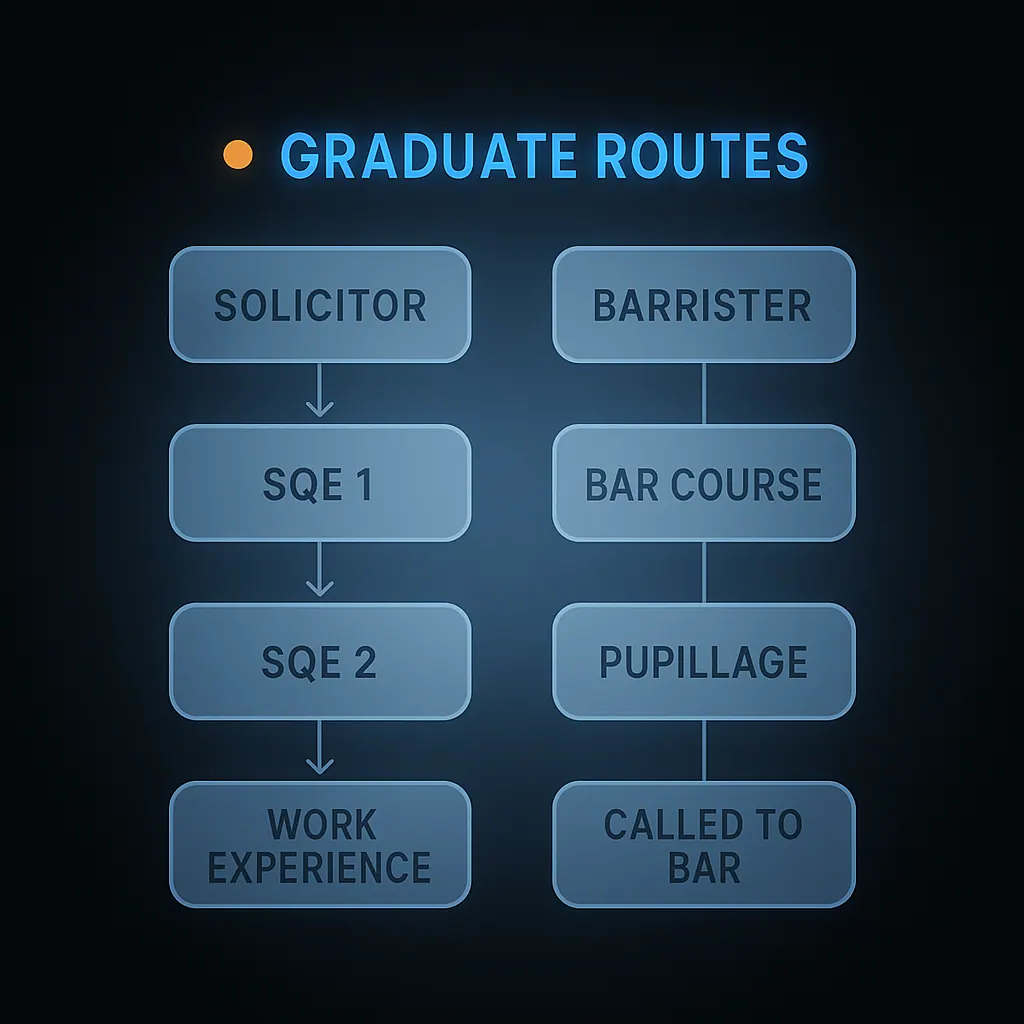
Finishing a law degree is the start of the professional route, not the end. In England and Wales, there are two main qualified-lawyer paths, and they work quite differently.
To become a solicitor, you must pass SQE1 (multiple-choice legal knowledge) and SQE2 (practical legal skills), complete Qualifying Work Experience (QWE), and pass a character and suitability assessment. The whole process is overseen by the Solicitors Regulation Authority (SRA). A qualifying law degree, such as the Bristol LLB, which is accredited by the SRA, provides partial preparation for SQE but does not exempt you from the assessments themselves. This is the counter-intuitive part many applicants miss: even a first-class law degree from a leading university means you still sit both SQE stages.
To become a barrister, you complete the Bar Practice Course (BPC) after your degree, then secure pupillage, a training period in chambers. The Bar Standards Board regulates this route. Bristol's LLB is also accredited by the Bar Standards Board, as are most qualifying law degrees at major UK universities.
Scotland operates separately. The Law Society of Scotland governs qualification there, and degrees at institutions such as Glasgow and Edinburgh lead to Scots Law qualifications, which do not automatically qualify graduates to practise in England and Wales without further steps.
Beyond practice, a strong law degree feeds roles in legal technology, policy, compliance, academia, and international organisations such as the UN or WTO. Oxford's Faculty of Law, for example, offers specialist programmes in AI law, competition law, and international human rights, reflecting the breadth of non-practising careers that legal training supports.
7. Entry Requirements: From Most to Least Selective
UK law entry requirements span a wide range, and knowing where each tier sits helps you build a realistic list.
At the most selective end, Oxford, Cambridge, and Bristol sit in the A\*AA to AAA band. Bristol's standard offer is A\*AA, with a contextual offer of AAB for applicants from underrepresented backgrounds. Mid-tier Russell Group universities typically ask for AAB to ABB. Broader-access universities work on UCAS Tariff, with listed law courses ranging from 96 to 136 Tariff points across UK providers.
Law degrees almost never specify required A-level subjects. The counter-intuitive implication: a student taking Mathematics and Sciences is not disadvantaged on paper, but admissions tutors at selective universities consistently value essay-based subjects such as History, English Literature, Politics, and Economics because they develop the analytical reading and extended writing skills that law degrees demand from day one.
For IB Diploma students, offers are expressed as overall points plus Higher Level conditions, and both elements must be read together. Bristol's stated standard offer is 38 points overall with 18 at Higher Level. Typical offers across selective UK law schools run from approximately 36 to 40 overall with 18 to 19 at Higher Level. Holding an essay-based HL subject such as History or English A strengthens an application for the same reasons as A-level subject choice.
Scottish universities including Glasgow, Edinburgh, and Aberdeen list no UCAS Tariff figure and assess applicants under the SQA Highers and Advanced Highers framework separately. Do not assume a Tariff conversion is possible or that an offer from one system maps cleanly onto the other.
One practical step worth taking early: check whether your target university has a named access scheme and what documentary evidence it requires, since contextual offers at selective universities can represent a meaningful grade reduction.
8. Combined Law Degrees: Business, Criminology, Psychology and More
A combined law degree is not a softer option. Chosen carefully, it signals a specific career direction from day one.
**Law with Business or Law with Economics suits anyone aiming at corporate law or commercial practice. The overlap with contract, company law, and finance theory is genuine rather than decorative. Law with Criminology or Law with Psychology opens routes into criminal justice, probation, and forensic work, where understanding behaviour matters as much as knowing the statute. Law with Politics is well suited to public law, human rights, and policy roles. Law with a Modern Language** remains one of the cleaner preparation routes for international or cross-border commercial practice, since it builds functional legal vocabulary in a second jurisdiction.
The volume of options is real. UCAS lists 53 courses matching "law and politics", ranging from Glasgow's separate LLB tracks in Common Law/Politics and Scots Law/Politics (no listed tariff) and Edinburgh's LLB in Law and Politics, through to Kent's LLB at 120-136 UCAS points and SOAS's BA with no listed tariff.
One non-obvious gotcha: combined degrees do not always cover all foundational SQE subject areas. A programme that replaces a core law module with a politics or psychology unit may leave a gap you only notice when you check accreditation. Verify the SQE preparation statement on each course page before applying.
International law and environmental law are worth noting separately. Both are primarily postgraduate specialisms. Oxford, LSE, and SOAS all offer LLM-level provision in these areas, covered in the next section. Pursuing either as a pure undergraduate track is rare and often less well-resourced.
9. Masters in Law (LLM): Best UK Universities for Postgraduate Study
The LLM (Master of Laws) is the standard taught postgraduate law qualification across UK universities. Oxford is the notable exception: its flagship postgraduate taught degrees are the Bachelor of Civil Law (BCL) and the Magister Juris (MJur), both regarded as among the most competitive postgraduate law programmes in the world. Oxford also offers a range of specialist MScs, including the MSc in Law and Finance, MSc in Taxation, MSc in Criminology and Criminal Justice, and MSc in International Human Rights Law.
The counter-intuitive quirk for Oxford applicants: the BCL is technically a bachelor's degree, but it sits at master's level and is treated as such by employers and graduate courts. Applying under the wrong degree classification assumption is a common mistake.
Beyond Oxford, specialist LLM tracks vary considerably by institution:
- Corporate and commercial law: LSE and UCL are frequently cited alongside Oxford for finance-adjacent programmes.
- International law: Oxford, LSE, and UCL offer well-regarded routes; SOAS is noted for international law with a focus on the Global South.
- Criminal justice: Oxford's MSc in Criminology and Criminal Justice sits alongside LLM criminal justice tracks at other institutions.
- Human rights: Oxford's Bonavero Institute of Human Rights underpins its specialist provision; LSE and SOAS are also commonly cited.
- Intellectual property and tax: Oxford offers part-time MSc routes in both, useful for practitioners already in work.
For a more vocational route, The University of Law's LLM Legal Practice (SQE1&2) is structured explicitly around the SQE pathway, making it one of the clearest options for graduates who want postgraduate study and professional qualification in a single programme.
International students, including Canadians and others qualified abroad, often use the LLM to gain familiarity with UK legal frameworks. Whether a programme prepares you for UK practice or for an academic and international career depends heavily on the course structure, so check the programme's professional exemptions before applying.
10. What to Do Next
Start with the LNAT question this week, not later. If any of your shortlisted universities require it, check whether the registration window is open - LNAT registration opens in August, and Oxford applicants must sit the test by 15 October, which arrives faster than it looks when combined with personal statement deadlines.
One non-obvious gotcha: a few universities that accept the LNAT score still set their own preferred sitting dates earlier than the official UCAS deadline, so confirm each university's guidance directly rather than assuming the UCAS deadline is your real cutoff.
Once your admissions timeline is clear, explore the Law subject hub for detailed guidance on entry requirements, course structures, and specialisms including corporate, criminal, international, and environmental law. Then compare individual law school pages side by side to weigh offer rates, course content, and career outcomes against each other.
FAQ
What is the best university for law in the UK?
Cambridge ranks first in the Complete University Guide 2026 and the Times University League Tables 2024 for law; Oxford and Bristol also consistently appear at the top of international and domestic rankings, with Bristol ranked 9th in the UK by THE World University Rankings by Subject 2026.
Which UK universities require the LNAT for law?
Oxford, Cambridge, UCL, Bristol, Durham, Nottingham and Glasgow are among the universities that require the LNAT; students should check each university's current course page because requirements can change, and Oxford applicants must sit the test before the October UCAS deadline.
Do you need a law degree to become a solicitor in the UK?
No - since the SRA introduced the Solicitors Qualifying Examination (SQE), graduates of any degree subject can qualify as a solicitor by passing SQE1 and SQE2 and completing Qualifying Work Experience, though an SRA-accredited LLB provides strong foundational preparation.
What A-levels do you need to study law at a top UK university?
Law degrees rarely name specific required subjects, but the most selective universities ask for offers in the A*AA-AAA range; essay-based subjects such as History, English Literature, Politics or Economics are widely valued because they develop the analytical and written communication skills the course demands.
Which UK universities are best for an LLM or masters in law?
Oxford (BCL/MJur and specialist MScs), LSE, UCL and SOAS are frequently cited for LLM study, with specialisms spanning corporate law, international law, human rights and criminal justice; The University of Law offers a vocational LLM Legal Practice aligned to the SQE pathway.
Can I study law in the UK with the International Baccalaureate?
Yes - most UK law schools accept the IB; Bristol's stated standard offer is 38 points overall with 18 at Higher Level, and universities typically require both an overall points threshold and specific HL conditions, with essay-based HL subjects such as History or English A strengthening applications.
References
- Law, BA (Hons) | Undergraduate Study - https://www.undergraduate.study.cam.ac.uk/courses/law-ba-hons
- Faculty retains top University rankings | Faculty of Law - https://www.law.cam.ac.uk/press/news/2023/09/faculty-retains-top-university-rankings
- Search | All results | "law" | UCAS - https://www.ucas.com/explore/search/all?query=law
- Law | University of Bristol | UCAS - https://www.ucas.com/explore/courses/0b4e71f8-7a9a-f266-0926-d6e77224e8f4/course?studyYear=2027
- Homepage | Faculty of Law - https://www.law.ox.ac.uk
- Search | All results | "law and politics" | UCAS - https://www.ucas.com/explore/search/all?query=law+and+politics