International Students Applying to UK Universities: Full Guide
By Michael Thompson · Former IB Diploma Programme coordinator; 10 years at Bromsgrove School · Published 5 July 2026 · Updated 4 October 2026
International students applying to UK universities follow the same UCAS route as home applicants, but several additional layers sit on top: a student visa, English language evidence, overseas qualification recognition, and separate fee status. Getting any one of these wrong can delay your application or cost you a place. This guide walks through each stage in order - from registering on UCAS correctly to understanding how your school-leaving certificate maps onto UK entry requirements - so you know exactly where the process differs from a domestic application and where it is identical.
Key Takeaways
- UCAS is the single application route: Almost all international undergraduate applicants use UCAS, not direct applications, and the process mirrors a home application apart from a small number of additional fields.
- Two deadlines matter: The mid-October deadline (15 October 2026 for 2027 entry) applies to Oxford, Cambridge, medicine, dentistry, and veterinary medicine regardless of your country; the main equal-consideration deadline falls in January (13 January 2027 for 2027 entry).
- English language requirements vary by course: Each university and each course sets its own minimum score - IELTS Academic is the most widely accepted test, but equivalents such as TOEFL iBT and PTE Academic are commonly accepted too.
- Your school-leaving qualification will be assessed for equivalency: UK universities map overseas qualifications - including the IB Diploma, national baccalaureates, and Advanced Placement tests - onto their standard entry requirements using published equivalency guides.
- International fees differ from home fees and vary widely: Universities set their own overseas tuition rates by course; you should check each institution's fee page directly and factor in living costs before applying.
- A confirmed sponsored place must come before a Student visa: You cannot apply for a UK Student visa until you hold a Confirmation of Acceptance for Studies (CAS) from a licensed sponsor university - check gov.uk for current financial and timing requirements.
In This Article
- How International Students Apply to UK Universities
- Extra UCAS Steps That Apply Only to International Applicants
- UCAS Application Deadlines for International Students
- English Language Test Scores: What UK Universities Accept
- Academic Qualifications Equivalency: How UK Universities Assess Overseas Credentials
- The UCAS Personal Statement for International Students
- International UK University Fees and Funding
- Student Visa Entry Requirements for the UK
- Building Your University Shortlist as an International Applicant
- What to Do Next
1. How International Students Apply to UK Universities
Almost every international student applying to UK universities does so through UCAS, the Universities and Colleges Admissions Service - the same centralised platform used by UK domestic applicants. There is no separate international admissions portal for undergraduate entry. You submit one application, list up to five courses, and UCAS routes it to each institution.
One feature of the system catches many international applicants off guard: UCAS operates on a pre-qualification basis. Universities make offers before you receive your final exam results, which means your referee's predicted grades carry real weight. A referee who undersells your expected performance can cost you an offer, even if your final grades are strong.
UCAS notes that some universities also require applicants to attend an interview or submit work samples as part of their admissions process, so the application form itself is not always the end of the assessment.
International applicants do face a small number of additional requirements on top of the standard process: an English language test, academic qualifications equivalency checks, and immigration-related document uploads. Most of these sit alongside the core application rather than replacing any part of it. The sections below cover each in detail.
One cost to note early: every applicant pays the UCAS application fee, which is £34.50 for 2027 entry. Cambridge's undergraduate admissions guidance adds that most international applicants to Cambridge also pay a £60 application fee, unlike home applicants, though waivers exist for applicants from certain countries.
2. Extra UCAS Steps That Apply Only to International Applicants
The UCAS form was designed around UK-based applicants, so several fields work differently when you are applying from overseas. Getting these details right matters: an admissions officer reading your application will see your qualifications exactly as you enter them.
The application fee. Every applicant pays the UCAS fee: £34.50 for 2027 entry, covering up to five choices. Cambridge also charges most international applicants, including EU students (with the exception of residents of Ireland and the Crown Dependencies), a £60 application fee. If you are from one of the countries on Cambridge's waiver list, such as Afghanistan, Bangladesh, Haiti, Syria, Ukraine, and Yemen, you are automatically eligible for a fee waiver. That list is reviewed each year and updated in September, so check it shortly before you submit rather than months in advance.
**Entering overseas qualifications.** UCAS has a drop-down menu for qualifications. Select the specific national qualification rather than a generic "overseas equivalent" option where one exists. If your qualification is not listed, use the free-text field and spell out the full official name, the awarding body, and the grading scale. Admissions teams cannot look up what they cannot identify.
**Your referee and predicted grades.** UK admissions works on predicted rather than final results, so your referee must submit predicted grades as part of their reference. If your school uses a different academic calendar and your referee is unfamiliar with the UK system, brief them on this early. A reference that only describes your character but omits grade predictions is incomplete by UCAS standards.
Document upload. For 2027 entry, UCAS lets applicants upload supporting documents directly into the relevant sections of their application for the first time. UCAS's guidance for international students gives English language certificates and proof of passport or immigration status as examples.
3. UCAS Application Deadlines for International Students
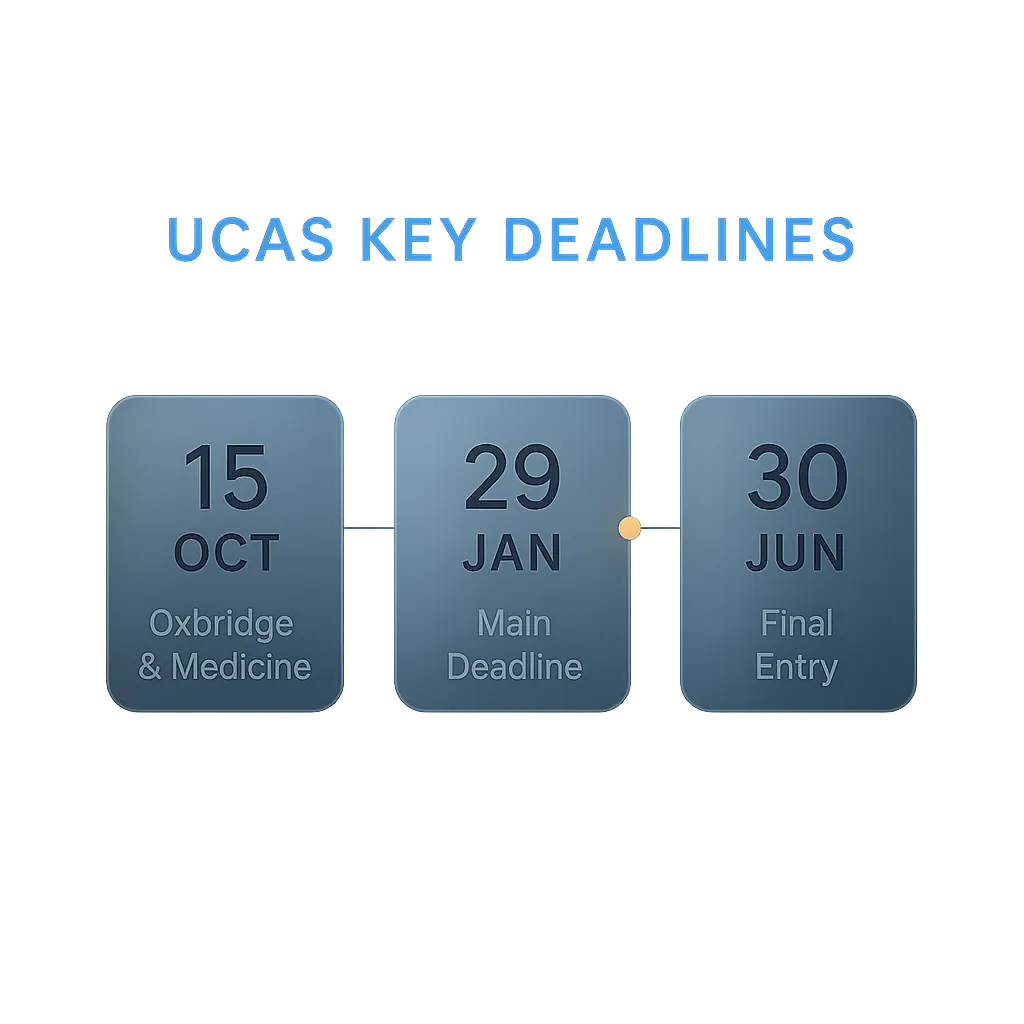
The deadlines are the same whether you are applying from Birmingham or Bangkok. Your nationality does not buy you extra time.
The mid-October deadline covers five course types: Oxford, Cambridge, medicine, dentistry, and veterinary medicine. For 2027 entry it is 18:00 UK time on 15 October 2026. Miss it and your application will not be considered for those programmes in that cycle. Check the exact date for your entry year on the UCAS applying page, as the precise calendar date shifts slightly each cycle.
**The main January deadline** is the one most international applicants target: 13 January 2027 at 18:00 UK time for 2027 entry. Applications submitted by this date receive equal consideration from admissions tutors, meaning no course fills its places before your application lands.
One non-obvious point: UCAS confirms that different courses have different deadlines, some set well in advance of the course start date. A few competitive art and design courses, for example, run their own portfolio deadlines that fall before the January date. Always check the specific course entry on UCAS Search, not just the headline deadline.
| Deadline type | Who it applies to | Timing |
|---|---|---|
| Oxford, Cambridge, medicine, dentistry, vet med | All applicants worldwide | Mid-October (15 October 2026 for 2027 entry) |
| Main equal-consideration deadline | Most UK and international applicants | January (13 January 2027 for 2027 entry) |
| Course-specific deadlines | Select programmes (art, design, some conservatoires) | Varies |
If you miss the January deadline, your application moves into the late-application pool, where places are scarcer. And if courses are still unfilled after results day, international students can use UCAS Clearing in exactly the same way UK students can.
4. English Language Test Scores: What UK Universities Accept
If you are applying from a non-majority English-speaking country, you will need to submit evidence of English language ability as part of your application. UCAS confirms that the required level varies by university and by individual course within the same university, so there is no single UK-wide threshold you can rely on.
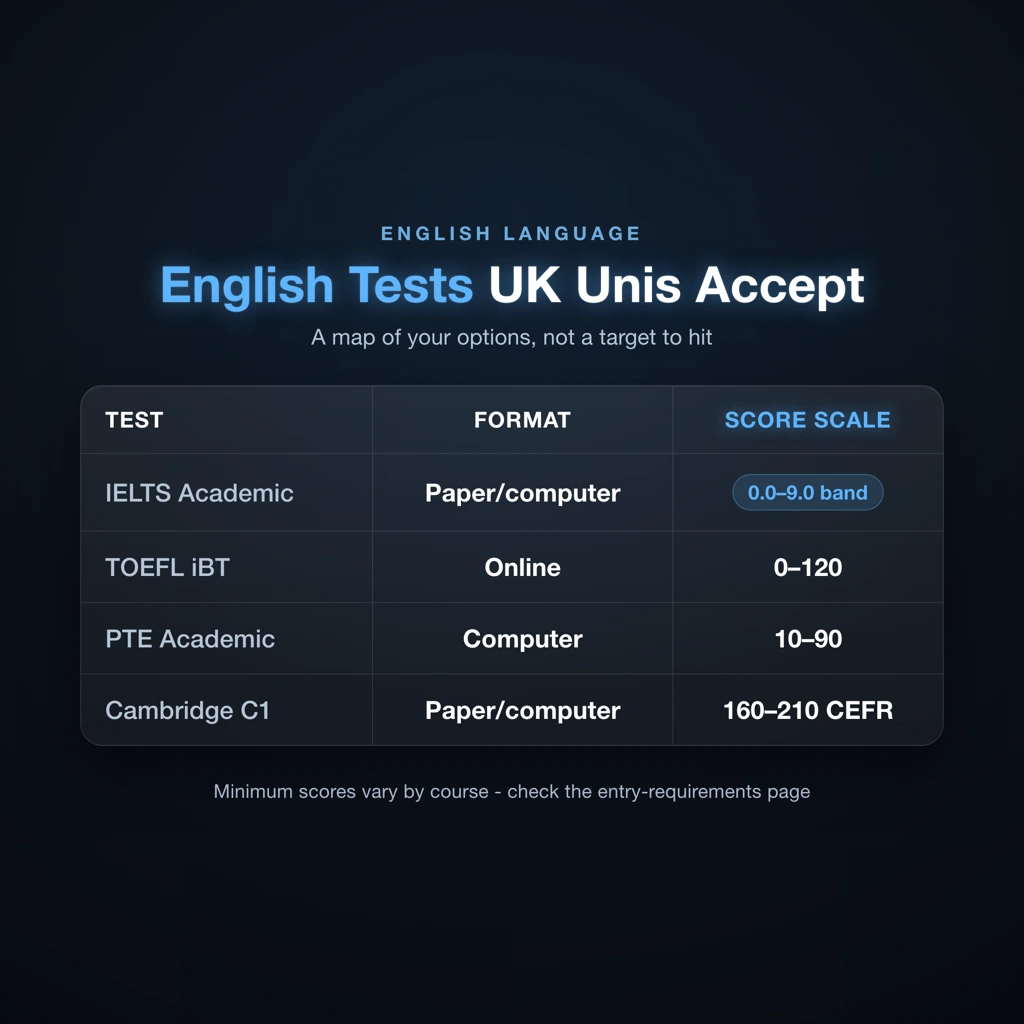
The most widely accepted tests are listed below. Minimum scores are set independently by each university and course, so treat the table as a map of your options, not a target to hit.
| Test | Format | Score scale | Notes |
|---|---|---|---|
| IELTS Academic | Paper or computer | 0.0-9.0 band | Most widely requested; check Academic, not General Training |
| TOEFL iBT | Online | 0-120 | Some universities also accept the TOEFL iBT Home Edition |
| PTE Academic | Computer | 10-90 | Fully computer-marked; results typically available faster |
| Cambridge C1 Advanced (CAE) | Paper or computer | 160-210 (CEFR scale) | C2 Proficiency (CPE) is also accepted and sits a grade higher |
One non-obvious trade-off worth knowing: a university may advertise a single minimum score for the institution, but individual departments, particularly in medicine, law, and teacher training, often set higher sub-scores for reading or writing within the same overall band. Meeting the headline figure does not guarantee you meet the course requirement.
For 2027 entry, UCAS lets all applicants upload documents such as English language certificates directly into their application.
The only reliable source for your required score is the entry requirements page for the specific course you are applying to. Check the university's own admissions pages, not aggregator summaries, as these can lag behind updates.
5. Academic Qualifications Equivalency: How UK Universities Assess Overseas Credentials
UK universities do not require you to hold A Levels. They map your school-leaving qualification onto their standard entry requirements using published equivalency guides, and most major national certificates are covered. As Cambridge notes, "many other school and national examinations at an equivalent level are equally acceptable" alongside GCE A Levels and the IB Diploma Programme.
**The IB Diploma is the smoothest path for most international applicants.** Universities specify both a total points threshold and the required grades at Higher Level (HL). HL grades carry significantly more weight than Standard Level (SL) grades in offer conditions, so a student with strong HL results in relevant subjects is assessed differently from one with the same total points earned mostly at SL. Check each offer letter carefully for the HL grade combination, not just the headline points total.
Other widely recognised qualifications include:
- European Baccalaureate - minimum offer levels are published on Cambridge's international entry requirements page.
- International A Levels - assessed on the same scale as UK A Levels.
- Country-specific leaving certificates - assessed individually, with examples ranging from the Albanian Matura Shtetërore to the Argentine Título de Bachiller.
A non-obvious quirk worth knowing: some qualifications are considered non-competitive on their own. Cambridge's guidance states that Albanian students holding only the Matura Shtetërore, and Argentine students holding only the Título de Bachiller, fall into this category. Acceptable routes for both groups include A Levels, the IB, or five or more AP Tests at Score 5 combined with the national qualification. Applicants planning to use the AP-plus-national-certificate route are advised to contact their shortlisted Colleges directly before applying.
If your qualification does not appear on a university's published list, contact the admissions office directly. Do not assume an unlisted credential is unacceptable; it may simply require individual assessment.
6. The UCAS Personal Statement for International Students
The personal statement is a standard UCAS requirement for every applicant, domestic or international. You complete the same form, the same 4,000-character limit, and submit it through the same application. There is no separate international version.
Admissions teams at selective universities are reading for intellectual engagement with the subject, not personal biography. A statement that opens with your childhood and spends three paragraphs on family background before reaching the subject itself is a common mistake. Get to your academic motivation quickly: what draws you to the subject, how you have pursued it, and what you have read, built, or investigated beyond the classroom.
International applicants do have one legitimate addition to make: contextual information about access to resources. If your school did not offer A-level Chemistry but you studied the IB Diploma Programme and covered equivalent content independently, or if you sat a national curriculum qualification that gave you limited exposure to a sub-field the UK course emphasises, saying so briefly is useful. Admissions readers know that educational systems differ. What you should avoid is letting this context crowd out the academic content, the statement still needs to demonstrate subject knowledge and motivation.
One counter-intuitive point: mentioning that you are an international applicant adds nothing. Admissions staff can see your qualifications and country of study already. The space is better spent on the subject itself.
Browse our universities directory to check what individual institutions say they are looking for in personal statements before you draft yours.
7. International UK University Fees and Funding
Unlike home students, international applicants face no regulated tuition fee cap. Universities set their own overseas fees, and the figure varies considerably by course type, institution, and year of entry. A clinical medicine programme at a research-intensive university will cost far more than a humanities degree at a post-1992 institution. There is no single number that covers the sector.
One non-obvious detail: as noted in the sources, universities set separate home and international recruitment targets before the admissions cycle begins. This means an international applicant is not competing against domestic students for the same places. It also means a course that appears to have room may still be full for international applicants specifically.
Where to find accurate fee information:
- Check each university's official fees page directly for the course and entry year you are applying to.
- Review UCAS guidance on scholarships and bursaries for international students, which lists funding options available across the sector.
- Ask each admissions team whether fee levels are fixed for the duration of your course or subject to annual increases.
Refugees, asylum seekers, and those with limited leave to remain may qualify for financial support that is not available to standard overseas applicants. UCAS provides separate guidance on this and it is worth reading before assuming you will be charged full overseas fees.
Financial support, scholarships, and bursaries are available to international students, but eligibility criteria differ widely. Check both UCAS and each university's own funding pages early in the cycle, as many awards close before the main application deadline.
8. Student Visa Entry Requirements for the UK
Unless you are an Irish citizen or already have the right to study in the UK through settled or pre-settled status under the EU Settlement Scheme or indefinite leave to remain, you will usually need a Student visa before you can enrol, whether you applied through UCAS or directly to an institution. If you already hold a different UK visa, check its conditions on gov.uk before assuming it covers a degree.
The CAS comes first. You cannot apply for a Student visa until you hold a Confirmation of Acceptance for Studies (CAS) from your university. The CAS is issued only after you have accepted a confirmed offer, which means the visa application happens after the admissions process, not alongside it. Plan your timeline accordingly - leaving too little time between receiving your CAS and your course start date is one of the most common avoidable problems international applicants face.
The visa application also requires proof that you have sufficient funds to cover both your tuition fees and living costs. The exact financial thresholds, how far in advance funds must be held, and the full list of supporting documents are updated periodically. Check gov.uk directly for the current figures rather than relying on third-party summaries.
As UCAS notes, for 2027 entry you can upload proof of passport or immigration status alongside your English language certificates directly into your application.
If you start in 2027 or 2028: two policy changes affect you. The Graduate visa, which lets you stay and work after your degree, is cut from two years to 18 months for applications made on or after 1 January 2027. Anyone starting a bachelor's degree in 2027 or 2028 will apply after that date, so plan on 18 months; PhD graduates keep three years. Separately, the government plans an international student levy of £925 per international student per year, charged to universities in England from August 2028. It is still draft legislation, not law, and no official source says whether universities will pass the cost on through higher fees.
Practical action: Once you receive a conditional offer, confirm your university's CAS issue timeline with their international admissions office so you know when to expect your visa window to open.
9. Building Your University Shortlist as an International Applicant
UCAS allows up to five choices, and for international applicants each slot deserves careful research before you commit. Check three things for every university on your list: the specific international entry requirements for your course, the overseas tuition fee level, and what scholarships are available to students from your country. Fee levels and award criteria vary considerably between institutions, so treating all five choices as interchangeable is a common mistake.
Location affects living costs as much as tuition. Universities outside London and the South East typically come with lower rent and transport costs, which can offset a significant portion of your annual budget. Factor this into comparisons alongside the headline fee.
One non-obvious gotcha: applying to Cambridge or Oxford is not simply a matter of choosing the university. At Cambridge, you must also select a specific college, and the process includes additional written assessments and interviews regardless of your nationality or country of origin. Build that into your timeline early.
UCAS recommends attending UK higher education events or British Council events held around the world as a practical way to compare institutions before finalising your list. These events let you ask fee, scholarship, and entry requirement questions directly.
Use our UK universities directory to compare universities by region, course, and entry requirements while building your shortlist.
10. What to Do Next
The paperwork catches more international applicants off guard than the academics do. Document requirements, English language certificate formats, and passport verification all have their own timelines, and universities will not hold offers while you chase missing files.
This week, decide whether you are targeting the 15 October 2026 deadline (Oxford, Cambridge, medicine, dentistry and veterinary courses) or the 13 January 2027 one, then visit the UCAS international students hub to confirm the current cycle dates and read the document upload guidance. For 2027 entry, all applicants can upload supporting documents directly into their UCAS application, and the guidance can change between cycles.
Check which English language certificates and proof of immigration status your chosen universities require. Then book any outstanding English language test now, before your application deadline closes the window.
FAQ
How do international students apply to UK universities?
International students apply through UCAS, the same centralised admissions service used by UK applicants, submitting predicted grades, a personal statement, and a reference before results are known.
Can international students apply directly to UK universities without UCAS?
For undergraduate study, almost all UK universities require an application through UCAS rather than direct contact, though some postgraduate routes and conservatoires operate differently.
What English language tests do UK universities accept?
IELTS Academic is the most widely accepted test, but universities typically also accept TOEFL iBT, PTE Academic, and Cambridge C1 or C2 qualifications - minimum scores are set by each university and course individually.
How do international students pay for university in the UK?
International students pay overseas tuition fees set by each university, which differ from the regulated home fee rate and vary by course; funding options include scholarships, bursaries, and in some cases financial support for those with refugee or asylum-seeker status.
When is the application deadline for international students applying to UK universities?
The mid-October UCAS deadline applies to Oxford, Cambridge, medicine, dentistry, and veterinary medicine for all applicants including international ones; most other courses fall under the main January equal-consideration deadline.
Do international students need a visa to study at a UK university?
Most do - unless you are an Irish citizen, have settled or pre-settled status under the EU Settlement Scheme, or have indefinite leave to remain, you will usually need a UK Student visa, which can only be applied for once you hold a Confirmation of Acceptance for Studies (CAS) from a licensed sponsor university; current financial and document requirements are set out on gov.uk.
References
- Applying to University - learn about everything involved - https://www.ucas.com/applying/applying-university
- Applying to university as an international student | UCAS - https://www.ucas.com/international/international-students/applying-to-university-as-an-international-student
- International applications | Undergraduate Study - https://www.undergraduate.study.cam.ac.uk/international-students/international-applications
- International students | UCAS - https://www.ucas.com/international/international-students
- International entry requirements | Undergraduate Study - https://www.undergraduate.study.cam.ac.uk/international-students/international-entry-requirements
- What is the application fee for the 2027 cycle? | UCAS - https://www.ucas.com/faqs/what-is-the-application-fee-for-the-2027-cycle
- 2027 cycle toolkit | UCAS - https://www.ucas.com/advisers/help-and-training/toolkits/2027-cycle-toolkit
- Common Travel Area guidance - GOV.UK - https://www.gov.uk/government/publications/common-travel-area-guidance/common-travel-area-guidance
- What settled and pre-settled status means - GOV.UK - https://www.gov.uk/settled-status-eu-citizens-families/what-settled-and-presettled-status-means
- Indefinite leave to remain - GOV.UK - https://www.gov.uk/settle-in-the-uk
- Student update: changes to the Student and Graduate rules | UKCISA - https://www.ukcisa.org.uk/news/student-update-changes-to-the-student-and-graduate-rules/
- International student levy: draft Finance Bill - GOV.UK - https://www.gov.uk/government/publications/introducing-an-international-student-levy-on-higher-education-providers/international-student-levy-draft-finance-bill