Best UK Universities for Medicine: 2026 Guide
By Michael Thompson · Former IB Diploma Programme coordinator; 10 years at Bromsgrove School · Published 5 July 2026 · Updated 4 October 2026
Choosing the best UK universities for medicine means weighing far more than a single league-table column. There are around 310 medicine courses listed on UCAS, spanning five-year and six-year programmes, traditional lecture-led teaching, problem-based learning, and integrated case-based models - and your fit with a school's teaching style will shape your experience more than its ranking position. Entry requirements, admissions tests, intercalation opportunities, and the hard four-choice cap on UCAS all narrow the realistic field before you write a single personal statement. This guide maps those factors so you can build a shortlist that matches how you learn, what you can realistically apply for, and what a medical career actually demands.
Key Takeaways
- Teaching model matters more than rank.: UK medical schools use three distinct models - traditional lecture-led, problem-based learning (PBL), and integrated/case-based - and choosing the wrong one for your learning style is a common and costly mistake.
- UCAT is now the standard admissions test.: The BMAT was withdrawn and UCAT is used by the majority of UK medical schools, though cut-offs vary significantly between institutions and are not published as fixed thresholds.
- UCAS limits you to four medicine choices.: Only four of your five UCAS choices may be medicine, dentistry or veterinary medicine combined, so your fifth choice must be a considered non-medicine alternative.
- Chemistry at A-level or IB Higher Level is a near-universal hard gate.: Almost every UK medical school requires HL or A-level chemistry (and often biology) regardless of overall grades or points - no chemistry typically means no offer.
- IB applicants need strong HL science combinations.: IB offers typically require HL chemistry plus a second science at Higher Level, with some schools also specifying minimum SL maths or English grades.
- Graduate entry routes exist at over a dozen schools.: UCAS lists 13 four-year graduate entry medicine courses for 2026 entry, all assessed without UCAS Tariff points and most requiring a 2.1 undergraduate degree.
In This Article
- What Makes a Medical School the Right Fit?
- The Three Teaching Models UK Medical Schools Use
- Admissions Tests: UCAT, Cut-offs and What Schools Actually Weight
- The UCAS Four-Choice Cap and How to Build Your List
- Entry Requirements: From Most to Least Selective
- Applying to UK Medical Schools With the International Baccalaureate
- Comparison Table: Teaching Model, Admissions Test, Intercalation and Selectivity
- Graduate Entry Medicine: The Best UK Schools for Career-Changers
- Medical Research Universities: Where to Study if Research Matters to You
- What to Do Next
1. What Makes a Medical School the Right Fit?
Choosing between the best UK universities for medicine is harder than picking whichever school sits highest in a league table. UCAS lists over 310 medicine courses across UK institutions, with degrees ranging from four-year accelerated programmes to six-year integrated courses, and award titles varying from MB ChB to BMBS to MB BCh depending on the institution. That variety is the first clue that a ranked list can only take you so far.
League tables measure what they can quantify: research output, student satisfaction scores, graduate employment. Those are real signals. But they do not capture whether a school uses problem-based learning or a traditional lecture model, how early you get clinical contact, or whether the intercalation year is optional or compulsory.
Three dimensions tend to matter most when building a shortlist:
- Teaching model - how the curriculum is structured and when you first see patients.
- Selectivity - entry requirements, admissions test weighting, and interview format.
- Practical fit - location, intercalation options, research culture, and whether a graduate-entry route exists.
One counter-intuitive point worth noting early: a school's overall university ranking reflects its research across all faculties, not the quality of its medical programme specifically. A Russell Group university ranked outside the top ten nationally may run a medical school that outperforms better-known institutions on clinical training outcomes.
The sections that follow give you a structured comparison across each dimension, not a simple top-ten list.
2. The Three Teaching Models UK Medical Schools Use
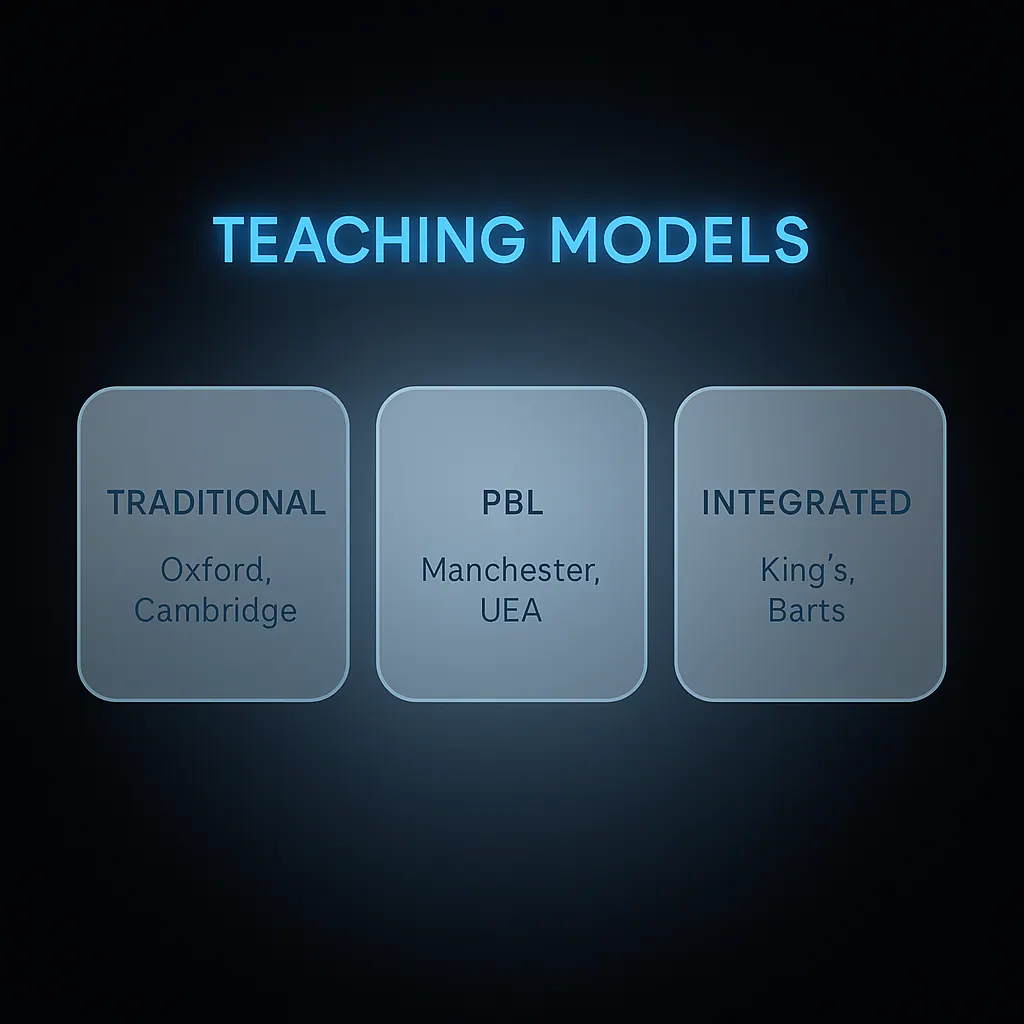
Not all medical degrees work the same way. The label "MBChB" or "MBBS" tells you the qualification, not how the teaching actually runs. The three main models differ enough that the wrong choice will make your first two years genuinely miserable, so it is worth understanding what each involves before you build your shortlist.
Traditional/lecture-led programmes, most closely associated with Oxford and Cambridge, separate pre-clinical and clinical study into distinct phases. The early years follow a tightly structured timetable of lectures, practicals and small-group tutor sessions. Oxford tutorials, in particular, put you in front of an expert once or twice a week to defend written work. This suits students who want clear external scaffolding and find self-directed study harder to sustain without regular checkpoints.
Problem-based learning (PBL), used at Manchester, Liverpool and UEA among others, runs almost the opposite way. Each week opens with a written clinical scenario ("trigger") that a small group works through together. Most of the reading and learning happens independently between those sessions, with no one directing which textbook chapter you read or in which order. The model suits students who are comfortable organising their own study and who find lectures passive. The counter-intuitive catch: PBL students often report that they read more, not less, than lecture-based peers, because the gaps in group discussion become personal reading lists.
Integrated/case-based programmes, including those at King's College London, Imperial and Nottingham, sit between the two. Clinical context appears from the first weeks alongside core science content, so anatomy is taught alongside relevant patient presentations rather than as a standalone pre-clinical block. The structure is tighter than PBL but less modular than traditional lecture courses.
| Model | Named examples | Weekly rhythm |
|---|---|---|
| Traditional/lecture-led | Oxford, Cambridge | Lectures + timetabled tutorials |
| Problem-based learning | Manchester, Liverpool, UEA | Trigger case, then self-directed reading |
| Integrated/case-based | King's, Imperial, Nottingham | Interleaved science and clinical content |
When you visit open days, ask specifically about a typical week in Year 1 and Year 2, not just the programme philosophy. Schools describe themselves using the same vocabulary but can mean very different things by it. The course page is a starting point; the answer to "how many hours per week am I in timetabled sessions?" is the number that matters.
3. Admissions Tests: UCAT, Cut-offs and What Schools Actually Weight
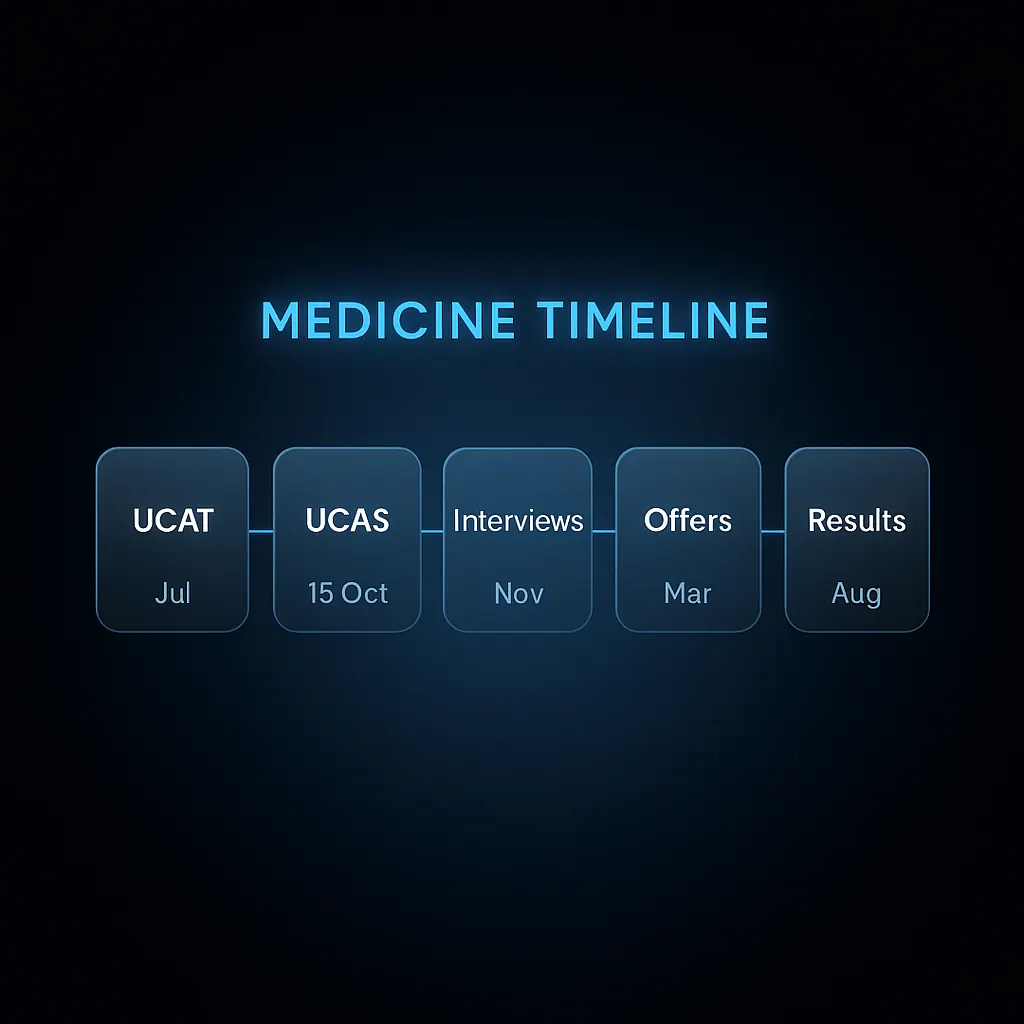
BMAT has been withdrawn. The last BMAT sitting was in 2023, which means every applicant for 2026 entry is working in a landscape where UCAT is the dominant common entrance test for UK medicine.
UCAT is sat in the summer before you submit your UCAS application, typically between July and September. It has four subtests: Verbal Reasoning, Decision Making and Quantitative Reasoning give a total cognitive score of 900-2700, and Situational Judgement is banded separately (Band 1 is the strongest). Abstract Reasoning was removed in 2025, per the UCAT Consortium.
The less obvious point is how schools actually use that score. No fixed national cut-off is published in advance. Some schools screen applicants with UCAT before even looking at GCSEs. Others combine UCAT, GCSE profile, and personal statement into a weighted ranking before issuing interview invitations. The same raw UCAT score can comfortably clear one school's threshold and fall short at another, so treating it as a single pass-or-fail number is a mistake.
Oxford and Cambridge have also used the UCAT for medicine since 2025 entry, when they dropped the BMAT, but each runs its own shortlisting and interviews. Check the exact current requirement directly on the Oxford Medical Sciences Division course page before applying, as requirements can change, and confirm the current format on the Cambridge undergraduate medicine page when you build your application list.
One practical tip worth knowing: UCAT testing slots fill up from early July. Candidates who book late are often left with September sittings, when test centres are at capacity and the material from summer preparation has had longer to fade. Book early, sit early.
4. The UCAS Four-Choice Cap and How to Build Your List
UCAS applies a specific rule to high-demand health subjects: **across your five UCAS choices, no more than four may be medicine, dentistry, or veterinary medicine combined.** That means you cannot fill all five slots with medical schools. Your fifth choice must be something else entirely.
This is not a technicality you can work around. It forces a real decision: what do you apply to instead?
The most common approach is to use that fifth choice for a closely related degree, such as biomedical sciences, pharmacology, or medical sciences, at a university you would genuinely attend if medicine did not work out. Treating it as a throwaway wastes the slot and leaves you without a safety net.
**Build your four medicine choices in tiers:**
- One ambitious school where your predicted grades and UCAT score sit at or just below the typical offer range
- Two realistic matches where your profile fits the published entry requirements comfortably
- One insurance school with the lowest entry threshold you are comfortable accepting
The less obvious point: UCAS lists over 300 medicine courses across UK universities, ranging from four-year programmes to six-year integrated degrees. With that much variation in structure, selectivity, and teaching model, the cap genuinely helps, because it prevents you from applying to five near-identical high-tariff schools and learning nothing useful about your own preferences in the process.
If you find yourself struggling to name a credible non-medicine fifth choice, that is worth pausing on before you submit.
5. Entry Requirements: From Most to Least Selective
Entry requirements vary more than most applicants expect, and knowing which band a school sits in helps you build a realistic list.
Selectivity falls into three broad bands:
- Very high selectivity - Oxford, Cambridge, and most London schools (Imperial, UCL, King's College London) sit at the top. Typical offers here are at the ceiling of what A-levels or IB permits, and GCSE profiles are scrutinised closely.
- High selectivity - The majority of Russell Group medical schools fall here. Offers are still demanding but slightly more range exists, and the balance between academic grades and admissions test performance can vary by school.
- Moderately selective - A smaller group of newer and regional schools operates at this level. Anglia Ruskin University (Chelmsford) is the only school on UCAS listing a specific points-based requirement: 144 UCAS Tariff points, making it a meaningfully different option for applicants whose predicted grades fall below the typical offers seen elsewhere.
Because medical schools update offers annually, always check each institution's own course page for current published requirements rather than relying on third-party summaries. You can verify individual schools through our university pages.
The hard gate that almost nobody avoids: A-level or IB Higher Level Chemistry is a near-universal requirement across UK medical schools. Biology is required or strongly preferred at many. One counter-intuitive quirk worth knowing: a small number of schools will accept a second science (Physics or Maths) in place of Biology at A-level, but this is the exception, not the default. Assuming flexibility here has caught applicants out.
Grades alone do not secure a place. Your GCSE profile (particularly the spread across science and English), admissions test score, and interview performance all contribute to whether an offer arrives.
6. Applying to UK Medical Schools With the International Baccalaureate
UK medical schools accept the IB Diploma Programme and publish IB-equivalent entry requirements alongside their A-level offers on individual course pages. You will not find a single national standard, so checking each school's current prospectus page is not optional - it is the only reliable source.
The hard subject gate is consistent across most schools. Almost all UK medical schools require Higher Level (HL) Chemistry, and the majority also specify HL Biology as the second science. Where a school accepts HL Physics or HL Mathematics instead of HL Biology, that substitution is usually named explicitly in the offer wording. If it is not named, assume HL Biology is required.
The total IB Diploma points threshold at highly selective schools sits in the upper range of what the IB awards, reflecting the same competitive pressure as the A-level requirements described in the previous section. Check each school's page for the current figure rather than relying on historical estimates.
Offer wording typically combines a total points target with named HL grade minima, such as a grade 6 in HL Chemistry. Some schools add Standard Level (SL) conditions: a minimum grade in SL Mathematics or SL English is common where candidates have not taken those subjects at HL. Missing an SL condition can invalidate an otherwise points-sufficient offer, which catches candidates off guard.
One non-obvious quirk: several schools treat IB equivalency as automatic through UCAS's qualification mapping, while others require applicants to submit a separate statement or verification of predicted grades directly to the admissions team. Check the admissions FAQs for each school, not just the entry requirements table, to confirm which process applies.
7. Comparison Table: Teaching Model, Admissions Test, Intercalation and Selectivity
The table below gives a quick reference across ten schools. One non-obvious point worth flagging: Oxford's pre-clinical years award a BA in Medical Sciences before students move to clinical training, meaning you leave with two separate qualifications. Cambridge does the same, awarding a BA (Hons) at the end of year 3 and the MB, BChir on completion of the full six years. Neither of those BA awards is optional or an intercalated degree in the conventional sense - they are baked into the course structure.
| School | Teaching model | Admissions test | Intercalation | Selectivity band |
|---|---|---|---|---|
| Oxford | Pre-clinical / clinical split | UCAT | Standard (BA awarded at year 3) | Very high |
| Cambridge | Pre-clinical / clinical split | UCAT | Standard (BA awarded at year 3) | Very high |
| Imperial | Integrated | UCAT | Available | Very high |
| UCL | Integrated | UCAT | Standard | Very high |
| King's College London | Integrated | UCAT | Available | High |
| Manchester | PBL | UCAT | Available | High |
| Edinburgh | Integrated | UCAT | Available | High |
| Nottingham | Integrated | UCAT | Available | High |
| UEA | PBL | UCAT | Available | Moderately selective |
| Anglia Ruskin | Integrated | UCAT | Check course page | Most accessible by tariff |
> Note: Admissions test requirements and intercalation policies can change between cycles. Check each school's course page directly for the most current figures. For side-by-side comparisons of entry requirements, student satisfaction scores, and research output, see the university profiles at /university.
8. Graduate Entry Medicine: The Best UK Schools for Career-Changers
Graduate entry medicine (GEM) is a four-year accelerated route for graduates who want to retrain as doctors. Unlike the standard five-year course, GEM programmes carry no UCAS Tariff points requirement - admissions decisions rest on degree class (typically a 2:1 or above), an admissions test, and interview performance.
UCAS lists 13 GEM courses for 2026 entry, all full-time and four years in duration. Schools offering places include Sheffield, Cardiff, UEA, Liverpool, Queen Mary University of London, Surrey, Swansea, Ulster, Worcester, St Andrews, and Bangor.
Two courses sit outside the standard mould and are worth flagging separately:
- Cambridge offers a four-year graduate course leading to the MB and BChir, but it is restricted to home fee status students only. Clinical teaching is based primarily at West Suffolk Hospital in Bury St Edmunds, a district general hospital rather than a large teaching hospital. That is a deliberate choice, not a compromise: the course is designed around generalist clinical training from the outset.
- Oxford's A101 graduate entry course is restricted to graduates in applied or experimental sciences. If your first degree is in humanities or social sciences, Oxford's GEM route is not open to you, regardless of grade.
Places across all GEM programmes are limited and competition is high. The most important pre-application check is whether a school requires a science undergraduate degree or accepts graduates from any discipline. Some schools are open to any 2:1; others specify life sciences or biomedical subjects. Getting this wrong wastes one of your four UCAS medicine choices.
9. Medical Research Universities: Where to Study if Research Matters to You
If research output is your priority, the evidence points clearly to Oxford and Cambridge at the top. Oxford has held the number one position in the Times Higher Education Subject Rankings for Medicine and Health for 15 consecutive years as of 2026, assessed across 1,230 universities in 102 countries using 18 performance indicators covering teaching, research quality, industry partnerships, and international collaborations. That is not a single strong year - it is sustained dominance across more than a decade.
Cambridge is ranked No. 1 in the UK for Medicine by The Complete University Guide 2026, and its pre-clinical structure has a built-in research dimension: completing years one to three awards a BA (Hons), which means every Cambridge medical student exits pre-clinical study with a standalone degree before their clinical years begin.
For students who want formal research training without going to Oxbridge, intercalated BSc and MSc options at UCL, Imperial, and Edinburgh embed a dedicated research year within the medical degree itself.
One counter-intuitive trade-off worth knowing: **research ranking reflects output, not teaching quality.** A department producing high-citation papers is not automatically producing the clearest clinical educators. Some students thrive in research-heavy environments; others find that the institutional focus on output leaves taught courses feeling thinly supported. Visiting open days and speaking to current students at any of these schools is the only reliable way to judge that balance for yourself.
10. What to Do Next
This week, open the UCAS medicine course search and work through it with a specific filter in mind: teaching model. Pick four schools whose approach matches how you actually learn, then go directly to each school's own course page and confirm the current admissions test requirement. Do this before UCAT registration closes, because the deadline moves and schools occasionally update their requirements between cycles.
One counter-intuitive gotcha: degree title varies by institution (MB ChB, BMBS, MB BCh, and others) and tells you nothing about quality or career outcomes. Do not use it as a ranking proxy.
For deeper profiles on individual institutions, browse the university comparison pages or visit our Medicine subject hub for structured guidance on every stage of the application.
FAQ
What are the best UK universities for medicine?
Oxford and Cambridge consistently top research and teaching rankings, but 'best' depends on teaching model, selectivity band and your learning style - PBL schools like Manchester and UEA suit self-directed learners, while integrated programmes at King's and Nottingham suit those who want early clinical contact alongside structured teaching.
Which UK universities offer graduate entry medicine?
UCAS lists 13 four-year graduate entry medicine courses for 2026 entry at schools including Sheffield, Cardiff, Liverpool, Queen Mary University of London, UEA, Surrey and Swansea; Cambridge and Oxford also offer GEM routes with specific eligibility restrictions.
How many medicine choices can I make on UCAS?
You can use a maximum of four of your five UCAS choices for medicine, dentistry or veterinary medicine combined, meaning your fifth choice must be a non-medicine subject.
Do UK medical schools accept the IB Diploma?
Yes - UK medical schools publish IB-equivalent offers alongside A-level requirements, typically requiring HL Chemistry plus a second science at Higher Level, with total points and any SL minimums specified on each school's course page.
Is UCAT required for all UK medical schools?
UCAT is now the most widely used admissions test for UK medical schools following the withdrawal of BMAT, but cut-off thresholds are not published in advance and weighting varies by institution, so you should check each school's admissions page directly.
Which UK medical schools are best for international students?
Most UK medical schools accept international applicants, but funded places are capped by the Office for Students - larger schools such as Birmingham, Manchester, Queen Mary University of London, Nottingham and King's College London hold the highest combined home and overseas intake limits for 2025-26.
References
- Search | All results | "medicine" | UCAS - https://www.ucas.com/explore/search/all?query=medicine
- Medicine - University of Oxford, Medical Sciences Division - https://www.medsci.ox.ac.uk/study/medicine
- Medicine, MB and BChir | Undergraduate Study - https://www.undergraduate.study.cam.ac.uk/courses/medicine-mb-bchir
- Search | All results | "graduate entry medicine" | UCAS - https://www.ucas.com/explore/search/all?query=graduate+entry+medicine
- Medicine (Graduate course), MB and BChir | Undergraduate Study - https://www.undergraduate.study.cam.ac.uk/courses/medicine-graduate-course-mb-bchir
- Number 1 for the 15th consecutive year - University of Oxford, Medical Sciences Division - https://www.medsci.ox.ac.uk/news/number-1-for-the-15th-consecutive-year
- UCAT 2025 | UCAT Consortium - https://www.ucat.ac.uk/about-ucat/ucat-2025/