Oxford Physics Interview Questions: Oxbridge Guide 2026
By Michael Thompson · Education Specialist; 10 years teaching the IB at Bromsgrove School · Published 27 October 2026 · Updated 28 October 2026
Oxford physics interview questions are maths and physics problems you work through aloud with academic tutors, often involving an estimate or a sketch, rather than a test of memorised facts. At Oxford, shortlisted applicants are interviewed online between 9 and 15 December 2026, normally twice at their first college and once at a randomly assigned second college, typically by two tutors per interview. At Cambridge, Natural Sciences applicants on the physical stream are interviewed between 7 and 18 December 2026, for 35 minutes to an hour in total for most, either online or in person depending on the College. Both universities say what they are looking for. Oxford's course page names the ability to apply basic principles to unfamiliar situations, and Cambridge lists critical and independent thinking, curiosity and enthusiasm. This guide sets out how each interview runs, what tutors are assessing, and how to prepare in the weeks after your ESAT, with a sourced list of reported questions in its own section.
Key Takeaways
- Oxford Physics interviews are online: They run from 9 to 15 December 2026, normally two at your first college plus one at a randomly assigned second college, typically with two tutors per interview.
- Cambridge format depends on the College: Natural Sciences interviews run from 7 to 18 December 2026, online or in person, and most applicants have one or two lasting 35 minutes to an hour in total.
- Tutors test how you think: Oxford looks for the ability to apply basic principles to unfamiliar situations, and Cambridge for critical and independent thinking, curiosity and enthusiasm.
- Your stream shapes the questions: Cambridge says the Biological or Physical choice, with the courses you are studying, affects the types of questions asked at interview.
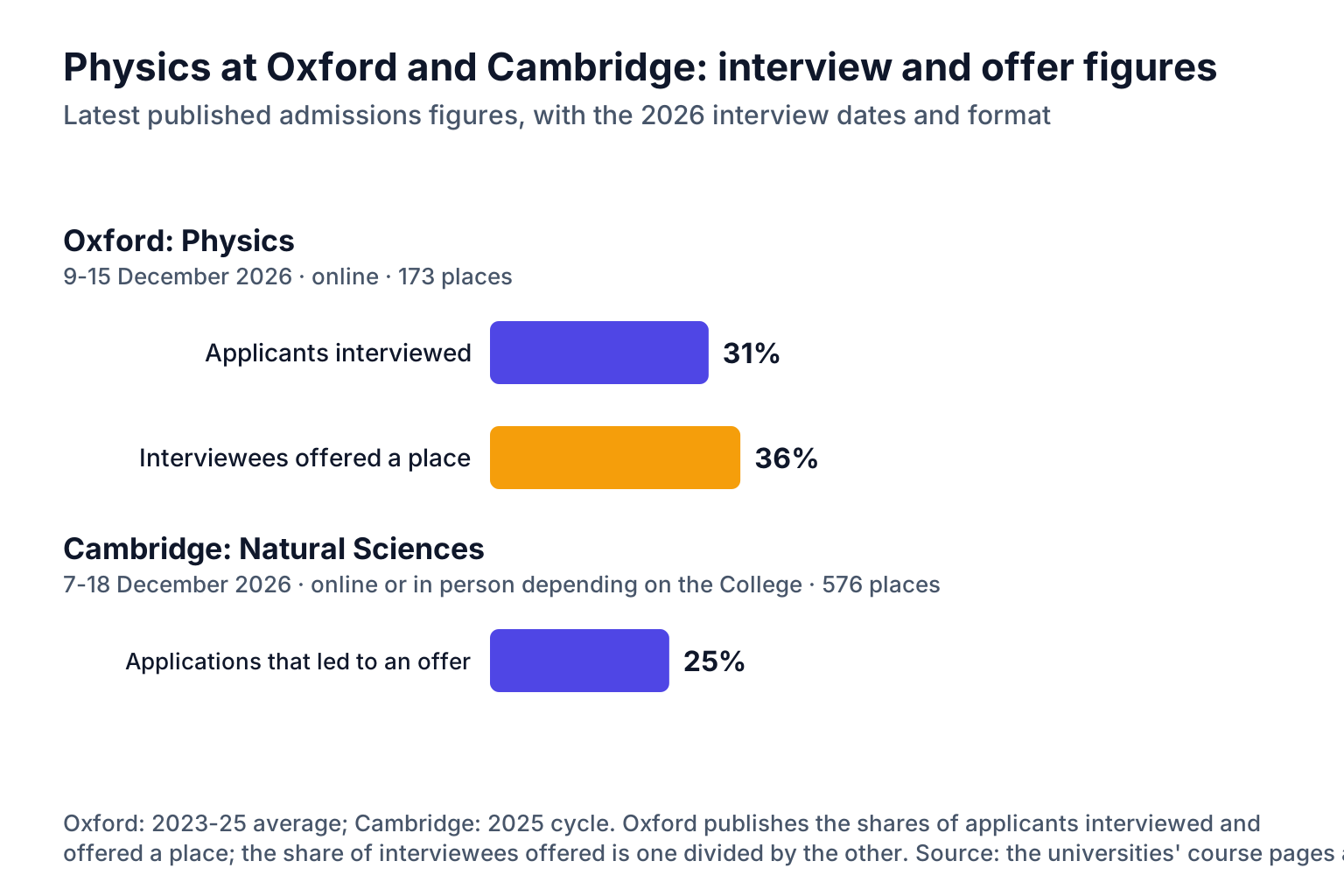
- Competition is real at both: Oxford interviewed 31% of Physics applicants and offered places to 36% of those interviewed (three-year average, 2023-25), while Cambridge Natural Sciences made 672 offers from 2,644 applications in the 2025 cycle.
- Pre-prepared answers do not help: A Cambridge college question pack warns that interview questions change each year and interviewers are not looking for rehearsed answers.
In This Article
- Oxford physics interview questions: what the interview actually is
- How the Oxford physics interview runs in December 2026
- How the Cambridge Natural Sciences physics interview runs
- Oxbridge physics interviews compared: where Oxford and Cambridge differ
- What tutors assess in an Oxford physics interview and at Cambridge
- Questions reported at Oxford and Cambridge Physics interviews, and practice questions
- How to work through physics interview questions out loud
- How to prepare for a Cambridge or Oxford physics interview
- Common mistakes in Oxbridge physics interviews
- What to do next before your physics interview
1. Oxford physics interview questions: what the interview actually is
Oxford physics interview questions are not a test of memorised facts. An Oxford or Cambridge physics interview is a set of maths and physics problems you work through aloud, often with a rough estimate or a quick sketch, in conversation with academic tutors who prompt, question and redirect you as you go.
At Oxford, the interviewers are Oxford academic tutors, typically two per interview, and the questions are mainly maths and physics. That balance mirrors the degree itself. The Oxford Physics course page says first-year time is split equally between mathematics and physics, so treat the maths in an Oxford physics interview as half the subject rather than a warm-up.
Cambridge describes its interviews as "academic conversations about the subject you're interested in studying". In a Cambridge Natural Sciences physics interview, subject interviews usually involve two or three interviewers. Not everyone interviewed gets an offer, but everyone made an offer will have been interviewed.
The material in front of you can take several forms:
- an unfamiliar physical scenario to model
- a graph to read, interpret or sketch
- a short passage to discuss
- a short proof to build step by step
The unfamiliarity is deliberate. Oxford says it is looking for the ability to apply basic principles to unfamiliar situations, so the interview tests reasoning you can do on the spot rather than answers you have rehearsed.
2. How the Oxford physics interview runs in December 2026
Oxford holds its Physics interviews online between 9 and 15 December 2026 (the Oxford interview dates guide lists every course). Every shortlisted applicant is interviewed, and the people on the other side of the screen are Oxford academic tutors, typically two per interview. The questions are mainly maths and physics.
How the interviews are arranged:
- First college: normally two interviews. Some colleges run one long interview or three short ones instead.
- Second college: one further interview at a college assigned at random.
- Before shortlisting: the ESAT admissions test.
The random second college has a practical consequence. You will usually meet at least two different sets of tutors, so it makes little sense to tailor your preparation to a single college. Prepare for the subject, not for the people.
The numbers behind the shortlist. According to Oxford's Physics course page, Physics admits 173 students a year on average (three-year average, 2023-25), and 31% of applicants are interviewed. The standard offer is A*AA, with the A* in Physics, Maths or Further Maths.
Of those interviewed, about 36% are offered a place, dividing one of Oxford's published shares by the other. That figure changes how the odds look. Across all applicants, the same page puts the success rate at 11%. Once you reach interview, your chances are closer to one in three. Most of the filtering has already happened by then, through your grades and the ESAT, before anyone hears you work through a problem.
Takeaway: if you are shortlisted, keep 9 to 15 December 2026 clear and plan for three interviews across two colleges. Test the online set-up you will use well before the first one.
3. How the Cambridge Natural Sciences physics interview runs
Cambridge has no standalone Physics degree for undergraduates. You apply for Natural Sciences, and your stream choice affects the types of questions you are asked. Cambridge advises the Physical stream if you take Physics and Maths A level, "because your interview will be on subjects that you have already studied" (Cambridge Natural Sciences). Physical-stream applicants are interviewed by physical sciences interviewers.
Dates and invitations. The main interview period is 7 to 18 December 2026, with winter pool interviews around mid to late January 2027. Most invitations arrive in November, some in early December. Each one states the time and place, what to bring, any pre-interview reading or tasks, and how to attend (Cambridge interviews).
Number, length and mode are set by each College:
- Most applicants have one or two interviews totalling 35 minutes to an hour. Some have three or four, and the number "does not relate to how strong your application is" (Cambridge interviews).
- Interviews are online or in person depending on the College, and you usually cannot choose. At Jesus College, for example, UK-based Natural Sciences (Physical) applicants interview in person. Churchill, Emmanuel, King's and Selwyn also interview in person; most other Colleges interview online or offer both.
- Subject interviews have two or three interviewers. A general academic interview may include academics from other subjects.
Before the interview, you sit the ESAT, a pre-registered admissions test. Written work is not usually required. Sidney Sussex describes its Natural Sciences interviews as "typically two short or one longer interview" involving "working through some science and maths problems" (Sidney Sussex College).
Read the numbers carefully. The 2025 cycle had 2,644 applications, 672 offers and 576 places, but these cover all of Natural Sciences. They do not show your odds in the physical stream.
4. Oxbridge physics interviews compared: where Oxford and Cambridge differ
The two processes look similar on paper but differ in mode, structure and how a second chance works. The table sets out the verified details side by side.
| Interview dates | Mode | Number of interviews | Who interviews | Admissions test | Extra round | |
|---|---|---|---|---|---|---|
| Oxford Physics | 9 to 15 December 2026 | Online | Normally 2 at the first college (sometimes 1 long or 3 short) | Oxford academic tutors, typically two per interview | ESAT | 1 interview at a randomly assigned second college |
| Cambridge Natural Sciences (Physical) | 7 to 18 December 2026 (main period) | Online or in person, set by the College | Varies by College: most have 1 to 2, some 3 to 4 | Two or three interviewers in subject interviews | ESAT (pre-registered) | Winter pool interviews, mid to late January 2027 |
Three differences matter most:
- Mode. Every Oxford physics interview is online. At Cambridge, each College sets the format, and you usually cannot choose. Check your invitation before booking travel.
- The extra interview. Oxford's second college is a standard step for shortlisted applicants. At Cambridge, an extra interview comes only if you enter the winter pool, and it may be at a different College. Cambridge also states that the number of interviews "does not relate to how strong your application is".
- Stream choice. Cambridge applicants pick Physical or Biological Sciences, and this choice shapes the questions asked at interview. If you take A-Level Physics and Maths, apply Physical.
5. What tutors assess in an Oxford physics interview and at Cambridge
Both universities publish what they look for, and neither list asks how many facts you can recall. Oxford says it wants "enthusiastic and highly-motivated students with the ability to apply basic principles to unfamiliar situations". For Natural Sciences, Cambridge lists understanding of the subject, readiness for high-level study, fit with the Cambridge learning environment, critical and independent thinking, curiosity and enthusiasm.
A 2023 Lucy Cavendish College interview preparation workshop breaks this down into four abilities:
- Fluency in expressing core knowledge and ideas
- Applying existing knowledge methodically to new situations
- Assimilating and applying new concepts
- Clarity of thinking and reasoning
The same workshop stresses that "no part of an application is considered in isolation". Your interview is read alongside your academic record, personal statement, teacher's reference, admissions test and contextual data. It also states plainly that the interview is not a memory or knowledge test.
What this means in physics
Unfamiliar problems are usually built from principles you already know from A level, such as forces, energy and waves. The skill being tested is choosing the right principle and applying it step by step, not recalling a fact. If a problem looks familiar, still say which principle you are using and why. A remembered answer with no reasoning shows the tutor very little of the "methodical" and "clarity" abilities above.
Why it feels like a teaching session
Oxford tutorials are usually given in colleges with two to four students and a tutor, and the Lucy Cavendish workshop notes that "Discussion is a key part of our supervision teaching" at Cambridge. The interview mirrors that format. Treat it as a small-group tutorial: talk through your reasoning, accept prompts, and build on them.
6. Questions reported at Oxford and Cambridge Physics interviews, and practice questions
Every question below can be traced to its source: one is published by the University of Oxford on the linked page; nine come from a practice pack Lucy Cavendish College, Cambridge, compiled to show the kind of question asked at Oxbridge interviews; and five were reported by applicants describing their own Physics interview (The Student Room reports are named but not linked). Tutors write new material each year, so read these for the kind of thinking they call for, not as a list to learn.
| Question | Reported at | Source |
|---|---|---|
| A ball, initially at rest, is pushed upwards by a constant force for a certain amount of time. Sketch the velocity of the ball as a function of time, from start to when it hits the ground. | Oxford | University of Oxford, published sample question |
| Can you sketch the sinc function, sin(x)/x? | Oxford | Applicant report, The Student Room (not linked) |
| Momentum is conserved, right? This marker has zero momentum, right? How do you explain that if it's conserved? | Oxford | Applicant report, The Student Room (not linked) |
| Why can many aeroplanes successfully fly upside down? | Oxford | Applicant report, The Student Room (not linked) |
| Could Felix Baumgartner have broken the sound barrier? | Cambridge | Applicant report, reasonabledeviations.com |
| How does air pressure vary as a function of height? | Cambridge | Applicant report, reasonabledeviations.com |
| Why do aeroplanes tilt to turn corners? | Oxbridge practice pack | Lucy Cavendish College, Cambridge, Oxbridge practice pack |
| Here is a blank graph. Sketch the curve of this equation: V(r) = A/r^12 - B/r^6 and then interpret the graph, differentiate the equation and label the minimum points. | Oxbridge practice pack | Lucy Cavendish College, Cambridge, Oxbridge practice pack |
| What height does a geostationary satellite need to be at? | Oxbridge practice pack | Lucy Cavendish College, Cambridge, Oxbridge practice pack |
| Why is it that in a sample of molecules, the energy given out in form of the electromagnetic spectra is less than that absorbed (Bearing in mind that in a sample of atoms it is the same)? How would the spectra be affected if an atom was bonded, as opposed to alone? | Oxbridge practice pack | Lucy Cavendish College, Cambridge, Oxbridge practice pack |
| If you had a cylinder, sealed at both ends, with the pressure rising inside, would it blow at the end or split along the side first? | Oxbridge practice pack | Lucy Cavendish College, Cambridge, Oxbridge practice pack |
| How hot does the air have to be in a hot air balloon if I wanted to use it to lift an elephant? | Oxbridge practice pack | Lucy Cavendish College, Cambridge, Oxbridge practice pack |
| Why is the pole-vaulting world record about 6.5m, and why can't it be broken? | Oxbridge practice pack | Lucy Cavendish College, Cambridge, Oxbridge practice pack |
| How would you design a gravity dam for holding back water? | Oxbridge practice pack | Lucy Cavendish College, Cambridge, Oxbridge practice pack |
| Seen from the Moon, the Earth has 3.6 times the angular diameter of the Sun. What is the ratio of densities of the Sun and the Earth? | Oxbridge practice pack | Lucy Cavendish College, Cambridge, Oxbridge practice pack |
Our dataset holds 183 further questions reported for these courses, mostly from preparation companies' lists and forum threads that cannot be traced to a university page or a first-hand account, so they are not reproduced here.
7. How to work through physics interview questions out loud
Tutors can only assess reasoning they hear. A right answer reached in silence tells them less than a half-finished method explained clearly, so the habit to build is narrating your physics as you go.
- Name the principle. Say whether you are reaching for conservation of energy, Newton's second law or a symmetry argument before you write anything down.
- State your assumptions. Ignoring air resistance or treating an object as a point mass is fine, as long as you say so out loud.
- Name what you would estimate. List the quantities you need and roughly how big each one is.
Treat a hint or challenge as part of the conversation. Changing your approach when a tutor pushes back is not a failure. The Lucy Cavendish interview workshop lists "assimilating and applying new concepts" among the abilities applicants are expected to show (Lucy Cavendish College). A challenge from a tutor gives you the opening to show it.
Use what you have been taught, not what you have memorised. The same workshop says interviews are not "a memory or knowledge test" (Lucy Cavendish College). Cambridge advises Natural Sciences applicants with Physics and Maths A levels to choose the Physical stream "because your interview will be on subjects that you have already studied" (University of Cambridge). Oxford looks for the ability to apply basic principles to unfamiliar situations. Reach for your A-level mechanics and calculus first.
Sketch, then sanity-check. A quick diagram or a rough graph with labelled axes often shows the shape of an answer before any algebra. At the end, check the order of magnitude. If the result is out by a factor of a million, say so and look for the slip.
Online, describe the page. Oxford physics interviews are held online, and some Cambridge Colleges also interview online. Say what you are writing or sketching as you do it, because the tutors may not see your paper clearly on screen.
8. How to prepare for a Cambridge or Oxford physics interview
Preparing for a Physics interview is less about guessing Oxford physics interview questions and more about using what you already know, out loud, while someone pushes back. Five areas deserve your time in the weeks before.
Re-read your personal statement. Any book, project or idea you mention may come up, so be ready to explain it in physics terms: the principle, the equation, the assumption. A summary is not enough. Cambridge Natural Sciences does not usually require written work, so for Cambridge your statement is likely to be the main piece of your own writing in front of the interviewers.
Practise unseen problems aloud. Work with someone who keeps asking "why?" after every step, even when you are right. The Lucy Cavendish College question pack points students who run out of practice material to free resources, including Isaac Physics and NRICH. It also warns that its questions are "NOT intended for you to prepare specific answers". The skill you are building is explaining your reasoning as you go, not memorising answers.
Look back at the ESAT. The ESAT comes before interviews at both universities. List the topics that slowed you down in it and revise them first. A gap that showed up in a timed test is still a gap in December.
Revise A level physics and maths, not university content. Cambridge advises Physics and Maths A level students to apply for Physical Sciences "because your interview will be on subjects that you have already studied" (University of Cambridge). Oxford's first-year core shows where the course goes next, but treat it as background, not interview content. It covers classical mechanics and special relativity; electromagnetism, circuit theory and optics; mathematical methods; and differential equations and waves (University of Oxford).
Set up a quiet online space. Oxford interviews are online for all shortlisted applicants. Many Cambridge Colleges also interview online, including Christ's, Downing and Girton, while others such as Churchill and King's interview in person (University of Cambridge). For an online interview you need:
- a quiet room where you won't be interrupted
- a stable internet connection
- a working camera and microphone
- plain paper and a pen for sketches and working
- a test call a few days before the interview
Your Cambridge invitation explains how to attend. If you need adjustments, request them through the College's "Adjustment at Interview" form (University of Cambridge).
9. Common mistakes in Oxbridge physics interviews
Most avoidable errors come from treating the interview as something to memorise or decode. Cambridge and Lucy Cavendish College, Cambridge, are explicit about each one.
- Rehearsing scripted answers. Even the Lucy Cavendish sciences and maths practice pack warns that its questions are "NOT intended for you to prepare specific answers ahead of your interview". It adds that questions change each year and "interviewers are not looking for pre-prepared answers" (Lucy Cavendish College). Use practice material to rehearse reasoning aloud, not to bank responses.
- Expecting a memory test or trick questions. A Lucy Cavendish workshop lists what interviews are not: trick questions with bizarre answers, a memory or knowledge test, scripted and identical for all applicants, a public speaking or debate contest, or a test of speech, dress or manners (Lucy Cavendish College workshop). Polished delivery and recalled facts are not what earns credit.
- Reading meaning into logistics. Cambridge says your interview time "does not reflect your perceived strength as a candidate". It also says the number of interviews "does not relate to how strong your application is" (University of Cambridge). One interview or three tells you nothing about your chances.
- Missing the window. Cambridge does not reschedule interviews except in exceptional circumstances, such as illness, hospital appointments, religious observance or exams. Applicants who do not attend are not considered (University of Cambridge).
Takeaway: treat any list of Oxford physics interview questions as practice in thinking aloud, not a script. Keep the whole interview period free, and ignore what the timetable seems to signal.
10. What to do next before your physics interview
Start with your diary. This week, keep 9 to 15 December 2026 completely free if you applied to Oxford, or 7 to 18 December 2026 for Cambridge. Oxford interviews you at a second, randomly assigned college as well as your first, so treat the whole window as taken. Cambridge interviews are not rescheduled except in exceptional circumstances, and applicants who do not attend are not considered (University of Cambridge).
Then watch your inbox, including spam. A Cambridge invitation lists the time, how to attend and any pre-interview reading or tasks.
In the fortnight before:
- Work through one session of unseen problems aloud with someone who keeps asking why.
- Re-read your personal statement.
- Test your camera, microphone and connection in the room you will use.
Check your email daily from this week. Read any invitation the day it arrives.
Related guides
- Oxford interview and offer rates by course
- Cambridge interview dates 2026
- What a Cambridge interview is like
- Cambridge offer rates by course
- Oxbridge engineering interview questions
- Cambridge Natural Sciences interview questions
- Every Oxbridge and medicine interview guide
Course pages
Entry requirements and the latest admissions figures: Oxford Physics and Cambridge Natural Sciences.
FAQ
How do I prepare for an Oxford physics interview?
Practise unfamiliar maths and physics problems aloud, re-read your personal statement and test your online set-up, because Oxford Physics interviews are online and look for the ability to apply basic principles to unfamiliar situations.
Are Oxford physics interviews online?
Yes, Oxford's Physics course page lists the 2026 interviews, held 9 to 15 December 2026, as online, with typically two Oxford academic tutors per interview.
How many interviews do you get for Oxford Physics?
Normally two at your first college (sometimes one long or three short) plus one at a randomly assigned second college, according to Oxford's Physics course page.
What percentage of Oxford Physics applicants get an interview?
Oxford interviewed 31% of Physics applicants and offered places to 36% of those interviewed, on a three-year average for 2023-25, with an average of 173 places.
Are Cambridge Natural Sciences interviews online or in person?
It depends on the College, which sets the format and usually does not let applicants choose, so check your invitation for how to attend.
Is Oxford good for physics?
Oxford describes its Physics course as 'challenging and mathematical with a strong emphasis on fundamental concepts such as optics and relativity', taught across six sub-departments with a four-year MPhys or three-year BA.
References
- Physics | Oxford University - https://www.ox.ac.uk/admissions/undergraduate/courses/course-listing/physics
- What to expect at your Cambridge interview | Undergraduate Study - https://www.undergraduate.study.cam.ac.uk/apply/after/cambridge-interviews
- Natural Sciences, BA (Hons) and MSci | Undergraduate Study - https://www.undergraduate.study.cam.ac.uk/courses/natural-sciences-ba-hons-msci
- Study Natural Sciences | Sidney Sussex College Cambridge - https://www.sid.cam.ac.uk/apply/subjects/natural-sciences
- Undergraduate Admissions Statistics, 2025 cycle, University of Cambridge - https://www.undergraduate.study.cam.ac.uk/sites/default/files/2026-05/ug_admissions_statistics_2025_cycle.pdf
- Interview preparation workshop 2023, Lucy Cavendish College - https://www.lucy.cam.ac.uk/sites/default/files/inline-files/Interview%20Preparation%20Workshop%20-%202023.pdf
- University of Oxford, published sample question - https://www.ox.ac.uk/admissions/undergraduate/applying/guide-for-applicants/interviews/sample_questions
- Applicant report: reasonabledeviations.com - https://reasonabledeviations.com/2017/05/01/cambridge-natsci-interview/
- Interview question pack (sciences and maths), Lucy Cavendish College - https://www.lucy.cam.ac.uk/sites/default/files/inline-files/Interview%20Question%20Pack%20%28Sciences%20&%20Maths%29.pdf