Oxford Biology Interview Questions: Format and Real Tasks
By Michael Thompson · Education Specialist; 10 years teaching the IB at Bromsgrove School · Published 27 October 2026 · Updated 28 October 2026
Oxford biology interview questions are less a quiz than a live problem-solving session. Shortlisted applicants talk online with Oxford academic tutors, usually two per interview, about an unfamiliar biological problem or a data figure and reason through it aloud. Biology applicants have two interviews at two different colleges between 7 and 11 December 2026, per the Oxford Biology course page. Biomedical Sciences and Biochemistry follow a similar pattern with their own dates, pre-reading and admissions test. Oxford's course page gives no interview length. This guide sets out the format for each course, what tutors say they are assessing in their own words, and how to prepare in the weeks before December.
Key Takeaways
- All three courses interview online: Biology, Biomedical Sciences and Biochemistry interviews are online, run by Oxford academic tutors, typically two per interview.
- Biology means two interviews at two colleges: Biology and Biochemistry applicants have two interviews at different colleges, while Biomedical Sciences applicants have at least one.
- Expect unfamiliar material: Biology interviews are likely to include a data figure, and Biochemistry interviews involve working through problems on paper or an interactive whiteboard.
- The right answer is not the point: An Oxford tutor writes that 'getting the correct answer isn't important here'; tutors watch how you apply what you know and justify it.
- Interview odds are roughly one in three: Over 2023-25, 33% of interviewed Biology and Biomedical Sciences applicants and 29% of interviewed Biochemistry applicants received an offer.
- Practise reasoning, not scripts: Rehearse thinking aloud on unseen material with someone who keeps asking why, rather than memorising answers.
In This Article
- What an Oxford Biology interview involves
- Oxford biology interview questions: format across the three courses
- Questions reported at Oxford biological sciences interviews
- What you are handed in an Oxford biological sciences interview
- What tutors assess in the Oxford Biology interview
- How competitive the interview stage is for each course
- How to prepare in the weeks before your interview
- Common mistakes tutors and admissions staff describe
- What to do next
1. What an Oxford Biology interview involves
Oxford Biology interview questions test what you do with something new, not what you have already memorised. You are given unfamiliar biological material, a problem or a data figure, and asked to reason about it aloud with academic tutors. The job is to think in front of people who study biology for a living. Explaining each step, checking it against the evidence in front of you and adjusting when a tutor pushes back matter more than reaching a neat final answer.
According to the Oxford Biology course page, all shortlisted applicants are interviewed online by Oxford academic tutors, typically two per interview. Questions on your UCAS form can come up, and you are likely to discuss a data figure.
How long does it last? Oxford's course page does not say. For comparison, a Lucy Cavendish College interview workshop puts Cambridge interviews at 20 to 40 minutes, usually with two interviewers.
The course page states what tutors assess in plain terms: your interest in biology and how you respond to an unfamiliar biological problem. Facts you have learnt for A-Level or IB Biology are raw material for that reasoning, not the thing being marked.
One practical detail is easy to miss. The same course page lists about an hour of tutorials a week in Year 1, depending on the college. An Oxford Biology interview looks a lot like a short version of that tutorial format.
Takeaway: treat the interview as a tutorial-style conversation, not a recall test.
2. Oxford biology interview questions: format across the three courses
Oxford runs three overlapping courses in the life sciences, and the interview format is not identical across them. Before you look at any Oxford biology interview questions, check which column below applies to you. The table gathers every format difference in one place so the rest of this guide can treat the three courses together.
| Biology (C100) | Biomedical Sciences (BC98) | Biochemistry (Molecular and Cellular) (C700) | |
|---|---|---|---|
| 2026 interview dates | 7-11 Dec 2026 | 9-10 Dec 2026 | 7-10 Dec 2026 |
| Number of interviews | 2, at two different colleges | At least 1 | 2, at two different colleges |
| Mode | Online | Online | Online |
| Interviewers | Oxford academic tutors, typically two per interview | Oxford academic tutors, typically two per interview | Oxford academic tutors, typically two per interview |
| At or before the interview | Questions on your UCAS form; likely discussion of a data figure | None listed on the course page | Problems worked on paper or an interactive whiteboard; a short article to read beforehand in some interviews |
| Other steps | None listed on the course page | ESAT admissions test | None listed on the course page |
Three details are easy to miss:
- Biomedical Sciences has the shortest window. At two days, it sits inside both other windows, and only one interview is guaranteed. Biomedical Sciences applicants will already have sat the ESAT, which the other two courses do not list.
- Biochemistry finishes a day before Biology. If you are comparing the two courses, do not assume the same final day.
- Biochemistry may send reading in advance. Because only some interviews include an article, keep your inbox and calendar clear in the days before your slot, not just on the day itself.
Every course is interviewed online, so you will not be travelling to Oxford for this stage. Neither the Biology nor the Biochemistry course page lists an admissions test or written work.
Takeaway: write your course's interview window in your diary now, and block out the whole range, not a single day.
3. Questions reported at Oxford biological sciences interviews
Every question below can be traced to its source: eleven are published by the University of Oxford on the linked page, and three were reported by applicants describing their own biological sciences interview (The Student Room reports are named but not linked). Tutors write new material each year, so read these for the kind of thinking they call for, not as a list to learn.
| Question | Reported at | Source |
|---|---|---|
| Why is sugar in your urine a good indicator that you might have diabetes? | Oxford | University of Oxford, published sample question |
| Is it easier for organisms to live in the sea or on land? | Oxford | University of Oxford, published sample question |
| Here's a cactus. Tell me about it. | Oxford | University of Oxford, published sample question |
| Why do some habitats support higher biodiversity than others? | Oxford | University of Oxford, published sample question |
| Would you expect this compound to be more soluble in octanol or water? (The student will be shown the structure of an organic compound with functional groups that they will be familiar with from A-level/IB studies). | Oxford | University of Oxford, published sample question |
| Why do many animals have stripes? | Oxford | University of Oxford, published sample question |
| Would it matter if tigers became extinct? | Oxford | University of Oxford, published sample question |
| Why do lions have manes? | Oxford | University of Oxford, published sample question |
| If you could save either the rainforests or the coral reefs, which would you choose? | Oxford | University of Oxford, published sample question |
| Why do a cat's eyes appear to 'glow' in the dark? | Oxford | University of Oxford, published sample question |
| Ladybirds are red. So are strawberries. Why? | Oxford | University of Oxford, published sample question |
| What is the sequence of events from an insulin molecule arriving outside a liver cell to its effect inside the cell? | Oxford | Applicant report, The Student Room (not linked) |
| What is the most electronegative atom in this peptide? | Oxford | Applicant report, The Student Room (not linked) |
| Draw an amino acid on the whiteboard. | Oxford | Applicant report, The Student Room (not linked) |
Our dataset holds 132 further questions reported for these courses, mostly from preparation companies' lists and forum threads that cannot be traced to a university page or a first-hand account, so they are not reproduced here.
4. What you are handed in an Oxford biological sciences interview
The material on the table differs by course, so check which of the three you have applied for before you practise.
| Course | Before the interview | In the interview |
|---|---|---|
| Biology | Nothing extra beyond your application | Discussion of your UCAS form and, likely, a data figure (Biology course page) |
| Biochemistry | A short article to read, for some interviews | Problems worked through on paper or an interactive whiteboard (Biochemistry course page) |
| Biomedical Sciences | The ESAT admissions test | Not described on the course page (Biomedical Sciences course page) |
The best public illustration of a handed-over task is a Biochemistry one. On Oxford's sample interview questions page, a Christ Church tutor describes showing candidates an organic compound whose functional groups are familiar from A-level or IB Chemistry and asking them to reason about its solubility. The extension moves to interpreting a graph of relative octanol/aqueous solubility against pH. The tutor states that "getting the correct answer isn't important here". What counts is how you apply chemistry you already know to something unfamiliar. Oxford says the questions on that page "come direct from the tutors who conduct the interviews" (Oxford).
Biology applicants should not skip this example. Their own interview is likely to include a data figure, and the skill is the same: read the axes, describe the trend, then explain it. Oxford's own Biology examples, in the table above, show the same habit: describe what is in front of you, then explain it.
Practise reading graphs you have never seen before, and sketch your reasoning on paper or on a shared screen as you talk.
5. What tutors assess in the Oxford Biology interview
Oxford describes what it is looking for in different words for each course. The Biology course page names interest in biology and response to an unfamiliar biological problem. Biomedical Sciences looks for "lively, receptive minds with the ability to evaluate evidence critically". Biochemistry asks for "an informed interest in the subject", which it says can come from podcasts, videos, books, magazine articles and similar sources. That last point is easy to miss: reading and listening outside the A-level or IB syllabus counts as evidence.
The clearest description of how this works in the room comes from Oxford's sample interview questions page. Kathryn Scott of Christ Church describes a Biochemistry solubility problem built around an organic compound. She states that "getting the correct answer isn't important here." Tutors watch how candidates:
- apply their chemical knowledge to an unfamiliar problem
- justify their conclusions
- consider alternatives
She calls it "a good approach" to analyse each functional group separately before considering the whole molecule. Candidates who struggle are not left stuck. They are asked to describe the types of intermolecular interactions and their relative strengths, then to think about how the compound would interact with each solvent. The prompt points back to first principles, not to the answer. The tutor is showing you a method and watching whether you can use it.
In practice, this means:
- Think aloud. Tutors can only assess reasoning they can hear.
- Treat a prompt as help. It is part of the design, not a sign you have failed.
- Change your mind openly when new evidence or a hint pushes you, and say why.
- Build from what you were taught. Start from A-level or IB principles such as bonding, enzyme kinetics or inheritance, rather than searching your memory for a fact.
A 2023 interview workshop from Lucy Cavendish College, Cambridge lists similar skills: applying existing knowledge methodically to new situations, assimilating new concepts, and clarity of reasoning.
When you practise Oxford Biology interview questions, judge yourself on whether you explained each step aloud, not on whether you reached the right answer.
6. How competitive the interview stage is for each course
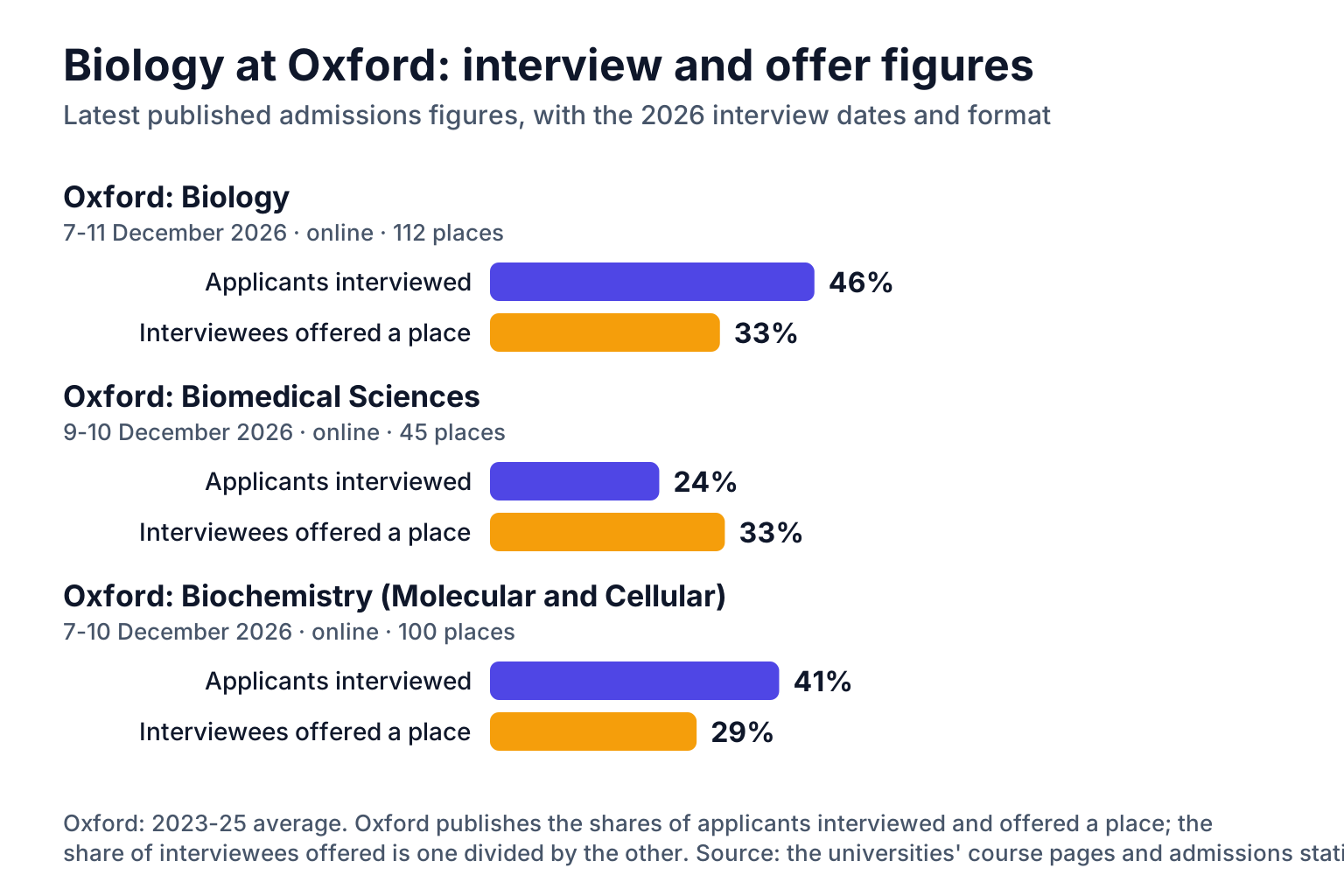
The figures below are Oxford's three-year averages for 2023-25. The columns use two different denominators. "Applicants interviewed" and "applicants successful" are shares of everyone who applied. "Interviewees offered" is a share of only those who reached interview, calculated by dividing one published share by the other.
| Course | Average intake | Applicants interviewed | Interviewees offered | Applicants successful |
|---|---|---|---|---|
| Biology | 112 | 46% | 33% | 15% |
| Biomedical Sciences | 45 | 24% | 33% | 8% |
| Biochemistry | 100 | 41% | 29% | 12% |
Biomedical Sciences interviews the smallest share of applicants. Once you are interviewed, though, its offer rate matches Biology's. Most of its sifting happens before December, which is where the ESAT admissions test comes in.
All three courses ask for A*AA, but each adds its own conditions:
- Biology: the A* must be in a science or Maths.
- Biomedical Sciences: Critical Thinking and Thinking Skills do not count.
- Biochemistry: you need Chemistry plus another science or Maths, with the A* in Maths, Physics, Chemistry or Biology, or a very closely related subject.
Grades alone do not decide the outcome. An interview workshop from Lucy Cavendish College, Cambridge puts it plainly: "No part of an application is considered in isolation."
Reaching an Oxford Biology interview puts you in a pool where roughly one in three receive an offer. The interview is worth preparing for properly.
7. How to prepare in the weeks before your interview
Start with what you have already sent. Tutors on the Biology course ask about your UCAS form, so re-read your personal statement and any written work you submitted, and be ready to explain or extend anything you mention. Oxford's sample questions page makes the same point, although in a different subject: an Asian and Middle Eastern Studies tutor notes that questions are tailored to each candidate's UCAS form and submitted work (University of Oxford). If you named a book or topic, expect to go one step beyond the sentence you wrote.
Practise unseen material out loud, with someone who keeps asking why. A parent, teacher or friend can hand you a graph, a short passage or a problem you have not seen, then interrupt. Work on paper, because Biology interviews are likely to include a data figure and Biochemistry interviews involve working through problems on paper or an interactive whiteboard. Practise being prompted, too. In Oxford's published Biochemistry example, candidates who struggle are steered towards intermolecular interactions, and a good approach is described as analysing each functional group separately before considering the whole molecule (University of Oxford). The skill to rehearse is taking a hint and revising your answer aloud, not defending your first guess. Memorising answers to lists of biology interview questions, university by university, does little for this.
Course-specific preparation:
- Biochemistry: tutors look for an informed interest drawn from podcasts, videos, books and magazine articles, and some interviews include a short article to read beforehand. Practise reading a short piece, summarising it in two minutes, then discussing what the evidence does and does not show.
- Biomedical Sciences: the ESAT admissions test is part of the process and is sat before shortlisting, so the maths and science you revised for it is good material to talk through aloud.
- Biology: be comfortable describing trends, outliers and possible explanations in a figure you have never seen.
Set up your online interview space early. All three courses interview online, so test the following a few days before, not on the morning:
- a quiet room where you will not be interrupted
- a stable internet connection
- a working camera and microphone
- paper and a pen within reach
- the whiteboard tool, if one is used, tried out in advance
On clothing, a Cambridge College workshop on Oxbridge interviews advises applicants to "wear whatever you feel comfortable in" (Lucy Cavendish College). Spend the energy on reasoning practice instead.
8. Common mistakes tutors and admissions staff describe
Two of the sources below come from Lucy Cavendish College, a Cambridge College, and cover Oxbridge interviews in general rather than Oxford Biology specifically. The third is Oxford's own sample questions page, written by the tutors who interview.
- Rehearsing scripted answers. The Lucy Cavendish question pack says its prompts are "NOT intended for you to prepare specific answers" because "interview questions change each year and interviewers are not looking for pre-prepared answers." Use practice material to rehearse reasoning aloud, not to build a bank of replies.
- Treating it as a memory test or a trap. The Lucy Cavendish workshop states that interviews are not trick-question sessions or memory tests, and are not scripted or identical for all applicants. It ties the format to teaching: "discussion is a key part of our supervision teaching."
- Chasing the right answer. On Oxford's sample interview questions page, Kathryn Scott of Christ Church says of a Biochemistry solubility problem that "getting the correct answer isn't important here." Tutors watch how you apply knowledge to an unfamiliar problem, justify your conclusions and consider alternatives. The same page describes tutors prompting candidates who struggle, so a hint is part of the exercise, not a sign you have failed. Take it and keep reasoning.
- Assuming paid coaching holds inside knowledge. The Lucy Cavendish workshop says such companies "do not have access to any information that's not freely available."
The fix for all four is the same: practise thinking out loud on unseen material, not memorising answers.
9. What to do next
This week, open the course page for your course and write your interview window somewhere you will see it daily. Biology runs 7-11 Dec 2026, Biomedical Sciences 9-10 Dec 2026 and Biochemistry 7-10 Dec 2026. The Biomedical Sciences window is only two days long, so keep both days clear. Then re-read your personal statement with a pen in hand and mark every claim a tutor could ask you to expand on.
In the fortnight before your interview:
- Run at least two unseen-graph sessions aloud with someone who keeps asking why. Biology interviews are likely to include a data figure.
- Test your online set-up in the room you will use. If you are a Biochemistry applicant, have paper and a pen ready, because you may work through problems on paper.
Book both practice sessions in your diary today. Check your camera, sound and desk in that room before 1 December.
Related guides
- Oxford interview dates 2026, every course
- What an Oxford interview is like
- Oxford interview and offer rates by course
- Cambridge Natural Sciences interview questions
- Oxford and Cambridge medicine interviews
- Every Oxbridge and medicine interview guide
Course pages
Entry requirements and the latest admissions figures: Oxford Biology, Oxford Biomedical Sciences and Oxford Biochemistry (Molecular and Cellular).
FAQ
Are Oxford Biology interview questions hard?
They are built around unfamiliar problems so tutors can watch you reason, and an Oxford tutor states that getting the correct answer isn't important; over 2023-25, 33% of interviewed Biology applicants received an offer.
Can you prepare answers to Oxford Biology interview questions?
Not usefully: the Lucy Cavendish College question pack says interview questions change each year and interviewers are not looking for pre-prepared answers, so practise reasoning aloud instead.
Are Oxford Biology interviews online?
Yes, the Oxford course pages list the interviews for Biology, Biomedical Sciences and Biochemistry as online, run by Oxford academic tutors, typically two per interview.
How many interviews do you have for Oxford Biology?
Biology applicants have two interviews at two different colleges, as do Biochemistry applicants, while Biomedical Sciences applicants have at least one.
How do you prepare for an Oxford interview?
Re-read your personal statement and any submitted work, practise unseen graphs and problems aloud with someone who asks why, and set up a quiet room for an online interview.
References
- Biology | Oxford University - https://www.ox.ac.uk/admissions/undergraduate/courses/course-listing/biology
- Interview preparation workshop 2023, Lucy Cavendish College - https://www.lucy.cam.ac.uk/sites/default/files/inline-files/Interview%20Preparation%20Workshop%20-%202023.pdf
- Biomedical Sciences | Oxford University - https://www.ox.ac.uk/admissions/undergraduate/courses/course-listing/biomedical-sciences
- Biochemistry (Molecular and Cellular) | Oxford University - https://www.ox.ac.uk/admissions/undergraduate/courses/course-listing/biochemistry-molecular-and-cellular
- Sample interview questions | Oxford University - https://www.ox.ac.uk/admissions/undergraduate/applying/guide-for-applicants/interviews/sample_questions
- Interview question pack (sciences and maths), Lucy Cavendish College - https://www.lucy.cam.ac.uk/sites/default/files/inline-files/Interview%20Question%20Pack%20%28Sciences%20&%20Maths%29.pdf