IB Revision Timetable: How to Plan Your Study Schedule
By Michael Thompson · Education Specialist; 10 years teaching the IB at Bromsgrove School · Published 21 May 2026 · Updated 6 October 2026
An IB revision timetable is a week-by-week study schedule that maps your revision across all six IB subjects, your Internal Assessments, the Extended Essay, and Theory of Knowledge in the weeks before your exams. Most students underestimate how differently this works from A-Level planning: you are balancing Higher Level and Standard Level papers across very different disciplines simultaneously, often while still submitting coursework. Getting the structure right early - rather than scrambling two weeks before your first paper - is what separates students who feel prepared from those who do not. This guide gives you a concrete method: when to start, how to allocate time, when to shift to past papers, and which mistakes to cut out before they cost you grades.
Key Takeaways
- Start 8-12 weeks out for May, 6-10 for November: The May session sits alongside ongoing IB coursework deadlines, so you need the longer runway.
- Rotate subjects daily rather than blocking a whole day on one: Spaced repetition across subjects builds retention better than marathon single-subject sessions.
- Switch to past papers at roughly the midpoint of your timetable: Past papers reveal command words, mark allocation, and timing - information content review alone cannot give you.
- Weight your time toward Higher Level subjects and known weak points: HL papers carry more marks and more complexity; Standard Level subjects still need attention but typically less time per week.
- Build in at least one full rest day per week from the start: Timetables with no slack collapse under the first missed session; a planned break day is not wasted time.
- Over-planning is a real mistake: A timetable with 12 colour-coded subjects and 45-minute micro-slots rarely survives contact with actual school life - simpler is more durable.
In This Article
- When to Start Your IB Revision Timetable
- How to Balance Six Subjects, IAs, EE, and TOK in One Plan
- Subject Rotation: Why Daily Variety Beats Single-Subject Blocks
- IB Subject Revision Priority List: Where to Focus First
- Past Paper Schedule: When and How to Use Past Papers
- Common IB Timetable Mistakes to Cut Out Now
- IB Revision Timetable Template: A Simple Weekly Format
- What to Do Next
1. When to Start Your IB Revision Timetable
Most students sit down to build an IB revision timetable far too late, then spend the first two weeks of it catching up on content they should have consolidated months earlier. The fix is straightforward: treat the timetable as something you build before you feel the pressure, not after.
For the May session, aim to start 8 to 12 weeks before your first paper, which puts your start date in early to mid-February. That window is longer than it looks, because the first several weeks will overlap with internal deadlines: Individual Oral confirmations for Language A and B, final Internal Assessment submissions, Extended Essay sign-off, and the Theory of Knowledge exhibition. You will not get eight clean weeks of revision. You will get eight weeks that also contain a significant amount of IB Diploma Programme coursework administration.
For the November session, the equivalent window is 6 to 10 weeks out, typically late August or early September, which means starting before most students feel like summer is properly over.
The non-obvious quirk worth knowing: the May session's longer lead time can create a false sense of security. February feels distant from May. Students who start in February but treat the first three weeks loosely often end up with the same effective revision time as someone who started in March.
Before you block out a single study hour, pull your school's internal deadline calendar. Schools set their own IA and EE submission dates, which are almost always earlier than the IBO's official deadlines. Your timetable has to fit around those fixed points, not the other way around.
2. How to Balance Six Subjects, IAs, EE, and TOK in One Plan
The hidden problem with most IB revision plans is that they treat revision as the only thing competing for study time. It is not. Internal assessments, the Extended Essay, and TOK commitments are running in parallel, and they will eat your revision hours if you do not account for them explicitly from the start.
Build a master calendar before you touch a revision timetable. List every component deadline across all six subjects: IA first drafts, final IA submissions, individual oral dates for Language and Literature or Language Acquisition, and any lab reports for Group 4 subjects. These are hard deadlines set by your school, not by you. Slot them onto a shared calendar first, then fit revision around them.
The counter-intuitive trade-off most students miss: finishing an IA during revision season costs more time than finishing it early, because switching between active writing and passive recall breaks both tasks. Treat coursework completion and revision as separate cognitive modes and protect each with its own blocks.
For TOK specifically, the exhibition and the essay have school submission windows that vary by institution but typically fall before or during the main revision period. If you do not assign them explicit weekly slots, revision pressure will crowd them out entirely.
If your Extended Essay is unsubmitted when revision begins, it needs a fixed weekly block, typically a few hours, kept completely separate from subject revision time. Mixing the two means neither gets done properly.
A rough weekly hour split to use as a starting framework:
- HL subjects: the largest share of revision hours, proportional to exam weighting
- SL subjects: meaningfully fewer hours than HL, but not neglected
- EE and TOK: protected slots, not borrowed from subject time
- IA and coursework: scheduled as tasks with deadlines, not fitted in ad hoc
Adjust this split as deadlines approach, but keep the protected coursework slots fixed.
3. Subject Rotation: Why Daily Variety Beats Single-Subject Blocks
Spending an entire day on History might feel disciplined, but it works against how memory consolidates. The cognitive mechanism at play is interleaving: practising multiple distinct subjects in sequence forces your brain to retrieve and re-apply knowledge repeatedly, which strengthens long-term retention more than massed repetition of a single topic. A related principle, spaced practice, means each subject benefits from a gap before you return to it, so the slight difficulty of picking it back up is doing useful memory work.
The practical format that follows from this is straightforward. Aim for two or three subjects per day in blocks of 45 to 90 minutes each, rather than one subject across a full afternoon.
A sensible daily pairing might look like this:
- Morning: a humanities subject (History, Economics, Language A)
- Afternoon: a science or experimental subject (Biology, Chemistry, Physics)
- Evening (shorter session): Mathematics or a second language
Pairing subjects with different cognitive demands reduces fatigue. Moving from an essay-based subject to a problem-set subject is less draining than doing two essay subjects back to back.
The counter-intuitive gotcha: single-subject marathon days produce false fluency. You feel confident by 5 p.m. because the material is still active in working memory, not because it has been stored. Test yourself a week later and that confidence evaporates.
Use a weekly rotation grid to make sure every subject gets at least two separate sessions per week. Map it out before the week starts, so you are not deciding in the moment which subject to open.
4. IB Subject Revision Priority List: Where to Focus First
Not all six subjects deserve equal time, and treating them equally is one of the most common ways students leave points on the table.
Rank your subjects across three factors before you allocate a single study hour:
- HL vs SL weighting. Higher Level subjects carry larger syllabuses and more teaching hours, although every subject, HL or SL, is worth up to 7 points. HL Sciences (Group 4) and HL Individuals and Societies subjects (Group 3) are particularly demanding in volume. HL Chemistry alone adds a block of HL-only topics to an already extensive shared core. If you are taking three HLs, they should dominate your timetable by default.
- Current grade vs target grade. A subject where you are sitting at a 4 and need a 6 for your university conditional offer is higher priority than a subject where you are comfortably at a 6. The gap is the signal, not the raw grade.
- Syllabus volume. Some subjects have a narrow, deep syllabus (Mathematics: Analysis and Approaches); others sprawl (History, Biology). A wider syllabus means weak spots are easier to miss and harder to recover quickly.
The counter-intuitive trap is this: students routinely over-invest in their strongest subject because the material feels comfortable and the session feels productive. That is not revision, it is reassurance.
Build a simple priority matrix. Put subjects where the grade gap is large and the syllabus is broad at the top. Work down from there.
Once subjects are ranked, go one level deeper: use mark schemes and teacher feedback to identify the specific topics dragging your grade down within each subject, not the subject as a whole. A student scoring 5 in Economics is rarely weak across the whole paper. More often, two or three command terms (evaluate, discuss) are costing marks on Paper 3. Fix the topic, not the subject.
5. Past Paper Schedule: When and How to Use Past Papers
Most students treat past papers as a revision tool. The more accurate framing: they are a separate skill set that must be practised under exam conditions, not just read through.
Phase 1 (first half of your timetable) is for content. Build notes, condense them, make topic flashcards, and fill knowledge gaps. Past papers in this phase are useful only for orientation, reading a paper cover to cover to understand its structure, the number of sections, and which questions are compulsory.
Phase 2 (midpoint onward) is when timed paper practice should begin in earnest. Sit each paper in a quiet space, remove any non-permitted materials, and set a timer for the exact exam duration. BBC Bitesize recommends this exam-condition approach specifically because it trains time management alongside content recall.
One non-obvious detail worth your attention: command words determine the depth of answer required, not the topic. Per BBC Bitesize, a question using "list" with 3 marks allocated typically requires exactly three correct items. Writing four does not earn a fourth mark. The IB uses command words such as "analyse", "evaluate", and "outline" in ways that carry specific mark-scheme definitions - these distinctions are invisible in your notes but become clear only through mark-scheme reading.
After each timed attempt, self-mark against the official mark scheme and log recurring errors. Those patterns tell you which topics still need time in Phase 1-style review.
Where to find IB past papers: ask your IB coordinator, or access them through your school's Follett Shelf subscription. Papers are not freely available online through official IB channels.
6. Common IB Timetable Mistakes to Cut Out Now
Most IB revision timetables fail not because the student ran out of time, but because the plan was broken from the start. Here are the mistakes worth cutting before they cost you.
Over-planning the grid. A colour-coded hourly schedule covering all six subjects, IAs, EE, and TOK looks thorough. It usually collapses by day three, because it leaves no slack for a session that runs long or a concept that needs re-reading. Build a looser structure: time blocks with subject labels, not minute-by-minute slots.
Revising the subjects you already know. Comfortable subjects feel productive. They rarely move your grade. Weak subjects and low-scoring SL topics deserve the first slots of the day, when concentration is highest, not the ones you fill with familiar material.
No rest days. Revision without rest degrades retention. Schedule at least one full day off each week, not as a reward, but as a fixed fixture. Skipping it to "catch up" tends to reduce the quality of the following week's sessions, not improve outcomes.
Treating the timetable as fixed. Build a 15-minute weekly review into your plan, typically Sunday evening. Anything that didn't get done needs to be rescheduled, not quietly dropped.
Leaving IAs, EE, and TOK out entirely. These components carry real marks. If they're not on the timetable, revision will crowd them out. Add them as named blocks.
Starting past papers in the final week. This is the counter-intuitive one: past papers are diagnostic tools, not finishing touches. Run them from eight weeks out so you have time to act on what they reveal.
7. IB Revision Timetable Template: A Simple Weekly Format
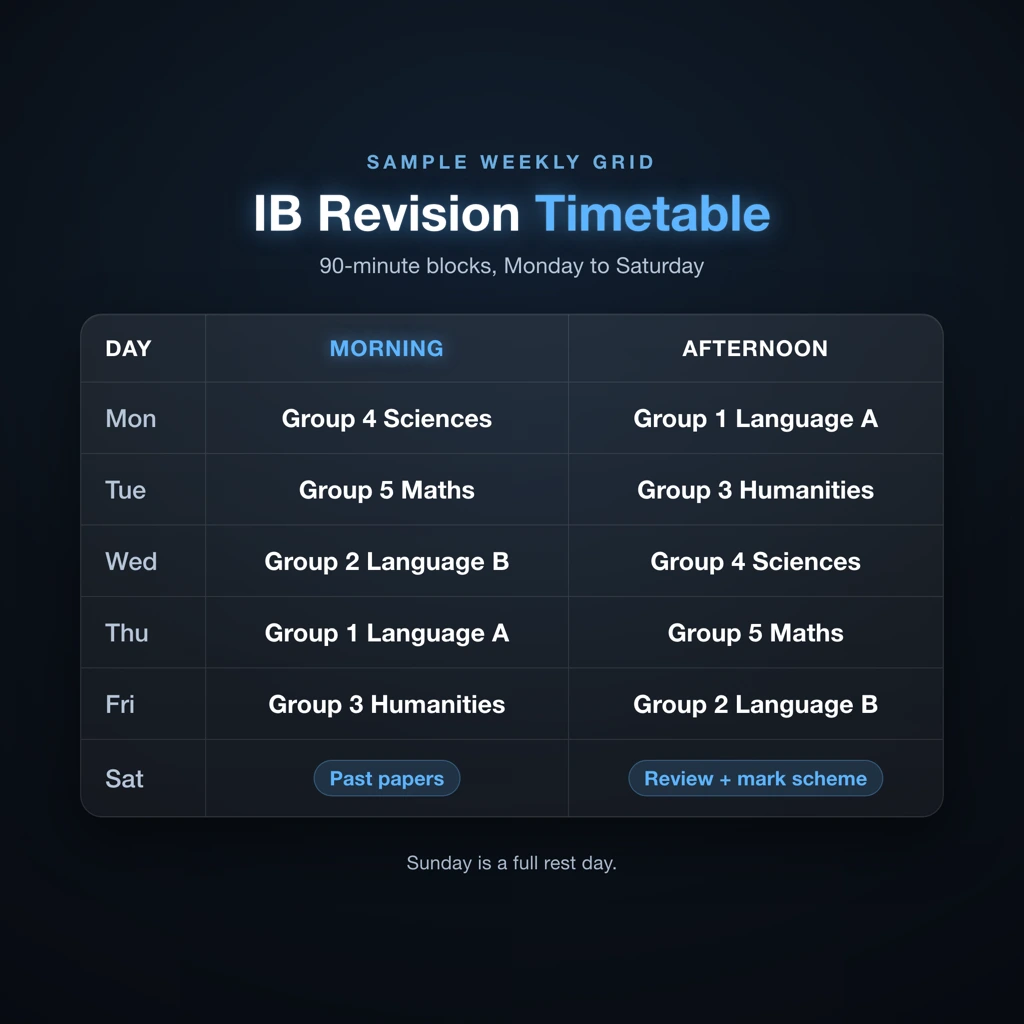
A working IB revision timetable does not need to be elaborate. Two or three subjects per day, in 45-90 minute blocks, with one full rest day is enough structure to cover all six subjects across a week without grinding to a halt.
Here is a simple Mon-Sat grid that rotates subjects and leaves Sunday free:
| Day | Morning (90 min) | Afternoon (90 min) |
|---|---|---|
| Monday | Group 4 (Sciences) | Group 1 (Language A) |
| Tuesday | Group 5 (Maths) | Group 3 (Humanities) |
| Wednesday | Group 2 (Language B) | Group 4 (Sciences) |
| Thursday | Group 1 (Language A) | Group 5 (Maths) |
| Friday | Group 3 (Humanities) | Group 2 (Language B) |
| Saturday | Past papers (any subject) | Review + mark scheme |
| Sunday | Rest | Rest |
The non-obvious detail: Saturday is most valuable when you treat it as exam simulation, not light reading. Running a timed paper in the morning and marking it against the IBO mark scheme in the afternoon creates a feedback loop that a normal content session cannot replicate.
As exams approach, shift the ratio: replace one content block per day with a past paper slot, so by the final two weeks you are running papers more than reviewing notes.
On format: a printed weekly planner keeps decisions off a screen when you sit down to study. A spreadsheet (Google Sheets works well) is easier to reschedule when an IA deadline moves. A calendar app such as Google Calendar adds reminders but can become fiddly to adjust at scale. Pick the format you will actually update, not the one that looks most organised on day one.
8. What to Do Next
Before you build a single revision block, open your school's internal IB deadline calendar and mark every IA submission date, your Extended Essay final draft deadline, and your TOK exhibition or essay hand-in. Those dates are fixed upstream of your revision timetable, and if you plan around them rather than before them, you will compress your study time without realising it.
One non-obvious gotcha: schools often set internal IA deadlines four to six weeks ahead of the IBO's official submission window. That gap disappears fast once mock season starts.
This week, email your IB coordinator to confirm those internal dates and ask about past paper access through your school's licence. Then open the template from section 7 and block the deadlines in before anything else. Build the revision schedule around what is already immovable.
FAQ
How does an IB revision timetable work?
An IB revision timetable allocates specific study blocks to each of your six subjects, plus coursework components like the Extended Essay and Theory of Knowledge, across the weeks before your exams - typically 8-12 weeks for the May session.
When should I start my IB revision timetable?
For the May exam session, start building your timetable 8-12 weeks before your first paper; for the November session, 6-10 weeks is the standard window.
Are free IB revision timetable templates available?
Simple weekly grid templates can be created in a spreadsheet or printed from a blank calendar; your school's IB coordinator may also have school-specific planning resources.
How many hours a day should I study for IB exams?
Most IB students aim for 3-5 focused hours of revision per day during the timetable period, split across two or three subjects, rather than attempting marathon single-subject sessions.
When should I start doing past papers in my IB revision plan?
Shift from content review to timed past papers at roughly the midpoint of your revision timetable, so you have enough remaining weeks to identify gaps and address them before exam day.
How do I balance Higher Level and Standard Level subjects in my IB study plan?
Allocate more weekly revision hours to your three Higher Level subjects given their greater syllabus volume and exam weighting, while still touching each Standard Level subject at least twice a week.
References
- Exam essentials: Using past papers - BBC Bitesize - https://www.bbc.co.uk/bitesize/articles/zrx7gwx