IB Computer Science: Guide to the New 2027 Course
By Michael Thompson · Education Specialist; 10 years teaching the IB at Bromsgrove School · Published 4 September 2026 · Updated 6 October 2026
IB Computer Science is a Group 4 science subject in the IB Diploma Programme, available at Standard Level and Higher Level. A new course was first taught in August 2025 and is first examined in May 2027. It removes the options and HL Paper 3: every student sits two papers, the pre-released case study is now part of Paper 1 at both levels, and Paper 2 is set in Java or Python. The internal assessment is a computational solution worth 30% of the grade at SL and 20% at HL. This guide covers the syllabus, HL vs SL, the papers, the IA, the case study, programming languages and how universities view the subject.
Key Takeaways
- A new course from May 2027: The course was first taught in August 2025 and is first examined in May 2027, with no options and no Paper 3 at either level.
- Two papers at SL and HL: Paper 1 covers the concepts theme plus the pre-released case study; Paper 2 covers computational thinking and problem-solving, with programming in Java or Python.
- The case study is now compulsory at SL: It moves out of the old HL-only Paper 3 and into Paper 1 for every student.
- The IA is a computational solution: 35 hours of recommended teaching time, documentation capped at 2,000 words plus a video of up to five minutes, 30 marks across five criteria, and no client required.
- No grade boundaries exist yet for the new course: They are set after the first exams, and May 2027 results are released on 6 July 2027.
- Computer science sits in Group 4 (Sciences): Universities vary on whether they count it toward science-specific entry requirements, so check each course you are interested in.
In This Article
- What Is IB Computer Science and Who Is It For?
- The 2027 Syllabus: Core Topics at a Glance
- HL vs SL: How Higher Level Computer Science Differs
- Assessment Model: Papers, Weightings, and the Internal Assessment
- The IB CS Internal Assessment: Building a Computational Solution
- The Case Study: What It Is and How to Prepare
- Programming Languages: Java or Python
- Key Algorithms and Data Structures You Need to Know
- How Universities View IB Computer Science
- What to Do Next
1. What Is IB Computer Science and Who Is It For?
IB Computer Science is a Group 4 subject in the IB Diploma Programme, available at Standard Level (SL) and Higher Level (HL). The current course was first taught in August 2025 and is first examined in May 2027. If you sit your exams in May 2027 or later, this is the course you are on.
The subject suits students heading toward computer science degrees, software engineering, data science, or any field with a quantitative and computational foundation. It also works as a rigorous science option for students who want something beyond biology or chemistry, though one important detail catches people out: universities classify IB CS differently. Because computer science sits within the DP sciences subject group, some admissions teams count it as a science for entry purposes, while others treat it as a technology subject and require a traditional lab science alongside it. That distinction matters if your target course specifies "a science subject" in its conditions, so checking university-specific entry requirements early is worth doing before you finalise your subject choices.
The course is one of the six subjects every Diploma student selects, taken alongside the core elements of Theory of Knowledge, the Extended Essay, and Creativity, Activity, Service (CAS). You choose whether to study it at SL or as one of your three to four HL subjects, and that choice shapes both workload and the range of universities that will find the qualification useful.
2. The 2027 Syllabus: Core Topics at a Glance
The new course replaces the old core-plus-options model with two themes that every student studies, at SL and HL (IB computer science updates). Your teacher has the full subject guide, which sets out every topic and what HL adds.
| Theme | Topics |
|---|---|
| A: Concepts of computer science | A1 Computer fundamentals; A2 Networks; A3 Databases; A4 Machine learning |
| B: Computational thinking and problem-solving | B1 Computational thinking; B2 Programming; B3 Object-oriented programming; B4 Abstract data types (HL only) |
The topics are as listed in the IB's Computer science guide (first assessment 2027).
Three things are new for everyone. Databases and object-oriented programming, which were options in the old course, are now part of the syllabus for all students, and machine learning is new to the course (ManageBac/Faria, IB computer science updates). Abstract data types (B4) is the only HL-only topic, although HL students also go into more depth within some of the shared topics. Machine learning is studied at both levels, so plan time for it rather than treating it as an add-on at the end of the course.
Section 3 covers what HL adds on top of this common core.
3. HL vs SL: How Higher Level Computer Science Differs
Per the IB's own structure, every Diploma Programme student takes at least three and no more than four subjects at Higher Level, with the rest at Standard Level. Computer Science can sit in either tier, and the choice has real consequences for your workload and your university options.
What HL adds over SL:
- The HL-only topic B4 Abstract data types, plus extra depth within some of the shared topics
- More marks on the papers, including more case-study questions in Paper 1 (four case-study challenges at HL against two at SL)
- More teaching time: the IB recommends 240 hours at HL against 150 at SL (IB DP curriculum), giving teachers room to go deeper on the theory
What stays the same: both levels sit two papers and complete the same internal assessment, marked against the same criteria. The IA counts for 30% of the grade at SL and 20% at HL.
The non-obvious trade-off: SL Computer Science is not an easy ride. The internal assessment, the case study and the programming paper are common to both levels, and the IA carries more weight at SL. What changes is the ceiling, not the floor. Students who pick SL expecting less rigour than SL Mathematics, for example, are sometimes caught out by the programming demands.
When to pick HL:
- You plan to apply for a computer science, software engineering, or closely related degree
- You need a rigorous sciences HL and your other HL slots are already taken by Biology and Chemistry
- Your target university lists Computer Science as a required or preferred subject at HL for your course
On that last point: IB course selection guidance notes that universities categorise subjects as "required," "preferred," or "recommended." Those are meaningfully different thresholds, and you should check each target university's entry requirements individually rather than assuming HL is always necessary or always sufficient.
4. Assessment Model: Papers, Weightings, and the Internal Assessment
From May 2027 there are no options and no Paper 3. SL and HL students both sit two written papers and complete one internal assessment, as set out in the IB's Computer science guide (first assessment 2027):
- Paper 1 (1 hour 15 minutes at SL, 2 hours at HL) - Section A tests Theme A (concepts of computer science); Section B tests the pre-released case study. It is marked out of 50 at SL (12 of those marks on the case study) and 80 at HL (24 on the case study), and is worth 35% of the grade at SL and 40% at HL.
- Paper 2 (1 hour 15 minutes at SL, 2 hours at HL) - tests Theme B (computational thinking and problem-solving). It is marked out of 50 at SL and 80 at HL, and is worth 35% at SL and 40% at HL. The paper comes in a Java version and a Python version, and you answer the one for the language you studied; one question tests algorithmic thinking without reading or writing code.
- Internal assessment - a computational solution marked out of 30, worth 30% of the final grade at SL and 20% at HL. The two papers make up the remaining 70% at SL and 80% at HL.
The IA weighting matters more than many students expect: at SL it is almost a third of your grade, and the IA is the part of your grade you can work on before the exam season begins, unlike the time-pressured paper questions.
No grade boundaries yet. Boundaries for the new course are set after the first exams, and May 2027 results are released on 6 July 2027. Treat any "2027 grade boundaries" you see before then as guesswork, and do not apply old-course boundaries to the new papers. See how IB grade boundaries work.
November 2026 candidates only: you are on the previous course, which still has options, an HL-only Paper 3 on the case study and the older client-based IA. Follow your teacher and the previous subject guide; the rest of this page describes the new course.
5. The IB CS Internal Assessment: Building a Computational Solution
The IA in the new course is a computational solution: you develop a working program that solves a problem of your own choosing, using the concepts and tools from the course. It is the same task, with the same criteria, at SL and HL. The key requirements, from the IB's Computer science guide (first assessment 2027):
- 35 hours of recommended teaching time
- Documentation capped at 2,000 words; code excerpts, code comments and diagrams do not count toward the limit, and you write the total word count on the first page
- A video of no more than five minutes showing the product working and examples of your testing strategy. It is not marked on its own, but it is evidence for Criterion D, and leaving it out costs marks
- Appendices holding your full source code. They are not marked, but without the full source code you cannot get full marks for the techniques in Criterion D
- No client required: unlike the old IA, you do not need a named client, so you can choose a problem that interests you
- Worth 30% at SL and 20% at HL
Assessment criteria
| Criterion | Marks | What it covers |
|---|---|---|
| A: Problem specification | 4 | The problem scenario, its computational context and your success criteria |
| B: Planning | 4 | Breaking the problem down and planning a solution that meets the success criteria |
| C: System overview | 6 | The system model, algorithms and testing strategy |
| D: Development | 12 | The development process, a fully working product and the supporting video |
| E: Evaluation | 4 | Evaluating the solution and recommending improvements |
| Total | 30 |
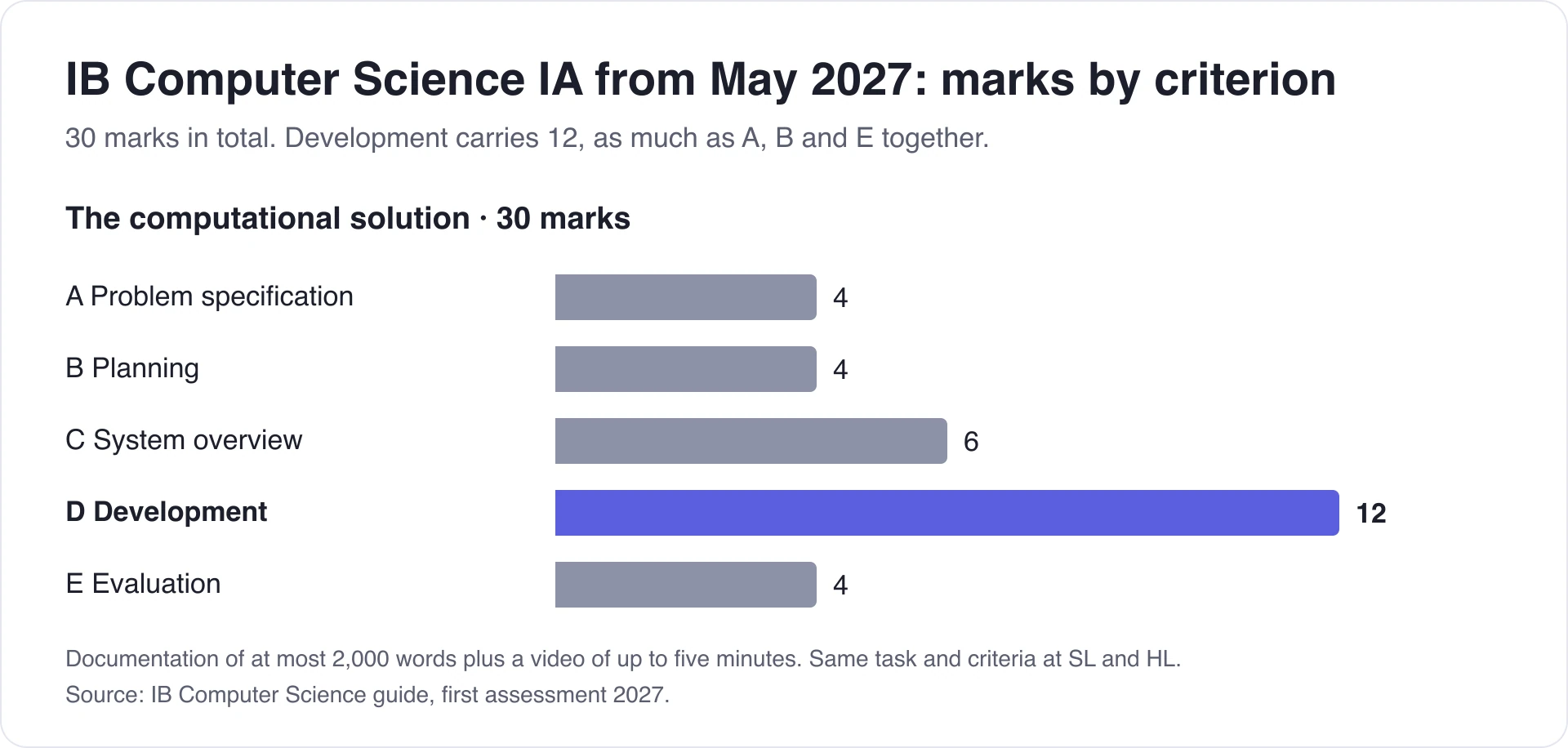
Criterion names and marks in the table above are from the IB's guide; the table's right-hand column is our summary of each criterion. Read the full level descriptors with your teacher before you submit.
What the documentation needs to show
- The problem and success criteria - what you are solving, why a computational solution fits, and how you will judge success
- Planning and design - how you broke the problem down, with the data structures, algorithms and diagrams you decided on before coding
- Development evidence - annotated code extracts that explain why you made specific choices, not just what the code does
- Testing - a testing strategy and evidence that the product meets your success criteria
- Evaluation - an honest judgement of how well the product meets the criteria, with realistic improvements
The non-obvious pitfall
Scope is where most IAs go wrong. Development is worth 12 of the 30 marks, but a small, well-documented system with clear evidence of computational thinking will outscore an ambitious project with thin planning and unexplained code. Your teacher and the moderator cannot award marks they cannot see in the documentation and video. If a design decision is not written down, it does not exist for assessment purposes. Choose a genuine, bounded problem, set specific measurable success criteria at the start, and record every significant decision as you build. The 2,000-word cap makes this harder, not easier, so decide early which decisions you will explain.
6. The Case Study: What It Is and How to Prepare
The case study is a pre-released booklet that the IB publishes 12 months before the May exams (18 months before the November exams). In the new course it is examined in Section B of Paper 1 at both SL and HL (IB computer science updates). It is no longer an HL-only Paper 3, and SL students now study it too. HL students prepare four challenges set out in the booklet and SL students two (ManageBac/Faria).
The case study for May and November 2027 is "Generative AI for image creation - a diffuse vision", set around a design company choosing between image-generation models (Computer Science Wiki). Later sessions get a new case study, so always work from the booklet your school gives you for your exam session.
The booklet describes a realistic technological scenario. Exam questions are set within that scenario, asking you to apply computer science concepts to the specific situation described, not to generic textbook examples. That framing matters: an answer that ignores the scenario and gives only abstract theory will lose marks even if the technical content is correct.
How to prepare, step by step:
- Read the case study in full at least three times before you begin researching anything. Annotate unfamiliar terms on your first pass.
- Extract every technical concept it references, explicitly or implicitly, and build a topic list. Note which challenges are HL-only.
- Research each concept using textbooks, your teacher's materials and revision resources. The goal is depth on a narrow set of topics, not broad coverage.
- Practise writing exam-style responses that name specific details from the case study, not generic examples.
- Use the specimen paper for the new course to see how Section B questions are set. Old Paper 3 case studies can still help you practise linking theory to a scenario, but their format and mark allocation are different.
One non-obvious gotcha: the booklet does not explain every technology it mentions, so you need to research beyond the document. Students who only annotate what is written, without investigating what the scenario implies, often struggle with the higher-mark questions.
7. Programming Languages: Java or Python
The new course is taught in Java or Python. You study the language your school teaches rather than picking one yourself; the IB's FAQ for the new course says the choice of language depends on the teacher's familiarity and confidence with it. Paper 2 comes in a Java version and a Python version, and you answer the one for the language you studied, without mixing the two (IB computer science updates). No other language is offered for the exam. The IA is more flexible: you will most likely use the language you studied, but the IB allows another language as long as you include a readable code listing and the language does not make the solution trivial.
Pseudocode: the previous course used the IB's own approved pseudocode notation in its exams, and many older revision resources are built around it. The new syllabus does not include that notation, and the IB's FAQ for the new course says pseudocode will not be used in any Paper 2 question and you are not expected to write it in your answers. Your teacher may still use it to help you plan algorithms, and in the IA you can present algorithms in natural language, flowcharts or pseudocode.
Practical tip: practise writing standard algorithms, such as searches and sorts, by hand in your school's language without leaning on built-in functions. Some Paper 2 questions prohibit specific built-in functions, such as Python's sort, max or min, and the IB does not publish the list in advance. Students who only ever call a library function often stall when asked to write the loop themselves.
8. Key Algorithms and Data Structures You Need to Know
Programming, algorithms and data structures sit in Theme B, which Paper 2 examines. Everyone studies computational thinking (B1), programming (B2) and object-oriented programming (B3); abstract data types (B4) is HL-only. Check your subject guide's topic list for exactly which data structures and algorithms sit in B2 at both levels and which belong to B4.
What to practise at both levels:
- Tracing algorithms by hand: step through loops and record how each variable changes. It is also the quickest way to find errors in your own IA code.
- Searching and sorting: be able to explain and compare standard algorithms, for example why binary search requires a sorted collection, which makes it a useful discussion point for trade-off questions.
- Object-oriented design: classes, objects and how they interact, since object-oriented programming is now studied by everyone.
For practice questions filtered by paper, level, and topic, the official source is the IB Questionbank, created by the IB and available through the Follett IB Store (Titlewave). It lets you pull past DP Computer Science questions by examination date, paper, or question type. Most of those questions were written for the previous course, so use them for topics that carry over and use the new specimen papers for the current format. A time-limited demo account is available before you commit to a licence.
9. How Universities View IB Computer Science
IB Computer Science sits in Group 4 (Sciences), but that classification does not automatically satisfy a science requirement at every university. Per the IB's own course selection guidance, universities apply three distinct categories when assessing subjects:
- Required - a minimum grade is set as a condition of the offer.
- Preferred - not mandatory, but strengthens your application.
- Recommended - not mandatory, but provides useful background for the degree.
Where HL CS falls in those categories varies by institution and by programme. A university might accept HL CS as satisfying a science condition for a Computer Science degree, while the same university's Engineering faculty requires Physics HL instead. The group placement does not decide this - the admissions team does.
A concrete example of how this plays out internationally: IU International University of Applied Sciences in Germany specifies one science (Biology, Physics, or Chemistry) separately from the 6th subject slot, where IB Computer Science is listed as an eligible option. In other words, CS there fills a breadth slot, not the science requirement.
For UK students considering IB Computer Science, requirements across UK universities vary significantly enough that checking each institution's entry requirement pages directly is the only reliable approach. Do not assume a Russell Group offer letter's wording mirrors another university's conditions, even for courses with identical names.
10. What to Do Next
If you have not yet chosen between SL and HL, read the IB's computer science updates page and ask your school for the subject guide (first assessment 2027). It sets out the assessment model and IA requirements at both levels in one place, so you can compare them directly before committing.
If you are already on the course, get the case study booklet for your exam session and start annotating it early. Most students do not start until the spring term of their final year, which leaves too little time. Then pin down your IA problem and success criteria, since the IA is worth 30% of the grade at SL and 20% at HL.
Read the updates page this week. Then put the case study and your IA deadlines in your calendar now.
FAQ
Is IB Computer Science hard?
Difficulty depends on your background. From May 2027 the course combines a concepts paper that includes a pre-released case study, a problem-solving paper with programming in Java or Python, and a computational solution IA of about 35 hours, so it suits students who enjoy both theory and coding.
What programming language is used in IB Computer Science?
From May 2027 the course is taught in Java or Python, chosen by your school. Paper 2 comes in equivalent Java and Python versions, and you answer in the language you studied.
How long is the IB Computer Science internal assessment?
The IB recommends 35 hours of teaching time for the computational solution. The documentation is capped at 2,000 words, not counting code, code comments or diagrams, and you also submit a video of no more than five minutes showing the working product and examples of your testing.
What is the IB Computer Science case study?
A booklet the IB releases 12 months before the May exams (18 months before November). From May 2027 it is examined in Section B of Paper 1 at both SL and HL. The case study for May and November 2027 is on generative AI for image creation (A diffuse vision).
Is there a Paper 3 in IB Computer Science?
No. From May 2027 there is no Paper 3 at SL or HL. The case study that used to be the HL-only Paper 3 is now part of Paper 1 for everyone. Only HL candidates on the previous course, such as those sitting in November 2026, still take Paper 3.
Does IB Computer Science count as a science for university entry?
Computer Science sits in Group 4 (Sciences), but whether a university counts it toward a science-specific entry requirement varies - students must check each university's own admissions pages.
What is the difference between IB Computer Science HL and SL?
Both levels sit Paper 1 and Paper 2 and complete the same IA against the same criteria. HL adds the abstract data types topic and extra depth elsewhere, has more marks on the papers including more case-study questions, and weights the IA at 20% against 30% at SL.
References
- Computer science updates - International Baccalaureate - https://www.ibo.org/university-admission/latest-curriculum-updates/computer-science-updates/
- Course selection guidance - International Baccalaureate® - https://ibo.org/university-admission/support-students-transition-to-higher-education/course-selection-guidance
- DP curriculum - International Baccalaureate - https://www.ibo.org/programmes/diploma-programme/curriculum/
- New Computer Science Guide: What to Expect - ManageBac - https://www.managebac.com/subject-support/new-computer-science-guide-what-to-expect
- Case study: Generative AI for image creation - a diffuse vision (May and November 2027) - Computer Science Wiki - https://faq.computersciencewiki.org/index.php/home/article/case-study-generative-ai-for-image-creationa-diffuse-vision-may-and-november-2027
- IB Questionbank - https://questionbank.ibo.org
- University Statement - https://recognition.ibo.org/en-US/university-statements?flag=&id=3ea43357-f3a1-ed11-aad1-000d3a85c377&university=IU+International+University+of+Applied+Sciences&countryID=9a436145-efa1-ed11-aad1-000d3a85c377&country=Germany&stateID=&state=