How to Get Into Computer Science at UK Universities
By Michael Thompson · Former IB Diploma Programme coordinator; 10 years at Bromsgrove School · Published 5 July 2026 · Updated 4 October 2026
How to get into computer science at a UK university comes down to one central fact: mathematics is the non-negotiable gateway subject, and the most competitive departments - Oxford, Cambridge, Edinburgh, Warwick - treat it as a filter before they read anything else. The range of courses is wide, with UCAS listing over 1,800 computer science programmes across UK institutions, from three-year BScs to four-year integrated masters degrees. Beyond grades, departments increasingly distinguish between applicants through admissions tests, technical interviews, and evidence of genuine independent projects. This guide covers the grade profiles you need, how IB and A-level offers compare, where admissions tests apply, and how to build an application that holds up under scrutiny.
Key Takeaways
- Maths A-level is essential: Every competitive CS department requires A-level Mathematics; most top departments expect at least an A, and Oxford's standard offer requires AAA with the A in Maths, Further Maths, or CS.
- Further Maths matters more than any other subject choice: Between 2022 and 2025, 96% of students offered places at Oxford's CS courses had taken Further Maths - it signals mathematical readiness more than any other addition to your application.
- IB applicants need Mathematics: Analysis and Approaches at HL: Edinburgh specifies HL Maths AA at grade 6 within an overall range of 34-43 points; Applications and Interpretation is not accepted as an equivalent.
- Oxford and Cambridge both require the TMUA: From 2027 entry Oxford uses the TMUA in place of its old MAT. Booking for the October sitting closes in late September, before the UCAS deadline, so book over the summer before you apply.
- A project portfolio demonstrating design decisions outweighs a list of languages: Admissions tutors want to see that you can reason about computational problems - independent projects, open-source contributions, or olympiad entries give you material to discuss in interviews and personal statements.
- You can only apply to Oxford or Cambridge, not both: The Oxbridge one-application rule applies to Computer Science just as it does to every other subject, so choose deliberately based on course structure and interview style.
In This Article
- The maths gate: A-level entry requirements for computer science
- Reading a computer science IB offer
- Admissions tests: the TMUA and when it applies
- Oxford and Cambridge computer science entry requirements
- Computer science entry requirements at other leading UK universities
- Building a project portfolio that holds up in an interview
- Writing the 2026 UCAS personal statement for computer science
- What CS degrees actually cover - and whether your A-levels match
- What to do next
1. The maths gate: A-level entry requirements for computer science
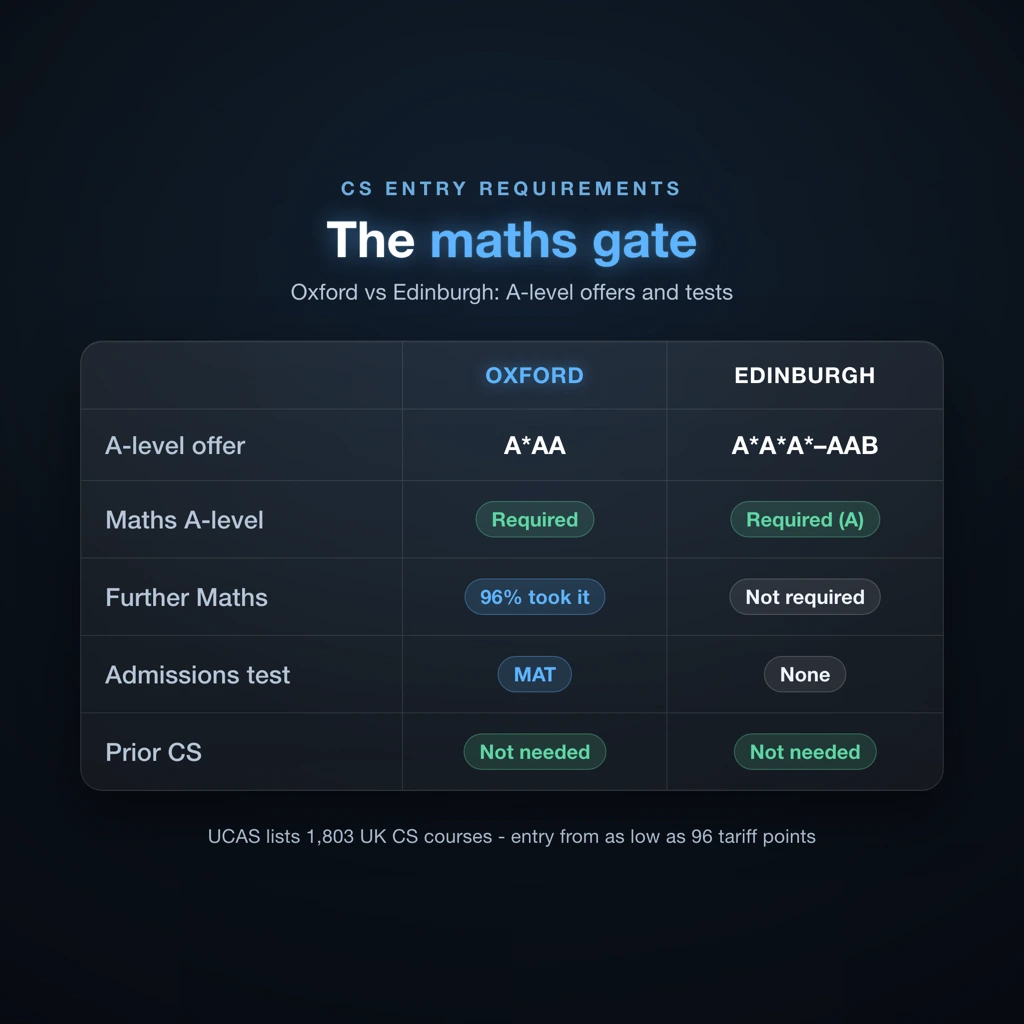
Knowing how to get into computer science at a competitive UK university starts with one non-negotiable: A-level Mathematics. This is not gatekeeping for its own sake. CS degree programmes lean heavily on mathematical logic, algorithm analysis, and formal proof techniques from the first term. If you cannot manipulate a recurrence relation or follow a proof by induction, the first-year curriculum will be brutal. Maths A-level is the department's signal that you can handle that workload.
The grade profiles vary widely across UK institutions. Oxford sets a standard offer of A\AA for Computer Science, with the A\ required in Maths, Further Maths, or Computer Science. Edinburgh ranges from A\A\A\* down to AAB depending on contextual factors, but in both cases Mathematics at grade A is a firm requirement. That gap between Edinburgh's upper and lower ends is worth noting: it reflects contextual admissions adjustments, not a relaxation of the maths condition.
Further Maths is where applications separate. Oxford does not formally require it, but 96% of A-level students offered places on Oxford CS courses between 2022 and 2025 took Further Maths. That figure is not a coincidence. Topics like matrices, complex numbers, and proof by induction sit in Further Maths and reappear immediately in first-year CS content. If your school does not offer Further Maths, Oxford's own guidance points students toward the Advanced Mathematics Support Programme, which provides free tuition and resources.
For your other A-level choices, Physics reinforces the mathematical reasoning that CS modules expect. A humanity or English-heavy subject demonstrates the written communication that personal statements and later dissertations actually require. Computer Science A-level adds useful context but is not assumed: both Oxford and Edinburgh explicitly state that no prior programming experience is required.
The concrete action here: check whether your school timetables Further Maths as a separate A-level. If it does not, contact the Advanced Mathematics Support Programme before your options choices are finalised.
2. Reading a computer science IB offer
IB offers have two components that both have to be met: a headline points total and a condition on specific Higher Level subjects. Meeting the points band while missing the HL condition is still a rejection.
Edinburgh shows how this works in practice. The university's UCAS listing gives a points range of 34 to 43, with HL Mathematics (Analysis and Approaches) at grade 6 required. Both numbers have to land.
The subject condition is where IB applicants most often come unstuck. HL Mathematics: Applications and Interpretation is explicitly not accepted at Edinburgh, even though it sits at the same HL level and carries identical UCAS Tariff points. The two courses are not interchangeable in admissions. Analysis and Approaches covers proof, algebra, and calculus in the depth that underpins a CS degree; Applications and Interpretation leans toward statistics and modelling. Universities treating them as equivalent for CS would be unusual.
That distinction maps directly onto the A-level picture covered in section 1. An HL Maths AA grade 6 signals the same readiness for formal mathematical reasoning as an A-level Mathematics pass at a strong grade. The label differs; the preparatory effect is similar.
Practical takeaway: when you check any university's CS requirements, look past the headline points total to the HL subject and grade condition listed on the course page. Those two lines, read together, tell you whether your current IB subject choices actually qualify you.
3. Admissions tests: the TMUA and when it applies
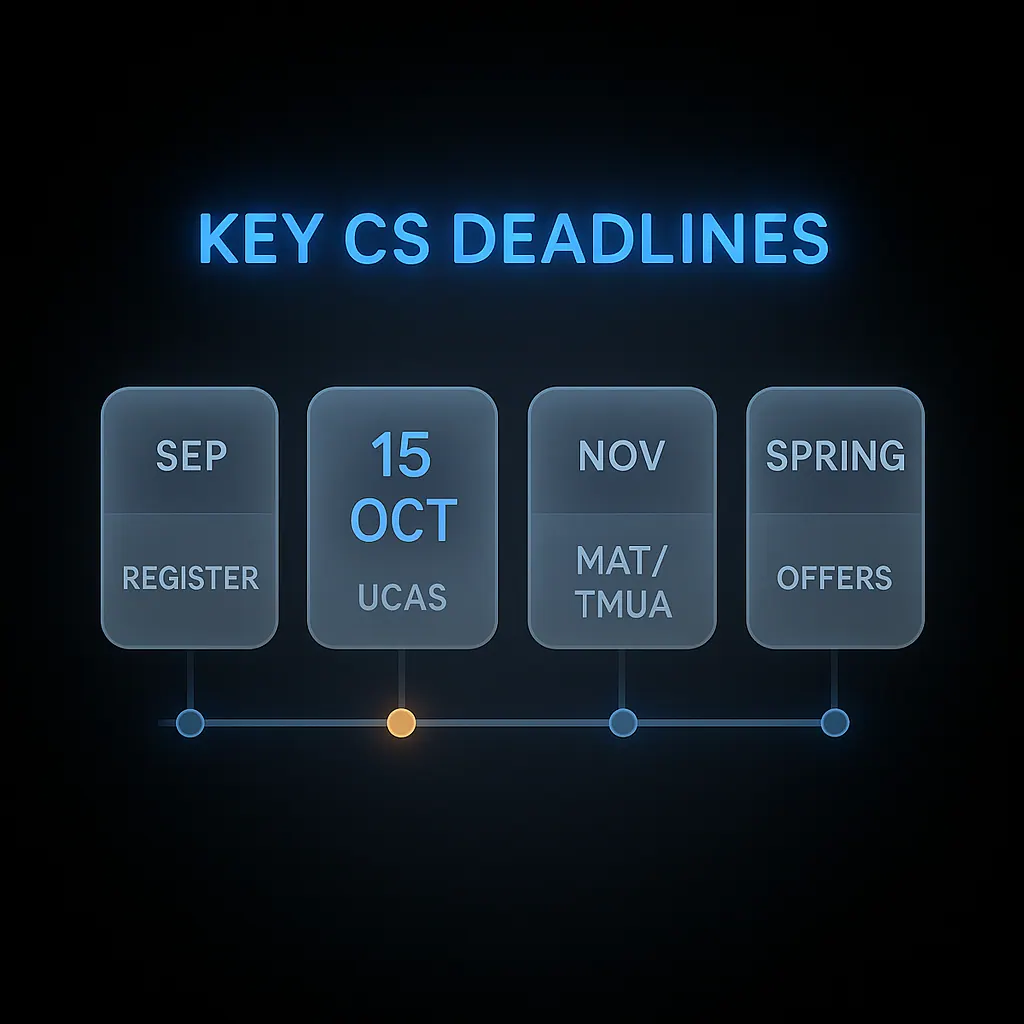
Oxford and Cambridge both require a separate admissions test - from 2027 entry, the same one - and its booking deadline lands before the 15 October UCAS deadline for those universities. If you leave booking until you submit your application, you have already missed it.
Oxford: the TMUA replaces the MAT
Oxford has dropped its own Mathematics Admissions Test (MAT). From 2027 entry, all applicants for Computer Science, Computer Science and Philosophy, and Mathematics and Computer Science must take the TMUA, the same test Cambridge uses, and must sit it in the October window (12-16 October 2026 for 2027 entry). Any advice telling you to register for the MAT is out of date.
Cambridge: the TMUA
Cambridge uses the Test of Mathematics for University Admission (TMUA) for its Computer Science course. The TMUA has two 75-minute papers, each with 20 multiple-choice questions: Paper 1 tests how you apply mathematical knowledge in new situations, and Paper 2 tests mathematical reasoning, including simple ideas from logic. It is designed to surface how you think, not whether you have memorised a technique. For 2027 entry, booking for the October sitting opened on 20 July and closed on 28 September 2026. You book it yourself through a UAT-UK account and sit it at a Pearson VUE test centre.
Other universities using the TMUA
Warwick's Computer Science department has adopted the TMUA, as have a number of other departments across the UK. This means the test has value beyond Oxbridge applications and is worth taking seriously even if Oxford or Cambridge is not your only target. There is also a January sitting (4-8 January 2027 for 2027 entry). Oxford and Cambridge applicants cannot use it unless they are applying to a Cambridge mature college or an Oxford foundation-year course with a January deadline, but Imperial, Warwick and LSE accept either sitting for 2027 entry. Check each university's rules for your course.
How to prepare
The non-obvious point: the TMUA deliberately uses problem types you will not have seen before. Practising past papers matters, but the goal is to train your approach to unfamiliar problems, not to build a library of memorised solutions. Students who prepare by working slowly through problems and writing out their reasoning tend to perform better than those who drill for speed alone.
Book over the summer, before booking closes in late September. Do not wait for your UCAS form to be ready first.
4. Oxford and Cambridge computer science entry requirements
Oxford and Cambridge both set high bars, but they differ in course structure, interviews, and what the degree actually prepares you for. Choosing between them on prestige alone is a poor strategy.
Oxford
Oxford's standard A-level offer for Computer Science is A\AA, including Maths, with the A\ in Maths, Further Maths, or Computer Science. Further Maths is not formally required, but 96% of A-level students who received offers between 2022 and 2025 had taken it. That figure is worth sitting with: it means students without Further Maths do get offers, but they are a small minority.
One counter-intuitive point Oxford states directly: students who have not studied Computer Science at school can apply realistically. The admissions process is designed to assess mathematical thinking, not prior programming exposure. The TMUA (covered in section 3) tests exactly that.
Cambridge
Cambridge offers the course as either a 3-year BA or a 4-year BA plus Master of Engineering (MEng). The MEng pathway matters if you are weighing graduate study options. Cambridge was the first Computer Science department in the UK and sits in the middle of Silicon Fen, the Cambridge area home to more than 1,000 specialist computing and advanced technology companies. That industrial density shapes the course's orientation toward applied and commercial work. Cambridge ranks #2 in the UK for Computer Science per the Complete University Guide 2026; Oxford ranks #1 in the Guardian's 2024 rankings. The ranking gap between them is negligible for most purposes.
The one-choice rule and what it means in practice
UCAS rules allow you to apply to Oxford or Cambridge in a given cycle, not both. This forces a real decision, though from 2027 entry the admissions test is no longer one of the differences: both use the TMUA (see section 3). Interview formats do differ. Oxford interviews tend to involve working through unseen mathematical problems aloud, often at a whiteboard. Cambridge supervisions-style teaching is reflected in its interview approach as well. In both cases, interviewers are testing how you reason through an unfamiliar problem, not whether you can recite content.
Decide which to apply to based on course structure and fit. If the MEng integrated master's appeals and you want proximity to a dense tech industry cluster, Cambridge is the stronger fit. If your strength is pure mathematical reasoning and you prefer Oxford's three-year single-honours structure, go there. Either way, make the choice early: your TMUA preparation counts for both, but the interviews and course structures do not.
5. Computer science entry requirements at other leading UK universities
Oxford and Cambridge get the headlines, but the range across the rest of the sector is wide enough to matter when you're choosing where to apply.
Edinburgh is the clearest example of a high-tariff university outside Oxbridge. Its Computer Science programme runs as both a BSc (Hons) and a BEng (Hons), with A-level offers spanning A\A\A\* down to AAB depending on the course and year, always with Mathematics at grade A. The IB range is 43-34 points, requiring HL Mathematics (Analysis and Approaches) at 6. One counter-intuitive detail: Edinburgh explicitly requires no prior Computer Science study or programming experience. If you've done Further Maths but no CS A-level, you are not disadvantaged. The BEng route is accredited by the British Computer Society; the BSc is more flexible on honours course passes if you narrowly miss the average threshold. Edinburgh's Informatics department is the largest in Europe by its own description, drawing students and staff from over 100 countries.
Warwick (covered in section 3 for the TMUA) sits in a similarly competitive bracket. Expect offers closer to the top of the Edinburgh range rather than the bottom.
The broader picture matters too. UCAS lists 1,803 computer science courses across the UK, with UCAS Tariff entry points starting as low as 96 at some institutions. Some universities, including Aston and Bath, list their Tariff as N/A, which signals a non-standard entry process: contextual offers, portfolio review, or interview-based decisions. Always go directly to the course page rather than relying on aggregated tariff tables.
Match your application list to your realistic predicted grades, then explore computer science courses at UK universities to see the full range.
6. Building a project portfolio that holds up in an interview
Listing Python, Java, and C++ on an application tells an admissions tutor you have installed some software. What distinguishes competitive applicants is the ability to discuss why they made specific design decisions: why they chose a hash map over a list, why they split a problem into particular modules, where their first approach broke and what they did about it.
The projects themselves matter less than how deeply you can discuss them. Pick one or two that you understand from the ground up, rather than a longer list of tutorials you followed and half-remember. Before any interview, write down the trade-offs you made in each project. That exercise is interview preparation in itself.
What counts as strong evidence:
- An independent project with a clearly articulated problem and solution. A tool you built because you needed it, with a README that explains the constraints, beats a generic to-do app built in an afternoon.
- A merged pull request on an open-source repository. A merged PR is concrete, dateable, and verifiable. It also demonstrates that you can read an unfamiliar codebase and communicate with other developers.
- Olympiad-style competitions. The British Informatics Olympiad tests algorithmic thinking directly. UKMT competitions signal the mathematical reasoning that underpins CS at degree level.
Both Oxford and Cambridge use technical interviews to test exactly this capacity: can you reason step by step through an unfamiliar problem? Your projects give you concrete examples to anchor that reasoning when an interviewer asks how you approached something.
One counter-intuitive point: prior CS study is not a formal requirement at Edinburgh, and Oxford is explicit that students who have not studied Computer Science at school can apply realistically. Independent projects therefore carry more weight for self-taught applicants than they might expect, precisely because coursework cannot speak for them.
7. Writing the 2026 UCAS personal statement for computer science
Since 2026 entry, UCAS has replaced the single open-essay format with **three structured questions** inside a 4,000-character total limit. The format is unchanged for 2027 entry. The three questions ask why you want to study the course, how your qualifications and studies have prepared you, and what else you have done outside education to prepare. All three must be answered. The character ceiling is shared across all three answers, so every sentence has to earn its place.
Question 1 is where computational thinking gets evidenced, not asserted. "I've always loved computers" and "passionate about technology" are phrases admissions tutors at any university see hundreds of times per cycle. What stands out is a specific problem that stopped you: a recursive algorithm that broke your understanding of loops, a sorting function you rewrote three times before grasping time complexity, a named competition like the British Informatics Olympiad where a particular problem changed how you thought. The UCAS subject guide for computer science lists core programme topics including algorithms and data structures, mathematical principles, and AI. Naming the concept that connected your A-level study to one of those areas is far more credible than a general interest claim.
Questions 2 and 3 translate your portfolio into evidence. Work from your A-level or IB courses belongs in question 2; independent projects and open-source contributions covered in section 6 belong in question 3, in condensed form: named tool, named problem, named outcome. "Built a Python web scraper to aggregate local bus timetables" is more specific than "developed programming skills."
One counter-intuitive point: admissions tutors read for gaps as much as highlights. A statement that lists five projects superficially reads weaker than one that explains two in precise technical terms.
8. What CS degrees actually cover - and whether your A-levels match
A computer science degree is not an extended coding course. The core curriculum spans algorithms and data structures, mathematical principles, programming languages, software engineering, database systems, and AI, according to UCAS. Each of those areas draws on formal reasoning and mathematics more than on typing speed.
Cambridge's Year 1 programme illustrates this concretely. Students learn OCaml, Java, C/C++, and Prolog, and study hardware topics including chip design. The non-obvious detail: OCaml is a functional language chosen specifically to teach type theory and formal reasoning, not because industry demands it. It is a deliberate pedagogical choice, and students who find algebraic thinking uncomfortable often struggle with it more than with the syntax.
The reason Maths A-level is required almost universally comes down to three areas: formal proofs, discrete mathematics, and algorithmic complexity. These underpin the theoretical half of most degree programmes. Further Maths gives you a head start on the proof-writing style that first-year courses assume.
CS graduates work across finance, healthcare, games, and research. Edinburgh's Informatics department, the largest in Europe, draws students and staff from over 100 countries, which reflects how broad the sector's applications have become.
The honest check: if you find the maths in your A-level course genuinely interesting, CS is a natural fit. If you are actively avoiding maths modules, reconsider whether the degree matches what you want to spend three or four years studying.
9. What to do next
If Oxford or Cambridge is on your list, the single most time-sensitive task is the TMUA. For 2027 entry the October sitting runs 12-16 October 2026, alongside the UCAS 15 October deadline, and booking closed on 28 September 2026. You book the test yourself through a UAT-UK account, not through your school's exams officer, so do not wait for anyone to remind you. Missing the October sitting means missing the application entirely, because most Oxford and Cambridge applicants cannot use the January sitting. If you are applying for 2028 entry, check the UAT-UK site for booking dates; for 2027 entry, booking opened in July.
For everywhere else, the personal statement is the first thing you can control right now. Get a draft in front of someone who can give you honest, specific feedback before the autumn rush. Have your computer science personal statement reviewed by an expert before your school's internal deadline, not UCAS's.
FAQ
What A-levels do you need for a computer science degree?
A-level Mathematics is required at virtually every competitive CS department; Further Maths is strongly recommended and taken by the overwhelming majority of successful applicants at top universities, with a third A-level in Physics, Computer Science, or another analytical subject completing most strong applications.
Is it hard to get into computer science at UK universities?
Difficulty varies significantly by institution - UCAS lists CS courses with entry requirements ranging from 96 tariff points to AAA* profiles, so competitiveness depends on which departments you are targeting and whether your predicted grades match their published conditions.
Can you get into computer science without a maths A-level?
At the most competitive UK CS departments (Oxford, Cambridge, Edinburgh, Warwick) A-level Mathematics is a formal requirement; some less selective institutions accept applicants without it, but mathematical aptitude is so central to degree-level CS that studying Maths before applying is strongly advisable regardless.
How do you get into computer science at Cambridge?
Cambridge's Computer Science BA/MEng requires sitting the TMUA admissions test, a strong mathematical A-level profile including Maths (Further Maths is strongly recommended), and a technical interview; Cambridge's department was the UK's first CS department and is ranked #2 in the UK by the Complete University Guide 2026.
What does a computer science personal statement need to include?
Under the 2026 UCAS three-question format, a strong CS personal statement evidences genuine computational thinking through named projects, competitions, or independent study - not generic claims about passion for technology - within the 4,000-character total limit.
Do you need to have studied computer science before applying for a CS degree?
No prior CS study is formally required at Edinburgh, and Oxford explicitly states that students who have not studied CS at school can apply realistically; what matters is mathematical preparation and evidence of independent curiosity about computational problems.
References
- Department of Computer Science, University of Oxford - https://www.cs.ox.ac.uk/admissions/undergraduate/why_oxford/offers.html
- Computer Science | The University of Edinburgh | UCAS - https://www.ucas.com/explore/courses/b05b4517-874b-1ee2-1c14-d63e806df2a7/computer-science
- Computer Science, BA (Hons) and MEng | Undergraduate Study - https://www.undergraduate.study.cam.ac.uk/courses/computer-science-ba-hons-meng
- Top for Computer Science in the UK according to The Guardian university rankings - https://www.cs.ox.ac.uk/news/2188-full.html
- Search | All results | "computer science" | UCAS - https://www.ucas.com/explore/search/all?query=computer+science
- Computer Science Subject Guide | Why Study Computer Science? | UCAS - https://www.ucas.com/explore/subjects/computer-science
- TMUA | Mathematical Institute, University of Oxford - https://www.maths.ox.ac.uk/study-here/undergraduate-study/tmua
- TMUA | UAT-UK - https://esat-tmua.ac.uk/about-the-tests/tmua-test/
- Deadlines | UAT-UK - https://esat-tmua.ac.uk/deadlines/
- Test of Mathematics for University Admissions (TMUA) | Imperial College London - https://www.imperial.ac.uk/study/apply/undergraduate/process/admissions-tests/tmua/
- Admissions Tests (TMUA) | University of Warwick - https://warwick.ac.uk/study/undergraduate/applying/admissions-tests/
- Test of Mathematics for University Admission (TMUA) | LSE - https://www.lse.ac.uk/study-at-lse/Undergraduate/Prospective-Students/How-to-Apply/Test-of-Mathematics-for-University-Admission-TMUA