IB Environmental Systems and Societies: The Full Guide
By Michael Thompson · Education Specialist; 10 years teaching the IB at Bromsgrove School · Published 4 September 2026 · Updated 4 October 2026
IB Environmental Systems and Societies (ESS) is the only IB Diploma subject that simultaneously satisfies two group requirements - Group 3 (individuals and societies) and Group 4 (sciences) - giving students an unusual amount of schedule flexibility. First taught in August/September 2024 and first assessed in May 2026, the updated course covers ecology, climate, energy, biodiversity and more through both scientific and humanistic lenses. That dual identity is not just an administrative quirk: it shapes the kind of answers examiners actually reward. This guide covers the full syllabus, the assessment model, how Higher Level differs from Standard Level, and what a strong Internal Assessment looks like.
Key Takeaways
- Double group credit: ESS counts for both Group 3 and Group 4 in the IB Diploma, freeing up a subject slot for another course.
- New syllabus, first assessment May 2026: The updated IB ESS curriculum began teaching in August/September 2024; IB Questionbank lists a 'first assessment 2026' version alongside the 'last assessment 2025' version.
- HL is a new addition: The revised syllabus introduced a Higher Level option for the first time, with additional content and an extra assessed component.
- Internal assessment is investigative: The IA requires a self-directed environmental investigation centred on a real environmental issue, assessed against set criteria.
- Answers blend science and ethics: Because ESS sits across two subject groups, examiners expect responses that combine quantitative evidence with social, ethical, and values-based reasoning.
- Passing the diploma still has conditions: No matter how well you do in ESS, the diploma requires at least 24 total points and no more than two grade 2s across all subjects.
In This Article
- What Is IB Environmental Systems and Societies?
- Where ESS Sits: Between the Sciences and the Humanities
- The ESS Syllabus: Core Topics and Structure
- SL vs HL: How Higher Level ESS Differs
- The Assessment Model: Papers, Weightings and the IA
- The Internal Assessment: Environmental Systems and Societies IA Explained
- Paper 1 Tips: What the ESS Exam Actually Tests
- Is IB ESS Hard? Grade Boundaries and Realistic Expectations
- How ESS Fits Into Your Diploma Combination
- What to Do Next
1. What Is IB Environmental Systems and Societies?
IB Environmental Systems and Societies (ESS) is an interdisciplinary subject in the IB Diploma Programme that sits at the intersection of the natural sciences and the social sciences. Most IB subjects belong to one group. ESS belongs to two: it counts simultaneously toward Group 3 (individuals and societies) and Group 4 (sciences). That double credit is the defining quirk of the subject, and it has real consequences for how you build your diploma. A student who takes ESS can satisfy both a Group 3 and a Group 4 requirement with a single subject, freeing up space for an additional language, a second science, or an arts option.
The catch worth knowing early: because ESS covers that double-group slot, universities in some competitive science programmes may still want a dedicated Group 4 science alongside it. Check individual entry requirements before treating the double credit as a free pass.
The current version of the course, listed under the IB's 2024 curriculum update cycle, began teaching in August/September 2024, with first assessment scheduled for May 2026. That makes the students sitting in classrooms now the first cohort examined on the updated syllabus.
One more structural point: ESS is unusual among IB science-side subjects because it is offered at both Standard Level and, as of the updated curriculum, Higher Level. Most schools have historically run it at SL only, so the HL option is a genuine change in how the subject can be positioned within a diploma combination.
2. Where ESS Sits: Between the Sciences and the Humanities
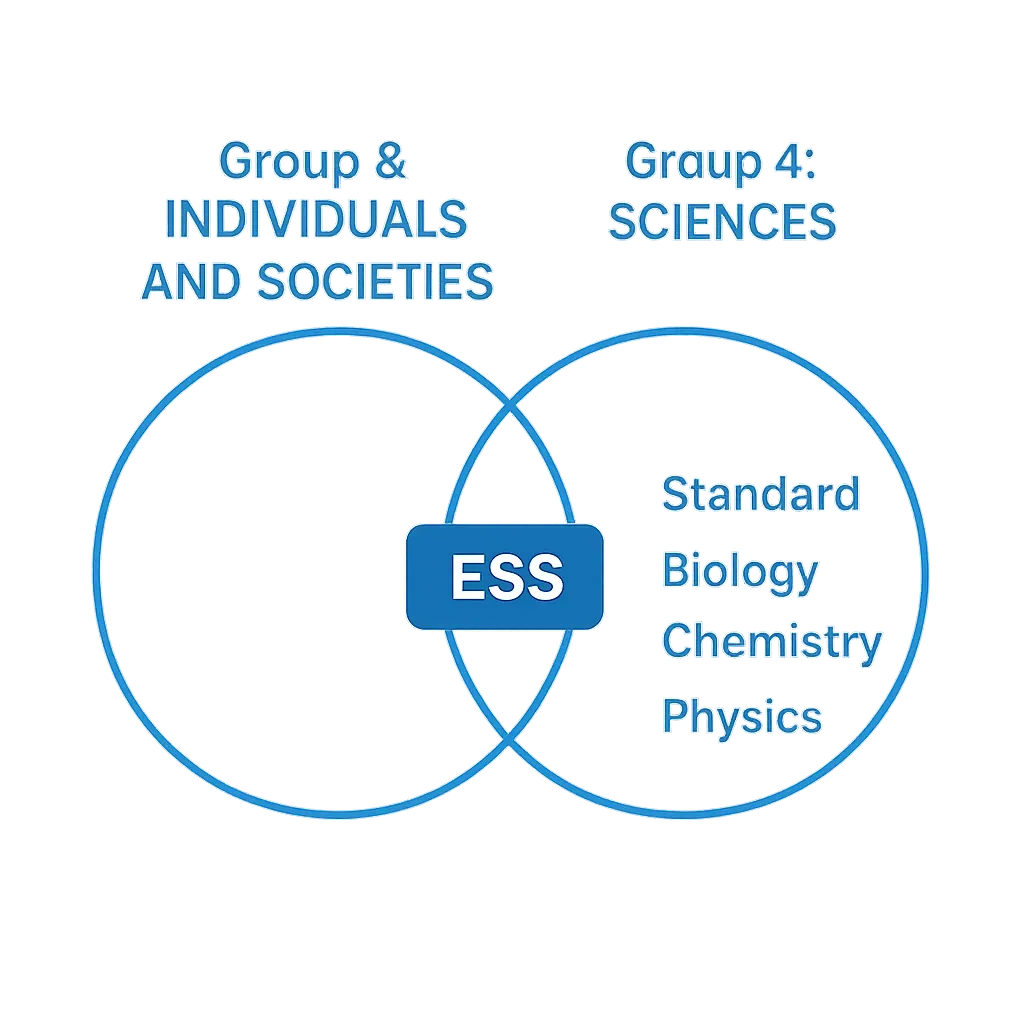
ESS occupies an unusual slot in the IB Diploma. The IBO classifies it as an interdisciplinary subject that simultaneously satisfies both the Group 3 (individuals and societies) requirement and the Group 4 (sciences) requirement. In practice, that means a student who takes ESS only needs five other subjects to complete a full Diploma, freeing up a slot that most students spend on a second language or an extra HL.
That administrative quirk reflects something genuine about the subject's intellectual identity. ESS puts quantitative ecology, population modelling, and systems diagrams alongside ethics, environmental justice, and values-based argument. These are not separate units bolted together. Examiners expect both strands inside a single answer. A response on fisheries management that cites only stock-depletion data, with no engagement with governance frameworks or competing stakeholder values, will not reach the top mark bands. Neither will one that argues purely from principle without any ecological evidence. The integration is the answer.
One counter-intuitive consequence: students who write in a clean lab-report style, a habit built up through biology or chemistry, often underperform in ESS exams precisely because that register signals they have not engaged with the social and ethical dimensions the mark scheme demands.
The critical trade-off to understand: ESS is not a substitute for a full Group 4 science if a university programme requires one. Biology, chemistry, and physics each remain distinct Group 4 subjects, and competitive science, medicine, or engineering courses typically ask for one of those by name. ESS serves students whose Diploma combination prioritises breadth over specialist science depth.
3. The ESS Syllabus: Core Topics and Structure
The updated ESS syllabus applies from first teaching August/September 2024, with the first assessment sitting in May 2026, per the IB's curriculum updates page. If you are starting the Diploma Programme in 2024 or 2025, this is the version you will be examined on.
The syllabus is organised around a set of thematic topic areas. Based on the current IB subject structure, these broadly cover:
- Foundations and systems thinking - concepts of systems, feedback loops, and models
- Ecology and biodiversity - ecosystems, species interactions, conservation
- Water and land - freshwater systems, soil, food production, and land use
- Atmosphere and climate - pollution, climate change, and atmospheric dynamics
- Energy - energy sources, transfers, and sustainability trade-offs
- Human populations - demographics, resource consumption, and urbanisation
Exact heading names and the ordering of topics should be confirmed against the official IB subject brief, which is available at both standard and higher level. The IB holds copyright over the full syllabus document, so treat any third-party topic lists, including this one, as an orientation rather than a definitive reference.
The non-obvious structural point is this: systems thinking is not just one topic among many, it is the analytical lens applied to every other topic. Students who treat it as a standalone unit and then move on tend to underperform on case-study questions, which consistently ask them to identify stocks, flows, inputs, outputs, and feedback loops regardless of the subject matter. Getting comfortable with systems diagrams early makes the rest of the course considerably more coherent.
For the authoritative topic list and assessment objectives, go directly to the IB curriculum page.
4. SL vs HL: How Higher Level ESS Differs
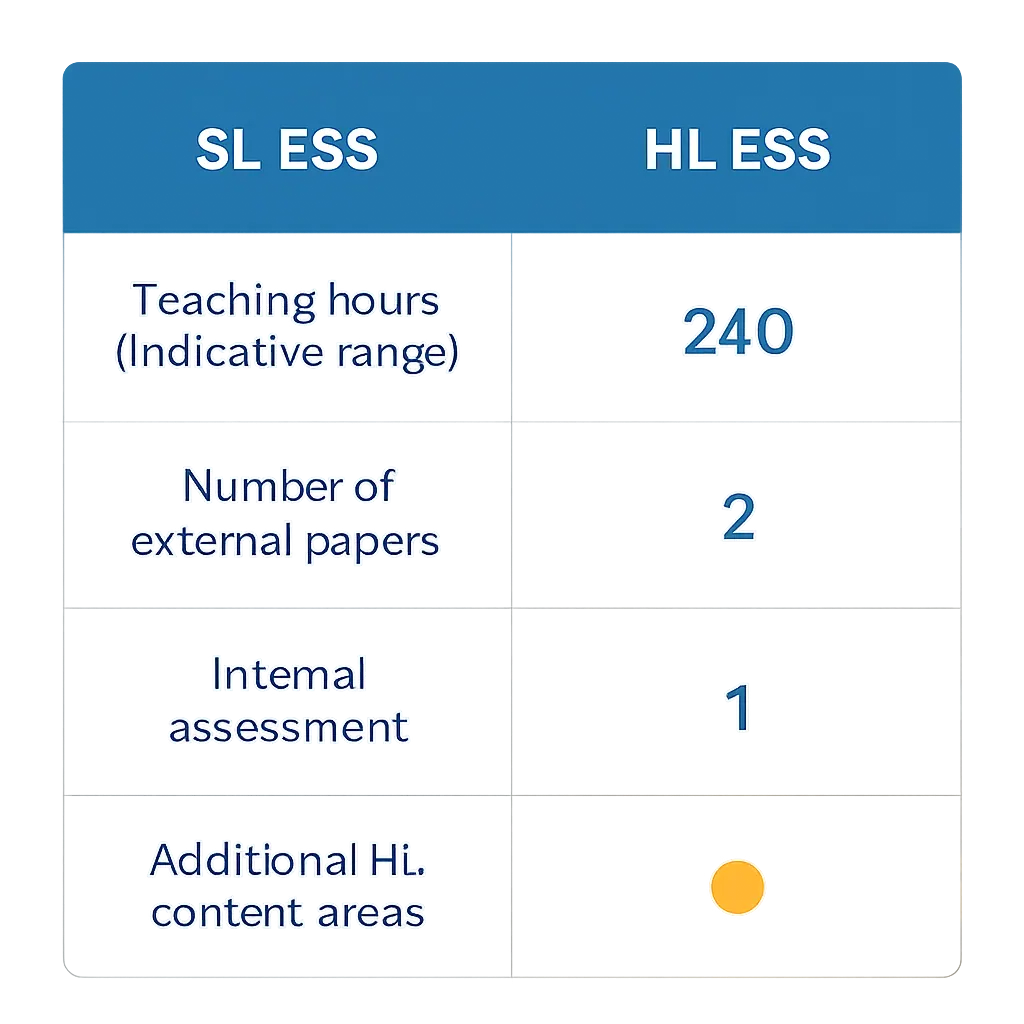
HL ESS is new. As part of the revised curriculum with first assessment in May 2026, IB Environmental Systems and Societies is now offered at both Standard Level and Higher Level, making HL a genuinely recent addition to the subject.
The HL pathway adds extra syllabus content and more teaching hours on top of the SL core, plus an additional assessed component that SL students do not sit. The practical effect is a meaningfully heavier workload, not just a slightly longer version of the same course.
The less obvious implication concerns diploma structure. SL ESS is popular partly because it satisfies both the Group 3 and Group 4 requirements in one subject, freeing up a slot for a different choice elsewhere. HL ESS still carries that dual-group benefit, but HL students must factor their ESS grade into the minimum 12 HL points requirement, which SL students are not counted against. A weak HL ESS grade therefore puts pressure on that threshold in a way a weak SL grade simply would not.
For exact teaching hour counts, paper formats, and component weightings at each level, check the official subject briefs published by the IB. Reproducing those figures here would risk misrepresenting details the IB may update, and the briefs are the only authoritative source.
The core question to ask your school: does offering HL ESS actually serve your diploma combination, or are you taking on HL hours and HL grade pressure without a strategic reason to do so?
5. The Assessment Model: Papers, Weightings and the IA
ESS assessment combines written external exams with an internally assessed investigation. The structure is the same at both levels in principle, but HL carries an additional external paper that SL students do not sit. That extra paper is the primary mechanism through which HL depth is tested, covering the additional content and extended conceptual treatment described in Section 4.
The three components at a glance:
- External papers (SL): two written exams, sat in the May examination session.
- External papers (HL): three written exams, with the additional paper targeting HL-only material.
- Internal Assessment (IA): a single individual investigation, submitted for moderation and counting toward the final grade at both levels.
The exact percentage weightings and paper durations are set by the IB and reproduced in the subject briefs. Rather than risk misquoting a moving target, check the official DP subject briefs on ibo.org directly, which cover both SL and HL requirements in full.
One non-obvious gotcha worth flagging now: the IA is not a minor add-on. Its weighting is large enough that a weak investigation cannot be offset by strong paper scores alone. Students who treat it as an afterthought late in the course routinely discover this the hard way.
On syllabus version, this matters practically. IB Questionbank currently lists ESS in two versions: last assessment 2025 and first assessment 2026. If you are beginning ESS now, the first assessment for the updated curriculum is May 2026, meaning past papers from the pre-2026 course cover different content. Confirm you are working with 2026-syllabus materials before building any revision bank.
6. The Internal Assessment: Environmental Systems and Societies IA Explained
The ESS internal assessment is a student-designed investigation into a real environmental issue. It is not a structured classroom lab where you follow a given method and record a predicted result. You choose the question, design the methodology, collect your own data, and draw conclusions tied back to the environmental system you investigated.
The IA is submitted to the IB for external moderation, so the standard it is marked against is set internationally, not just by your school.
What the IA requires
A complete IA includes four main components:
- A focused research question - specific enough that you can actually answer it with the data available to you in the field or from a credible secondary source.
- A student-designed methodology - your decisions about sampling strategy, variables, and data collection method, with justification.
- Data collection and analysis - raw data processed with appropriate statistical or graphical treatment, not just described.
- A conclusion - one that returns explicitly to the named environmental issue behind your research question, not just to your numbers.
Assessment criteria
The ESS IA has its own assessment criteria, which are not the same as the Biology, Chemistry or Physics IA criteria, so work from the rubric in the current ESS guide (first assessment 2026) that your teacher uses, not a science IA rubric or one from the previous ESS course. Across that rubric, credit goes to a focused research question tied to a real environmental issue, a justified method, careful processing and interpretation of your data, a conclusion that answers the question, and an honest appraisal of your method's limitations and what your findings do and do not show.
The counter-intuitive trade-off
A narrow, local question almost always outperforms a broad, global one. "How does salinity vary across three zones of the Exe Estuary?" is markable. "What is the impact of climate change on global ecosystems?" is not. The second question has no methodology a student can realistically design, and the analysis criterion will collapse because there is no manageable dataset to work with.
Common mistakes to avoid
- Choosing a research question too broad to investigate with available equipment or publicly accessible data.
- Writing a conclusion that summarises your results without connecting them back to the named environmental issue.
- Treating published IA examples as templates to adapt rather than as models of structure and depth. Looking at previous students' work is useful for understanding what a strong IA looks like, but the IB moderates your submission for originality.
7. Paper 1 Tips: What the ESS Exam Actually Tests
Paper 1 is a stimulus-based paper. You receive an unseen case study, typically describing a real or fictional ecosystem, resource management scenario, or environmental conflict, and you answer structured questions that require you to apply ESS concepts directly to that material. You cannot predict the context in advance, which is the point.
The exam rewards a specific skill set, not recall alone:
- Reading unfamiliar data quickly and accurately (graphs, maps, systems diagrams, tables)
- Applying systems thinking to a new scenario, identifying inputs, outputs, flows, and stores within whatever system the case study presents
- Constructing arguments that weave scientific evidence together with ethical or social judgement, since ESS explicitly sits across both domains
The non-obvious gotcha: students who revise only their favourite topics often score poorly here because the case study can draw on any part of the syllabus. A question framed around a fishery might test population dynamics, food security, economic valuation of ecosystems, and the ethics of international resource governance, all in one paper. Breadth of coverage matters more than depth in one area.
Concrete preparation strategies:
- Practise annotating case study texts before attempting the questions. Mark the system boundaries, identify the stakeholders, and note where data is incomplete or contested.
- Build fluency with systems diagrams. Sketch inputs, outputs, flows, and stores for at least six different system types (soil, water cycle, human population, food web, energy, waste).
- Review the full syllabus topic list and identify any you have not practised applying to unseen material.
One important caveat on resources: the updated ESS curriculum, first teaching from August/September 2024 with first assessment in May 2026, means older past papers may test different content or use a different paper structure. IB Questionbank lists ESS in two versions (last assessment 2025 and first assessment 2026), so check which version a question belongs to before using it as exam practice, and cross-reference every question against the current syllabus.
8. Is IB ESS Hard? Grade Boundaries and Realistic Expectations
ESS has a reputation as one of the more accessible IB sciences, and that reputation is partly deserved. The content draws on systems thinking and real-world examples rather than the heavy mathematical formalism of Physics or Chemistry. Students who can write analytically and think across disciplines tend to find it manageable.
The trap is treating ESS as pure memorisation. The exam rewards applied reasoning: a student who has memorised ecosystem definitions but cannot evaluate a management strategy in an unseen context will underperform. The essay-science hybrid style catches people who prepared for one or the other, not both.
Grade boundaries shift after every session. The IB sets them post-exam based on cohort performance, so any specific numbers you find on forums are session-specific and can mislead. Check the IB website for current data rather than relying on secondhand figures.
One point students underestimate: a weak ESS grade carries the same diploma risk as a weak grade in any other subject. The IB's passing conditions require a minimum of 24 total points, no more than two grade 2s across all subjects, and at least 12 points across your HL subjects. A grade 2 in ESS counts against that limit regardless of how the subject is perceived.
HL ESS, specifically, adds substantial content on top of the shared SL core. Students who take it expecting an easy HL are routinely surprised by the workload.
9. How ESS Fits Into Your Diploma Combination
ESS has a structural quirk that no other IB subject shares: it simultaneously satisfies two subject groups, counting as both an individuals and societies subject and a sciences subject within the same diploma, according to the DP passing criteria. In practice, that frees up a slot that most students spend on a second HL or a second language.
The IB's own example subject choices page illustrates this with a "social scientist" combination: ESS SL alongside German A: language and literature HL, Portuguese B SL, Global politics HL, Geography HL, and Mathematics: applications and interpretation SL. A student carrying two languages and three HLs in the humanities would not normally have room for a science requirement. ESS solves that without adding a seventh subject.
The trade-off is real and worth stating plainly. If you are applying to medicine, engineering, or veterinary science, most competitive programmes specify biology or chemistry (or both) as entry requirements. ESS does not substitute for either. The IB notes that some medical pathways, including those in India, Pakistan, and several Scandinavian countries, require three separate sciences plus mathematics, at which point ESS is not part of the picture at all. Check university entry requirements before building your combination around ESS as your sole science.
One diploma-level rule also shapes the decision: passing criteria require at least 12 points across your three HL subjects. Because ESS is SL only, it contributes nothing to that HL threshold, so your other subject choices carry the full weight of that requirement.
10. What to Do Next
If you are starting ESS in August or September 2024, you are among the first cohort sitting the updated curriculum, with first assessments in May 2026. That matters practically: past papers from earlier versions of ESS will not map perfectly onto your exams, and any study guides written before 2024 may reference topics or weightings that no longer apply.
One thing many students miss early on: the IA fieldwork question shapes everything else in the course. Choosing a testable, locally accessible system now, before the topic feels urgent, gives you far more time to collect clean data across seasons.
This week, ask your ESS teacher to confirm which version of the syllabus your school is delivering and request the current subject brief directly. Check whether your school has the updated DP subject brief for ESS at your level. Do that before your next lesson.
FAQ
What is IB Environmental Systems and Societies?
ESS is an interdisciplinary IB Diploma subject that counts simultaneously as a Group 3 (individuals and societies) and Group 4 (sciences) subject, covering ecology, climate, energy, biodiversity and human populations through both scientific and ethical frameworks, with first assessment under the updated syllabus in May 2026.
Is IB Environmental Systems and Societies hard?
ESS is generally considered more accessible than standalone sciences like chemistry or physics, but students who treat it as pure memorisation tend to underperform - examiners reward answers that blend quantitative evidence with social and ethical reasoning, and HL adds a substantial extra content load.
What do you learn in IB Environmental Systems and Societies?
The course covers systems thinking, ecology and biodiversity, water and land systems, atmosphere and climate change, energy resources, and human population dynamics, with a thread of environmental values and ethics running through every topic.
Is IB ESS available at Higher Level?
Yes - the revised ESS syllabus (first teaching 2024, first assessment May 2026) introduced a Higher Level option for the first time, which adds extra content, more teaching hours, and an additional assessed component compared with Standard Level.
What is the ESS Internal Assessment?
The ESS IA is a student-designed investigation into a real environmental issue; students formulate their own research question, collect and analyse data, and evaluate their findings against set IB criteria - it is submitted to the IB for external moderation and contributes to the final grade.
Can ESS replace biology or chemistry for university entry?
Not always - while ESS satisfies the Group 4 sciences requirement within the IB Diploma, many universities (especially for medicine, engineering, or pharmacy) specify biology or chemistry by name, so students should check individual university entry requirements before relying on ESS as their sole science.
References
- Sciences in the DP - International Baccalaureate® - https://ibo.org/programmes/diploma-programme/curriculum/sciences
- Read curriculum updates - International Baccalaureate® - https://ibo.org/university-admission/latest-curriculum-updates
- DP passing criteria - International Baccalaureate® - https://ibo.org/about-the-ib/what-it-means-to-be-an-ib-student/recognizing-student-achievement/about-assessment/dp-passing-criteria
- IB Questionbank - https://questionbank.ibo.org
- Example diploma subject choices - International Baccalaureate® - https://ibo.org/programmes/diploma-programme/curriculum/example-subject-choices