IB Geography: Syllabus, Papers and IA Explained
By Michael Thompson · Education Specialist; 10 years teaching the IB at Bromsgrove School · Published 4 September 2026 · Updated 4 October 2026
IB Geography is a Diploma Programme subject in the Individuals and Societies group that examines how physical and human processes shape places, environments, and societies at local and global scales. It runs at both Standard Level and Higher Level, with HL students studying additional topics and sitting a third exam paper. The course is structured around a compulsory core, a choice of optional themes, and a fieldwork-based internal assessment. Understanding the structure early - what you study, how you are examined, and how the marks are split - is the most useful thing you can do before the course begins.
Key Takeaways
- Three compulsory core topics: All IB Geography students study Changing Populations, Global Climate and Change, and Global Resource Consumption and Security, regardless of level.
- HL adds the Global Interactions extension: Higher Level students cover three additional sub-topics under the Global Interactions unit and sit Paper 3, which is not taken at SL.
- Seven optional themes to choose from: SL students study two optional themes and HL students three; these are examined in Paper 1 and reward detailed, located case-study knowledge.
- The internal assessment is a 2,500-word fieldwork report: The IA is based on primary data you collect in the field and is worth 25% of the final grade at SL and 20% at HL.
- Map, diagram, and infographic skills are directly tested: Paper 2 in particular includes stimulus-based questions requiring you to interpret maps, graphs, and statistical data under timed conditions.
- SL requires 150 hours; HL requires 240 hours: The additional 90 hours at HL cover the Global Interactions extension and a third examination paper worth 20% of the final grade.
In This Article
- What is IB Geography and where does it sit in the Diploma?
- The IB DP Geography syllabus: current version and first-assessment year
- The compulsory core: Changing Populations, Global Climate, and Resource Security
- Optional themes: what IB Geography Paper 1 covers
- HL Geography: the Global Interactions extension and Paper 3
- How IB Geography papers are structured and what skills they test
- Assessment weightings: papers and the internal assessment
- The IB Geography internal assessment: the 2,500-word fieldwork report
- Building your IB geo case studies and revision notes
- What to do next
1. What is IB Geography and where does it sit in the Diploma?
IB Geography is a Group 3 subject in the IB Diploma Programme (IBDP), sitting within the Individuals and Societies category. Per the International Baccalaureate, all Diploma students study six subjects drawn from six subject groups over two years, alongside the Extended Essay, Theory of Knowledge (TOK), and Creativity, Activity, Service (CAS). Group 3 requires exactly one subject, and Geography is one of the most widely chosen options in that slot.
The subject runs at both Standard Level (SL) and Higher Level (HL). The content differs meaningfully between the two, not just in volume but in the type of thinking required, so the choice matters early.
One non-obvious detail: the IB's own "social scientist" example combination pairs Geography HL with Global Politics HL and Environmental Systems and Society SL. That pairing is common enough that some schools treat it as a named track, but it also means Geography HL sits alongside another essay-heavy, case-study-driven subject. Students who choose that combination should expect significant overlap in analytical skills, and significant competition for revision time in Year 2.
Most universities accept IB Diploma Geography at either level, but some environmental science and geography degree programmes state a preference for HL. Check individual entry requirements before settling on SL.
2. The IB DP Geography syllabus: current version and first-assessment year
The IB DP Geography syllabus in current use was introduced with a first-assessment year of May 2019. That guide remains the definitive document for all students sitting the subject now. As of the IBO's curriculum update page, last updated 24 March 2026, IB Geography does not appear under any upcoming revision cycle, so the existing guide is not being replaced in the near term. The definitive subject brief, syllabus PDF, and past papers are all available directly from the IBO.
One non-obvious quirk: the IB publishes subject briefs separately from the full subject guide. The brief is a short summary aimed at universities, while the guide is the document that actually specifies content, command terms, and mark schemes. Students writing revision notes should work from the full guide, not the brief.
The syllabus is built around three parts:
- Compulsory core - three themes every student must cover, regardless of SL or HL.
- Optional themes - SL students study two from a menu of seven and HL students three; Paper 1 is set on the options your school selects.
- HL extension - an additional unit on global interactions, examined in Paper 3, which SL students do not sit.
That three-part structure shapes every element of teaching, revision, and assessment weightings covered in the sections that follow.
3. The compulsory core: Changing Populations, Global Climate, and Resource Security
Every IB Geography student, whether sitting Standard Level or Higher Level, studies the same three core topics. There is no choice here: all three are compulsory, and all three are examined in Paper 2 alongside stimulus material such as maps, graphs, and infographics.
The three core topics are:
- Changing Populations - population change (birth rates, death rates, natural increase), population movement including migration and displacement, and population management policies at local, national, and international scales.
- Global Climate and Change - the natural and human causes of climate change, its physical and human consequences, and the range of responses from community-level adaptation through to international agreements.
- Global Resource Consumption and Security - access to, demand for, and stewardship of water, food, and energy resources, including the trade-offs between development pressures and sustainability.
The non-obvious thing most students miss: Paper 2 rewards place-specific case studies, not general theory. An answer explaining that "some countries have pronatalist policies" earns far fewer marks than one naming France's family benefit system or Singapore's historical population campaigns with concrete detail. The stimulus material in Paper 1 is there to anchor your response, not to replace your own case study knowledge. Examiners expect you to bring named places and evidence to the table alongside whatever map or graph they provide.
A practical consequence of the compulsory structure is that you cannot hedge your revision across the core. Weakness in any one of the three topics will surface directly in Paper 2. Build your case studies for each topic before you start the optional themes, not after.
4. Optional themes: what IB Geography Paper 1 covers
Your school picks the optional themes from the list of seven (two at SL, three at HL), and those themes form the entire basis of IB Geography Paper 1. In practice you answer on the themes you were taught, so gaps in any of them carry real risk.
Commonly taught themes include:
- Oceans and Coastal Margins
- Urban Environments
- Food and Health
- Freshwater: Issues and Conflicts
- Hazards
- Leisure, Sport, and Tourism
Each theme is a self-contained unit with its own concepts, processes, and required case studies. Switching between them during revision is not a practical fallback strategy, because the underlying content shares little overlap.
Case studies are the backbone of Paper 1 marks. The IB Geography mark scheme consistently rewards answers that use located, real-world examples: a named place, a date or time frame, and at least one piece of data that gives the example weight. A vague reference to "a coastal city" earns far less credit than a specific account of, say, erosion rates at a named site, with a year and a figure attached.
The non-obvious catch many students miss: the IB does not publish a fixed list of approved case studies for optional themes, which sounds freeing but is actually a trap. It means teachers select the examples, and students who try to substitute a different case study in the exam often find their example lacks the depth needed to hit the higher mark bands. Work with the examples your teacher has built up, add your own detail to them, and make sure every concept in both themes has at least one located example behind it.
Your ib geo notes for Paper 1 should be organised theme by theme, with case study summaries that capture place name, date, cause, impact, and a concrete number or statistic for each one.
5. HL Geography: the Global Interactions extension and Paper 3
Choosing HL over SL in IB Geography is not simply a matter of doing more of the same. HL students study an entirely separate unit, Global Interactions, on top of the compulsory core and their chosen optional themes. That unit is what Paper 3 is built around, and it demands a different kind of thinking: less place-specific case study recall, more conceptual argument about interdependence, globalisation, and inequality at a global scale.
Global Interactions covers three broad areas:
- Power, places, and networks - how political and economic power shapes connected spaces
- Human development and diversity - the uneven geography of wellbeing, identity, and opportunity
- Global risks and resilience - systemic threats and the capacity of communities and states to absorb them
The workload difference is real. HL Geography requires 240 guided learning hours against 150 for SL. That extra time is almost entirely absorbed by Global Interactions, so students who pick HL expecting a modest step up in difficulty should factor that in early.
Paper 3 is the assessment attached to this content. It is a structured essay paper, HL only, and it accounts for 20% of the final HL grade. The counter-intuitive thing about Paper 3 is that it rewards broad conceptual fluency more than the dense case study knowledge that scores well in Papers 1 and 2. Students who revise Global Interactions the same way they revise their optional themes often find the essay questions harder to answer well, because the unit asks you to synthesise across scales and systems, not simply describe a named example.
If you are weighing HL against SL, the Global Interactions requirement is the deciding factor worth scrutinising first.
6. How IB Geography papers are structured and what skills they test
Each IB Geography paper targets a distinct part of the syllabus, and the skill demands shift noticeably between them. Knowing what each paper rewards helps you practise the right thing.
Paper 2 (SL and HL) assesses the compulsory core. Questions are built around stimulus material: maps, graphs, infographics, photographs, and statistical tables. Short-answer questions come first, then extended-response questions that require you to use the same stimuli as evidence. The non-obvious detail here is that the stimulus itself contains the raw material for a strong answer, so annotating diagrams before you write is not a warm-up habit, it is the method. Students who skip annotation often misread a graph's axis and lose marks on a factual question they could have answered correctly.
Paper 1 (SL and HL) assesses your chosen optional themes (two at SL, three at HL). Each option has a structured question and an extended-answer question. You are expected to name, locate, and apply placed case studies. A vague reference to "a city in Southeast Asia" will not score as well as a precise named example with specific details attached.
Paper 3 (HL only) assesses Global Interactions through an extended essay format. The IBO expects evaluation and synthesis rather than description. Simply listing evidence without taking a position will cap your mark.
Across all IB Geography papers, the examiners test four overlapping skills:
- Interpreting maps, graphs, and diagrams accurately
- Analysing and questioning data rather than just restating it
- Applying geographic concepts to unfamiliar contexts
- Constructing argued responses backed by evidence
Command terms signal mark-scheme depth. "Describe" asks you to state what you see. "Explain" asks for mechanism. "Discuss" and "evaluate" require a balanced argument and a conclusion. "Examine" sits between explain and evaluate. Practise rewriting the same answer under different command terms until the shift in depth feels automatic.
7. Assessment weightings: papers and the internal assessment
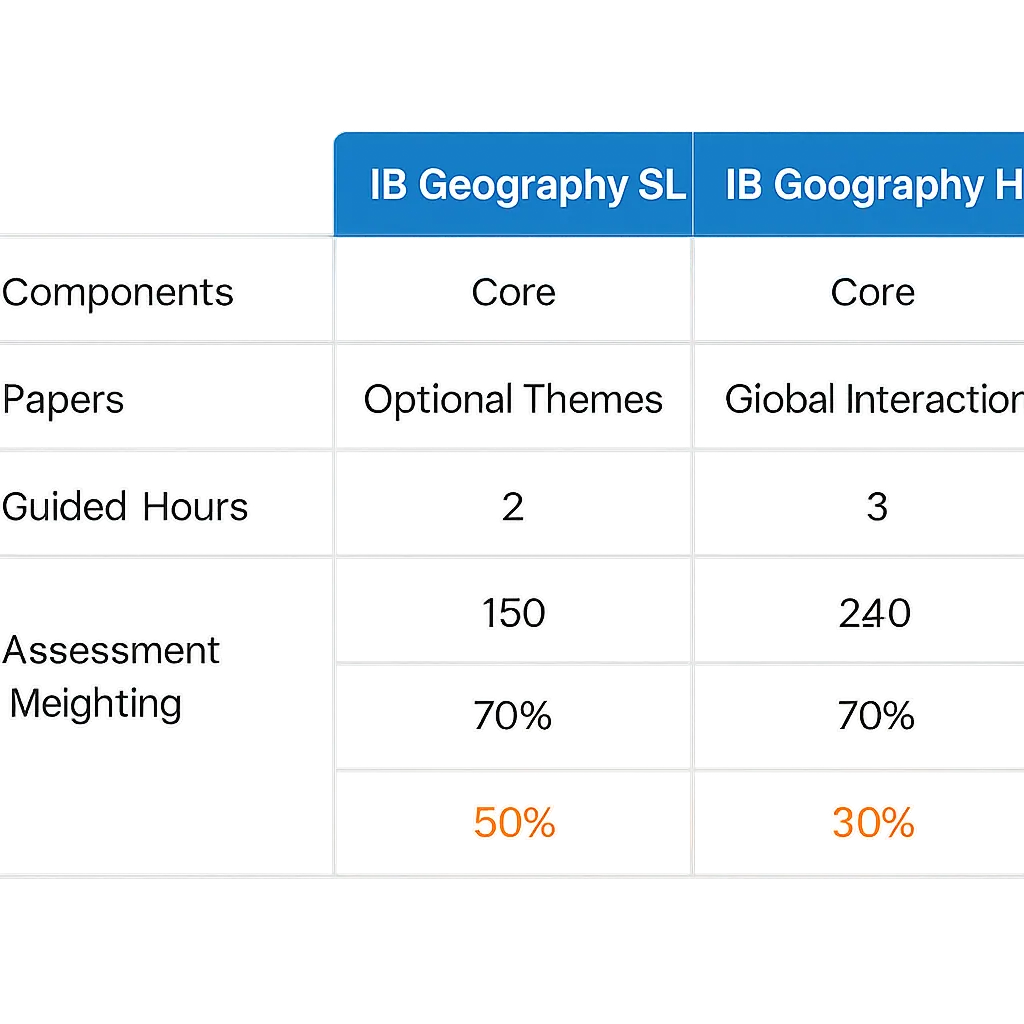
The split between papers and fieldwork differs meaningfully between SL and HL, and the shift in Paper 1 duration at HL (an extra 45 minutes) is easy to underestimate when planning revision time.
| Component | SL | HL |
|---|---|---|
| Paper 1 (optional themes) | 1 hr 30 min, 35% | 2 hr 15 min, 35% |
| Paper 2 (core themes) | 1 hr 15 min, 40% | 1 hr 15 min, 25% |
| Paper 3 (HL extension) | Not assessed | 1 hr, 20% |
| Internal assessment (fieldwork report) | 25% | 20% |
A few things worth noting:
- The IA carries more weight at SL. It is 25% of the SL grade and 20% at HL, which makes the fieldwork report one of the most controllable strategic priorities at either level.
- Paper 2 shrinks proportionally at HL. SL candidates rely on the core paper more than HL candidates do: it is 40% of the SL grade but 25% at HL.
- Paper 1 at HL is not just longer, it asks more. The extra 45 minutes covers a third optional theme, not simply more writing time.
Confirm all timings and weightings against the IB subject brief on ibo.org, since the figures above apply to the current guide's first-assessment cohort and could be revised in future cycles.
Grade boundaries are set by the IB after each examination session, based on that sitting's paper difficulty, and are not published in advance. Do not treat any boundary list from a previous year as a guaranteed guide to the next.
8. The IB Geography internal assessment: the 2,500-word fieldwork report
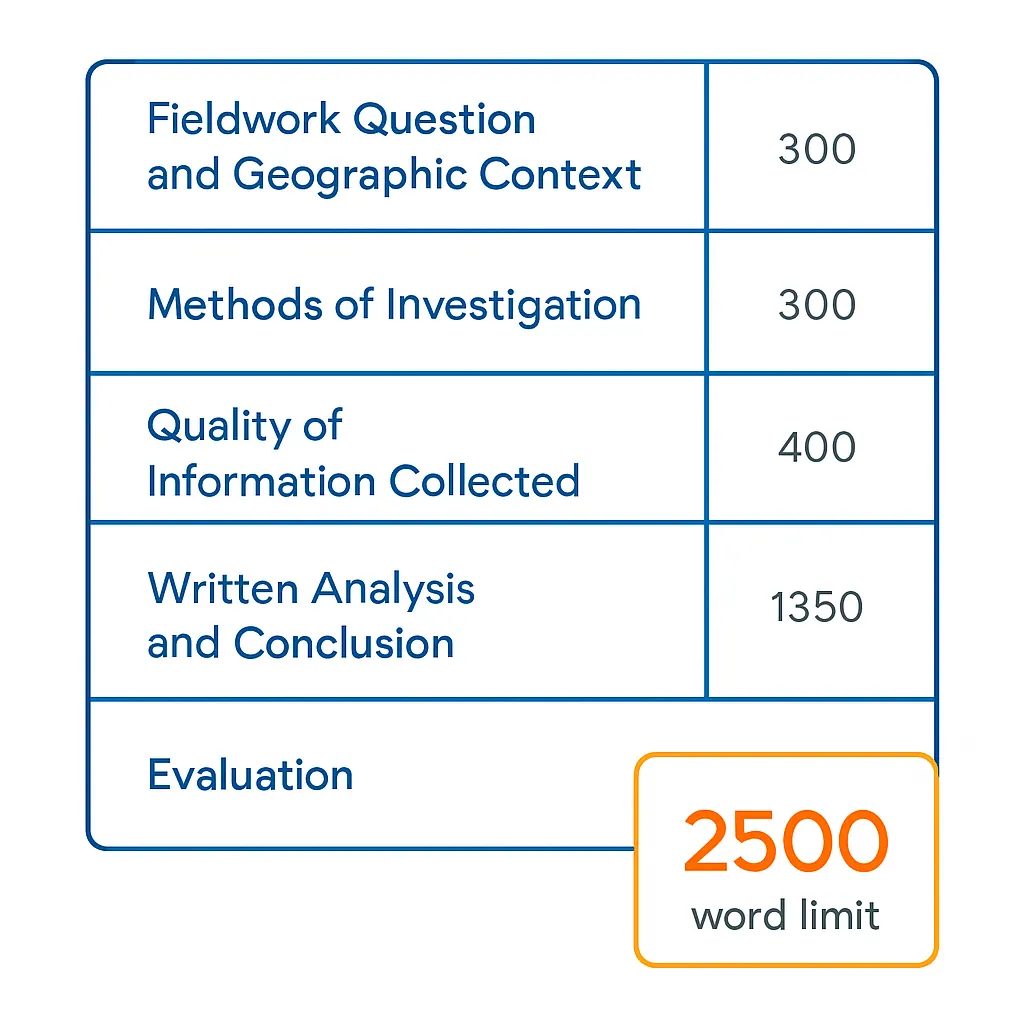
The IB Geography internal assessment is a written fieldwork report of up to 2,500 words, based on primary data the student collects themselves. It carries 25% of the final grade at SL and 20% at HL, which makes it one of the most controllable components in the whole course. Unlike the timed papers, you set the pace.
The report is assessed against criteria covering:
- Fieldwork question and geographic context - a clear, geographically grounded question and justification of why it matters
- Methods of investigation - explanation and evaluation of the data-collection techniques used
- Quality of information collected - the accuracy, relevance, and presentation of primary data
- Written analysis, conclusion, and evaluation - how well the data is interpreted and critically discussed
Primary data must be gathered by the student. Secondary sources (census data, published maps, satellite imagery) can support the contextual framing but cannot substitute for original collection.
Common fieldwork approaches include river channel transects, pedestrian flow counts, urban land-use mapping, coastal sediment surveys, and microclimate comparisons across different surface types. Any of these can produce a strong IA if the fieldwork question is tight.
The non-obvious gotcha: the word limit includes all text in tables, figure captions, and annotations. Students who produce dense annotated maps or data tables often find they have used several hundred words before writing a single paragraph of analysis. Plan the balance between data presentation and written argument early, not after data collection.
The teacher marks the IA first, then the IB externally moderates a sample. If the moderation finds the teacher's marks consistently high or low, the whole cohort's scores shift. Your mark is not solely in your teacher's hands.
9. Building your IB geo case studies and revision notes
A strong IB geo case study has four components: a specific named place, a defined time period, at least one quantified data point, and an explicit link to the concept being examined. A vague reference to "a coastal city" scores nothing. A reference to the Maldives' sea-level vulnerability, anchored to a policy response and a date, can anchor an entire paragraph.
The non-obvious problem with case-study building is timing. Students who wait until the revision period to compile their bank discover that the core and your optional themes together demand a large number of distinct examples. Start building from the first unit, one case study per concept, and the workload distributes across two years rather than compressing into six weeks.
Organise revision notes by paper, then by topic, then by case study. This mirrors the exam structure directly: Paper 1 tests the optional themes, Paper 2 tests the compulsory core. Notes structured any other way create a retrieval mismatch under timed conditions.
Past papers, available through the My IB student portal and the IB store, are the most reliable guide to question style and expected depth. The command terms matter more than most students realise. "Explain" requires mechanism; "evaluate" requires a judgment with evidence on both sides. Practising timed responses using your case-study bank tests both retrieval and command-term accuracy at once, which is harder than reading notes but much closer to what the exam actually demands.
10. What to do next
Your school's optional theme choices determine every Paper 1 question you will ever sit, yet many students only discover which themes were selected weeks before the exam. Fix that gap this week.
Download the IB Geography subject brief from ibo.org and take it to your geography teacher. Ask them to mark which two or three optional themes your school has chosen. Once you have those confirmed, you can build a targeted case-study list rather than covering material that will never appear on your paper.
One non-obvious thing worth noting: the brief also confirms which paper carries which weighting at SL versus HL, so it is the fastest way to check whether your revision time is proportioned correctly. Download the brief and mark your optional themes before your next geography lesson.
FAQ
What is IB Geography?
IB Geography is a Group 3 (Individuals and Societies) subject in the IB Diploma Programme that studies how physical and human processes interact across different places and scales, examined through a compulsory core, optional themes, and a fieldwork internal assessment.
How long is IB Geography Paper 1?
Paper 1 is 1 hour 30 minutes at SL and 2 hours 15 minutes at HL; it assesses your optional themes (two at SL, three at HL). The compulsory core (Changing Populations, Global Climate and Change, and Global Resource Consumption and Security) is examined in Paper 2, which uses stimulus-based questions including maps, graphs, and infographics.
What is IB Geography Paper 3 and who sits it?
Paper 3 is an HL-only extended essay paper lasting 1 hour that assesses the Global Interactions extension unit; SL students do not sit Paper 3.
How hard is IB Geography?
IB Geography demands strong case-study knowledge, data-interpretation skills, and the ability to write argued responses under time pressure; the workload is significant at HL, but the internal assessment component is completed over the two-year course rather than under exam conditions.
What is the IB Geography internal assessment?
The internal assessment is a fieldwork report of up to 2,500 words, worth 25% of the final grade at SL and 20% at HL, in which students investigate a self-chosen geographic question using primary data they have collected themselves.
Is IB Geography SL hard?
SL Geography covers the same compulsory core as HL but only two optional themes (HL takes three) and no Global Interactions extension or Paper 3, making it a narrower course; it still requires detailed case-study knowledge and the ability to interpret geographic data in exams.
References
- Example diploma subject choices - International Baccalaureate® - https://ibo.org/programmes/diploma-programme/curriculum/example-subject-choices
- Read curriculum updates - International Baccalaureate® - https://ibo.org/university-admission/latest-curriculum-updates