IB Subject Changes: What Students Need to Know
By Michael Thompson · Education Specialist; 10 years teaching the IB at Bromsgrove School · Published 21 May 2026 · Updated 4 October 2026
IB subject changes are structured, not sudden - the International Baccalaureate runs a formal 7-year curriculum review cycle that determines when each subject is redeveloped and when the new syllabus takes effect in exams. Understanding which cycle window your subjects fall into tells you whether your current study materials are already out of date, whether you are the last cohort on the old guide, or whether you are among the first to sit the revised assessment. The cycle affects everything from the subject guide you should be using to the specimen papers your school downloads. This article maps out how the cycle works, which subjects are currently mid-change, and what to do if a revision lands while you are partway through the Diploma.
Key Takeaways
- Seven-year review cycle: The IB reviews each subject on a rolling seven-year cycle, meaning every subject guide has a predictable 'first teaching' and 'first exam' date attached to it.
- First-teaching vs first-exam: There is typically a two-year gap between when a revised subject guide is introduced to schools (first teaching) and when students sit exams under the new specification (first exam).
- Assessment structure often stays intact: When a subject is updated, the number of papers, internal assessment weighting, and Higher vs Standard Level split frequently remain the same even when content changes significantly.
- Mid-diploma changes are rare but have a defined protocol: If a revision is published after you have already started the Diploma, the IB specifies which cohort transitions to the new guide and schools are notified directly.
- Official subject guides and specimen papers are the authoritative source: The IB Programme Resource Centre (for schools) and the public IB website are the only places to confirm which guide version is live for your exam session.
- Discontinuations follow a separate policy: When a subject is discontinued entirely rather than revised, the IB publishes a final examination session date, giving enrolled students time to complete the course.
In This Article
- How the IB Curriculum Review Cycle Works
- How to Read the IB's Published Curriculum Timeline
- IB Syllabus Changes: Subjects in the Current Window
- What Actually Changes - and What Stays the Same
- IB Subject Discontinuations: How the Policy Works
- What to Do If a Change Lands Mid-Diploma
- Where to Go From Here
1. How the IB Curriculum Review Cycle Works
IB subject changes follow a structured rolling review cycle, not an ad-hoc update process. The International Baccalaureate Organisation periodically revises each subject guide on a roughly seven-year schedule, working with subject-matter specialists, teachers, and assessment experts to update content, skills requirements, and assessment models. The output is a new subject guide that replaces the previous version.
Two milestone labels matter most when tracking where a subject sits in this cycle:
- First teaching - the academic year in which schools are required (or permitted early) to begin delivering the revised guide. Your class notes, Internal Assessment tasks, and course structure change from this point.
- First examination - the session in which students are assessed under the new guide for the first time. This typically falls two years after first teaching, matching the standard two-year Diploma Programme.
The counter-intuitive gotcha: a student starting the Diploma in a first-teaching year will sit the first examination under the new syllabus, while a student who started one year earlier may complete their course under the old one. Schools can overlap cohorts studying different versions of the same subject simultaneously, which creates genuine logistical pressure on teachers preparing two distinct sets of materials.
Because the IB Diploma Programme covers six subject groups, the review cycle is staggered deliberately. At any given moment, some subjects are in active revision, others are in first teaching, and others are mid-cycle and stable. This means IB curriculum changes rarely land as a single sweeping overhaul.
2. How to Read the IB's Published Curriculum Timeline
The IB publishes its curriculum development schedule in two places. The public-facing version sits under the "Diploma Programme" section of the main IB website. The more detailed version, including subject briefs and formal review documents, lives inside the Programme Resource Centre (PRC), which is accessible to teachers and coordinators at IB World Schools through their school login.
When you open a curriculum timeline, you will typically see three columns worth understanding:
- Subject - the full course name, including whether it is Standard Level, Higher Level, or both.
- First teaching year - the academic year in which schools are authorised (and sometimes required) to start delivering the new syllabus.
- First examination year - the May or November session when the revised assessment first applies.
Cross-referencing is straightforward: find your own first examination session, then check whether any of your subjects have a "first exam year" that falls on or before it. If it does, you are sitting the new version.
One non-obvious detail worth knowing: the first teaching year and the first examination year are not the same, and the gap between them is usually two years. That means a syllabus change can be formally published while you are already mid-course, covering content that was never in your initial subject guide.
Schools receive formal notifications from the IB directly, ahead of any public announcement. Your IB coordinator sees these before most students do, which makes them a reliable first stop if you spot something ambiguous in the published timeline.
3. IB Syllabus Changes: Subjects in the Current Window
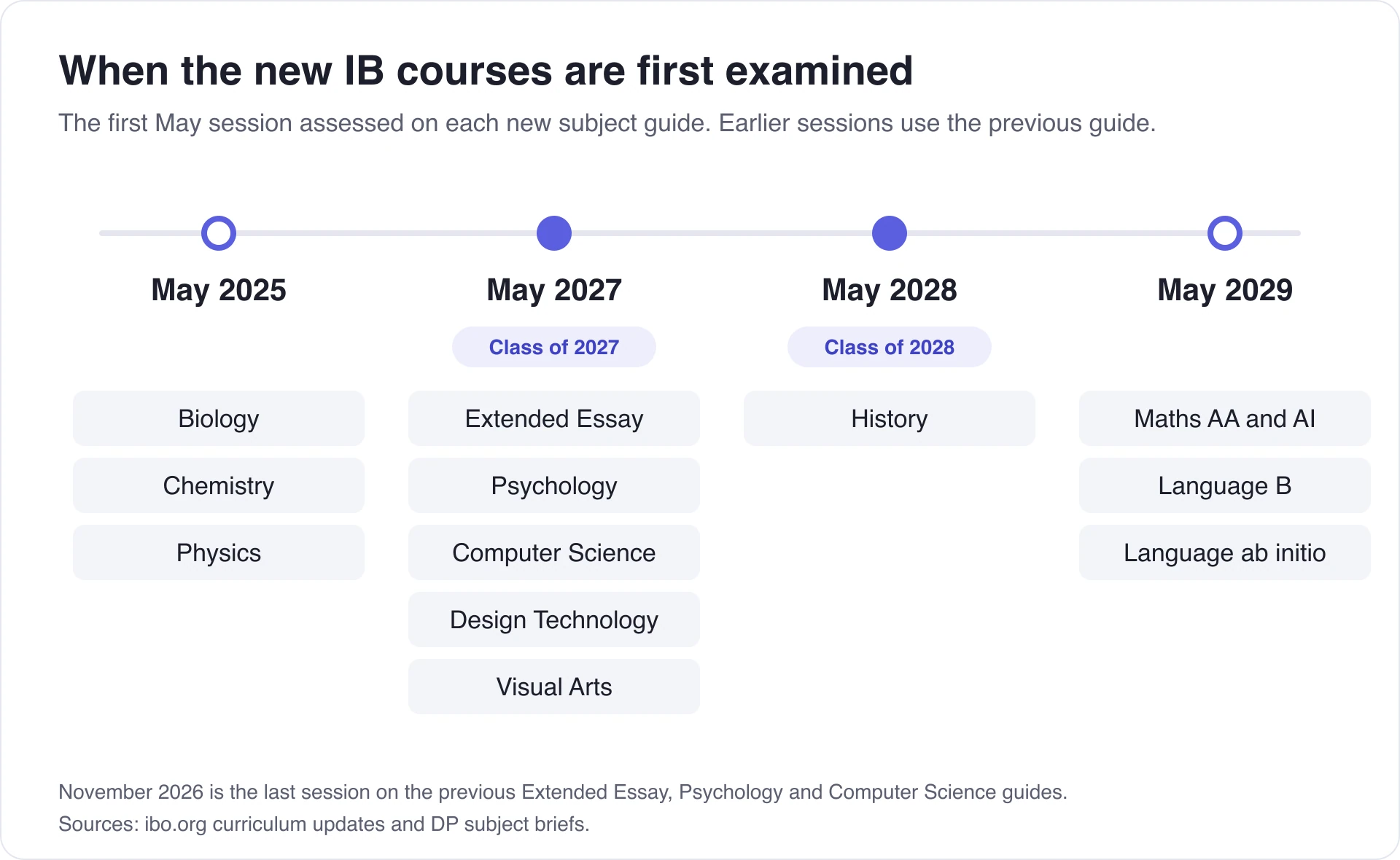
The IB rolls out revised syllabuses in staggered waves rather than all at once, so in any given year a handful of subjects are in their first-teaching window while others are approaching their first exam session. The clearest recent example is Group 4: the revised Biology, Chemistry, and Physics guides (first teaching 2023) had their first examinations in May 2025, replacing the old three-paper model with two papers - Paper 1 (multiple choice plus data-based questions) and Paper 2 - and a single set of internal assessment criteria at both levels. Always confirm exactly which subjects and sessions affect your cohort against the IB's published curriculum timeline.
The current wave, as published on the IB's curriculum updates page:
- First examined in May 2027 (first taught August 2025): Psychology, Computer Science, Design Technology, Visual Arts and the Extended Essay.
- First examined in May 2028 (first taught August 2026): History.
- First examined in May 2029 (first taught August 2027): Mathematics: analysis and approaches, Mathematics: applications and interpretation, Language B, Language ab initio, Dance, and Religion and society, which replaces World religions.
Nothing changes in Maths for anyone sitting in 2027 or 2028: the current courses, including the exploration criteria, apply up to and including the November 2028 session. The Language B update also leaves its assessment model unchanged.
What typically changes in a revised subject:
- Content scope. Some topics are removed, others added. The headline change is rarely the whole story: a topic that looks the same often has rewritten assessment objectives underneath.
- Assessment structure. The number of examination papers, internal assessment weighting, and mark allocations can all shift. A counter-intuitive quirk worth knowing: a reduced paper count does not always mean a lighter assessment load. The IB has in some recent revisions compressed two shorter papers into one longer one, which changes the stamina demands on exam day without reducing the total marks in play.
- Specimen papers. The IB releases specimen papers for each revised subject, typically on the Programme Resource Centre. These are the authoritative guide to question style under the new syllabus. A common mistake is using old past papers as primary revision material when specimen papers exist: the mark scheme philosophy can differ significantly.
Your coordinator can download current specimen papers through the IB Programme Resource Centre. If your school's access is restricted, ask your subject teacher to pull the relevant documents before your first-teaching year is complete.
4. What Actually Changes - and What Stays the Same
Not every revision touches the same layer of the Diploma Programme. Knowing which layer is affected tells you how much disruption to expect.
Content changes are the most common. These include swapped case studies, updated data-response questions, dropped optional topics, or new prescribed literature titles. They matter for revision and teaching resources, but they do not alter the shape of your assessments.
Structural changes go deeper. A shift in the internal assessment weighting, a new paper format, or a change to the number of examination components requires teachers to redesign how they sequence the two-year course. The IB signals these changes with more lead time precisely because of that planning burden. A content tweak can be absorbed mid-cycle; a new paper format cannot.
One counter-intuitive point: a subject can receive an entirely new syllabus and still feel structurally familiar, because the IB rarely moves the IA percentage by more than a few points in a single review. The bigger risk for students is assuming that a "minor update" only affects content, then discovering a changed mark-scheme emphasis too late.
Across all revisions, three things hold firm:
- The six subject group structure (Studies in Language and Literature through to The Arts).
- The 24-point minimum for Diploma award.
- The Core: Theory of Knowledge, Extended Essay, and CAS. These are not subject-group options and have never been removed from the Diploma requirement.
If a change touches any of those three, it is headline news from the IBO, not a quiet syllabus update.
5. IB Subject Discontinuations: How the Policy Works
Discontinuation is different from revision. When the IB revises a subject, the course continues under an updated syllabus. When the IB discontinues a subject, it is removed from the Diploma Programme offer entirely, meaning no new students can register for it and existing cohorts must finish before the final examination session closes.
The IB's standard practice is to announce a final examination session well in advance, giving students already registered enough time to complete their assessments and receive a grade. This window is the critical detail: once that final session passes, the subject no longer counts toward group requirements in any future Diploma registration.
The non-obvious gotcha is timing within a two-year programme. A student who starts a subject in Year 1 and only learns of its discontinuation partway through Year 2 may have very little room to switch, because most schools set internal subject-change deadlines months before the IB's own registration cutoffs. If a subject you are studying appears on a discontinuation notice, act at the school level immediately, not just before the IB deadline.
Students who miss the switch window cannot use a discontinued subject to satisfy group requirements, which can affect whether the full Diploma is awarded.
6. What to Do If a Change Lands Mid-Diploma
A syllabus revision does not automatically affect students already partway through their two-year programme. The IBO specifies a cohort cut-off for each revised guide: students who began the course under the previous guide are normally permitted to complete it and sit the final exam under that guide's assessment model. The old guide is retired only once its last permitted exam session has passed.
Which guide applies is set by the exam session, not chosen by your school: every candidate in a given session sits the same assessment for that subject. Confirm with your IB coordinator which guide applies to your exam session before the start of Year 2, especially if you plan to sit in November rather than May or to resit. This is not a formality.
Third-party revision resources are the other pressure point. Publishers and revision websites often update their materials on a different schedule from the IBO, and an outdated textbook can reflect command terms, content weightings, or internal assessment criteria that no longer apply to your cohort.
Three steps worth taking now:
- Ask your teacher for the official subject guide PDF from the IB's Programme Resource Centre.
- Check the "first assessment" date printed on the front of the guide - that confirms which cohort it applies to.
- Cross-reference any revision material against that PDF before relying on it.
7. Where to Go From Here
The most useful thing you can do this week is open the IB's published curriculum timeline and log the first-exam session date for each of your subjects. That single column tells you which syllabus guide is live for your cohort and whether any changes are already in effect or still incoming.
One non-obvious gotcha: the guide is tied to the exam session, so if you resit a subject in a later session, check which guide applies to that session. Contact your IB coordinator this week to confirm which guide applies to your exam session, then ask for the matching specimen papers, which the IB publishes to schools through the Programme Resource Centre.
For broader context, see our guides on IB subject options and IB Diploma requirements.
FAQ
How do IB subject changes work?
The IB revises each subject on a rolling seven-year cycle, publishing a new subject guide with a specified 'first teaching' year and a 'first exam' year roughly two years later.
Can I change IB subjects after my first exam?
Subject changes after the first exam session of the Diploma are generally not permitted; any switch must be agreed with your IB coordinator before the school's internal registration deadline.
Are IB syllabus changes the same as A-level syllabus changes?
No - IB subject changes follow the IBO's own review cycle and are independent of Ofqual-regulated A-level specification changes managed by UK exam boards such as AQA, OCR, or Edexcel.
Where can I find the official IB subject guide for my course?
The authoritative source is the IB Programme Resource Centre (accessible to registered IB World Schools); the public-facing IB website subject pages carry shorter subject briefs, so ask your teacher for the full guide.
What happens to a subject I am studying if it is discontinued?
The IB publishes a final examination session for any discontinued subject, so students already enrolled can complete their assessment; after that date the subject cannot count toward Diploma requirements.
References
- Latest curriculum updates - International Baccalaureate - https://www.ibo.org/university-admission/latest-curriculum-updates/
- Language B updates - International Baccalaureate - https://ibo.org/university-admission/latest-curriculum-updates/language-b-updates/