IB Resits: The Complete Guide for UK Students
By Michael Thompson · Education Specialist; 10 years teaching the IB at Bromsgrove School · Published 21 May 2026 · Updated 6 October 2026
IB resits give you a second chance at your International Baccalaureate exams - and the rules are more flexible than most students realise. The IB runs two exam sessions each year, May and November, and retake candidates can register for either through an IB World School. You can retake individual subjects, the core components, or both, in any future session - the IB removed its old three-session limit in 2023 - and the highest grade you achieve in a subject is the one that counts. This guide covers every rule, deadline, cost, and university admissions implication you need to weigh before committing to a retake.
Key Takeaways
- Resits run in both May and November: Retake candidates can register for either session through an IB World School - for UK students who finish in May, November is the quickest route back.
- No subject cap or session limit: The IB removed its old three-session rule in 2023 - you can retake as many subjects as you need, in as many future sessions as it takes.
- Your highest grade counts: If your resit grade is higher than your original, the higher score counts towards your diploma - and if it is lower, your original grade stands.
- Fees are paid per subject: Resit candidates pay a registration fee plus a per-subject exam fee, either through their school or as a private candidate via an IB World School.
- TOK and EE can be retaken separately: The core components - Theory of Knowledge and the Extended Essay - can each be retaken without retaking a full subject.
- UK universities vary widely on resits: Some competitive courses, including medicine at several Russell Group universities, require grades in one sitting and will not accept a resit diploma.
In This Article
- What Are IB Resits and Who Can Use Them
- The Two IB Sessions: When IB Resits Actually Run
- IB Retake Rules: How Many Subjects and How Long You Have
- IB Retake Cost: Fees and How to Pay
- IB Resit Dates and Registration Deadlines
- How Resit Grades Are Reported on Your IB Diploma
- Retaking TOK and the Extended Essay (Core Components)
- IB Resit Results and University Admissions in the UK
- US University Admissions and IB Resits
- Is an IB Resit Worth It? How to Decide
- What to Do Next
1. What Are IB Resits and Who Can Use Them
IB resits let a candidate sit one or more International Baccalaureate exams again after completing their original examination session, without returning to school or repeating the full two-year IB Diploma Programme. That distinction matters: a resit targets specific subjects or components, while repeating the programme means starting from scratch as a registered school candidate.
Eligibility is straightforward in principle. You must have already completed IB exams in a previous session, either as a full Diploma candidate or as a Certificate candidate sitting individual IB courses outside the full Diploma. Both routes remain open for resits, so a student who sat three standalone IB courses at a school that did not offer the full Diploma can return to resit those same subjects.
One reassuring point: a weaker resit cannot pull your result down. The IB counts the highest grade you achieve in each subject towards the diploma, so a lower retake score never replaces a higher original. Your results history still covers all sessions, though, so a university seeing both attempts is a real possibility, not a theoretical one.
Logistically, every retake runs through an IB World School. Most candidates register through their original school; if that is not possible, you need to find another school willing to administer your exams as a retake candidate, pay its fees, and work to its internal deadlines.
2. The Two IB Sessions: When IB Resits Actually Run
The International Baccalaureate runs two exam sessions each year: May and November. Understanding which one applies to you is the first practical step for anyone planning IB resits.
The May session is the main northern-hemisphere sitting. It is the session UK school cohorts sit, and it is open to retake candidates too, provided an IB World School registers you. May results arrive in early July, in time for that year's university confirmation window.
The November session is the quickest route back for most UK students. The exam window runs across October and November, with written papers spread over several weeks. For a candidate who finished in May, it is the earliest opportunity to improve a grade, with results released to schools on 16 December.
A quirk worth knowing: the November session exists primarily to serve southern-hemisphere schools, where the academic year runs roughly February to November. Not every IB World School in the UK administers a November session, so confirm that your chosen school participates before you build a plan around those dates.
The practical consequence is that missing a registration deadline costs you six months. If you miss the cutoff for November, the next opportunity is the following May. For students holding a university offer conditional on an improved IB score, the deciding factor is usually which session releases results in time: mid-December for November sittings, early July for May sittings.
3. IB Retake Rules: How Many Subjects and How Long You Have
The IB retake policy is more flexible than most students expect, but the logistics still catch people out when they are planning ahead.
You can retake as many subjects as you need in a single session - there is no cap. That applies whether you are sitting in May or November. In practice most candidates focus on one or two subjects, because each subject carries its own fee and its own revision load.
There is no longer a limit on how many sessions you can use. Until 2023 the IB capped candidates at three examination sessions to complete the diploma; that rule has been removed, so you can enter any future May or November session. The real constraint is practical: every extra session adds fees and pushes your university timeline back, so plan to close the gap in one sitting if you can.
Internal Assessment: the carry-forward gotcha
This is where the retake rules get genuinely counter-intuitive. Your IA mark from the original session is normally carried forward automatically, so you only sit the written exams again. That sounds convenient, and it is. The problem is that your IA mark is fixed at whatever you originally scored, even if your practical or coursework work has improved since. You can submit a new IA, but doing so means producing a fresh piece of work, paying an additional fee, and accepting that the new mark replaces the old one entirely, with no guarantee it will be higher.
Retaking to pass versus retaking to improve
The IBO draws no line here. You can retake a subject you have already passed purely to chase a higher score - to meet a university condition, say - just as you can retake to rescue a failed diploma. Because the highest grade counts, the risk is financial rather than academic: the question is not whether you are allowed to improve a grade, but whether the time and fees are worth the likely gain.
Resitting in May 2027 or later
New Psychology, Computer Science, Design Technology and Visual Arts courses are examined for the first time in May 2027. November 2026 is the last session for the old versions of all four - so if you resit one of these subjects in May 2027 or later, plan to sit the new course's papers, not the ones you were taught. The Extended Essay changes at the same point: essays submitted from May 2027 are marked on the new 30-mark model, with a single reflective statement replacing the old three-part reflection form. Ask your coordinator what carries over, including any IA, before you register.
4. IB Retake Cost: Fees and How to Pay
IB retake fees have two separate components, and conflating them is the most common budgeting mistake candidates make.
The two fee components:
- Candidature/registration fee. A one-off charge per session that covers your administrative enrolment as a retake candidate.
- Per-subject exam fee. Charged for each examination paper you sit. Retaking three subjects costs roughly three times the per-subject rate.
If you are retaking an Internal Assessment (IA) rather than just the written exam, an additional moderation fee applies on top of the standard exam fee, because the IB has to re-moderate your coursework against the global standard. This is a non-obvious cost that catches candidates off-guard when they budget based on the written-exam rate alone.
School candidate vs. private candidate
The route you take affects what you pay and who invoices you.
- School candidate. Your current IB World School handles registration and typically bills you directly. The school absorbs some administrative costs, so the total you pay may be lower.
- Private candidate. You must find a separate IB World School willing to administer your exams. Not every school accepts external candidates, and those that do set their own administration surcharges on top of the IB's base fees.
The IB does not publish a single global fee schedule. Costs vary by region and by the individual centre's pricing. Contact IB-registered centres in your area directly to get a quote before you commit to a session, and ask explicitly whether their fee covers IA moderation if that applies to your subjects.
5. IB Resit Dates and Registration Deadlines
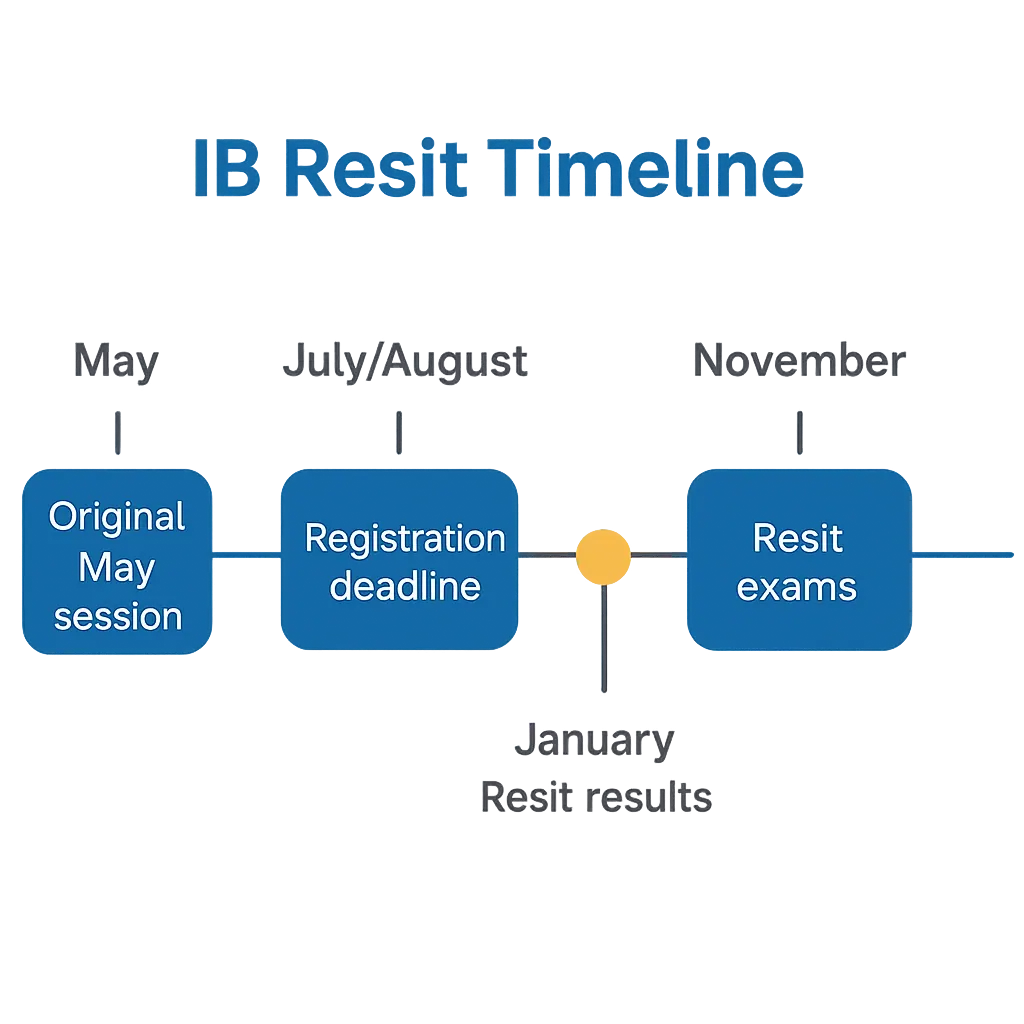
The tricky part of a November resit is registration. You only know you need one once May results arrive in early July, and the administering school will want your entry soon after. The gap between "I want to resit" and "I need to register" is shorter than it looks.
The most important deadline is not the IBO's own cutoff - it is your school's internal deadline, which will be earlier. The administering school has to compile candidate entries and submit them to the IBO before the external deadline closes. In practice, this means your school may require confirmation several weeks before the IBO's own date. Contact the IB coordinator at your administering school first, before you do anything else.
A few other timing points worth knowing:
- The IBO publishes the November exam timetable in advance, and individual subject exam dates fall across a window running from late October to mid-November (23 October to 13 November in 2026), not on a single day. Check your specific subjects rather than assuming all exams cluster at the start of the month.
- Results for November resits are released to schools on 16 December, and candidates see them 6 to 48 hours later.
- That December release date matters for UK university entry. It comes before the main UCAS deadline in January (18:00 on 13 January 2027 for 2027 entry), so you can apply for the following September with your new grades in hand. What a November resit cannot do is rescue a place for the autumn just gone: those courses have already started by the time the exams begin.
The university timeline is the detail most candidates underestimate at registration time. Plan it before you commit to a November resit, not after.
6. How Resit Grades Are Reported on Your IB Diploma
The IBO's reporting system works in your favour, and that is the single most important thing to understand before you register.
If your resit grade is higher than your original, the IBO records the higher grade. Your diploma certificate and official transcript are updated to reflect it, and the overall point total adjusts accordingly. Universities that request a revised transcript will see the improved profile.
If your resit grade is lower, your original grade stands. The IB counts the highest grade achieved in each subject towards the diploma, so a weaker retake cannot drag down your certificate or your point total. The A-level-style fear of losing a grade by resitting does not apply here.
This is the detail that surprises candidates: the IBO keeps the better of the two grades by default. A student who scored a 5 and resits hoping for a 6 keeps the 5 even if the retake paper goes badly on the day.
After results are released, candidates receive either an updated diploma certificate or an official results statement showing the revised grade, depending on whether the original diploma was already issued. Either way, the document universities see is the updated version.
The practical consequence: the decision is about time and money, not grade risk. Before registering, assess honestly whether your preparation can realistically add a point, because a retake costs a session's fees and months of work even though it cannot lower your recorded grade.
7. Retaking TOK and the Extended Essay (Core Components)
The Theory of Knowledge essay and the Extended Essay together can contribute up to three bonus points to your diploma total. Failing both components, or scoring an E grade in either, triggers automatic diploma failure regardless of your subject scores. If the core is what brought your diploma down, retaking full subjects may be the wrong call entirely.
The useful detail here is that TOK and the Extended Essay are retakable separately, without touching any of your six subjects. A candidate who passed all six subjects but failed solely on the core can enter a session, submit only the core component they need to redo, and leave their subject grades untouched.
How each retake works in practice:
- Extended Essay: You submit a new essay. You can choose the same subject area as your original or switch to a different one. Essays submitted from May 2027 are marked on the new 30-mark model. The higher of your two results is the one that counts towards your diploma; there is no averaging.
- TOK: You resubmit the TOK essay. Where the IB also requires the TOK exhibition for your registration category, that must be submitted too. Again, the better result is the one that counts.
The same session rules that govern subject retakes apply here: you can enter any future May or November session. For a May first-sitting candidate, the following November is usually the earliest opportunity to complete a core retake.
One gotcha worth flagging: a weaker second submission cannot push you backwards, but it does burn a session and months of work. Treat a core retake with the same seriousness as a full subject resit, not as a lighter option.
8. IB Resit Results and University Admissions in the UK
November resit results reach schools on 16 December, before the main UCAS deadline in January. For 2027 entry, that deadline is 18:00 on 13 January 2027, so if you have not yet applied, you can apply with achieved grades rather than predictions. Oxford, Cambridge and most medicine, dentistry and veterinary courses are different: their deadline is 15 October (15 October 2026 for 2027 entry), before the November exams begin, so those applications go in before your resit grades exist.
A November resit cannot rescue a place for the autumn just gone, but it can work for the following year. The realistic paths are:
- Applying with your new grades - if you have not yet applied, wait for your December results and apply before the January deadline, with your personal statement and reference ready in advance.
- Deferred entry - if you already hold an offer and the university agrees to defer, a November resit can sometimes satisfy the condition for the following autumn start.
- Updating an application already sent - if you applied before the exams, send your new grades to each university as soon as you have them and ask whether they change your offer.
One non-obvious complication: some courses, including medicine, dentistry, and certain Russell Group programmes, specify that required grades must be achieved in a single sitting. A resit diploma, even with an improved total, may not satisfy that requirement regardless of the final points score. This is separate from any IB rules, it is the university's own admissions policy.
UCAS has no blanket position on IB resits. Each institution sets its own rules, and those rules are not always published clearly. Contact the admissions office directly, in writing, before you register for a November resit. Ask explicitly whether a grade from the November session will be accepted against your offer. Get the answer in writing.
9. US University Admissions and IB Resits
Most US universities assess applications holistically and do not require all IB grades to come from a single sitting. Unlike the UK's UCAS system, where conditional offers are tied to a specific exam cycle, US admissions offices typically review the best available transcript across all sessions. That distinction matters: a November resit result can be submitted before many US spring enrolment deadlines.
Both the Common App and Coalition Application accept updated IB transcripts. Once your resit results are released, request a revised official transcript from the IBO through your school coordinator and send it directly to any institution still processing your application or holding a deferred place.
The counter-intuitive gotcha with selective universities such as MIT, Stanford, and the Ivy League is that they do not publicise a penalty for IB resits, but they receive your full academic history. A resit that improves a grade from 4 to 6 reads positively. A resit that produces a marginal gain after multiple attempts across many subjects reads differently. The improvement itself is not the issue; the pattern is.
One concrete benefit worth knowing: IB credit and exemption policies at US universities are set course-by-course, not programme-wide. A score of 6 or 7 at Higher Level may qualify you for course credit or advanced standing where a 5 did not. Checking a specific university's credit table before you register for an IB resit can help you decide whether a particular subject is worth retaking.
If you hold a deferred place or an offer from a US institution, inform the admissions office in writing that a resit is in progress before the examination session begins. Silence is rarely treated charitably if a different result arrives unexpectedly.
10. Is an IB Resit Worth It? How to Decide
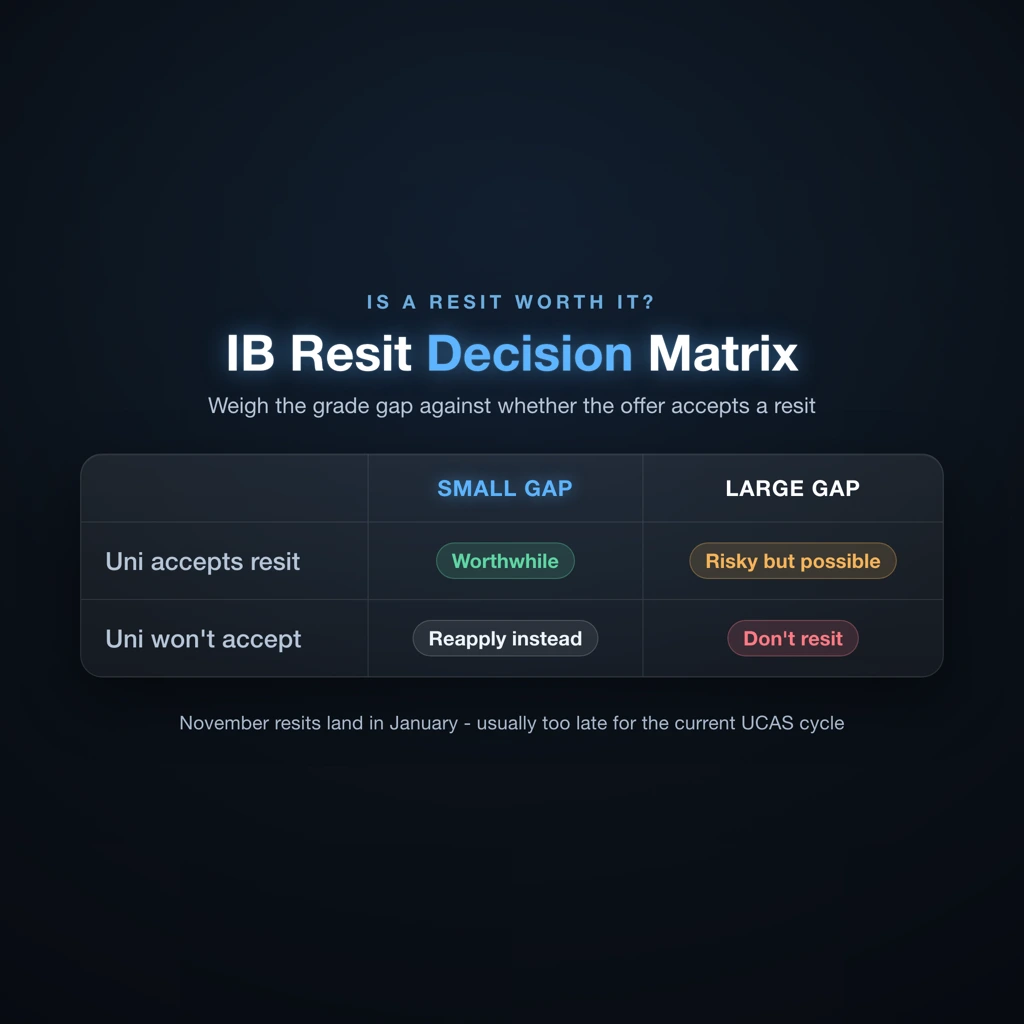
Start by mapping the exact gap, not a vague sense that you "did badly". Which subject, which grade, and which university offer depends on it? A student who scored a 5 in HL Chemistry and holds a conditional offer requiring a 6 has a clear, bounded case. A student who missed their overall points total by one or two points faces a different calculation, because a single subject resit may not close that gap if TOK or the Extended Essay contributed to the shortfall. Our free IB Points Calculator lets you model exactly that: change one grade and watch the total, the bonus points, and the award conditions move.
The real costs are time and money, not grade risk. A lower resit grade never replaces a higher original - the IB counts your best result - but each attempt appears on your results history and costs a full session of fees and preparation. Weigh that carefully where your original grade was already acceptable and the offer required a total points threshold rather than a subject-specific grade.
Timing matters too. November session results reach schools on 16 December, before the UCAS equal consideration deadline in January, so a November resit can feed into an application for the following year or meet the condition of a deferred offer. What it cannot do is rescue a place for the autumn just gone.
Before committing, check these practical blockers:
- Finding a school. You need an IB World School willing to register you as a private candidate. Many decline, especially at short notice.
- Internal deadlines. The school's own registration cutoff usually falls weeks before the IBO's official deadline.
- Cost. Fees cover registration, per-subject charges, and any school administration fee layered on top.
If any of those three cannot be resolved, the realistic alternatives are a foundation year at your target university, switching to A-levels with a college or sixth-form, or reapplying in the next cycle using your original grades alongside a stronger personal statement.
11. What to Do Next
The most time-sensitive task is not finding the IBO registration portal. It is calling or emailing a local IB World School that accepts private candidates this week and asking for their internal registration deadline for the next exam session. That school-level cutoff is typically several weeks earlier than the IBO's own published date, and missing it means waiting for the next session and re-planning your university timeline.
Once you have that date confirmed, work backwards:
- Review IA carryover eligibility with the administering school before you register, since carrying a previous IA score locks in a mark you cannot improve.
- Check the specific admissions policy of any UK university you are targeting, as deferral and resit conditions vary by course and institution.
For broader context, see the related guides on UCAS Clearing and IB Diploma requirements. Contact your nearest accepting school today.
FAQ
Can you retake IB exams?
Yes - IB candidates can retake one or more subjects (and/or core components) in any future May or November examination session, registering through an IB World School; the highest grade achieved counts towards the diploma.
How many times can you retake IB exams?
There is no limit - the IB removed its old three-session rule in 2023, so you can retake subjects in as many future May or November sessions as you need, though each sitting carries registration and per-subject fees.
What happens if you fail IB exams?
If you fail to meet the diploma requirements - for example by scoring below 24 total points, scoring a 1 in any subject, or failing the core - you can retake the subjects or components where you fell short in any future May or November session - for most UK students, the November sitting straight after their May results is the quickest route.
When in November are IB retake exams held?
The November IB session runs from late October to mid-November (23 October to 13 November in 2026), with individual exam dates varying by subject according to the timetable published by the IBO; results are released to schools on 16 December, and candidates see them 6 to 48 hours later.
Do universities accept IB resit grades?
UK universities set their own policies - many will accept a resit grade for standard entry, but competitive courses such as medicine at several Russell Group universities require grades achieved in one sitting; always check directly with the admissions office.
Are IB resits worth it?
Whether a resit is worthwhile depends on the grade gap to your target offer, the registration and per-subject fees involved, and whether your target university will accept a November-session resit result in time for your intended entry year.
References
- Retaking examinations | International Baccalaureate - https://ibo.org/programmes/diploma-programme/assessment-and-exams/retaking-examinations/
- Getting results | International Baccalaureate - https://www.ibo.org/programmes/diploma-programme/assessment-and-exams/getting-results/
- New release date set for November 2024 examination results | International Baccalaureate - https://www.ibo.org/news/news-list/new-release-date-set-for-november-2024-examination-results/
- Psychology updates | International Baccalaureate - https://ibo.org/university-admission/latest-curriculum-updates/psychology-updates/
- DP extended essay updates | International Baccalaureate - https://www.ibo.org/university-admission/latest-curriculum-updates/dp-extended-essay-updates/
- Assessment FAQ | International Baccalaureate - https://www.ibo.org/programmes/diploma-programme/assessment-and-exams/getting-results/assessment-faq/
- Exam schedule - Diploma | International Baccalaureate - https://ibo.org/programmes/diploma-programme/assessment-and-exams/exam-schedule/