Medicine Degree Entry Requirements: A Complete UK Guide
By Michael Thompson · Former IB Diploma Programme coordinator; 10 years at Bromsgrove School · Published 5 July 2026
Medicine degree entry requirements in the UK are more layered than a single grade string: schools screen applicants on GCSEs, an admissions test, and academic qualifications before anyone reaches interview. Most universities want Chemistry at A-level or Higher Level as a non-negotiable, but what sits alongside it - and how high the bar is set - varies considerably across the sector. This guide sets out the standard gates every applicant must clear, how the requirements shift for graduate and foundation-year routes, and what a realistic spread of offers looks like from the most selective to the most accessible programmes. By the end you will have a clear picture of where you stand and what to check next.
Key Takeaways
- Chemistry is the near-universal requirement: Almost every UK medical school demands Chemistry at A-level (or IB Higher Level); biology is usually required or strongly expected alongside it.
- GCSEs filter before interview: English, maths, and sciences at GCSE are screened early in the process - a weak GCSE profile can rule you out before your A-levels are ever considered.
- UCAT has replaced BMAT: BMAT has been retired; the UCAT is now the standard admissions test for 2026 entry at the vast majority of UK medical schools.
- UCAS rules cap medicine applications at four: You may use only four of your five UCAS choices for medicine; the fifth should be a related backup such as biomedical science.
- Graduate and foundation-year routes widen access: Graduate-entry programmes require a 2:1 degree rather than specific A-level grades, and foundation-year pathways carry lower published requirements with widening-participation criteria.
- IB applicants need competitive HL scores plus a high overall total: Oxford requires 39 points overall with 7, 6, 6 at Higher Level including Chemistry; Edinburgh requires 38 points with 666 at HL - check your target university directly.
In This Article
- What Are the Core Medicine Degree Entry Requirements?
- GCSE Requirements and the UCAT Admissions Test for 2026 Entry
- UCAS Rules for Medicine Undergraduate Entry
- Medical School Entry Requirements: A-level and IB Comparison Table
- Graduate Entry Medicine UK Requirements
- Foundation Year and Gateway Programmes: The Accessible End of the Spread
- The IB Route to Medical School Entry Requirements
- What to Do Next
1. What Are the Core Medicine Degree Entry Requirements?
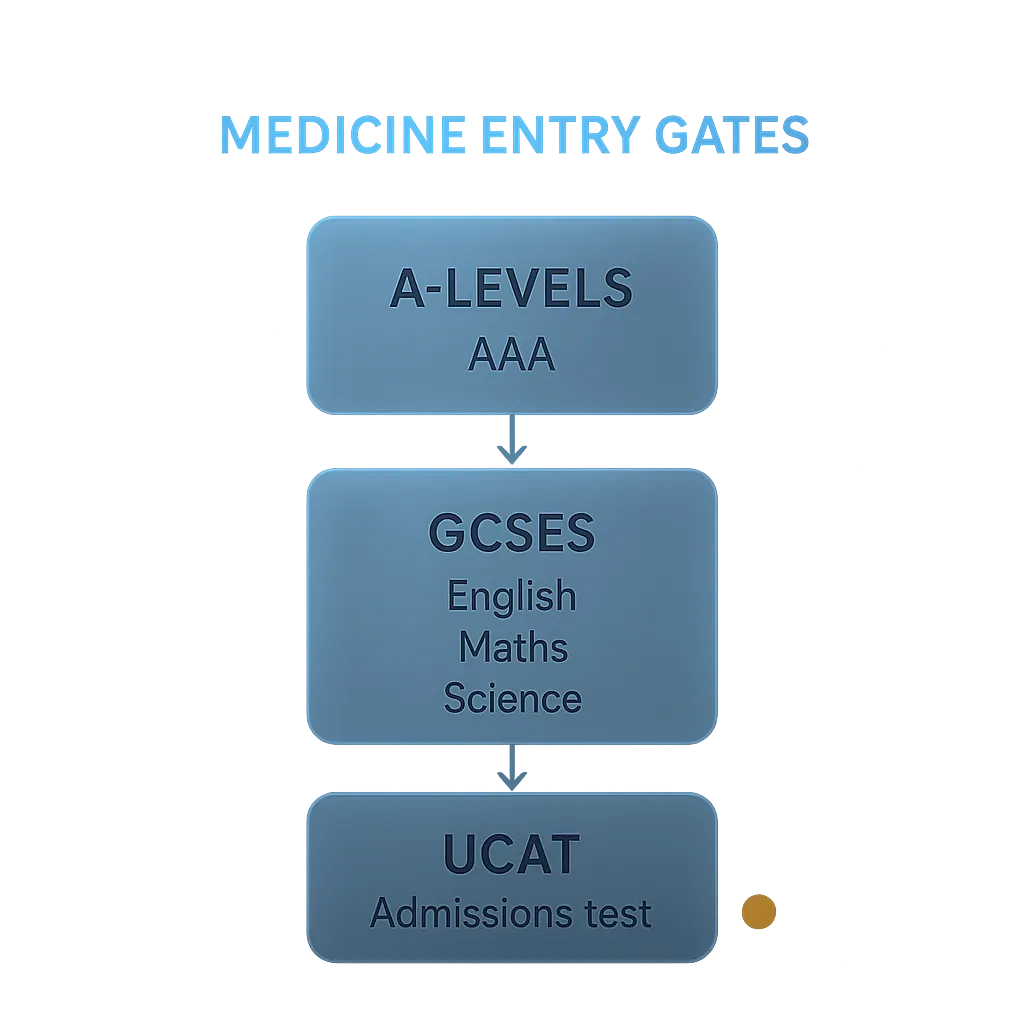
Medicine degree entry requirements in the UK operate on three separate gates, not one. You need to clear academic qualifications, GCSE screening, and a standardised admissions test before most offers are even considered. Treating any one of these as sufficient is the most common planning mistake.
Chemistry at A-level is as close to a universal requirement as UK medical admissions gets. Oxford requires A in Chemistry alongside an overall offer of A\*AA. Edinburgh requires AAA including Chemistry. The reason is practical: pharmacology, biochemistry, and physiology all depend on it. The second required science, however, varies. Oxford accepts Biology, Physics, Mathematics, or Further Mathematics alongside Chemistry. Edinburgh accepts Biology, Mathematics, or Physics.
That variation matters more than most applicants realise. A student with Chemistry and Physics but no Biology is eligible at some schools and screened out at others before their personal statement is read.
Published grade strings (A\*AA at Oxford, AAA at Edinburgh) are a starting point, not a complete picture. Conditional offers also reflect GCSE profiles, admissions test scores, and interview performance. Always verify current requirements directly on the UCAS course listing or the university's own admissions page. Third-party summaries, including this one, can lag behind annual updates.
2. GCSE Requirements and the UCAT Admissions Test for 2026 Entry
GCSEs are not just a box-tick. Most medical schools screen them before deciding who gets interviewed, which means a weak set can end your application before a single assessor reads your personal statement.
The specific grades expected vary by school, but the University of Edinburgh gives a clear illustration: applicants must hold Biology, Chemistry, English, and Maths at grade A/7 or above at GCSE (or equivalent), alongside A-level AAA with Chemistry plus a second science or maths subject, per UCAS. One non-obvious detail: Edinburgh accepts Double Award Combined Science at grade AA/77 as a substitute for separate Biology and Chemistry GCSEs, but will not accept Applied Science or Additional Applied Science in any combination.
BMAT was retired after the 2023 admissions cycle. For 2026 entry, the standard admissions test across the majority of UK medical schools is the UCAT (University Clinical Aptitude Test). UCAT measures verbal reasoning, decision-making, quantitative reasoning, abstract reasoning, and situational judgement. A strong score sits alongside your predicted grades as a screening tool, and a weak score can exclude you from shortlisting even if your academics are strong.
The test landscape is not entirely uniform. At the University of Surrey's graduate-entry programme, most applicants submit a GAMSAT score rather than UCAT. UCAT is only accepted from Surrey applicants whose first degree is in Biochemistry, Biology, Biomedical Science, Chemistry, or Natural Sciences, per UCAS. If you hold a non-science degree, Surrey requires GAMSAT with no alternative.
Check each target school's GCSE floor and preferred admissions test separately, before you build your application list.
3. UCAS Rules for Medicine Undergraduate Entry
UCAS limits medicine applicants to four medicine choices out of the five available. The fifth slot should go to a related alternative - biomedical science is the standard safety pick - because leaving it empty wastes a real option and applying a fifth medicine choice is not permitted.
You may apply to only one of Oxford or Cambridge in a single UCAS cycle. This is a firm UCAS rule, not a preference. Choosing both means one application is automatically rejected before anyone reads it.
One trap that catches applicants more often than it should: Cambridge's graduate-entry MB BChir is open to home fee status students only. International fee status students are ineligible entirely. This is different from most other UK graduate-entry programmes, so an international applicant who has built their application around Cambridge as a graduate route will find the door closed regardless of grades or UCAT score.
Key structural rules at a glance:
- Maximum four medicine choices on a single UCAS application.
- Fifth choice: use a related subject (biomedical science is the conventional fallback).
- Oxford or Cambridge - one only per cycle, never both.
- Cambridge graduate-entry medicine: home fee status only, no international applicants eligible.
4. Medical School Entry Requirements: A-level and IB Comparison Table
The table below pulls directly from each university's admissions pages. One detail worth noting: Oxford's undergraduate offer is A\*AA, while Cambridge's undergraduate offer is not published as a fixed grade string in the same way - the source does not specify a standard A-level offer for undergraduate entry, so that cell is left blank rather than invented.
| University | Typical A-level offer | IB offer | Required subjects | Admissions test |
|---|---|---|---|---|
| Oxford (UG) | A\*AA | 39 points; 7,6,6 at HL | Chemistry at A-level and HL; plus one of Biology, Physics, Maths | BMAT (check current cycle) |
| Cambridge (UG) | Not specified in source | Not specified in source | Chemistry expected; see admissions page | BMAT |
| Edinburgh (UG) | AAA | 38 points; 666 at HL | Chemistry + one of Biology, Maths, or Physics at HL | UCAT |
| Oxford Graduate Entry | AAB at A-level (if taken within last 5 years); 2:1 degree required | 36 points; 6+ at HL including Chemistry | Chemistry A-level (or Chemistry/Biochemistry degree); plus one of Biology, Physics, or Maths | BMAT |
| Cambridge Graduate Entry | 2:1 degree in any subject (home fee status only) | Not specified in source | No specific A-level subjects listed | BMAT |
| Surrey Graduate Entry | A-levels not accepted; 2:1 degree required | Not specified in source | GCSE Maths and English at grade C+ | GAMSAT (or UCAT for science graduates) |
Sources: Oxford UG, Edinburgh via UCAS, Oxford Graduate Entry, Cambridge Graduate Entry, Surrey Graduate Entry via UCAS.
One counter-intuitive detail: Surrey's graduate entry programme does not accept A-levels, BTECs, or Scottish Highers at all. If you hold a 2:1 in any subject, your undergraduate degree is the qualification, and pre-university grades are irrelevant. Oxford's graduate entry works differently: A-level grades still matter, but only if you sat them within the last five years.
Offers change annually. Before submitting your UCAS application, verify every grade string directly on the university's admissions page or the official UCAS course listing. The figures above reflect requirements published for 2026 entry.
5. Graduate Entry Medicine UK Requirements
Graduate-entry medicine programmes run for four years and lead to the same qualification as the undergraduate route. The degree requirement across all three programmes below is a 2:1 honours degree, but the subject rules diverge sharply.
| University | Degree subject required | Admissions test | Home students only? |
|---|---|---|---|
| Oxford | Applied or experimental science | UCAT | No |
| Cambridge | Any subject | UCAT | Yes |
| Surrey | Any subject | GAMSAT or UCAT* | No |
*Surrey accepts UCAT only from applicants with degrees in Biochemistry, Biology, Biomedical Science, Chemistry, or Natural Sciences. All other Surrey applicants must sit GAMSAT.
The Oxford quirk most applicants miss: Oxford GEM checks your A-level Chemistry if you sat it within the last five years, requiring at least AAB with an A in Chemistry. Chemistry or Biochemistry graduates are exempt. This creates a counter-intuitive situation where a recent Physics graduate may face an A-level hurdle that a Biochemistry graduate does not.
Cambridge accepts any undergraduate subject but restricts the course to home-fee-status students. International applicants are ineligible, full stop.
Surrey's hard rule on prior qualifications: A-levels, BTEC, and Access to HE Diplomas cannot substitute for the degree requirement at Surrey. This is not a soft preference, and there are no exceptions listed.
If you hold a non-science degree and are weighing Surrey against Oxford, confirm your GAMSAT preparation timeline first. GAMSAT is a distinct, science-heavy test with its own preparation demands, separate from the UCAT you would sit for Oxford or Cambridge.
6. Foundation Year and Gateway Programmes: The Accessible End of the Spread
Foundation year and gateway-to-medicine programmes carry lower published A-level grade requirements than standard five-year entry routes. The counter-intuitive detail is that grades alone rarely determine eligibility. Most universities restrict these programmes to applicants who meet widening-participation criteria, so a student with ABB who attended a high-performing independent school will typically be screened out regardless of their grades.
Eligibility criteria commonly include one or more of the following:
- First-generation university attendance (neither parent holds a degree)
- Care-leaver or estranged-student status
- Attendance at a school or college with below-average progression rates to higher education
- Residence in a postcode flagged by POLAR or similar participation indices
Universities of Lincoln, Nottingham, and Southampton are among the institutions frequently mentioned in gateway-medicine discussions, though published requirements and eligibility thresholds change each cycle. Always check the admissions page for the exact entry year rather than relying on third-party summaries.
One gotcha worth knowing: some gateway programmes feed directly into year one of the MBChB only if you pass the foundation year at a specified grade. Failing to hit that progression threshold can mean no automatic medicine place, even if you pass the year.
Browse medicine foundation year and gateway programmes to compare current published entry requirements side by side.
7. The IB Route to Medical School Entry Requirements
Chemistry at Higher Level is non-negotiable for IB applicants to virtually every UK medical school. Beyond that, most schools require a second science at HL, typically Biology, Physics, or Mathematics.
The non-obvious gotcha: Oxford's undergraduate medicine requires all three A-level-equivalent subjects in the same sitting, and its IB equivalent is equally strict. Per the University of Oxford Medical Sciences Division, IB applicants must achieve 39 points overall (including core), with HL scores of 7, 6, 6, and Chemistry plus at least one of Biology, Physics, or Mathematics at HL. A student sitting Chemistry at SL cannot substitute a high HL score elsewhere to compensate.
For Oxford's Graduate Entry Medicine, the bar is slightly lower. Oxford GEM requires 36 points overall with 6 or above in all HL subjects, again including Chemistry and one further science or Maths at HL.
Edinburgh sits between the two. Per UCAS, the MBChB requires 38 points with 666 at HL, Chemistry plus one of Biology, Maths, or Physics at HL, and SL must cover Mathematics, English, and Biology if any of those are not taken at HL. That SL constraint catches students off guard more often than the HL requirements do.
One thing worth stating plainly: Oxford considers A-levels and the IB equally. The university explicitly states that success rates are broadly similar across both qualifications, and qualification choice plays no part in selection.
8. What to Do Next
The most useful thing you can do this week is open UCAS Course Search for every medical school on your shortlist and record the exact GCSE grade thresholds and admissions-test requirements for each one. Those two filters eliminate more applicants earlier in the process than A-level grades do, and the specific numbers vary more between schools than most applicants expect.
One non-obvious quirk worth checking now: some schools list a minimum GCSE science grade separately from their overall profile requirement, and the two figures can differ. Missing that distinction costs you a shortlist place before you have written a single personal statement line.
For a broader view of how individual courses compare on published entry criteria, browse UK medicine courses and entry requirements. When you are ready to go deeper on the subject, the medicine subject guide covers every stage of the application in detail. Start with UCAS Course Search today.
FAQ
Can you apply for undergraduate medicine with a degree?
Yes - holding a degree does not bar you from undergraduate (standard-entry) medicine, but most graduates apply to the 4-year graduate-entry programmes (A101) instead, which require a 2:1 or above and typically replace A-level grade requirements with a degree classification threshold.
How many graduate entry medicine courses can you apply for?
The standard UCAS rule caps medicine applications at four choices in total (across both A100 and A101 courses combined), with the fifth choice reserved for a non-medicine backup; there is no separate sub-limit specifically for graduate-entry courses.
Do medicine degree entry requirements change from year to year?
Yes - grade thresholds, GCSE requirements, and admissions-test policies can change each cycle, so you should always verify requirements on the official university admissions page or UCAS Course Search for the year you intend to apply.
Which universities accept Access to Medicine courses?
Oxford's graduate-entry medicine accepts Access and Foundation courses only if they are assessed by formal written examination, classified, and passed at Distinction level; Surrey's graduate-entry programme does not accept Access to HE Diplomas at all - policies vary significantly so check each institution directly.
What are the GCSE requirements for medical school entry?
Most medical schools screen GCSEs in English, maths, and sciences before interview; Edinburgh, for example, requires Biology, Chemistry, English, and Maths at grade A/7 or above, and combined Double Award science at AA/77 is accepted as a substitute for individual science GCSEs.
Do you need a degree before going to medical school?
No - standard-entry (A100) programmes accept applicants straight from school or college on the basis of A-levels, IB, or equivalent qualifications; a prior degree is only required for graduate-entry (A101) programmes.
References
- Medicine: Academic Entry & Age Requirements - University of Oxford, Medical Sciences Division - https://www.medsci.ox.ac.uk/study/medicine/pre-clinical/requirements/academic
- Medicine | The University of Edinburgh | UCAS - https://www.ucas.com/explore/courses/c126ddd9-0cf0-19ed-a60a-e79c38769df4/medicine?optionId=496c8717-c7ca-4c8f-85a2-5bcd631ff745
- Medicine (Graduate Entry) | University of Surrey | UCAS - https://www.ucas.com/explore/courses/bedbe508-a30a-43e6-bd66-14d94ac35c49/course
- Medicine (Graduate course), MB and BChir | Undergraduate Study - https://www.undergraduate.study.cam.ac.uk/courses/medicine-graduate-course-mb-bchir
- Graduate Entry Medicine: Entry Requirements - University of Oxford, Medical Sciences Division - https://www.medsci.ox.ac.uk/study/medicine/graduate-entry-medicine/graduate-entry-medicine-entry-requirements
- Pre-clinical medicine: Do you prefer A-levels or the IB? - University of Oxford, Medical Sciences Division - https://www.medsci.ox.ac.uk/study/medicine/pre-clinical/faqs/do-you-prefer-a-levels-or-the-ib