How to Get Into Law School in the UK: Complete Guide
By Michael Thompson · Former IB Diploma Programme coordinator; 10 years at Bromsgrove School · Published 5 July 2026
Getting into law school in the UK is more structured than many students realise: there is no single required A-level subject, no universal admissions test, and entry requirements vary considerably between universities. What most selective law schools are looking for is evidence that you can read closely, construct an argument, and engage critically with ideas - qualities you can demonstrate through your subject choices, your UCAS personal statement, and any relevant experience outside the classroom. This guide covers law degree entry requirements, how the LNAT works, how to write a law personal statement under the new 2026 UCAS format, and where a law degree can take you after graduation.
Key Takeaways
- No mandatory A-level subject: but essay-based subjects such as English, history, or politics build the reasoning and analytical writing skills law tutors want to see.
- IB offers are quoted as total points with HL minimums: so you need to read each university's official IB entry page carefully rather than treating all offers as equivalent.
- The LNAT is required by a specific group of UK universities: not all of them - check the official LNAT site for the current list before registering, and note that the 2026 registration window has firm deadlines.
- Super-curriculars matter when they become reflective evidence: a list of books you have read carries less weight than a short explanation of how a specific argument changed the way you think about a legal question.
- The 2026 UCAS personal statement has three questions: each suited to a different dimension of your law application, within a combined 4,000-character limit.
- Qualifying as a solicitor now goes through the SQE route: while barristers still complete the Bar course and pupillage - the regulatory details are set by the SRA and Bar Standards Board respectively.
In This Article
- What Law Schools Are Actually Looking For
- Law Degree Entry Requirements: A-Levels and Scottish Qualifications
- Law Degree Entry Requirements for IB Students
- The LNAT: Which Universities Require It and How to Prepare
- Super-Curriculars for Law: Going Beyond the Reading List
- Writing a Law School Personal Statement for the 2026 UCAS Format
- What a UK Law Degree Actually Looks Like
- Where a Law Degree Can Take You: SQE, the Bar, and Beyond
- What to Do Next
1. What Law Schools Are Actually Looking For
Knowing how to get into law school in the UK means understanding one counter-intuitive fact first: there is no required A-level subject. Admissions tutors at leading universities are not looking for prior legal knowledge. They are looking for evidence that you can read a complex argument closely, identify its weaknesses, and construct a structured response in writing. These skills matter because a law degree, from day one, demands exactly that work.
The three abilities that admissions tutors consistently signal they want are:
- Close reading - tracking how an argument is built, not just what it concludes
- Logical reasoning - spotting unstated assumptions and testing them
- Sustained written argument - holding a position across several paragraphs without contradicting yourself
The counter-intuitive trade-off this creates: a student who has read philosophy or history and can argue precisely will often look stronger on paper than one who has studied law-adjacent topics but writes loosely.
A strong application to a UK law degree combines four things, each covered in the sections below: the right grades and qualifications, a credible LNAT score where the university requires one, a personal statement that demonstrates analytical thinking rather than career enthusiasm, and super-curriculars that show genuine intellectual engagement with legal ideas.
2. Law Degree Entry Requirements: A-Levels and Scottish Qualifications
No A-level subject is compulsory for law. That said, essay-heavy subjects - English literature, history, politics, and philosophy - build the analytical and written argument skills that law tutors specifically reward at interview and in written work. A student with an A in History who can construct a tight argument will often outperform one with a science A-level at the same grade.
Grade expectations vary significantly by institution. Most Russell Group law schools sit in the AAA to AAB range at A-level. Oxford Law requires AAA, and meeting that threshold still does not guarantee a place - admissions is explicitly described as a competition across the full application.
For Scottish students, the picture is different. Oxford's entry requirements list Advanced Highers at AAB, or AA at Advanced Higher plus an additional Higher at grade A. The combination route matters: two Advanced Highers alone may not be sufficient if the grades do not hit the threshold.
Across the broader sector, law degree entry requirements vary widely. UCAS data shows tariff-based offers ranging from 96 points (Anglia Ruskin) to 136 points (Bangor), with several universities, including Aberdeen and Aston, not using tariff points at all for entry assessment. That last point is worth noting: a strong tariff score tells you nothing about whether a non-tariff institution will consider you competitive.
The practical takeaway: check each university's entry page individually rather than relying on tariff ranges as a proxy for selectivity.
3. Law Degree Entry Requirements for IB Students
IB offers for law are structured differently from A-level offers. Instead of naming required subjects, universities set a total Diploma points score plus minimum grades at Higher Level (HL), and both conditions must be satisfied independently.
Oxford Law asks for 38 points overall, with at least 6,6,6 across three HL subjects. That pairing matters more than most students realise. A student scoring 39 points but with a 5 in one HL subject does not meet the offer, even though their total exceeds Oxford's threshold. The HL floor and the points total are separate gates, not a combined average.
**How to read any IB law offer:**
- Total points requirement: the minimum Diploma score including bonus points from Theory of Knowledge and the Extended Essay.
- HL grade floors: the minimum grade required in each Higher Level subject, listed separately.
- Meeting the total but missing an HL floor = offer not met. Meeting the HL floors but falling short on total = offer not met.
The range across the sector is wide. The University of Law accepts scores from 24 to 31 points depending on the programme, which illustrates that highly selective and graduate-entry providers sit at very different points on the scale.
One non-obvious catch: some universities specify that HL subjects must include particular disciplines (such as an essay-based or humanity subject), even when the offer text does not name them explicitly. Always check the university's official IB entry page and cross-reference the IBO recognition database rather than assuming a single points threshold covers everything. A UCAS tariff conversion will not tell you whether your HL profile satisfies a specific condition.
4. The LNAT: Which Universities Require It and How to Prepare
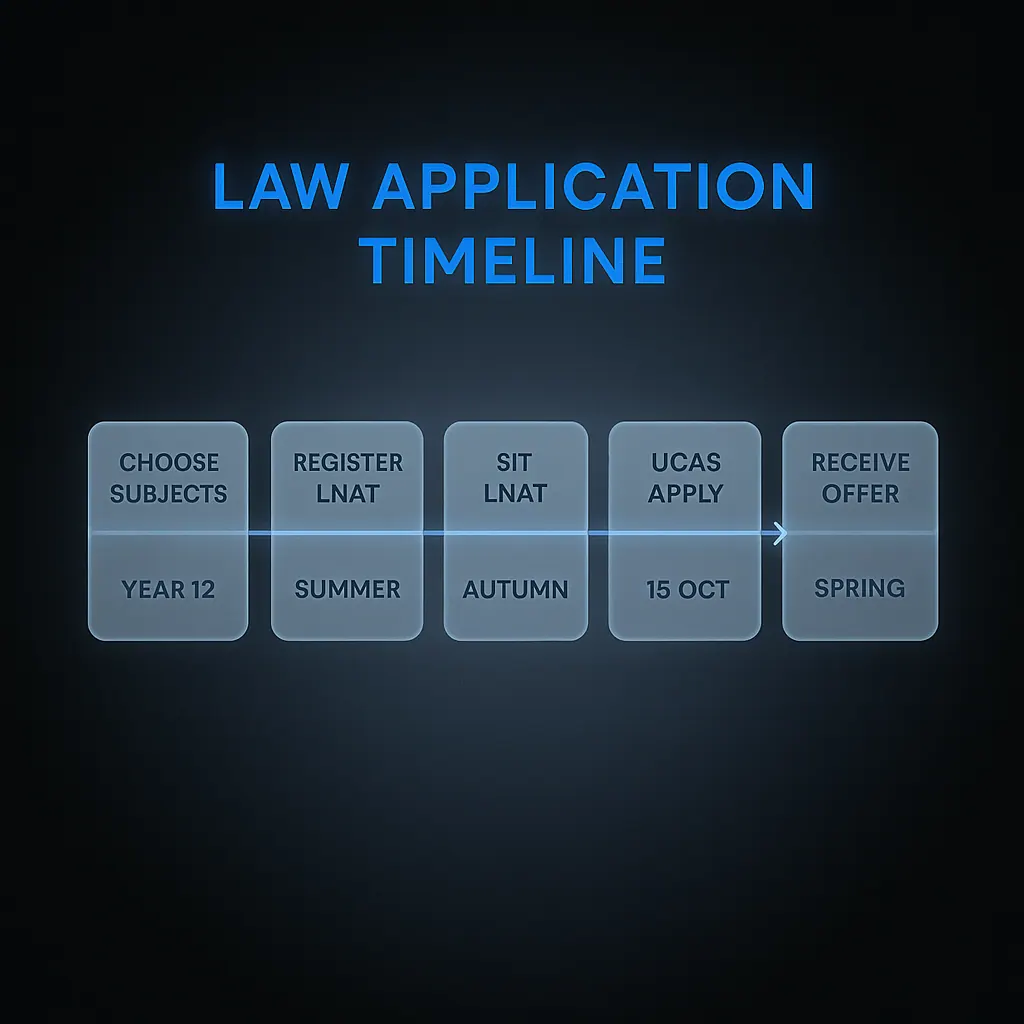
The LNAT is not a universal requirement. A defined group of UK universities use it as part of their law admissions process, and the list changes. Check lnat.ac.uk for the current requiring-university list before you register. What the sources confirm: both Oxford and Cambridge require the LNAT for undergraduate law entry.
The test has two distinct parts:
- Multiple-choice section. You read a series of unseen argument passages and answer questions about them. This produces a numerical score that LNAT-requiring universities can see.
- Essay section. You write one essay in 40 minutes, choosing from a short list of prompts. The essay is not scored centrally. Individual universities read it themselves, which means the weight they place on it varies. Oxford, for instance, uses both components as part of a competitive shortlisting process.
One non-obvious point: your essay score is literally "unscored" by LNAT, but that does not mean it matters less. Some universities weight it heavily for deciding between candidates with identical multiple-choice scores.
**Registration and sitting deadlines** are set annually. LNAT does not carry test slots over, and popular test centres fill quickly. Late registration frequently leaves students with no nearby slot or a sitting date that clashes with their UCAS deadline. Check lnat.ac.uk for the exact dates relevant to your application cycle and register as early as the system allows.
How to prepare:
- Work through unseen argument passages, practising identification of conclusions, assumptions, and logical gaps rather than testing subject knowledge.
- Treat the essay as focused analytical writing: pick a clear line of argument and defend it, rather than surveying a topic generally.
- Official practice materials are available on the LNAT site.
5. Super-Curriculars for Law: Going Beyond the Reading List
The counter-intuitive truth here: a long reading list impresses no one. What selectors want is evidence that you can think analytically about what you have encountered. Two or three experiences engaged with properly will always outweigh ten items on a CV.
Useful activities to consider:
- Wider reading in legal philosophy (Hart, Dworkin) or current case law reported in outlets such as the Supreme Court's published judgments
- Essay competitions, including national law essay prizes run by university law departments and legal charities
- Debating competitions such as those run through school or regional mooting circuits
- Work shadowing in a solicitors' firm, a barristers' chambers, or a magistrates' or Crown Court (all routes into the profession that UCAS identifies as distinct career paths)
The critical move is turning an experience into a specific, named insight. "I attended a magistrates' court hearing" is not reflection. "Observing a magistrates' court hearing made me question how the proportionality principle operates when sentencing guidelines meet individual circumstance" is. The gap between those two sentences is the gap between a weak and a strong application.
Depth over breadth is not a cliche. Selectors reading hundreds of personal statements can spot a padded list immediately. Pick the two or three activities where you genuinely changed or sharpened your thinking, and be prepared to articulate exactly what shifted.
These reflections are not separate from your UCAS application. They are the raw material for it. The specific insights you develop here become the concrete examples that answer the new UCAS personal statement questions, covered in the next section.
6. Writing a Law School Personal Statement for the 2026 UCAS Format
From 2026, UCAS replaces the single free-text personal statement with three separate questions, all sharing a combined 4,000-character limit. For law applicants, this structure is actually useful: it forces you to separate intellectual engagement from practical experience, which admissions tutors at law schools have long wanted to see done clearly.
How to map each question to a law application:
- Question 1: Why this subject. This is where your genuine intellectual interest in law belongs. Name specific legal concepts, cases, or ideas that shifted your thinking. Save the activity-listing for question 2.
- Question 2: How your experience has prepared you. Work shadowing at a solicitor's firm, mooting, legal clinics, or any super-curricular reading sits here. Link the experience to a skill or insight, not just attendance.
- Question 3: Wider skills and achievements. Debating competitions, essay prizes, or analytical skills developed through other subjects fit here. A strong EPQ on a legal or philosophical question is worth naming explicitly.
The counter-intuitive constraint: 4,000 characters across three answers is roughly 600 words total. That is tight. The common mistake is spending characters summarising activities that admissions tutors can infer from your predicted grades or UCAS form elsewhere. Grades are already visible. Every sentence in the statement needs to add new evidence.
The clearest way to test whether a sentence earns its place is the weak-versus-strong test:
- Weak: "I read The Rule of Law by Tom Bingham and found it interesting."
- Strong: "Bingham's argument that subjective rights-based review is compatible with parliamentary sovereignty challenged my assumption that the two principles are in direct tension, which made me reconsider how proportionality is applied in cases involving secondary legislation."
The second version demonstrates reasoning. It shows you engaged with a legal argument, not just a book. That is the difference law admissions tutors are looking for when they say they want evidence of a "legal mind."
One specific gotcha: question 1 is not an invitation to explain why law is a good career. UCAS notes that law opens routes into roles ranging from solicitor to advice worker to trading standards officer, but admissions tutors do not need convincing that law careers exist. They want to know why you find the subject intellectually compelling. Keep the career narrative for interview, or omit it entirely.
7. What a UK Law Degree Actually Looks Like
Most law degrees in England and Wales run for three years as an LLB (Hons); Scottish universities such as Aberdeen and Abertay offer a four-year LLB (Hons) instead, reflecting Scots law as a distinct legal system. Either way, the core modules are broadly similar: Criminal Law, Contract, Tort, Constitutional Law, Land Law, and Equity appear across virtually every programme.
Cambridge illustrates how a selective degree structures this material. The BA Law Tripos divides across three parts: Part IA (Year 1) covers four compulsory papers including Criminal Law, Constitutional Law, and Law of Tort; Part IB (Year 2) adds five papers chosen from options such as Contract Law and Land Law; Part II completes the degree. One non-obvious feature: resits are not usually permitted, so each set of end-of-year examinations carries full weight. That is a meaningfully different risk profile from A-level retake culture.
Beyond the standard three-year route, several specialist options exist:
- Year abroad - Cambridge sends students to partner institutions in Germany, France, the Netherlands, Spain, New Zealand, and Singapore after Year 2, with potential Turing Scheme funding available.
- Joint honours - King's College London offers an Anglo-French Law programme, combining law study with a European language.
- Flexible study - The University of Law offers hybrid LLB programmes across campuses including Birmingham, Exeter, and Manchester, with part-time routes suited to those who cannot study full-time.
To compare law degree structures, entry requirements, and course content across UK universities, browse the UCAS Law subject hub, which lists over 1,597 law courses currently available.
8. Where a Law Degree Can Take You: SQE, the Bar, and Beyond
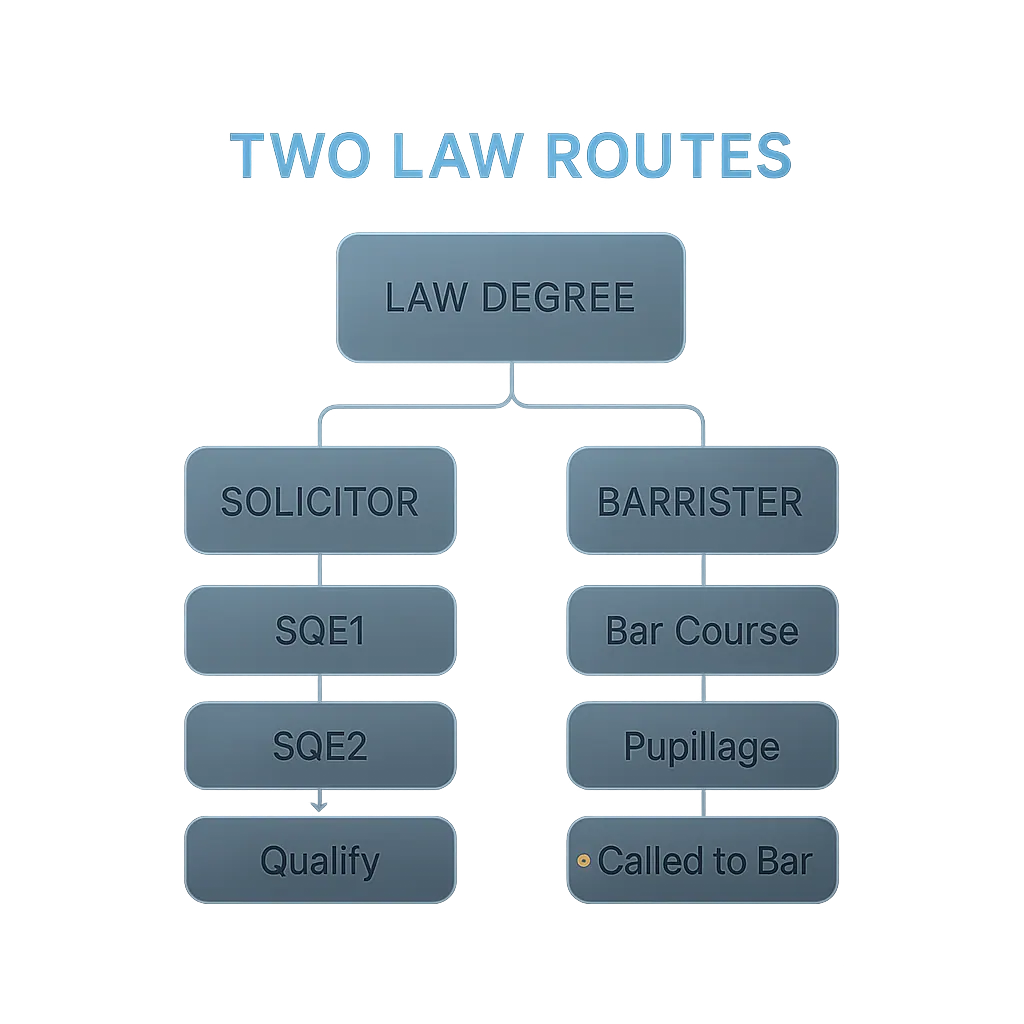
A law degree opens two main professional routes in England and Wales, and they work quite differently from each other.
The solicitor route no longer requires a Legal Practice Course. Under the current framework, qualifying law graduates sit the SQE1 and SQE2 assessments and complete a period of qualifying work experience. The Solicitors Regulation Authority (SRA) is the regulatory body overseeing this process. One counter-intuitive point: the SQE route means you can accumulate qualifying work experience across multiple employers rather than in a single two-year training contract, which changes how you plan your post-degree years.
The barrister route requires completing the Bar Practice Course (BPC) and then securing pupillage at a chambers, a competitive year-long placement that acts as on-the-job training. The Bar Standards Board regulates this pathway.
A law degree is not compulsory for either route. Non-law graduates can convert via a Graduate Diploma in Law (GDL) equivalent or an SQE preparation course before sitting the assessments. This matters when you're choosing A-levels: a strong academic record in any subject can still lead to qualification as a solicitor or barrister.
The profession is also broader than those two titles. According to UCAS, law graduates also work as advice workers, trading standards officers, and coroners. The same source notes that solicitor and barrister roles are projected to grow by approximately 3.5% over the next eight years, which puts demand broadly in line with mid-range professional occupations.
If you're weighing up whether understanding how to get into law school is worth the effort, that employment picture is worth factoring in.
9. What to Do Next
The research is done. The reading list is building. Now the work that actually moves applications forward is getting your thinking onto the page.
If you have notes on work experience, moot practice, or legal reading, this week's task is concrete: turn those notes into a structured draft answer for UCAS question one. The 2026 format rewards specificity over breadth, so a tight draft you can stress-test is worth more than a long list of activities you plan to mention. Submit that draft to get feedback on your law personal statement before it calculates into something harder to reshape.
While you are at it, compare law courses across UK universities to check whether your shortlist includes any LNAT-requiring institutions that would change your preparation timeline. Register by the October UCAS deadline, not the night before.
FAQ
Do you need a specific A-level to get into law school in the UK?
No specific A-level is required; most law schools value essay-based subjects such as English, history, or politics because they build the analytical and written argument skills the degree demands, but entry is not restricted to these.
Which UK law schools require the LNAT?
A defined group of UK universities require the LNAT, including Oxford and Cambridge; the full current list is published on the official LNAT website (lnat.ac.uk) and should be checked before registering, as the group can change.
How do I get into law school in the UK as an IB student?
UK law schools quote IB offers as a total Diploma points score with Higher Level grade minimums - for example, Oxford requires 38 points including 6,6,6 at HL - so you must meet both the points total and the HL floors simultaneously.
What do I write in a law personal statement?
Under the 2026 UCAS three-question format, use the first question to show genuine intellectual engagement with a specific legal idea, the second to reflect analytically on relevant experience such as work shadowing or debating, and the third for wider skills - all within a 4,000-character combined limit.
How do you qualify as a solicitor after a UK law degree?
After a qualifying law degree, you sit the SQE1 and SQE2 assessments set by the Solicitors Regulation Authority and complete a period of qualifying work experience; the SRA's website sets out the full current requirements.
Can mature students get into law school in the UK?
Yes - UK law schools consider mature applicants, and options including part-time and hybrid delivery programmes such as the University of Law's evening LLB make the degree accessible to students who cannot study full-time.
References
- Law Subject Guide | Why Study Law At Uni? | UCAS - https://www.ucas.com/explore/subjects/law
- How to apply | Faculty of Law - https://www.law.ox.ac.uk/content/how-apply
- Search | All results | "law" | UCAS - https://www.ucas.com/explore/search/all?query=law
- Courses | Faculty of Law - https://www.law.cam.ac.uk/courses
- Law, BA (Hons) | Undergraduate Study - https://www.undergraduate.study.cam.ac.uk/courses/law-ba-hons