How to Get Into Veterinary School in the UK
By Michael Thompson · Former IB Diploma Programme coordinator; 10 years at Bromsgrove School · Published 5 July 2026
How to get into veterinary school is one of the most competitive questions in UK university admissions. Vet medicine consistently attracts far more applicants than there are places, and the bar is set by a combination of high grades, extensive animal work experience, a strong personal statement, and an interview - not a single admissions test. This guide sets out the full picture: what grades each school asks for, how to build the work experience portfolio that actually differentiates candidates, what the 2026 UCAS personal statement format demands, and how to prepare for a vet school interview. Use it as a checklist from sixth form onwards.
Key Takeaways
- Biology is non-negotiable: Every UK vet school requires Biology at A-level (or HL in the IB), and most also require Chemistry - check each school's exact combination before choosing your subjects.
- Work experience is the biggest differentiator: You need varied, hands-on animal exposure spanning small-animal practice, farm work, and ideally equine or exotic settings - logged over time with reflective notes, not crammed in one summer.
- The four-choice cap is a real constraint: Veterinary medicine is a capped UCAS subject: only four of your five choices may be vet medicine, so plan your fifth choice - typically zoological or animal science - carefully.
- Most UK vet schools do not use an admissions test: Unlike medicine, the majority of UK vet schools rely solely on grades, experience, personal statement, and interview - Cambridge is the notable exception, requiring the ESAT.
- The 2026 UCAS personal statement has three questions: The old 4,000-character essay is replaced by three structured questions; for vet medicine, each answer needs concrete evidence of animal-care experience and reflective understanding.
- Interviews are typically MMI or panel format: Expect animal-welfare ethics scenarios, resilience questions, and evidence that you understand veterinary work extends well beyond companion animals.
In This Article
- A-Level Entry Requirements for Veterinary Medicine
- IB and Scottish Higher Routes into Vet School
- Vet School Work Experience: What You Actually Need
- Admissions Tests: Does Vet School Require the UCAT?
- The Four-Choice Rule and How to Use Your Fifth UCAS Option
- The Veterinary Medicine Personal Statement: 2026 Format
- Vet School Interviews: MMI, Panel, and What They Test
- Graduate Entry and Mature Applicant Routes into Vet School
- How Competitive Is UK Vet School Entry?
- What to Do Next
1. A-Level Entry Requirements for Veterinary Medicine
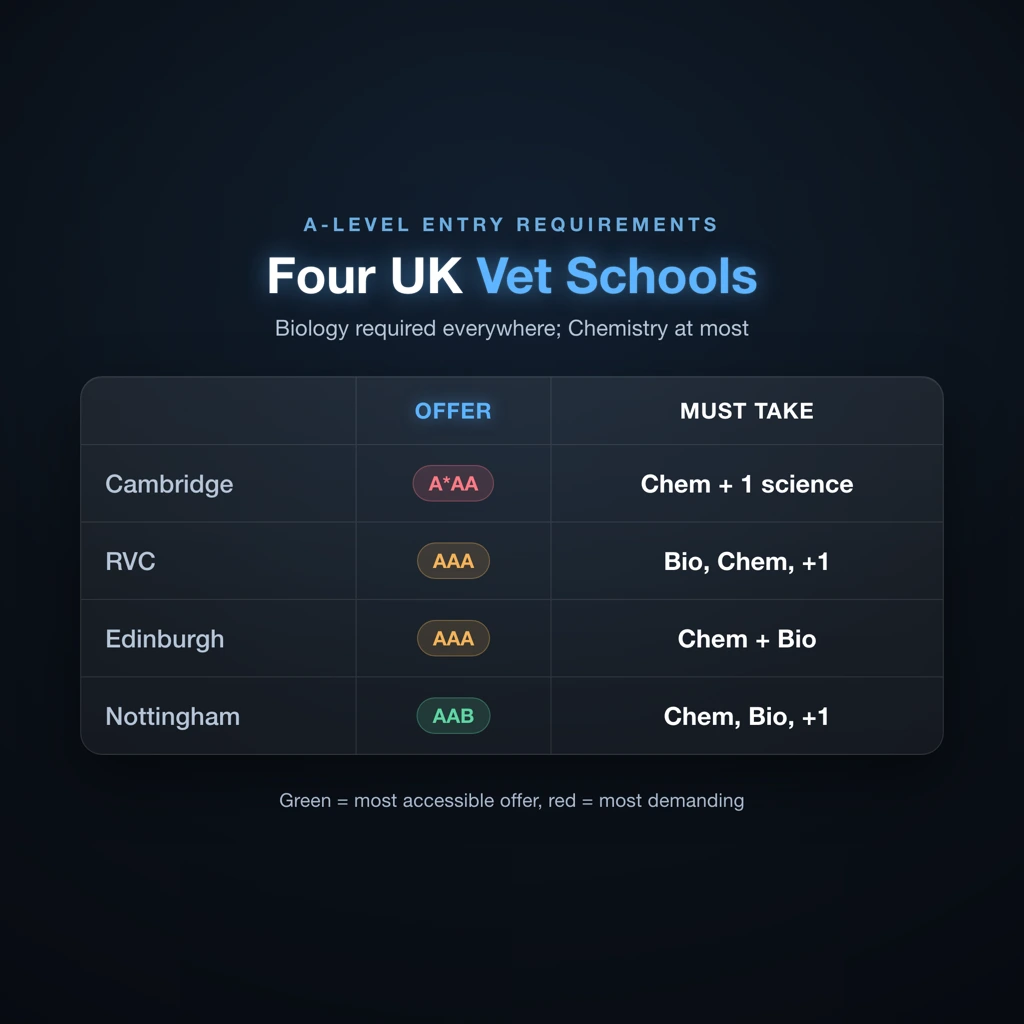
Knowing how to get into veterinary school starts with getting your A-level subject choices right, because a wrong pick in Year 12 can close off multiple schools at once. Vet school entry requirements UK-wide share a common core, but the grade thresholds and mandatory subjects vary enough between institutions that the details matter.
Biology is required by every UK vet school. Chemistry is mandatory at most, and non-negotiable at Cambridge, the Royal Veterinary College (RVC), and Edinburgh. If you are not taking Chemistry, you are already ruled out of the majority of UK programmes before applications open.
Here is how the grade offers compare across four key schools:
| School | Offer | Mandatory subjects | Notes |
|---|---|---|---|
| Cambridge | A\*AA | Chemistry + one of Biology, Physics, or Maths | Some colleges require the A\* specifically in Chemistry |
| RVC | AAA | Biology A, Chemistry A, third subject A | A\* grades give no advantage over predicted As |
| Edinburgh | AAA | Chemistry and Biology both at A | Resits not accepted except in exceptional circumstances |
| Nottingham | AAB | Chemistry A, Biology A, third subject B | Science practical pass required if separately assessed |
Nottingham's AAB is the most accessible standard offer among these four schools. Cambridge's A\*AA with mandatory Chemistry is the most demanding.
A non-obvious gotcha: RVC explicitly states that an A\* does not improve your chances over a predicted A. Chasing the top grade there is therefore wasted anxiety. Spend that energy on your work experience log instead.
General Studies and Critical Thinking are not accepted at any of these schools. Both Edinburgh and Nottingham state this explicitly. Do not count either subject as your third A-level.
On BTECs: acceptance is narrow. RVC accepts only three named qualifications at D\D\D\* (Pearson Applied Science, Pearson Animal Management, or City and Guilds Animal Management Science). Nottingham does not accept BTECs at all. If you are on a BTEC pathway, check each school's policy individually before building your application list.
2. IB and Scottish Higher Routes into Vet School
IB and Scottish Higher applicants face the same subject gatekeeping as A-level candidates, just expressed differently. Chemistry and Biology are non-negotiable at the higher level for both qualifications.
IB Diploma
The two schools listed in their UCAS entries give slightly different IB offers:
| School | Total points | HL grade requirement | Subject specifics |
|---|---|---|---|
| Edinburgh | 38 | 666 | Chemistry HL6, Biology HL6 required (source) |
| RVC | Not specified | 666 | Biology, Chemistry, and a third subject of choice (source) |
The non-obvious catch with Edinburgh's offer: a candidate who scores 39 points overall but drops to a 5 in Chemistry HL will not meet the offer, regardless of their total. The HL subject grades are assessed independently of the points total.
The 36-38 point threshold common across vet schools also means that SL subjects and bonus points need to be planned, not improvised, in Year 1 of the IB.
Scottish Highers
Edinburgh requires AAAAB by the end of S5, plus Advanced Highers at BB, with Advanced Higher Chemistry and at least one of Biology, Mathematics, or Physics at B. Achieving the S5 profile matters because Edinburgh does not accept resits except in very exceptional circumstances.
Most other vet schools accept Scottish Highers, but their specific Advanced Higher combinations differ. Check each school's UCAS entry directly before applying.
3. Vet School Work Experience: What You Actually Need
Work experience differentiates vet applicants more sharply than it does in medicine or dentistry, because admissions tutors are assessing whether you understand what the profession actually involves - not just whether you like animals.
Variety is the core requirement. A single placement at a local small-animal practice is not enough. Most schools want to see at least three distinct settings, typically drawn from:
- Small-animal general practice
- Farm animal work (lambing, calving, TB testing days)
- Equine yards or racing stables
- Kennels, catteries, or rescue centres
- Exotic animal collections or wildlife rehabilitation
Experience with farm and equine species matters beyond box-ticking. It signals that you understand veterinary medicine as a food chain, public health, and production discipline, not only companion-animal care. Admissions tutors read that distinction clearly.
Hours alone are not the point. Logging your placements in a reflective diary and recording what you observed, what questions it raised, and what you learned about clinical decision-making is what turns time spent into something usable in a personal statement or interview. Passive observation that you cannot discuss is worth considerably less than fewer days where you handled, fed, or assisted directly.
The counter-intuitive outlier here is Cambridge, which explicitly states it does not require extensive experience and suggests around ten working days if possible. Every other UK vet school expects considerably more. Do not let Cambridge's position set your benchmark unless Cambridge is your only application.
The RCVS requires all registered veterinary students to complete 10 weeks of pre-clinical EMS and 20 weeks of clinical EMS during their degree, which gives you a sense of the profession's expectations around hands-on time from the outset.
Start arranging farm and equine placements early. They are harder to secure than small-animal practices and are the most common gap in weaker applications.
4. Admissions Tests: Does Vet School Require the UCAT?
Unlike medicine and dentistry, most UK veterinary schools do not require any admissions test. There is no UCAT, no BMAT equivalent, no subject-specific aptitude test sitting between you and your application at the majority of schools. Your grades, work experience, personal statement, and interview performance carry the full weight.
Cambridge is the one exception. From 2024 applications onwards, all Cambridge Veterinary Medicine applicants must sit the Engineering and Science Admissions Test (ESAT) before interview. The ESAT is not used in isolation: Cambridge assesses it alongside all other available application information, so a single bad session does not automatically end your application.
The gotcha that catches applicants every year: the ESAT registration deadline falls in September, before the 15 October UCAS deadline for veterinary medicine. If you are applying to Cambridge, you must register for the test before you have even submitted your UCAS form. Missing the registration window means Cambridge cannot consider your application, regardless of your grades.
At every other UK vet school, there is no test to register for. That means your personal statement, your experience record, and your interview technique carry proportionally more weight at those schools than they would in a system that also used a scored admissions test to filter applicants.
If Cambridge is not on your list, you can set aside admissions test preparation entirely and focus on those elements instead.
5. The Four-Choice Rule and How to Use Your Fifth UCAS Option
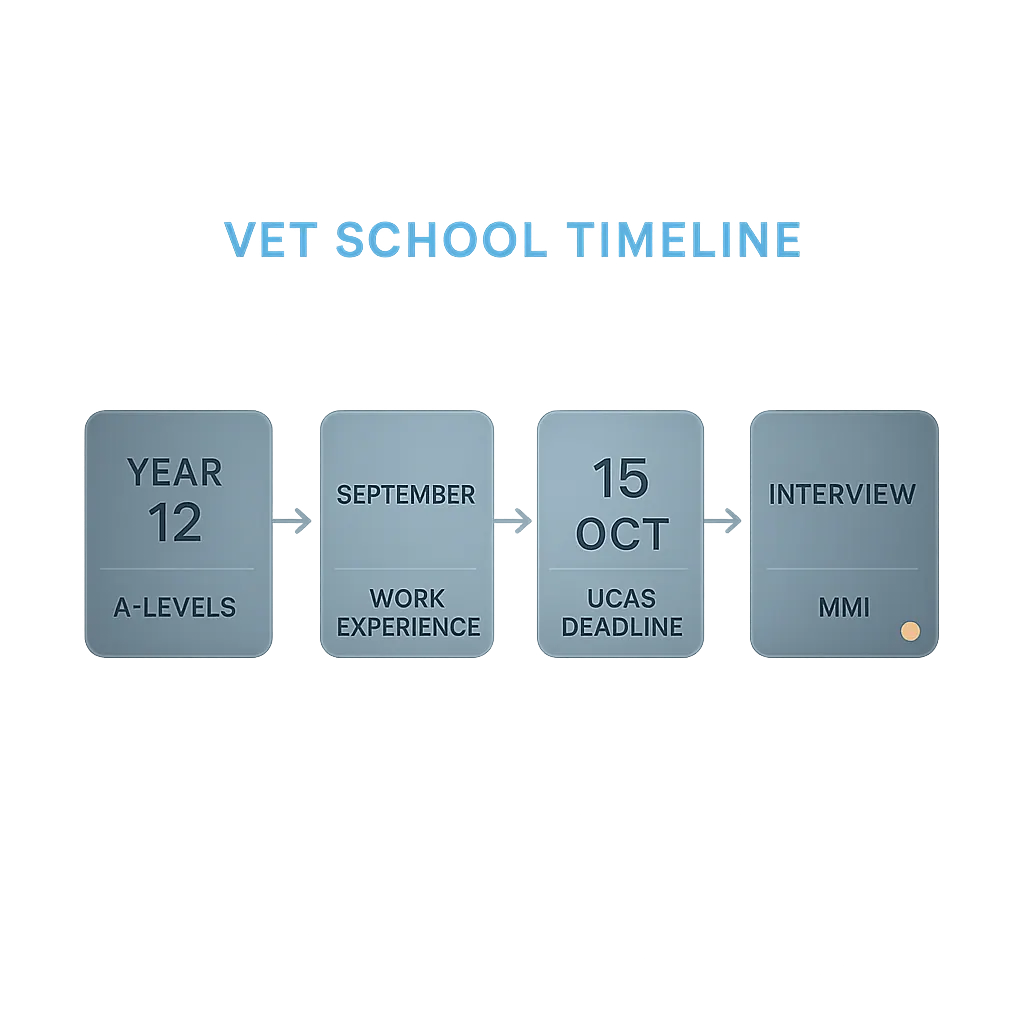
Veterinary medicine is one of a small group of capped UCAS subjects. You may list a maximum of four vet medicine courses across your five choices. The fifth must be something else.
That fifth choice is not a throwaway. Used well, it gives you a realistic landing point if your vet applications don't convert. Used badly, it wastes the slot entirely. Two common mistakes:
- Listing a fifth vet school anyway. UCAS will reject it. The cap is enforced at submission.
- Leaving it blank. You lose an application with no upside.
A strong fifth choice is a related degree where your A-level profile is competitive: Animal Science, Zoological Science, or Biological Sciences are the obvious options. These keep relevant subjects alive and, in some cases, provide a route into a graduate-entry veterinary programme later.
The 15 October deadline applies to every vet school on your list. All three courses below share that cutoff, and missing it means your application is no longer guaranteed equal consideration:
- University of Edinburgh BVM&S - 15 October
- Royal Veterinary College BVetMed - 15 October
- University of Nottingham BVM BVS - 15 October
One specific gotcha worth knowing: Edinburgh does not accept deferred entry, except for applicants completing National Service (maximum one-year deferral). If you are planning a gap year, Edinburgh cannot be one of your four choices. That effectively narrows your options before you have written a single word of your personal statement.
6. The Veterinary Medicine Personal Statement: 2026 Format
From 2026, UCAS replaces the single 4,000-character free-text essay with three structured questions. The total character allowance across all three answers remains tight, so **plan your word allocation before you write a single sentence** rather than drafting freely and cutting later.
Each question has a distinct job for vet medicine applications:
- Question 1 (motivation): Ground your reasons in specific animal-care experience. Name the placement, the species, the context. "I spent a week on a mixed farm practice in Shropshire and watched a vet manage a dystocia in a ewe" is evidence. "I have always loved animals" is not, and selectors at every UK vet school see the latter hundreds of times per cycle.
- Question 2 (skills and learning): This is where work placements become material for reflection, not a CV list. Describe what you did, what surprised you, and what you would do differently. One lambing placement where you articulate the ethical weight of a difficult culling decision outweighs a list of ten silent observation days.
- Question 3 (future commitment): Show you understand what the profession actually involves, including the commercial pressures on mixed and farm practices, the physical demands, and the mental health realities. Vague statements about "helping animals" signal that an applicant has read about vet work rather than witnessed it.
The counter-intuitive trap here is length envy. Applicants who try to pack every placement into Question 2 produce a timeline, not a reflection. Selectors are assessing analytical thinking, and a single well-interrogated experience demonstrates that more clearly than breadth.
Before drafting, sketch a rough character split across the three questions. Question 2 typically warrants the most space for vet applicants, but do not neglect Question 3 as an afterthought.
7. Vet School Interviews: MMI, Panel, and What They Test
Most vet schools use either a Multiple Mini Interview (MMI) format, where you rotate through a series of short stations each testing a different skill, or a traditional panel interview with two or three academics. The format varies by school, so check each university's admissions page before you prepare.
Cambridge is the clearest outlier: interviews consist of two half-hour conversational interviews, and over 50% of applicants are called, which is a higher interview rate than most schools. That broad net means Cambridge is not using the interview to filter ruthlessly on academics - it is looking for genuine intellectual engagement.
Common themes across all formats:
- Animal welfare and ethics scenarios, often with a deliberate economic tension. A typical prompt: a farmer's animal and a companion animal have the same condition - should treatment differ when the economics are completely different? There is no clean answer; interviewers want to see structured reasoning.
- Understanding of the full scope of the profession: livestock, wildlife, government and public health roles, not only small animal practice.
- Resilience and self-awareness. A student who witnessed an animal euthanised on placement and can discuss what they felt, what they learnt, and how it changed their view of the job will stand out far more than someone who avoids the subject.
The counter-intuitive gotcha: interviewers are trained to probe for over-rehearsed answers. If you have memorised a "correct" welfare position, expect a follow-up that forces you to defend the opposite side.
Practical preparation:
- Read the BVA (British Veterinary Association) animal welfare policy before your interview date.
- Follow current veterinary news: disease outbreaks, antibiotic resistance policy, and changes to the Veterinary Surgeons Act surface regularly as scenario prompts.
- Practice talking about your work experience out loud to someone who will ask awkward follow-up questions, not just someone who will nod along.
8. Graduate Entry and Mature Applicant Routes into Vet School
Most UK vet schools treat graduate applicants the same as school leavers. Two exceptions stand out: Cambridge and Edinburgh.
Cambridge reserves approximately six places per year for affiliated (graduate) applicants, though the target intake is described as flexible. The structural quirk is significant: affiliated students typically skip Year 3 of the six-year VetMB and complete Years 1, 2, 4, 5, and 6 instead. That means a graduate applicant finishes in five years rather than six, but still qualifies for both the BA and VetMB on completion. Some Cambridge colleges offer entrance bursaries of £10,000-£20,000 for affiliated students, and tuition fee loans are described as usually available for second degrees.
Mature applicants at Cambridge (defined as over 21 on the course start date, without a prior degree) undertake all six years. Two colleges, St Edmund's and Wolfson, have particular experience supporting mature vet applicants, and both routes carry a strong recommendation to contact your intended college before submitting a UCAS application.
Edinburgh accepts graduates who hold a UK 2:1 honours degree or equivalent in an appropriate science subject. The catch: those admitted as graduates pay fees on a full-cost basis, which is a material financial difference from standard home-fee entry.
One thing that does not change regardless of entry route: the RCVS requires 10 weeks of pre-clinical EMS and 20 weeks of clinical EMS for all students. A prior science degree earns no exemption from placements.
Cambridge also explicitly welcomes applicants who have previously been unsuccessful at UK vet schools, provided they met or exceeded the standard conditional offer. That is worth knowing if you are reapplying after a difficult cycle.
9. How Competitive Is UK Vet School Entry?
Veterinary medicine is one of the most oversubscribed degree programmes in the UK. The applicant-to-place ratio is tighter than for many medicine courses, and the number of UK vet schools accepting home applicants is small. Understanding just how competitive the field is shapes everything from how you choose your four UCAS choices to whether you apply again after a rejection.
The clearest illustration of demand: Nottingham's 2026 entry listing shows no vacancies for applicants from England, Wales, Scotland, Northern Ireland, or the Republic of Ireland, even while EU and international places remain open. Places fill fast, and late or borderline applications have very little margin.
Programme quality is high across the sector. Edinburgh scored 95% in the National Student Survey "Teaching on my course" category, and Nottingham achieved 99% satisfaction in the NSS 2021. Cambridge is ranked No. 1 in the UK for Veterinary Science by The Guardian University Guide 2026.
The counter-intuitive detail worth knowing: Cambridge explicitly welcomes re-applicants who met or exceeded the standard conditional offer threshold on a previous application. Many strong candidates apply more than once. A first rejection from a well-regarded school is not a signal to stop.
The honest framing: no applicant can guarantee entry, regardless of grades or experience. Build your four choices carefully, treat each application cycle as a full attempt, and treat a second cycle as normal rather than a last resort.
10. What to Do Next
The sequence matters more than the pace. Work experience takes months to accumulate, so contact one veterinary practice or farm this week to arrange a placement, and open a log on day one to record not just what you observed but what it made you think. Reflective notes written at the time are far more useful in a personal statement than memories reconstructed six months later.
While you are arranging that, check each school's specific subject requirements against your current A-level or Higher options. Some schools accept one science outside the core three; others do not, and switching subjects becomes harder the longer you wait.
Fix two dates in your calendar now: the 15 October UCAS deadline, and, if Cambridge is one of your four choices, the September ESAT registration window, which closes before UCAS opens.
When you are ready to write, get your veterinary medicine personal statement reviewed before you submit. A second pair of eyes on a 4,000-character statement is not optional at this level of competition.
FAQ
How hard is it to get into vet school in the UK?
Vet medicine is one of the most competitive undergraduate programmes in the UK; all five schools have far more applicants than places, typical offers are AAA or above at A-level, and strong work experience is expected on top of high grades.
What A-levels do you need for veterinary medicine?
Biology is required at every UK vet school; Chemistry is required at most, including Cambridge (A*AA), RVC (AAA), and Edinburgh (AAA) - check the third subject requirement individually as it varies by school.
Do UK vet schools require the UCAT or any admissions test?
Most UK vet schools do not require the UCAT or any admissions test; Cambridge is the exception, requiring all vet applicants to sit the Engineering and Science Admissions Test (ESAT) before interview, with registration due in September.
How much work experience do you need to get into vet school?
There is no single fixed minimum, but most schools expect varied experience across at least two or three settings - such as a small-animal practice, a farm, and an equine yard - logged reflectively over time rather than completed in one block.
Can you apply to more than four vet schools on UCAS?
No - veterinary medicine is a capped subject, so you can use a maximum of four of your five UCAS choices for vet medicine; the fifth should go to a related subject such as animal or zoological science.
Are there graduate entry veterinary programmes in the UK?
Cambridge offers approximately six affiliated (graduate) entry places per year, allowing degree-holders to skip Year 3; Edinburgh accepts graduates with a relevant 2:1, though on a full-cost fee basis - other schools should be checked individually.
References
- Frequently Asked Questions | Department of Veterinary Medicine - https://www.vet.cam.ac.uk/study/vet/FAQ
- Veterinary Medicine | Royal Veterinary College, University of London | UCAS - https://www.ucas.com/explore/courses/f7254ac4-57de-a135-289d-f86d71cc0a67/course
- Veterinary Medicine | The University of Edinburgh | UCAS - https://www.ucas.com/explore/courses/bb0a961c-8e24-1324-31ac-893f2e504832/course
- Veterinary Medicine and Surgery | University of Nottingham | UCAS - https://www.ucas.com/explore/courses/c21521d0-9d44-c8dd-668e-c154ab4d5814/course
- How to apply | Department of Veterinary Medicine - https://www.vet.cam.ac.uk/study/vet/howtoapply
- Veterinary Medicine, VetMB | Undergraduate Study - https://www.undergraduate.study.cam.ac.uk/courses/veterinary-medicine-vetmb
- Postgraduates, over-21s & ‘transfers’ | Department of Veterinary Medicine - https://www.vet.cam.ac.uk/study/vet/grads-and-matures