Nursing Degree Entry Requirements: The Full UK Guide
By Michael Thompson · Former IB Diploma Programme coordinator; 10 years at Bromsgrove School · Published 5 July 2026
Nursing degree entry requirements in the UK are more flexible than most applicants expect, but they come with a set of professional hurdles that medicine and other healthcare degrees do not share. You apply to a specific field - adult, children's, mental health or learning disability nursing - and that choice shapes your course, your placements, and what you write in your personal statement. Most universities accept a science or health and social care A level, and many will consider a BTEC National Extended Diploma or an Access to Higher Education Diploma instead. What no one tells you early enough is that every course must be approved by the Nursing and Midwifery Council before you can register as a nurse, and that an enhanced DBS check and occupational health clearance are part of the deal before you set foot on a ward.
Key Takeaways
- Four fields, one application: You apply to adult, children's, mental health or learning disability nursing - the field you choose determines your course content, your clinical placements, and your NMC registration.
- Typical A-level offer is BBC: Many universities ask for BBC at A level with at least one science or social science subject, though offers vary; BTEC National Extended Diplomas and Access to HE Diplomas are widely accepted alternatives.
- GCSE minimums are firm: Most universities require at least grade 4/C in English, maths, and a science subject at GCSE - these act as a threshold even if your A-level or equivalent offer is the main criteria.
- NMC approval is non-negotiable: A nursing degree must be approved by the Nursing and Midwifery Council for you to register as a qualified nurse - always check this before accepting an offer.
- Non-academic requirements catch applicants off guard: An enhanced DBS check, occupational health and immunisation clearance, and a values-based interview are standard requirements at most nursing schools.
- Degree Apprenticeship offers an earn-while-you-train route: The Registered Nurse Degree Apprenticeship lets you work and study at the same time, with tuition funded through apprenticeship funding so you pay nothing for the course.
In This Article
- Choose your field before you apply
- GCSE requirements for nursing and why they act as a firm gate
- A-level, BTEC and Access to HE: what qualifications nursing courses accept
- IB and Scottish Highers routes into nursing
- Non-academic requirements every nursing applicant needs to know
- Comparing nursing courses: entry requirements at a glance
- Mature student and alternative entry routes: Access courses and degree apprenticeships
- What to do next
1. Choose your field before you apply
Understanding nursing degree entry requirements starts with a decision most applicants underestimate: which field of nursing you are applying to. UCAS lists four registered fields: adult nursing, children's nursing (paediatric), mental health nursing, and learning disability nursing. Some universities also offer dual-field programmes that combine two of these.
This is not a stylistic preference you can leave vague. Your UCAS application is submitted to a specific field, and the course you study, the clinical placements you attend, and the NMC registration you graduate with are all determined by that choice. Adult nursing degree entry requirements, for example, may differ from mental health nursing degree entry requirements at the same university, even within the same faculty.
The less obvious consequence is what this means for your personal statement. Admissions tutors expect you to articulate why you want to work in that specific field, not why nursing appeals to you broadly. A statement written for adult nursing that mentions interest in child development is a red flag, not a selling point. Decide your field before you write a single word of your application.
2. GCSE requirements for nursing and why they act as a firm gate
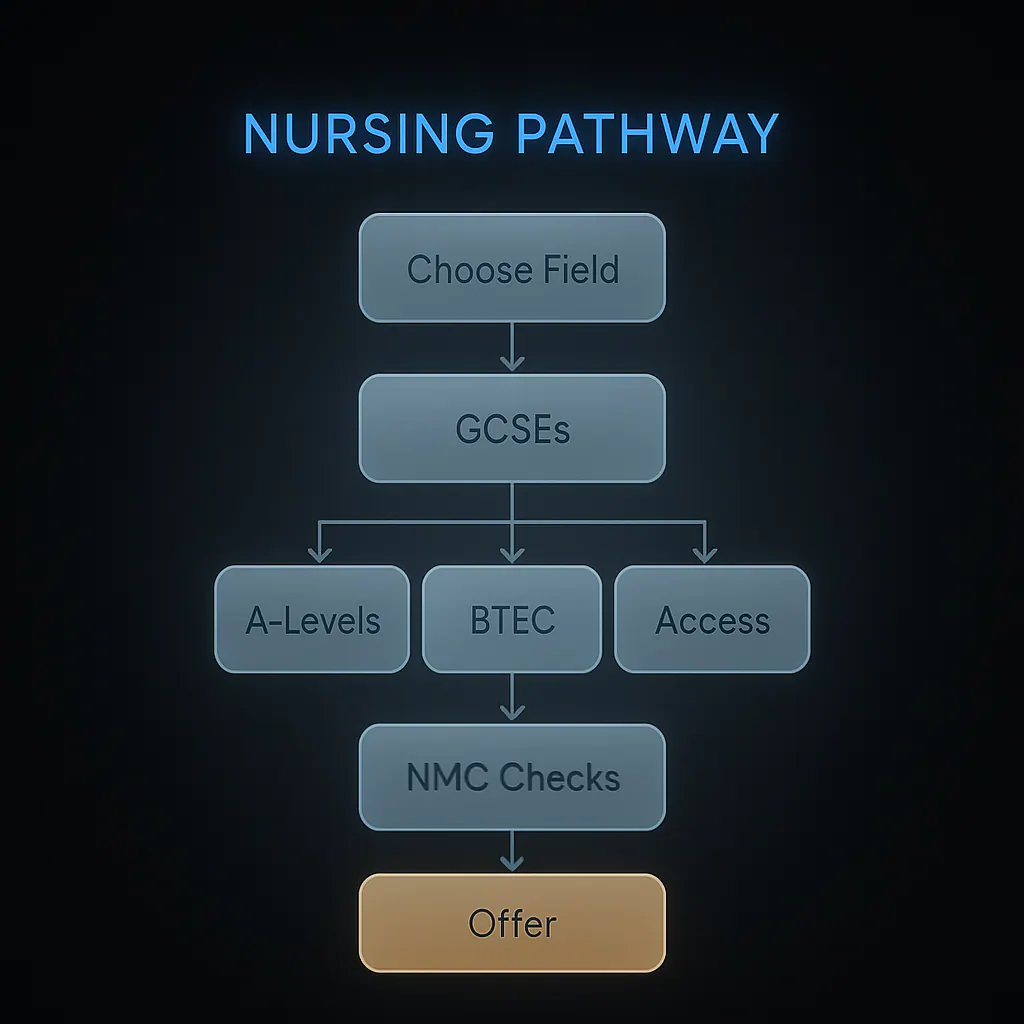
GCSEs are not just a formality that A levels or an Access to HE Diploma supersede. Universities check both levels of qualification independently, and falling short at GCSE level can block an application regardless of how strong your Level 3 results are.
The standard minimum across UK nursing programmes is **five GCSEs at grade 4/C or above, including English, maths, and a science subject**. UCAS confirms that biology is a prerequisite subject for nursing, and the Liverpool BN (Hons) programme illustrates how this works in practice: even applicants applying via a BTEC or Access to HE Diploma must still present GCSE English, maths, and a science at grade C/4.
The non-obvious gotcha is the relationship between a science GCSE and a science A level. A science A level does not replace the science GCSE requirement - universities typically want to see both. If you took biology at A level but dropped science before GCSE, that gap will surface at application.
Because each university sets its own requirements independently, always check the specific course listing rather than relying on a general benchmark. The Liverpool entry requirements page, for example, spells out exactly which GCSE grades apply to each qualification route, BTEC and Access to HE included.
Check your GCSE certificates now, before you shortlist courses.
3. A-level, BTEC and Access to HE: what qualifications nursing courses accept
Most nursing courses accept several different Level 3 qualifications, but the subject and grade profile matter more than the raw UCAS points total. At the University of Liverpool, for example, the A-level offer is BBC, with at least one subject being a science such as biology, or a social science. If you take a science A-level, a pass in the practical component is also required.
The non-obvious gotcha here: Liverpool explicitly states that UCAS Tariff points alone are not accepted. You could hold 128 points from a combination of subjects and still be rejected at the qualification-check stage if the subjects do not fit. This is common across nursing programmes, so checking the individual course page rather than relying on a points total is essential.
BTEC route
A BTEC National Extended Diploma is a well-established alternative. Liverpool accepts DDM in Health and Social Care or Applied Science. As with A-levels, the subject area carries weight, not just the grade.
Access to HE Diploma route
The Access to HE Diploma is accepted, but with a specific credit mix: 45 Level 3 credits in science or health-science subjects, with at least 27 at Distinction and 18 at Merit or above. GCSE English and maths at grade 4/C remain required alongside it.
If you are studying an Access course online, note that providers such as Access Pathways advise completing the diploma by the end of May for a September university start, which means enrolling well before the UCAS equal consideration deadline in January.
As UCAS notes, some universities accept Level 3 qualifications in place of A-levels, but applicants must verify this with individual institutions before applying.
4. IB and Scottish Highers routes into nursing
The IB and Scottish Highers routes into nursing illustrate just how wide the entry bar can stretch between institutions offering the same degree.
**IB Diploma**
The gap between a broadly accessible and a more selective university is stark here. University of Liverpool accepts 26 points overall with no individual score below 4, or an alternative profile of 5,4,4 at Higher Level. University of Edinburgh asks for 34 points with 655 at Higher Level, plus English at Standard Level 5 and Mathematics at Standard Level 4.
That eight-point overall difference matters more than it looks. To reach 34 points with a 655 HL profile, you need consistent 6s and 7s across your remaining subjects as well. Liverpool's threshold is reachable with a more mixed profile.
One thing IB applicants often miss: neither published offer specifies which Higher Level subject must be science. Requirements vary by university, so check each institution's UCAS listing directly before you finalise your HL choices. Picking the wrong HL subjects can leave you ineligible even if your points total is sufficient.
Scottish Highers
- Edinburgh: ABBB by end of S5, or AABB/ABBBB by end of S6; National 5s in English and Mathematics required.
- Liverpool: BBBBB at Higher plus BB at Advanced Higher, with at least one Advanced Higher science (Biology, Chemistry, Physics, Psychology, or Mathematics); five National 5s including English, Maths, and a Science.
Liverpool's Scottish route is notably specific: the Advanced Higher science requirement means you cannot substitute it with a humanities subject, regardless of your overall grade profile.
5. Non-academic requirements every nursing applicant needs to know
Academic grades get you shortlisted. These requirements determine whether you can actually start the course.
Enhanced DBS check. Every offer is conditional on an Enhanced Disclosure and Barring Service check. A criminal record does not automatically disqualify you, but certain offences (particularly those involving harm to vulnerable people or children) will. Check the university's fitness-to-practise policy before you apply rather than after you receive an offer.
Occupational health clearance. Before your first clinical placement, you must pass an occupational health assessment and provide evidence of immunisation, including hepatitis B and MMR. If your vaccination records are incomplete, your GP can help fill the gaps, but this takes time. Start the process as soon as you accept an offer.
**Values-based interviews.** Many nursing schools use structured interviews or situational judgement scenarios to assess compassion, communication, and professional values. These are distinct from academic knowledge tests. Preparing for them is different from revising for an exam: you need to draw on real examples from your own experience, not textbook answers.
Clinical placements. The Nursing and Midwifery Council requires theory and practice to be equally weighted across the programme. Placements cover settings including emergency care, critical care, rehabilitation, and surgical and medical wards. These are not optional modules.
Prior healthcare experience. UCAS guidance on nursing describes some prior experience of working with people as advisable. Expect to be asked about it at interview in detail. Volunteering in a care setting, a hospital ward, or a hospice gives you specific examples to draw on. A vague claim that you "like helping people" will not hold up under questioning.
6. Comparing nursing courses: entry requirements at a glance
Entry requirements vary more than most applicants expect. Edinburgh's A-level offer is ABB with no required science subject; Liverpool's is BBC but demands at least one science or social science. That counter-intuitive gap means a student with BBB including Biology might meet Liverpool's offer but not Edinburgh's.
| Course | Field | Typical A-level offer | IB offer | Science subject required? | NMC approved |
|---|---|---|---|---|---|
| University of Liverpool BN (Hons) | Adult Nursing | BBC (inc. one science or social science) | 26 points, min 4 in each subject | Yes | Yes |
| University of Edinburgh BNurs | Adult Nursing | ABB (no specified subject) | 34 points, 655 at HL | No (but high overall offer) | Yes |
| Accessible end of spectrum | Various | Typically 96-112 UCAS tariff points or equivalent Access to HE | Lower IB band, varies | Often yes | Verify independently |
| Competitive end of spectrum | Mental health / paediatric | Up to AAB or equivalent | Up to 36 points | Usually yes | Verify independently |
A few things to note. Neither Liverpool nor Edinburgh accepts UCAS tariff points as a standalone route, so chasing a points total without checking qualification-specific requirements will mislead you. Both programmes are regulated by the Nursing and Midwifery Council, which means graduates are eligible to register as adult nurses. For any other course you consider, verify NMC approval independently before applying.
Use the Course Directory at /courses to compare published entry requirements across real UK nursing programmes side by side.
7. Mature student and alternative entry routes: Access courses and degree apprenticeships
Not having A levels does not close the door to nursing. Two routes in particular suit career-changers and mature applicants: the Access to Higher Education Diploma and the Registered Nurse Degree Apprenticeship.
The Access to HE Diploma is widely accepted by UK universities as a direct alternative to A levels for adult, children's, mental health, and paediatric nursing degrees. Per Access Pathways, the diploma covers 16 units including Cell Biology, Critical Thinking, and Academic Research Skills, and can be studied entirely online with open enrolment. One non-obvious timing quirk: if you are aiming for a September university start, the diploma must be completed by the end of May, which is tighter than many applicants realise when they enrol mid-autumn.
The Registered Nurse Degree Apprenticeship works differently from a standard degree application. Tuition is funded through apprenticeship funding, so apprentices pay nothing for the course. Around 80% of time is spent on practical work, with university study fitted around employment. Applications go directly to employers via the Find an Apprenticeship website or UCAS, not through the standard UCAS undergraduate cycle. There is no upper age limit, though applicants must be at least 18.
Funding for eligible students in England is worth knowing about regardless of which route you take. Per UCAS, the NHS Learning Support Fund pays at least £5,000 per year to every eligible student nurse studying in England. That rises to up to £8,000 per year for students on mental health or learning disability nursing courses, or those who require parental support.
8. What to do next
Before you submit any application, check the NMC's register of approved programmes to confirm your chosen course appears on the list. This is a non-obvious step that catches people out: a university can run a nursing-titled degree that is not NMC-approved, which means graduates cannot register as nurses. Do this before you spend time on a personal statement.
Once you have confirmed approval status, use our nursing and healthcare subjects hub to compare courses by field, entry route, and typical offer levels across UK universities.
The concrete action for this week: open the NMC register, search your shortlisted institutions by name, and cross-check each course title against your UCAS choices. It takes ten minutes and removes the single most costly mistake an applicant can make.
FAQ
Can I do a nursing degree without qualifications?
Most universities require at least GCSEs in English, maths and a science plus A levels, a BTEC, or an Access to HE Diploma - but mature applicants with relevant healthcare experience and an Access to HE Diploma can enter without traditional A levels.
How many UCAS points do you need for nursing?
Several universities do not accept UCAS Tariff points alone - they require specific qualifications and subjects, so the grade profile and subject matter of your qualifications matter more than a points total.
Do nursing degree entry requirements differ by field?
The academic entry requirements are broadly similar across adult, children's, mental health, and learning disability nursing, but the personal statement, interview focus, and placement settings differ significantly between fields.
Do nursing degree entry requirements change?
Entry requirements are set independently by each university and can change year on year, so always check the current UCAS course listing or the university's own admissions page rather than relying on older sources.
What is a values-based interview in nursing admissions?
A values-based interview assesses qualities such as compassion, communication, and professional commitment through structured questions or scenarios, rather than testing academic knowledge - most nursing schools use this format.
Is a nursing degree approved by the NMC?
It must be - only NMC-approved nursing degrees allow graduates to apply for registration as a qualified nurse in the UK, so confirming NMC approval is one of the first checks to make on any course you consider.
References
- Nursing Subject Guide | Why Study Nursing At Uni? | UCAS - https://www.ucas.com/explore/subjects/nursing
- Nursing | University of Liverpool | UCAS - https://www.ucas.com/explore/courses/a388d698-98eb-a239-7e51-66ccc233b3a7/course
- Access to HE Diploma in Nursing | Study Online - https://accesspathways.co.uk/diplomas/nursing
- Nursing Studies | The University of Edinburgh | UCAS - https://www.ucas.com/explore/courses/7e31af75-30e4-0b64-fd93-e3e90c7579c5/course
- Degree apprenticeships: How you could get a degree for free – The Education Hub - https://educationhub.blog.gov.uk/2024/02/degree-apprenticeships-how-you-could-get-a-degree-for-free