Law Degree Entry Requirements: What UK Students Actually Need
By Michael Thompson · Former IB Diploma Programme coordinator; 10 years at Bromsgrove School · Published 5 July 2026
Law degree entry requirements are more flexible than most students expect - and the subject myths around them cost applicants good options every year. Almost no UK university requires a Law A-level, and taking one gives you no meaningful advantage over someone who studied History or English. What admissions tutors do look for is strong analytical writing, good grades, and - at a specific group of universities - a separate admissions test called the LNAT. This guide sets out what you actually need, from A-level combinations to IB points, and flags the small print that catches students out.
Key Takeaways
- No A-level subject is required for most law degrees: Including Law A-level itself - Cambridge's admissions page states explicitly that most of their law students have not studied Law at school.
- General Studies and Critical Thinking are excluded: Many universities, including Royal Holloway and the University of Law, will not count these toward your offer, so check each course's exclusions carefully.
- The LNAT applies only to specific universities: It is a separate registration with its own deadline and fee - missing it will block your application regardless of your predicted grades.
- IB students need essay-rich Higher Level subjects: Offers range from around 29 points (University of Law) to 38 points including core at Oxford, so the IB route is viable across the full range of courses.
- Conversion is a legitimate route: The SQE now governs qualification as a solicitor, which means a non-law graduate can convert without being locked out of the profession.
- Published entry requirements vary widely: From BBB at the University of Law to A*AA at Cambridge - comparing courses side by side before applying is worth the time.
In This Article
- The subject myth: what A-levels law courses actually want
- Typical A-level grades: from accessible to highly competitive
- Law degree entry requirements for IB students
- The LNAT: the admissions test that operates outside UCAS
- University law entry requirements comparison table
- LLB, joint honours, and the conversion route: which law degree path fits you
- Foundation year and alternative entry routes into law
- What to do next
1. The subject myth: what A-levels law courses actually want
Law degree entry requirements trip up a surprising number of applicants before they even write a personal statement. The most persistent myth is that studying Law at A-level signals genuine commitment to the subject and gives you a head start. It does neither.
Cambridge's BA Law states this plainly: the degree has no specific A-level subject requirements, and most of its students have not studied Law at school. No Cambridge College requires it. The logic is straightforward: a law degree trains you to read carefully, reason precisely, and write persuasively under pressure. A-level Law does not develop those skills as effectively as subjects that demand sustained analytical writing.
Cambridge specifically recommends English Literature, History, languages, and Mathematics as strong preparation. Admissions teams at other universities echo this. These subjects build the habits the degree actually rewards.
The less obvious gotcha is exclusions. Several universities explicitly refuse to count certain A-levels toward their offers:
- Royal Holloway excludes General Studies and Critical Thinking.
- The University of Law excludes General Studies, and also does not accept AS Levels or EPQ toward its 120-point tariff offer.
Exclusion lists vary by institution, so check each course's entry requirements individually on UCAS, not just the headline grades. Holding an excluded subject in place of a counted one is a common and avoidable mistake.
2. Typical A-level grades: from accessible to highly competitive
The published grade ranges across UK law schools span a wider band than most applicants expect, from BBB at the lower end to A\*AA at the very top.
- **The University of Law:** BBB (General Studies excluded)
- **Royal Holloway, University of London:** AAB-ABB (General Studies and Critical Thinking excluded)
- **University of York:** AAA
- **University of Oxford:** AAA
- **University of Cambridge:* A\AA
Contextual offers can shift these requirements significantly. York states that eligible applicants can receive an offer up to two grades below the standard AAA requirement, which could bring an offer down to ABB. That is a meaningful difference, and worth checking if your school or postcode qualifies.
One specific gotcha: York does not accept UCAS Tariff points. Hitting 120 points through a combination of grades and additional qualifications will not satisfy the requirement. You must hold the named grade combination, AAA or the contextual equivalent, as a standalone result. This is different from how many other universities operate, and it catches applicants who assume tariff equivalence always applies.
Check each university's entry page directly rather than relying on general tariff calculators when comparing law degree entry requirements across institutions.
3. Law degree entry requirements for IB students
IB Diploma students face a wider points spread than A-level applicants, and the gap between accessible and highly selective is steep. Here is how the main law degree entry requirements stack up across four universities:
| University | IB points required | HL conditions |
|---|---|---|
| University of Law (3-year LLB) | 29 | None specified |
| Royal Holloway | 34 | 6,6,5 at Higher Level |
| University of York | 36 | None specified |
| Oxford | 38 (including core) | 6,6,6 at Higher Level |
Sources: University of Law, Royal Holloway, York, Oxford
One non-obvious point: Oxford counts core points (Theory of Knowledge and Extended Essay) toward its 38-point threshold, so a student scoring 36 on subject grades alone but only 2 core points would fall short. Maximising the Extended Essay matters in a way it simply does not for most other programmes.
Essay-rich Higher Level subjects - History, English Language and Literature, or a modern language - align well with what law admissions tutors look for: close reading, structured argument, and handling of competing interpretations. Choosing these at HL is not mandatory, but it makes your application more coherent.
For Cambridge, the picture is different. Cambridge sets entry requirements at college level, so the Faculty of Law page alone is not enough. Check the specific college you intend to apply to, since requirements and preferences can differ.
If English is not your first language, confirm English language requirements separately. The IBO's recognition portal lists which IB English qualifications each institution accepts - and not all are equivalent. The University of Law, for example, accepts English Language A (Literature or Language and Literature) and English Language B at Standard or Higher Level, but does not accept Literature and Performance or Language Ab Initio as proof of proficiency.
4. The LNAT: the admissions test that operates outside UCAS
The LNAT (Law National Admissions Test) is a separate hurdle that sits entirely outside the UCAS process. It has two parts: a 42-question multiple-choice section that tests reading comprehension and logical reasoning, followed by an essay that the applying university reads directly. The essay is not scored numerically by the test itself, which catches many applicants off guard. A strong essay can only be assessed by the university, not factored into any central LNAT score.
Oxford requires the LNAT, and a defined group of other universities do too. The current full list is on lnat.ac.uk and changes periodically, so check it directly rather than relying on secondhand lists.
The critical practical point: the LNAT has its own registration deadline and its own sitting deadline, both of which are completely independent of UCAS. Missing either one disqualifies your application regardless of your grades or personal statement. For Oxford, the sitting deadline falls before the 15 October UCAS early deadline, which means applicants need to register and book a test centre slot weeks before most students have finished their UCAS forms.
There is also a registration fee. The current figure is on the LNAT website and subject to change, so do not rely on any amount printed in a guide like this one.
5. University law entry requirements comparison table
The spread below illustrates how wide the range is. Oxford asks for AAA; the University of Law accepts BBB. That gap matters if you are predicting grades in Year 12.
| University | Typical A-level offer | IB offer | LNAT required |
|---|---|---|---|
| Cambridge | A\*AA | Not specified (check College pages) | Yes |
| Oxford | AAA | 38 points, min 6,6,6 at HL | Yes |
| University of York | AAA | 36 points | No |
| Royal Holloway | AAB-ABB | 34 points, min 6,6,5 at HL | No |
| University of Law | BBB | 120 UCAS Tariff points (IB: check directly) | No |
One non-obvious detail: Cambridge explicitly states that taking four A-levels gives no advantage, so adding a fourth subject to impress admissions tutors there is wasted effort. Oxford, by contrast, requires a minimum grade C in GCSE Mathematics, which is a straightforward gatekeeping requirement most applicants will meet but should confirm early.
These are standard published offers. Contextual and foundation year routes can lower the threshold significantly, as covered in section 7.
Compare real law degree entry requirements across UK universities on our law courses directory.
6. LLB, joint honours, and the conversion route: which law degree path fits you
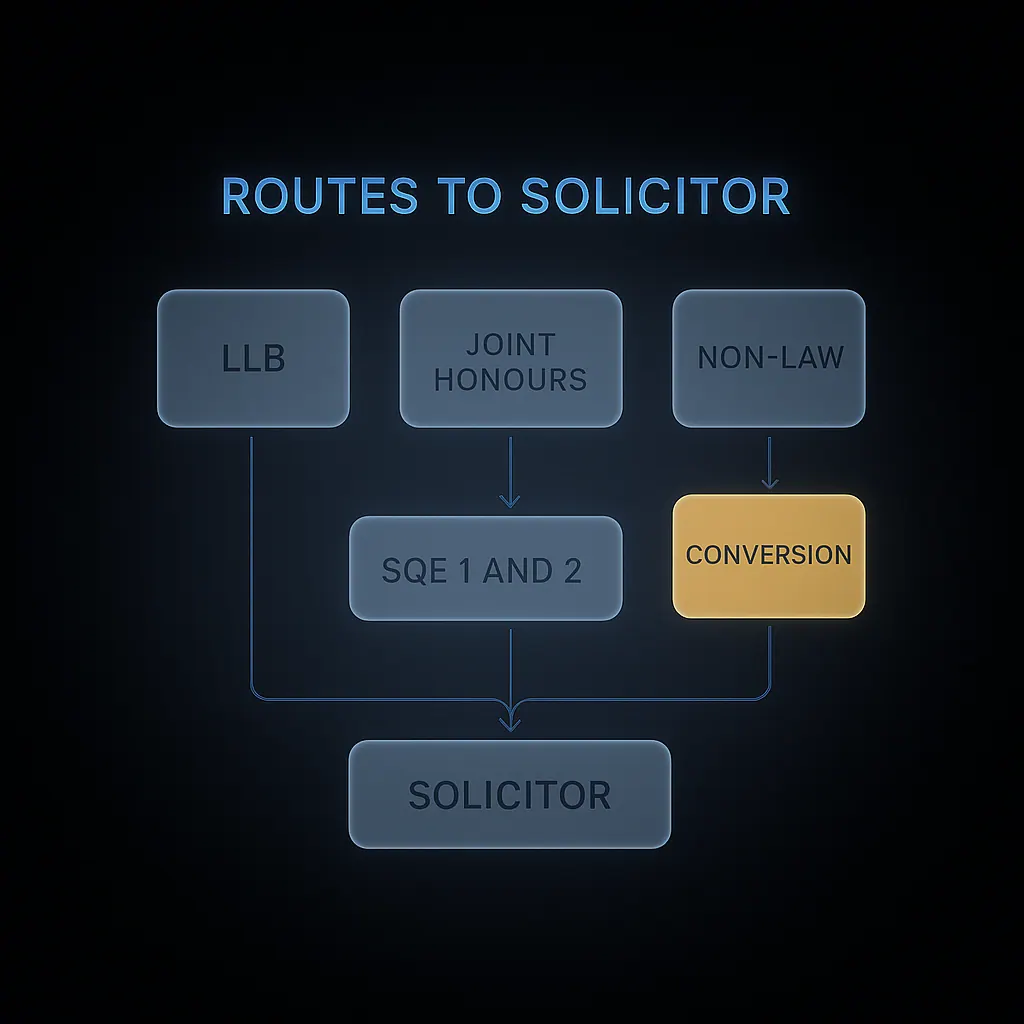
The choice between degree types is less consequential than it looks from a sixth form. Here is how the three main paths differ.
Single-honours LLB is the traditional route. You study law exclusively from day one, covering contract, tort, criminal law, and the rest of the qualifying subjects. It satisfies the academic stage of training for both solicitor and barrister routes, as recognised by the Solicitors Regulation Authority and the Bar Standards Board.
Joint honours combines law with another subject, most commonly criminology, politics, or a language. Criminology and law joint degrees are popular because they share significant curriculum overlap with the single-honours LLB, and entry requirements are typically comparable. Check individual course pages to confirm which qualifying subjects are covered, because not all joint degrees satisfy the full academic stage automatically.
Non-law degree, then conversion is a genuinely viable path. Because the SQE (Solicitors Qualifying Examination) now governs qualification as a solicitor in England and Wales, a graduate in history or economics can sit SQE1 and SQE2 after completing any degree. The law degree decision is not the permanent fork students assume it to be.
One concrete quirk worth knowing: at Cambridge, qualifying as a barrister requires completing seven specified papers including Criminal Law, Contract Law, Land Law, and Equity within the degree itself. Solicitor qualification follows the same post-degree SQE1 and SQE2 route as everywhere else, as Cambridge notes on its course page. If the Bar is your target, paper selection in Years 2 and 3 is not optional.
7. Foundation year and alternative entry routes into law
Not every applicant arrives with three strong A-levels. Several institutions offer structured alternative routes, and the entry benchmarks are precise enough to plan around.
Foundation year: The University of Law's four-year foundation year route accepts 64 UCAS points from IB Certificates rather than a full Diploma. That is a notably lower bar than the 120-point UCAS tariff on the standard three-year LLB.
Access to HE Diploma: Credit mix requirements differ between institutions, so check carefully before assuming one offer matches another.
| Institution | Distinction credits | Merit credits |
|---|---|---|
| Royal Holloway | 30 | 15 |
| University of Law | 24 | 21 |
The University of Law asks for fewer Distinctions but compensates with more required Merits, so a transcript heavy on Passes will not bridge the gap.
Scotland-specific requirements: Law degree entry requirements differ north of the border. The University of Law accepts Scottish Highers at AABB, while Royal Holloway requires AAABB. Students targeting Scottish universities or entry requirements for law degrees in Scotland should check those institutions directly, as the four-year LLB structure there sets its own benchmarks entirely separate from the English and Welsh system.
8. What to do next
The most common mistake at this stage is assuming LNAT registration happens automatically through UCAS. It does not. Universities that require it will not remind you. Check every shortlisted university's admissions page this week to confirm whether the LNAT applies, then register directly at lnat.ac.uk before your sitting deadline closes. Oxford and UCL candidates face particularly tight autumn windows, and late registration is not accepted.
Once you have confirmed your LNAT position, use our law subject hub to get a full picture of what the degree actually involves, from qualifying law modules to career routes. Then head to /courses to compare published entry requirements for real UK law courses side by side, including grade offers, GCSE conditions, and any subject preferences you may not have spotted yet.
FAQ
What A-levels do you need for a law degree?
No specific A-level subjects are required by most UK law universities - Cambridge states no subjects are required and Law A-level gives no advantage, while essay-based subjects such as History and English are recommended; check individual course pages for excluded subjects like General Studies.
Can I get into law without a Law A-level?
Yes - the majority of UK law students, including those at Cambridge, have not studied Law at school, and no major UK university requires it as a condition of entry.
Do I need to sit the LNAT for a law degree?
Only if you are applying to universities that require it, including Oxford; the LNAT has its own registration deadline and fee separate from UCAS, so check lnat.ac.uk early in your application cycle.
What are the minimum requirements for a law degree in the UK?
The lowest published standard A-level offer in the research is BBB at the University of Law (excluding General Studies), with a 120 UCAS tariff alternative; more competitive universities require AAB up to A*AA.
How can I get into law without a law degree?
A non-law graduate can qualify as a solicitor in England and Wales by passing SQE1 and SQE2 after their degree, making a conversion route a viable path into the profession without an LLB.
What are law degree entry requirements in Scotland?
Scottish Higher requirements vary by university - the University of Law requires AABB and Royal Holloway requires AAABB; students applying to Scottish universities for a Scots law degree should check those institutions' individual pages as requirements differ.
References
- Your qualifications | BA Law - https://www.ba.law.cam.ac.uk/applying/your-qualifications
- Law | Royal Holloway, University of London | UCAS - https://www.ucas.com/explore/courses/43b9b9f2-5c63-8364-81a4-512a88d560eb/law?studyYear=2026
- Law | The University of Law | UCAS - https://www.ucas.com/explore/courses/5dbe55a4-974d-cb62-3cfa-397aceef14af/law?studyYear=2027
- Law | University of York | UCAS - https://www.ucas.com/explore/courses/b3860852-bdf4-5a4d-4587-d0cade0b3bc4/course
- How to apply | Faculty of Law - https://www.law.ox.ac.uk/content/how-apply
- University Statement - https://recognition.ibo.org/en-US/university-statements?id=7adcc6b8-f2a1-ed11-aad1-000d3a85c377&university=University+of+Law&countryID=f4436145-efa1-ed11-aad1-000d3a85c377&country=United+Kingdom&stateID=&state=
- International entry requirements | Undergraduate Study - https://www.undergraduate.study.cam.ac.uk/international-students/international-entry-requirements
- Law, BA (Hons) | Undergraduate Study - https://www.undergraduate.study.cam.ac.uk/courses/law-ba-hons