How to Get Into Dentistry: The Complete UK Guide
By Michael Thompson · Former IB Diploma Programme coordinator; 10 years at Bromsgrove School · Published 5 July 2026 · Updated 4 October 2026
Getting into dentistry is one of the most competitive application processes in UK higher education, and the rules are stricter than most guides admit. You need the right A-level subjects, a strong UCAT score, verified work experience in a dental practice, and a personal statement that answers three distinct questions under a 4,000-character cap. This guide sets out every step - entry requirements, the dental school application process timeline, interview format, and what selectors actually look for - so you can build an application without gaps.
Key Takeaways
- Chemistry is non-negotiable: All UK dental schools require A-level Chemistry, and most also require Biology alongside it.
- The UCAT has four sections: Abstract Reasoning was removed in 2025; for 2027 entry, testing ran from July to September 2026, and dental schools use your score as a threshold or weighting tool.
- You only get four dentistry choices on UCAS: Dentistry is a capped subject, so your fifth UCAS choice must be something else - use it for a related back-up such as biomedical science or dental hygiene therapy.
- Work experience must include dental-practice observation: Selectors also want evidence of manual dexterity - crafts, model-making, playing an instrument - reflected on in the personal statement.
- Most dental schools use an MMI interview: Multiple Mini Interviews typically include ethics stations, motivation-for-dentistry questions, and discussion of manual skills.
- Two new dental schools open in 2027: The University of East Anglia and the University of Portsmouth each received 25 funded places, representing the first sustained expansion in nearly 20 years.
In This Article
- A-level Entry Requirements for UK Dental Schools
- The IB Route: Reading a Dentistry Offer
- UCAT for Dental Schools: Sections, Dates, and How Scores Are Used
- The UCAS Application: Four-Choice Rule and Deadlines
- Work Experience for Dentistry UK: What Selectors Want
- The 2026 UCAS Personal Statement: Three Questions for Dentistry
- Dental School Interviews: MMI Format and Common Stations
- Dental School Landscape: Places, Competition, and New Schools
- Where to Go From Here
1. A-level Entry Requirements for UK Dental Schools
Knowing how to get into dentistry starts with understanding that the subject requirements are stricter than for most other degrees, and that small differences between schools matter more than applicants often expect.
Chemistry is non-negotiable. Dental Mentor reports that all UK dental schools require A-level Chemistry. The majority also require Biology alongside it: 13 dental schools require both Chemistry and Biology, while around 19 will consider Chemistry plus Physics or Maths as an alternative second science.
Grade targets vary, but the most selective programmes sit at the top end. King's College London, ranked first in the UK for dentistry, requires *A\AA**, with Biology or Chemistry as one subject and a second chosen from Biology, Chemistry, Physics, Maths, or Psychology. Less selective schools typically ask for AAA or AAB, so checking each programme individually is worth doing early.
Three A-levels is the rule, not a suggestion. Schools will not consider a fourth subject, and certain combinations count as only one entry. A-level Maths and Further Maths, or Biology and Human Biology, each count as a single subject toward the three required. Planning your Year 12 timetable around this is essential.
Several subjects are explicitly excluded. General Studies, Critical Thinking, Citizenship Studies, and Global Perspectives are not accepted by most dental schools, so choosing any of these as your third A-level wastes an application slot.
GCSEs carry more weight than many applicants realise. King's requires at least grade 6/B in both English Language and Mathematics at GCSE. Check individual school pages: some set similar floors in science subjects.
On vocational qualifications: King's does not accept the BTEC Level 3 National Extended Diploma or T Levels for its BDS programme. This is broadly representative of the most selective dental schools, where traditional A-levels remain the expected route.
2. The IB Route: Reading a Dentistry Offer
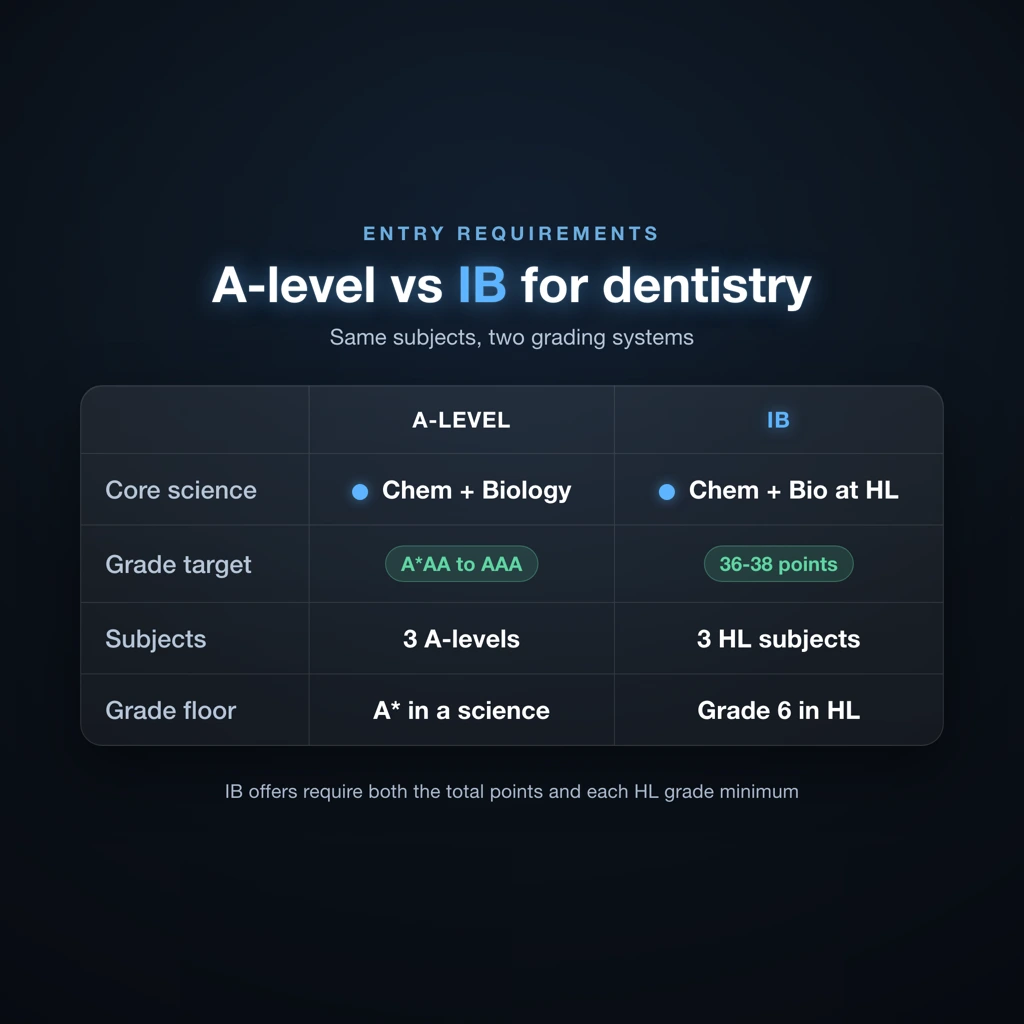
IB offers for dentistry combine two separate requirements: a total points score and minimum grades in specific Higher Level (HL) subjects. You need to satisfy both. Hitting the overall points target while falling short on an HL grade minimum will still result in a rejected offer.
King's College London illustrates the format clearly: 38 points overall, including grade 6 in Higher Level Chemistry or Biology, plus grade 6 in a second qualifying HL subject. That means a student scoring 40 points but only achieving grade 5 in HL Chemistry would not meet the condition.
Across dental schools more broadly, Chemistry and Biology at Higher Level are the standard expectation. The non-obvious gotcha: schools vary on whether they require both sciences at HL or allow one at Standard Level. A school that accepts HL Chemistry plus HL Mathematics as the qualifying pair will have a different profile from one insisting on both science HL subjects. **Check each school's IB condition individually** rather than assuming King's College London's wording applies everywhere.
A quick reference for reading any dentistry IB offer:
- Total points - the overall Diploma score (Theory of Knowledge and Extended Essay points included).
- HL grade minimums - subject-specific grade floors, usually 6 or 7, applied on top of the total.
- Qualifying HL subjects - the permitted subject list for the second (or third) HL slot, which varies by school.
3. UCAT for Dental Schools: Sections, Dates, and How Scores Are Used
The UCAT (University Clinical Aptitude Test) is a separate, compulsory admissions test for most UK dental schools. You sit it before submitting your UCAS application, not after, which means preparation has to run in parallel with your A-level or IB coursework.
Since 2025 the test has four sections, after Abstract Reasoning was removed:
- Verbal Reasoning
- Decision Making
- Quantitative Reasoning
- Situational Judgement
The scores from the first three are added together into a total between 900 and 2700; Situational Judgement is reported separately in bands.
For 2027 entry, testing ran from 13 July to 24 September 2026, so that cycle has closed. Because the UCAS dentistry deadline is 15 October, you must book and sit UCAT before that date, and you can sit it only once per testing cycle. If you are applying for 2028 entry, UCAT dates for 2027 have not been published yet. Check the official UCAT website for exact registration dates, cut-off scores, and banding tables, as these are updated each cycle.
How schools use the score varies, and this matters more than most applicants realise. Some universities set a minimum threshold: fall below it and your application is not shortlisted, regardless of predicted grades. Others fold the raw score into a ranking formula alongside GCSEs and A-level predictions. The practical implication is that a borderline UCAT score can be survivable at a weighting school but terminal at a threshold school, so check each institution's published admissions policy before you register.
One concrete example: King's College London BDS (A205) requires all applicants to sit UCAT. However, King's graduate-entry programme for qualified medical graduates (A204) does not require UCAT. If you are applying to both routes at the same institution, check the course code carefully.
Aim to confirm your target schools' UCAT policies by June, before the summer testing window opens.
4. The UCAS Application: Four-Choice Rule and Deadlines
Dentistry is a capped subject on UCAS, meaning **no more than four of your five choices can be dentistry programmes**. That fifth slot matters. Biomedical science, dental therapy, or dental hygiene and therapy are all considered options, with dental hygiene and therapy programmes typically requiring 112-128 UCAS Tariff points depending on the institution, per UCAS course listings. Leaving the fifth choice blank, or filling it with an equally competitive course you are unlikely to get, is a common and avoidable mistake.
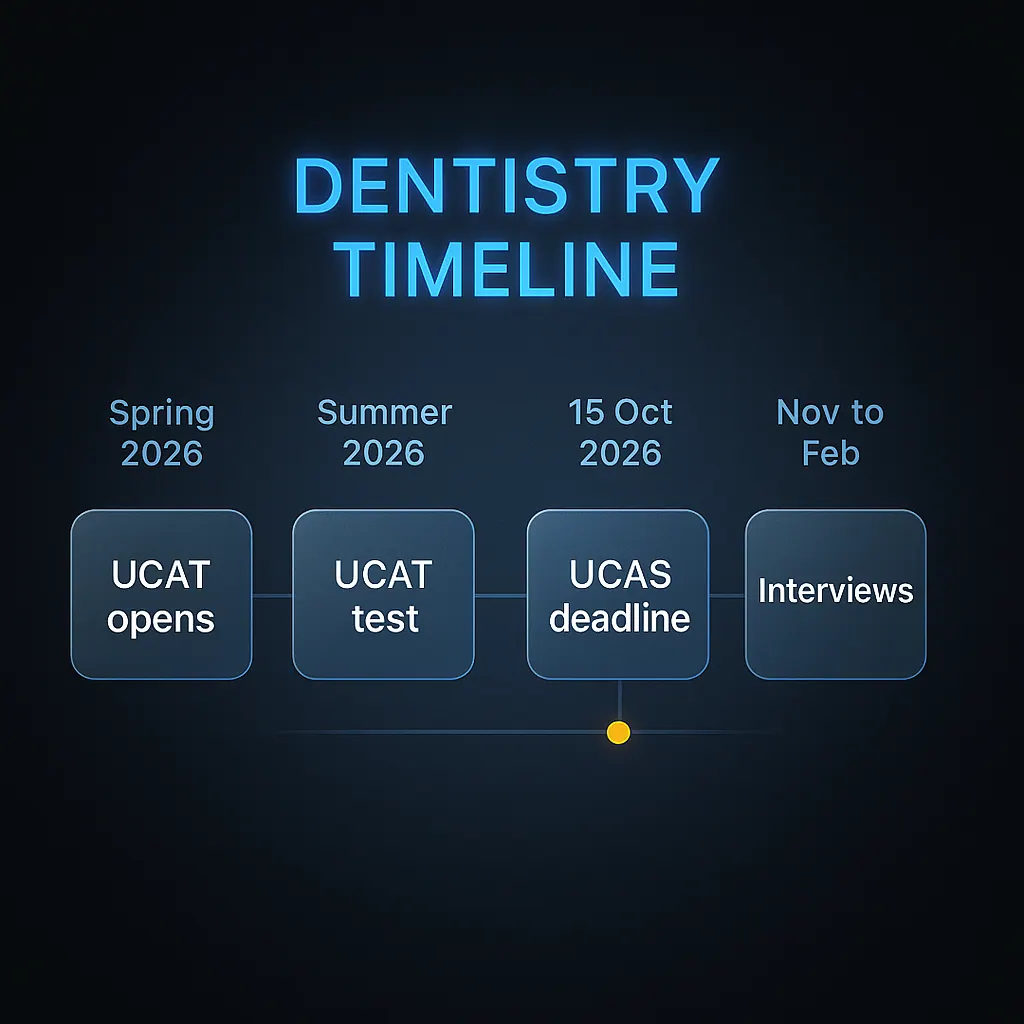
**The UCAS deadline for dentistry is 15 October** for 2027 entry (15 October 2026), the same date that applies to medicine, veterinary medicine, and Oxford and Cambridge applications. Missing this deadline by even one day means your application is treated as late, and most dental schools will not consider it. UCAS lists 120 dentistry-related courses for September 2026 entry, so there is more variety in the landscape than the headline BDS programmes suggest.
One specific route worth knowing: King's College London offers a separate three-year BDS programme (course code A204) exclusively for qualified medical graduates registered with the UK General Medical Council who have completed Foundation Years 1 and 2, and who intend to pursue oral and maxillofacial surgery or oral medicine. The deadline for A204 is 13 January 2027, not October, and applicants are not required to sit the UCAT. It is a narrow route, limited to a very small number of places, but it is a distinct application pathway that many medics are unaware of.
5. Work Experience for Dentistry UK: What Selectors Want
Shadowing a GDP (general dental practitioner) in a working NHS or private practice is the core expectation. Selectors want evidence that you have seen dentistry as it actually happens, not as a prospectus describes it. A single afternoon counts for little. Several sessions across different contexts, ideally with more than one dentist, gives you the material to write and talk about meaningfully.
The counter-intuitive point many applicants miss: observation alone does not differentiate you. What selectors are reading for is reflection. When you write about your placement, name specific things you noticed, how a dentist managed an anxious patient, how infection control protocols shaped the pace of the appointment, how trays were prepared between patients. Vague statements about "gaining insight into the profession" are forgettable.
Manual dexterity evidence is a dentistry-specific requirement that has no real equivalent in medicine applications. Instruments are small, mouths are small, and the work is precise. Activities that demonstrate fine motor control include:
- Playing a musical instrument
- Sculpture, model-making, or ceramics
- Technical drawing or jewellery-making
- Detailed crafts such as embroidery or woodcarving
You do not need all of these. One or two, described with specific skill progression, carries more weight than a long list.
UCAS lists a virtual work experience programme with mydentist, running from mid-2026. Virtual programmes can supplement in-person observation and are worth doing if access to a local practice is difficult, but they should not replace it. Selectors can tell the difference.
Keep a reflective log after every session. Record specific incidents and dates rather than general impressions. That log becomes the raw material for your personal statement and your interview answers.
6. The 2026 UCAS Personal Statement: Three Questions for Dentistry
From 2026, UCAS replaces the traditional free-form personal statement with three structured questions, with a total character limit of 4,000 across all three. For dentistry applicants, the structure is actually an advantage: selectors can now locate your dental evidence quickly rather than hunting through a wall of text.
The non-obvious gotcha: the three-question format removes the temptation to open with a sweeping healthcare narrative. Selectors at competitive dental schools have always penalised statements that read as though the applicant considered medicine first and settled for dentistry. The new format makes that mistake harder to hide.
How to use each question
Question 1 - why this course Make the case for dentistry as a distinct profession, not healthcare in general. Anchor every claim to something you observed during work experience: a specific procedure, a patient management decision, or the way a dentist explained treatment options. Vague admiration for "helping people" signals that your placement was passive.
Question 2 - preparation and skills Connect your science A-level content (A-Level Chemistry mechanisms, Biology tissue content) to what dental training actually demands. Manual dexterity activities belong here too: name the activity and say what it trained, rather than listing hobbies.
Question 3 - wider contributions Keep this proportionate. A short, honest paragraph on extra-curricular involvement is enough. Padding this section at the expense of dental-specific content is a common trade-off that works against you. Selectors are reading for evidence that you understand the scope of dentistry as its own discipline, not for a long list of unrelated achievements.
7. Dental School Interviews: MMI Format and Common Stations
Most UK dental schools use the Multiple Mini Interview (MMI) format: a circuit of short, timed stations rather than a single panel sitting. You move from room to room, spending roughly 5 to 8 minutes at each station before a bell signals the next. The format is designed to reduce interviewer bias and test how you think on your feet, not how well you've rehearsed.
King's College London, the UK's largest dental school, uses an interview as one of three selection hurdles alongside UCAT score and academic screening.
Common station types:
- Ethical scenario - a patient refuses a recommended treatment; you work through their autonomy versus clinical duty
- Motivation - why dentistry specifically, not medicine or another health profession
- Manual dexterity - discussion of tasks requiring fine motor control, or occasionally a practical exercise
- Role-play - an actor plays a distressed or difficult patient; you respond in real time
- Current NHS dentistry issue - access problems, NHS contract pressures, or workforce challenges
How to prepare without over-scripting:
- Practise timed responses out loud using the STAR framework (Situation, Task, Action, Result) for experience-based questions
- Read the GDC Standards for the Dental Team for ethical grounding - examiners often probe whether you know the difference between patient consent and patient preference
- Avoid memorising word-for-word answers; selectors reward candidates who reason through a problem aloud rather than recite a polished script
The counter-intuitive point: strong performance on ethical stations usually comes from acknowledging complexity, not from landing on a "right" answer quickly.
8. Dental School Landscape: Places, Competition, and New Schools
The UK has a small number of dental schools, and most admit fewer than 100 students per year, which makes each application count more than in many other degree programmes.
**King's College London is the largest dental school in the UK**, graduating approximately 150 dentists per year and ranked 1st in the UK and 4th in the world by QS World University Rankings by Subject 2025. Its size is the exception, not the rule.
All BDS (Bachelor of Dental Surgery) programmes run for five years. One counter-intuitive detail worth knowing: UCAS lists no Tariff points for BDS courses at universities including Birmingham, Glasgow, King's, and Queen Mary. The entry bar is set by specific subject grades, not a points total, so comparing dentistry offers using Tariff arithmetic will give you the wrong answer.
The supply of places is also changing. In June 2026, the University of East Anglia and the University of Portsmouth were each awarded 25 new dental training places starting 2027, the first sustained expansion in nearly 20 years. The expansion was targeted at areas previously without dental training, and it means all NHS England regions will now have a dental school.
If a BDS feels out of reach right now, dental hygiene and dental therapy BSc degrees offer a separate, shorter route. These are three-year programmes with UCAS Tariff ranges of 112-128 points at most institutions, and they carry different entry requirements from a BDS entirely.
9. Where to Go From Here
If you are applying for 2028 entry, the most time-sensitive item on your list is UCAT registration. For 2027 entry, testing ran through the summer of 2026, and popular test centre slots fill quickly. A counter-intuitive gotcha: many applicants assume they can book a late-summer sitting and still have time to retake if something goes wrong, but you can sit the UCAT only once per testing cycle, so booking early gives you more room to prepare rather than more chances to resit.
Check the UCAT website for the 2027 registration dates once they are published, and block out a test date in your calendar before the summer holidays begin.
Once your test is done and your UCAS draft is taking shape, get your dentistry personal statement reviewed before the October deadline so you have time to act on feedback.
FAQ
What A-levels do you need to get into dentistry in the UK?
All UK dental schools require A-level Chemistry; most also require Biology, and the typical offer at the most selective schools is A*AA or AAA depending on the institution.
How many dentistry choices can you make on UCAS?
Dentistry is a capped subject on UCAS, so you can apply to a maximum of four dentistry programmes; your fifth choice must be a different course.
When is the UCAS deadline for dental school applications?
The UCAS deadline for dentistry is 15 October, the same as medicine, veterinary medicine, and Oxford and Cambridge - missing it means equal consideration is not guaranteed.
Do you need work experience to get into dental school?
Yes - dental schools expect evidence of dental-practice observation (shadowing a GDP) and many also want demonstration of manual dexterity through activities such as crafts or playing an instrument.
What is the UCAT and which dental schools require it?
The UCAT is a four-section aptitude test taken between July and September; the majority of UK dental schools use it to shortlist applicants, though the King's graduate-entry programme (A204) is one exception that does not require it.
Can you get into dentistry with the IB Diploma?
Yes - dental schools accept the IB Diploma and typically require Chemistry and Biology at Higher Level, with a total-points score around 36-38 depending on the school.
References
- Entry Requirements For Dental Schools – Dental Mentor - https://dental-mentor.org/entry-requirements-for-medical-schools
- Dentistry | King's College London, University of London | UCAS - https://www.ucas.com/explore/courses/5b90f0cb-c50f-78cd-6d1d-b23ea68423f4/course
- Dentistry Entry Programme for Medical Graduates | King's College London, University of London | UCAS - https://www.ucas.com/explore/courses/89582f0c-558a-f36f-3914-9886a3a92db2/course?studyYear=2027
- Search | All results | "dentistry" | UCAS - https://www.ucas.com/explore/search/all?query=dentistry
- Brand new dental school places in 'dental deserts' - GOV.UK - https://www.gov.uk/government/news/brand-new-dental-school-places-in-dental-deserts
- UCAT 2025 | UCAT - https://www.ucat.ac.uk/about-ucat/ucat-2025/
- FAQs | UCAT - https://www.ucat.ac.uk/faqs/