UCAS Clearing Explained: How It Works in 2026
By Michael Thompson · Education Specialist; 10 years teaching the IB at Bromsgrove School · Published 21 May 2026 · Updated 4 October 2026
UCAS Clearing is the process that matches students who don't hold a university place to courses that still have vacancies - and more than 50,000 students use it every year. It runs from 2 July to 19 October 2026, which means it's open well before A-level results day on 13 August. Whether you missed your grades, never received an offer, or simply changed your mind about your firm choice, Clearing gives you a structured route to a place. This guide covers every stage: who qualifies, how Clearing Plus works, what to say when you call a university, and what happened to Adjustment after it was removed in 2021.
Key Takeaways
- Clearing runs from 2 July to 19 October 2026: It opens weeks before A-level results day, so you can browse vacancies and prepare well in advance.
- Three routes into Clearing: You qualify if you missed your offer conditions, hold no offer at all, or applied after 30 June 2026.
- Clearing Plus matches you to courses automatically: UCAS uses your existing application data to suggest up to 50 matched courses, visible via a 'My matches' button in your hub.
- You must call universities yourself: Parents cannot make Clearing calls on your behalf - have your Clearing number, Personal ID, and grades ready before you dial.
- Adding a Clearing choice is a binding acceptance: Once you add a choice in UCAS Hub, it counts as accepting that offer - you can only hold one Clearing choice at a time.
- Adjustment was removed in 2021: There is no longer a formal Adjustment period; students who exceed their offer conditions should contact universities directly to discuss their options.
In This Article
- What Is UCAS Clearing and Who Can Use It
- Clearing 2026 Dates and Key Deadlines
- How Clearing Plus Works: Automatic Course Matching
- Step-by-Step: What to Do on Results Day If You Go Into Clearing
- How to Call Universities During Clearing: What to Say and What to Ask
- Self-Release from a Firm Offer: The Risks of Declining Your Place
- What Happened to Adjustment? Clearing After 2021
- Clearing for International Students
- UCAS Extra vs Clearing: Understanding Both Routes
- Alternatives to Clearing Worth Considering
- Your Next Move Before Results Day
1. What Is UCAS Clearing and Who Can Use It
UCAS Clearing is the system that matches applicants to university and college places that have gone unfilled after the main admissions cycle. If a course still has seats available and you need a new option, Clearing is how the two sides find each other. More than 50,000 students find places through Clearing every year, so it is a well-worn route rather than a last resort.
You are eligible for Clearing if you fall into one of four groups:
- Missed your offer conditions - your grades came in below what your firm or insurance choice required.
- Hold no offer - your applications were unsuccessful or you received no offers worth accepting.
- Applied after 30 June - late applications automatically enter Clearing rather than the standard decision process.
- Declined your firm place - you used the 'Decline my place' button on UCAS Hub to voluntarily release yourself. This last route surprises many students: you can choose Clearing even if you met your conditions, which matters if your results significantly exceeded your offer and you want to aim higher.
One important boundary: UCAS Conservatoires do not use Clearing to fill vacancies, so if your ambitions run to conservatoire music programmes, a different route applies entirely.
Once you are in Clearing, your UCAS Hub status updates automatically to confirm it, and the process of finding and securing a new place begins.
2. Clearing 2026 Dates and Key Deadlines
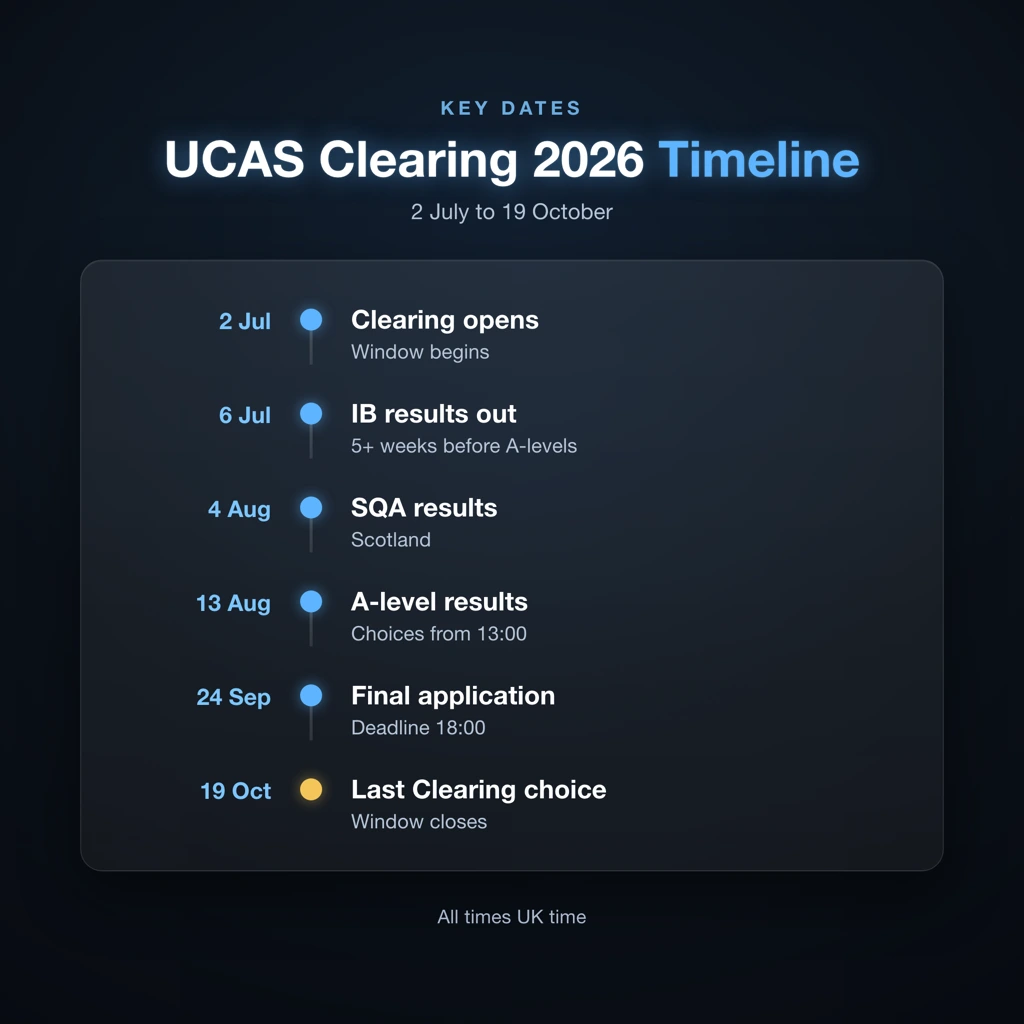
UCAS sets firm open and close dates for Clearing each year, and missing one by even a few minutes can change your options.
The window for 2026 runs from 2 July to 19 October. Any application submitted after 30 June 2026 at 18:00 UK time is automatically placed into Clearing, so late applicants enter the system without needing to do anything extra.
The counter-intuitive timing quirk worth knowing: IB Diploma Programme results are released on 6 July, more than five weeks before A-level results day. That gives IB students a genuine head start, with Clearing already open and universities actively filling places.
| Event | Date | Time (UK) |
|---|---|---|
| Clearing opens | 2 July 2026 | - |
| Late applications auto-enter Clearing | after 30 June 2026 | 18:00 |
| IB results released | 6 July 2026 | - |
| SQA results day (Scotland) | 4 August 2026 | Hub statuses 09:00, choices from 10:00 |
| A-level results day (England, Wales, NI) | 13 August 2026 | Hub statuses 08:00, choices from 13:00 |
| Final UCAS application deadline | 24 September 2026 | 18:00 |
| Last date to add a Clearing choice | 19 October 2026 | - |
Sources: UCAS dates and deadlines; results day guide
Note that on A-level results day, UCAS Hub statuses update at 08:00, but you cannot add a Clearing choice until 13:00. Those five hours exist, but you cannot act on them in the system yet. Use the time to call universities and secure an informal offer first.
3. How Clearing Plus Works: Automatic Course Matching
Clearing Plus is a matching tool built into UCAS Hub that suggests courses to you based on the application data you have already submitted, such as your predicted or actual grades, subject choices, and personal statement. You do not need to do anything extra to activate it.
According to UCAS, up to 50 matched courses appear when you click the 'My matches' button inside your application. You can browse these and indicate interest to a provider directly through the interface, which flags your profile to that university without any commitment on your part.
Clearing Plus is available if you applied after 30 June or if you are holding no offers at all. Students who missed the main cycle deadline and applied directly into Clearing will see it automatically.
The critical distinction most students miss: indicating interest through Clearing Plus is passive and non-binding. Actually adding a Clearing choice in your application is a definitive acceptance. Those are two separate actions, and confusing them is an easy mistake under results-day pressure. You can signal interest to several providers through 'My matches', then call the ones who respond before you commit to any single Clearing choice in your Hub.
The matches are generated from your existing UCAS application data, so a thin or generic personal statement can limit how well the algorithm aligns you with relevant courses. Think of Clearing Plus as a shortlist, not a decision.
4. Step-by-Step: What to Do on Results Day If You Go Into Clearing
Results day is faster than most people expect. Having a clear sequence in your head before the morning matters more than improvising on the day.
1. Collect your grades from school or college first. Your exam results are not visible in the UCAS Hub. Per UCAS, you must get them directly from your school or college. On JCQ results day (England, Wales, Northern Ireland) that is 13 August 2026; for SQA results (Scotland) it is 4 August 2026.
2. Log into UCAS Hub and check your status. Hub statuses update from 08:00 UK time on 13 August for JCQ applicants. If your firm offer has fallen through, your status will show "You are in Clearing." UCAS confirms this update is automatic once results are processed.
3. Search for vacancies using the UCAS search tool. This is the only official vacancy list. Third-party aggregators pull from it, but the UCAS tool is always the most current version. You can also check your "My matches" tab, where UCAS surfaces up to 50 personalised course suggestions based on your application data and entry requirements.
4. Call the university directly. Have three things ready before you dial: your Clearing number, your Personal ID (both shown in UCAS Hub), and your grades. An informal offer is made over the phone. Note the name of the person you spoke to.
5. Add the Clearing choice in UCAS Hub and confirm. UCAS is clear that you can only hold one Clearing choice at a time, and adding it counts as a definitive acceptance. It is not a holding position. If the university does not confirm the place, the choice is removed and you can add another, but you cannot queue multiple options simultaneously.
The non-obvious gotcha: Clearing choices can only be added from 13:00 UK time on JCQ results day, not from the moment Hub statuses update at 08:00. That five-hour window is phone-only research time, which is why preparing a shortlist of courses in advance is worth doing.
5. How to Call Universities During Clearing: What to Say and What to Ask
Before you pick up the phone, get three things in front of you: your Clearing number, your Personal ID, and your actual grades converted to UCAS Tariff points. Admissions staff will ask for all three immediately, and fumbling for them wastes time on a morning when lines are busy.
UCAS recommends writing out a separate list for each university you plan to contact, noting the institution name, phone number, and the exact course code and title. That last detail matters more than it sounds: calling about "the psychology course" when a department runs four different psychology programmes will slow the conversation down.
You must make the call yourself. Parents and guardians cannot speak to admissions on your behalf, and universities will not discuss your application with them. If phone lines are overwhelmed, most universities also offer live chat and social media contact as alternatives.
When you get through, ask:
- Whether your grades meet the entry requirements for that specific course
- What the course structure looks like (content, placement year, assessment style)
- If you are an international student, whether an offer would affect your visa status
One detail many applicants miss: you can seek offers from universities whose offers you previously declined earlier in the cycle. That earlier rejection is not a permanent door close.
With over 30,000 courses available through Clearing, the volume of options is real. Prepare a shortlist before Results Day so you are calling with purpose, not scrolling under pressure.
6. Self-Release from a Firm Offer: The Risks of Declining Your Place
If you hold an unconditional firm offer and want to pursue a different course or university, you can enter UCAS Clearing voluntarily. According to UCAS, students who have changed their mind about their firm unconditional offer can release themselves by clicking the 'Decline my place' button in their application.
The critical detail: this action is irreversible. The moment you click decline, your original place is gone. No university is obliged to reinstate it, and most will not.
You then enter Clearing with no guarantee of anything. A course you have in mind may have no vacancies left, or the university may not make you an informal offer when you call. The UCAS search tool is the only official source of live vacancies, and places update in real time, so what was listed an hour ago may already be gone.
The scenario where self-release can make sense: you collected grades well above your firm offer conditions and want to aim for a more competitive course or institution. Before 2021, a separate process called Adjustment existed specifically for this situation, allowing students to hold their firm place while exploring upgrades. That route has since been removed (covered in section 7). Self-releasing is now the only mechanism available, and it carries all the downside risk Adjustment was designed to avoid.
If you are considering this, check Clearing vacancies on the UCAS search tool before you click decline, not after.
7. What Happened to Adjustment? Clearing After 2021
UCAS removed the Adjustment period in 2021. It no longer exists.
Previously, Adjustment gave students who exceeded their firm offer conditions a short window (typically five days) to approach higher-tariff universities while keeping their original place as a safety net. That safety net is gone.
What you lose without Adjustment is concrete: if you beat your offer grades and want to apply somewhere more competitive, the only mechanism now is to use the 'Decline my place' button in the UCAS Hub. As UCAS explains, this releases you into Clearing fully. Your original offer is surrendered the moment you click. There is no reversal, no parallel negotiation, no protected position.
The practical consequence is asymmetric risk. A student who misses their firm offer conditions enters Clearing with nothing to lose. A student who exceeds them and self-releases is gambling a confirmed university place on an informal conversation with an admissions team that has no obligation to follow through.
UCAS's current guidance is that students in this position should contact universities directly to discuss their options before making any decision in the Hub. That means calling admissions teams, asking whether a place is realistic, and only then deciding whether to decline. Doing it the other way around is the most expensive mistake you can make on results day.
8. Clearing for International Students
International and EU students are eligible for UCAS Clearing on exactly the same basis as UK applicants. There is no separate process and no additional UCAS fee.
IB students have a timing advantage most applicants miss. International Baccalaureate results are released on 6 July, more than five weeks before A-level results day on 13 August. Universities continuously add new course vacancies between Clearing opening on 2 July and 13 August, so IB students who move quickly can reach admissions teams when competition is thinner and the vacancy list is longer.
Clearing Plus is also available to international applicants. It uses your existing UCAS application data to suggest matched courses automatically, which is useful if you are unfamiliar with the UK university landscape.
The visa timeline is the critical constraint for overseas students. Student visas typically take three weeks to process after application, with processing times varying by country and the visa service chosen. Apply as soon as you receive your CAS number (Confirmation of Acceptance for Studies) from the university. Any delay between accepting a Clearing place and requesting your CAS adds directly to your pre-term anxiety.
One practical note: if you use an international adviser to help manage your application, they can access and manage your UCAS Hub provided you grant them nominated access first.
9. UCAS Extra vs Clearing: Understanding Both Routes
Extra and Clearing solve the same problem (no university place) but operate at different points in the cycle and work quite differently.
Extra opens on 26 February 2026 and is available to applicants who have used all five choices and hold no offers. You add one course at a time, wait for a response, and only move to another if that university declines you or you withdraw the application yourself. The last day to add an Extra choice is 1 July 2026.
Clearing opens on 2 July 2026, the day after Extra closes. Any application submitted after 30 June 2026 at 18:00 UK time is automatically entered into Clearing rather than Extra, so the handover is abrupt and exact.
The less obvious distinction: Extra runs before results day, so you are making course decisions without knowing your final grades. Clearing runs after results, meaning universities see your actual grades when they consider you. That timing difference matters more than it looks. A student who narrowly misses their predicted grades during Extra has no leverage; the same student in Clearing can point to confirmed results.
| Extra | Clearing | |
|---|---|---|
| Opens | 26 Feb 2026 | 2 July 2026 |
| Closes | 1 July 2026 | 19 Oct 2026 |
| Applications at a time | One | Unlimited calls |
| When you have grades | No | Yes |
| Who can use it | Used all 5 choices, no offers | Anyone without a confirmed place |
If you are in Extra as the 1 July deadline approaches with no offer, do not panic-withdraw just to get into Clearing faster. Wait for any outstanding response first.
10. Alternatives to Clearing Worth Considering
Clearing is one option, not the only one. UCAS itself lists apprenticeships, foundation years, and reapplying the following year as legitimate paths alongside it.
- Foundation year. A foundation year gives you a structured route into a degree programme starting the year after. It suits applicants whose grades fell short of a specific subject requirement rather than by a wide margin. The counter-intuitive point: some Russell Group universities offer their own foundation years, meaning you can still arrive at a competitive institution through this route.
- Gap year and reapply. Deferring and going through the main UCAS cycle with your current grades, or using the year to resit, keeps all options open. BBC Bitesize notes this as a recognised alternative to Clearing.
- Resitting A-levels. AQA, OCR and Pearson Edexcel A-levels are examined only in the May-June series, so a resit means sitting the papers the following summer (January sittings exist only for International A-levels). Applying with confirmed higher grades the following autumn is a stronger position than applying with predicted ones.
- Apprenticeships. These appear in the UCAS Clearing search tool alongside degree courses, so you can compare them in the same session.
If results day is affecting your mental health, UCAS signposts Student Space for wellbeing support. A bad set of results is a setback, not a fixed outcome.
11. Your Next Move Before Results Day
Results day pressure is real, and the worst time to set up your UCAS Hub access is at 08:00 on 13 August. Do the admin now.
Three things to do this week, per UCAS:
- Log into UCAS Hub and check your login works. Simple, but surprisingly easy to forget until you need it.
- Grant nominated access to a parent or adviser if you want them to speak to UCAS on your behalf. UCAS will not discuss your application with anyone else without it.
- Favourite any courses you would consider in Clearing so they are one tap away on results day, not buried in a search.
One counter-intuitive point: Clearing Plus "My matches" is visible from 2 July, well before JCQ results day on 13 August. Check it in early July, not just on the morning your grades arrive. Courses disappear as places fill.
Open UCAS Hub today and complete all three steps before the end of this week.
FAQ
How does UCAS Clearing work?
Clearing lets students without a university place contact institutions directly to secure a vacancy; you call with your Clearing number and Personal ID, receive an informal offer, then add the choice in UCAS Hub to confirm acceptance.
What is UCAS Clearing Plus?
Clearing Plus is a UCAS feature that automatically matches your application data to up to 50 suitable courses, shown via a 'My matches' button in your hub - available to students applying after 30 June or those holding no offers.
How does UCAS Clearing work on results day?
On A-level results day (13 August 2026) your UCAS Hub status updates from 08:00; if you're in Clearing, you can add a Clearing choice from 13:00 after calling a university and receiving an informal offer.
How do I find my UCAS Clearing number?
Your Clearing number appears in your UCAS Hub once you are in Clearing - log in, and it will be displayed alongside your Personal ID on your application status page.
Can you apply through Clearing without a prior UCAS application?
Yes - students who apply to UCAS after 30 June 2026 are automatically entered into Clearing and can use the process to find a place, including uploading supporting documents via UCAS's document upload service.
How long does UCAS Clearing take?
Clearing is open from 2 July to 19 October 2026, but in practice most places are filled around A-level results day on 13 August; popular courses can fill within hours, so acting quickly improves your options.
References
- What is Clearing? Find out when Clearing happens and how it works - https://www.ucas.com/undergraduate/results-confirmation-and-clearing/what-clearing
- Dates and deadlines for uni applications | UCAS - https://www.ucas.com/applying/applying-to-university/dates-and-deadlines-for-uni-applications
- Clearing guide for international students | UCAS - https://www.ucas.com/applying/after-you-apply/clearing-and-results-day/what-is-clearing/clearing-guide-for-international-students
- Get results day ready this summer | UCAS - https://www.ucas.com/applying/after-you-apply/clearing-and-results-day/get-results-day-ready-this-summer
- Top tips for calling universities during Clearing | UCAS - https://www.ucas.com/applying/after-you-apply/clearing-and-results-day/what-is-clearing/top-tips-for-calling-universities-during-clearing
- Clearing toolkit for parents | UCAS - https://www.ucas.com/applying/after-you-apply/clearing-and-results-day/what-is-clearing/clearing-toolkit-for-parents
- Clearing and results day | UCAS - https://www.ucas.com/applying/after-you-apply/clearing-and-results-day
- What is Clearing? A comprehensive guide by Bitesize Careers - BBC Bitesize - https://www.bbc.co.uk/bitesize/articles/z4rncqt