UCAS Personal Statement Changes: The New 2026 Format Explained
By Michael Thompson · Education Specialist; 10 years teaching the IB at Bromsgrove School · Published 21 May 2026 · Updated 4 October 2026
The UCAS personal statement changes for 2026 entry replace the traditional single free-text essay with three structured questions - a shift that affects every UK undergraduate applicant from autumn 2025 onwards. The overall 4,000-character limit stays the same, but how you distribute those characters across the three prompts is now your strategic decision. For students currently in Year 12 or equivalent, this means the advice your older siblings or teachers received no longer applies. This guide covers what the three questions are, how admissions tutors read the new format, what has not changed in the UCAS process, and how to write each section well.
Key Takeaways
- 2026 entry is the first cycle: The new structured personal statement applies to students entering university in autumn 2026, meaning applications opened in autumn 2025.
- Three questions replace one essay: UCAS now asks why you want to study the subject, how your qualifications prepared you, and what you have done outside education - each with a 350-character minimum.
- The total character limit is unchanged at 4,000: You can distribute the 4,000 characters unevenly across the three answers; there is no fixed per-question cap beyond the 350-character minimum.
- Admissions tutors read all three answers as a whole: UCAS advises against repeating information across sections - each answer should add new evidence, not restate the same points.
- Five choices, firm and insurance still apply: The rest of the UCAS application - number of choices, offer-reply process, UCAS Hub - is unchanged.
- Official UCAS guidance and examples are already published: UCAS has live guidance pages and subject-specific guides for 2026 entry applicants and their advisers.
In This Article
- What are the UCAS personal statement changes and when do they apply?
- The new UCAS personal statement format: three questions and character limits
- How admissions tutors read the new format
- What stays the same in your UCAS application
- How to choose your firm and insurance offers strategically
- Practical dos and don'ts for Question 1: why this subject?
- Practical dos and don'ts for Question 2: qualifications and studies
- Practical dos and don'ts for Question 3: outside education
- Can you change your personal statement after submitting to UCAS?
- Where to find official UCAS guidance and new personal statement examples
- What to do next
1. What are the UCAS personal statement changes and when do they apply?
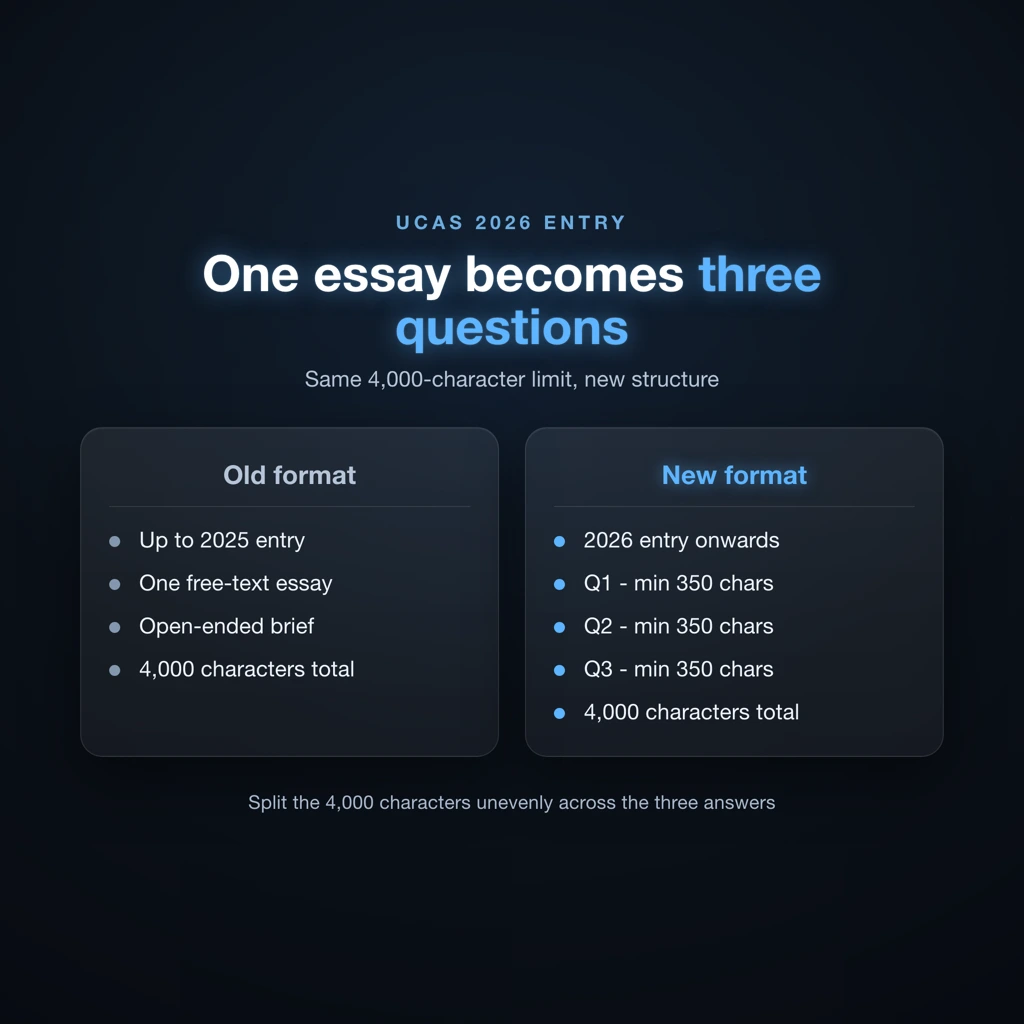
The ucas personal statement changes take effect for 2026 entry, meaning students applying from autumn 2025 onwards will use the new format. The most significant shift is structural: the single free-text essay is replaced by three separate structured questions, each requiring a distinct answer. The overall 4,000-character limit (including spaces) stays the same, but each question carries a minimum of 350 characters.
The counter-intuitive detail most applicants miss: the 4,000 characters can be distributed unevenly across the three answers. There is no fixed per-question cap, so a student could write 2,800 characters on Question 1 and split the remainder across Questions 2 and 3. That flexibility is deliberate, but it also means you need an active strategy rather than a default three-way split.
UCAS did not arrive at this format quickly. According to UCAS, the consultation involved over 1,200 domestic and international students, over 200 teachers and advisers, and over 100 universities and colleges. The stated aims were to reduce the stress of an open-ended brief and to give applicants clearer prompts. The same research found that 83% of students reported the personal statement process as stressful, which gave UCAS a clear mandate to restructure it.
2. The new UCAS personal statement format: three questions and character limits
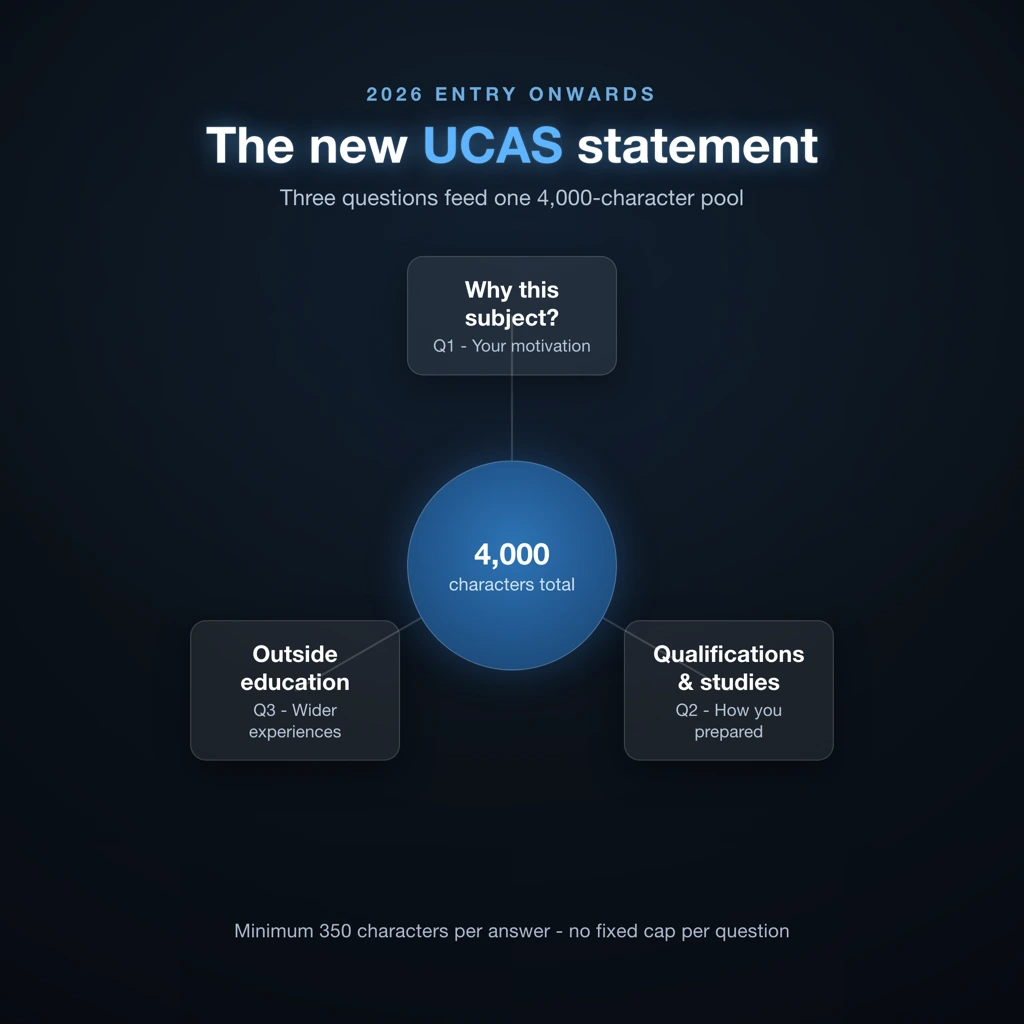
From 2026 entry, the free-text personal statement is replaced by three structured questions. According to UCAS, the full question texts are:
- Why do you want to study this course or subject?
- How have your qualifications and studies helped you to prepare for this course or subject?
- What else have you done to prepare outside of education, and why are these experiences useful?
Character limits at a glance
| Limit | |
|---|---|
| Total across all three answers | 4,000 characters (including spaces) |
| Minimum per question | 350 characters |
| Maximum per individual question | No fixed cap |
The 4,000-character ceiling is unchanged from the old single-essay format, per UCAS. What is new is the floor: each answer must reach at least 350 characters, so you cannot leave one question almost blank.
The strategic implication of the uneven distribution rule is easy to miss. A student applying for a subject they have studied formally but with limited extracurricular activity could, in principle, write 3,000 characters on Question 2 and the minimum on Question 3, provided no question falls below 350 characters. The reverse applies for applicants whose strongest case is independent research or work experience. There is no prescribed "wrong" question for specific evidence; UCAS advises placing each piece where it fits most naturally, and warns against repeating the same information across answers.
In practice, 4,000 characters is roughly 550-650 words, so the structural change does not give you more space. It gives you a different shape.
3. How admissions tutors read the new format
Admissions tutors don't read each answer in isolation and then score them separately. Per UCAS, they review all three answers as a whole, which means a weak Question 3 drags down the impression created by a strong Question 1, even if no single answer is formally weighted.
UCAS explicitly advises against repeating information across the three sections. With only 4,000 characters shared across all three answers, repetition is also a practical waste. If you mention a book you read in Question 1, don't restate it in Question 2 to pad the word count.
There is no prescribed "wrong" question for any particular piece of evidence. A work placement, for instance, could sit in Question 2 if you're emphasising the transferable academic skills it gave you, or in Question 3 if the focus is on personal motivation. UCAS guidance confirms applicants should place evidence wherever they consider it most relevant.
The non-obvious trade-off here: because placement is flexible, tutors at competitive universities will notice when an applicant has placed everything in Question 1 and left Questions 2 and 3 thin. The structure makes imbalance visible in a way the old free-text format never did. A lopsided application that would have blended into a single paragraph now stands out immediately.
That structural transparency is the sharpest contrast with the old format. Unstructured free text forced readers to interpret what each paragraph was trying to say. The three-question format removes that ambiguity on both sides: the applicant knows what is expected, and the tutor can assess each dimension directly.
4. What stays the same in your UCAS application
The new format changes how you write, not how you apply. The underlying application structure is unchanged.
Five choices, same process. You still apply to a maximum of five courses through the UCAS Hub dashboard, which you access after registering and completing onboarding. Firm and insurance choices work exactly as before: you accept your preferred offer as your firm, hold a lower offer as insurance, and reply through the same Hub interface.
The 4,000-character total limit remains. The new format splits that allowance across three questions, but the ceiling has not moved. If anything, this makes character economy more visible than before because you can see exactly how much space each answer is consuming.
Extra and Clearing are still there. The Extra service opens on 25 February 2027 for 2027 entry, allowing one additional application at a time if you have received all five decisions and hold no offer. Clearing is also unchanged.
One detail worth knowing: reply changes made within 14 days of accepting an offer can be processed once by a UCAS adviser without needing university permission, but no reply swaps are permitted after UCAS's late-July cut-off (22 July 2027 for 2027 entry). That deadline catches people out every year, and the ucas personal statement changes do nothing to alter it.
5. How to choose your firm and insurance offers strategically
Your firm choice should be the highest realistic offer you hold, where "realistic" means your predicted grades match or come close to the entry requirements. It is not the offer from the most prestigious university on your list regardless of grades. If AQA Biology is your weakest subject and a firm offer requires A*AA, factor that in before accepting.
Your insurance choice (your second accepted offer) exists as a safety net. The grade requirement for your insurance should be meaningfully lower than your firm, not just one grade below. A gap of two or more A-level grades, or the equivalent in IB Diploma Programme points, gives you genuine protection. An insurance offer only one grade below your firm is nearly worthless if results day goes badly.
The counter-intuitive trade-off many applicants miss: because reply changes after 14 days need the universities' agreement and no swaps are permitted after UCAS's late-July cut-off (22 July 2027 for 2027 entry), your insurance pick is harder to change than it feels at the time of accepting. Choose it carefully, not as an afterthought.
One further consideration specific to the new format: your personal statement is identical across all five applications. If you are applying to both Economics and Economics and Management, admissions tutors for each course will read the same text. Make sure your subject motivation reads clearly enough to work for all courses you are applying to, or reconsider whether one of your five choices genuinely fits.
6. Practical dos and don'ts for Question 1: why this subject?
Question 1 asks: "Why do you want to study this course or subject?" According to UCAS, it is the place for your motivations, subject knowledge, super-curricular activities, and future plans. It is not a life story opener or a grades list.
One counter-intuitive point worth knowing: UCAS explicitly categorises super-curricular activities under Question 1, not Question 3. Super-curriculars are subject-adjacent activities you pursued out of curiosity, such as reading beyond the syllabus or attending a lecture series. Extracurriculars, the broader non-academic activities, belong in Question 3. Mixing them up wastes your most valuable evidence in the wrong answer.
Do:
- Name specific texts, events, or experiences that sharpened your interest. "Reading Daniel Kahneman's Thinking, Fast and Slow" is more credible than "I have always been fascinated by psychology."
- Reference super-curricular activities: online university taster courses, subject Olympiads, museum visits, academic podcasts, or a relevant public lecture you attended.
- Connect an experience to a specific idea or question it raised for you. That connection shows intellectual engagement, not just participation.
- Mention future plans briefly if they are course-specific. A clear direction signals you have thought about why the subject matters to you beyond the A-level classroom.
Don't:
- Open with a quote. Admissions tutors read thousands of applications; a quotation from Einstein or Maya Angelou signals nothing about your subject knowledge.
- Use vague claims like "I have always had a passion for..." without the evidence to back them up immediately.
- List your grades or A-level results here. UCAS notes that grades appear elsewhere in the application and should not be repeated in Question 2, let alone Question 1.
Your takeaway: before drafting Question 1, write down three specific moments, a book chapter, a problem, a conversation, anything concrete, that genuinely shifted how you think about the subject. Build the answer around those moments.
7. Practical dos and don'ts for Question 2: qualifications and studies
Question 2 asks how your qualifications and studies have prepared you for the course. That scope is broader than just A-levels: UCAS explicitly includes school, college, training providers, and short online university courses, and names the Extended Project Qualification (EPQ) and UKMT competitions as eligible examples.
The non-obvious trap here is that Q2 looks like a achievements list, but it isn't. A-level grades, GCSE results, and predicted grades are already visible elsewhere in your application, so restating them wastes character allowance. UCAS is direct about this: the question excludes grades by design.
Do:
- Explain what a subject, project, or competition gave you in terms of skill or understanding, not just that you took it. "My EPQ on antibiotic resistance taught me how to read primary literature critically" is useful. "I completed an EPQ" is not.
- Reference transferable skills that connect to the course, such as statistical analysis from A-level Geography feeding into a Psychology application.
- Use UKMT participation to show mathematical reasoning, but focus on what the problem-solving process demanded, not your round or score.
- Draw on short online courses if they genuinely extended your subject knowledge beyond the syllabus.
Don't:
- Repeat content from Q1 (your motivations and subject curiosity belong there) or Q3 (non-academic experiences go there). UCAS advises against repeating information across answers.
- List module titles without context. Admissions tutors know what AQA Biology contains.
- Treat Q2 as a CV. One well-explained qualification is stronger than five names in a row.
The minimum for each answer is 350 characters, but Q2 rewards depth over breadth. Pick two or three things and explain the mechanism of learning, not the credential itself.
8. Practical dos and don'ts for Question 3: outside education
Question 3 asks what you have done to prepare outside formal education: work experience, volunteering, hobbies, paid employment, and personal responsibilities all count. The question isn't just a list prompt. It asks you to explain why those experiences are useful, which means every item needs a "so what" attached to it.
UCAS guidance names Springpod virtual work experience as a valid example, which matters for students who couldn't access in-person placements. A Springpod programme in, say, engineering or healthcare is treated the same as a physical placement if you can articulate what you took from it.
One non-obvious point: international students should use Question 3, not Question 1, to explain why they want to study in the UK specifically. Question 1 is reserved for subject motivation. Mixing in country-of-study reasoning there muddies your answer and wastes character space. Question 3 is the correct home for that context.
Do:
- Name the activity, then immediately state the skill or perspective it gave you relevant to your subject.
- Include paid work and caring responsibilities. Admissions tutors understand that not every student has had time for unpaid volunteering.
- Use Springpod or similar virtual programmes if in-person access wasn't available.
Don't:
- List activities in bullet form without explanation. A paragraph listing ten clubs and two part-time jobs, with no analysis, tells the reader nothing about your readiness for the course.
- Repeat anything already covered in Question 2. Extracurricular activities belong here; academic study belongs there.
The difference between a strong Q3 and a weak one is almost always the same: specificity of reflection, not volume of activity.
9. Can you change your personal statement after submitting to UCAS?
Once you submit your application, your personal statement is locked. UCAS sends it to all five universities simultaneously, and there is no mechanism to amend it afterwards. This is the sharpest reason to treat your draft as a final document before you hit submit, not after.
What you can change post-submission is more limited than most applicants expect. Per UCAS:
- Contact details - postal address and phone number via the UCAS Hub; a change of home address requires calling UCAS directly.
- Qualifications - amendments go through the Qualification Amendment Form and can take up to 21 days to process.
- Course choices - a choice can be substituted within 14 days of your welcome email, but each choice can only be substituted once, and no substitutions are permitted after 30 June.
- Reply changes - if you change your mind within 14 days of accepting offers, a UCAS adviser can process this once without university permission. No reply swaps are permitted after UCAS's late-July cut-off (22 July 2027 for 2027 entry).
The non-obvious gotcha: because your personal statement cannot be tailored per university, a last-minute decision to add a very different course (say, swapping one choice from History to Computer Science) leaves you with a statement that no longer fits that application. The 14-day substitution window exists, but your words are already with every admissions team. Draft carefully before you submit.
10. Where to find official UCAS guidance and new personal statement examples
Start with the primary source: UCAS's full guidance page for 2026 entry covers the three-question structure, character limits, and what to include under each question. It is the only source you should treat as definitive, because UCAS updates it as the cycle develops.
For teachers and advisers, the UCAS personal statement toolkit includes classroom resources, training materials, and webinars. Students sometimes find it useful too, particularly the worked examples that show how the 4,000 characters can be distributed unevenly across the three answers.
Subject-specific guides show the new format in practice. The marketing personal statement guide, for instance, names specific experts (Rory Sutherland, Jessica Apotheker) whose TED Talks admissions tutors at named universities are likely to recognise. The non-obvious point: these guides are written with input from real departments, so the examples reflect what individual courses actually want to see, not generic advice.
UCAS also publishes guidance on using AI and ChatGPT with personal statements. Read it before you start. Universities can detect AI-generated text, and a statement that reads as synthetic will work against you regardless of the content.
International students have a dedicated page at personal statement tips for international students: 2026 entry. One point specific to that audience: Question 3 is the correct place to explain why you want to study in the UK, not Question 1.
11. What to do next
Open the UCAS 2026 personal statement guidance this week and read the question wording carefully. Then write one sentence answering each of the three questions: why this subject, how your studies have prepared you, and what you do outside the classroom. One sentence each, nothing polished. The point is to surface gaps early, before you are staring at a 350-character minimum with nothing drafted.
The non-obvious gotcha: because the 4,000 characters can be distributed unevenly, most applicants pour nearly everything into Question 1 and leave Question 2 thin. Decide your allocation now, before the habit forms.
Do that planning exercise today. Ask your subject teacher to check your one-sentence answers for Question 2 specifically.
FAQ
When did the UCAS personal statement change?
The new three-question format applies from 2026 entry, meaning students applying from autumn 2025 onwards use the new structure.
How has the UCAS personal statement changed?
UCAS replaced the single free-text essay with three separate questions covering subject motivation, academic preparation, and outside-education experience, while keeping the 4,000-character total limit.
What is the personal statement word count for the new UCAS format?
The total limit is 4,000 characters including spaces across all three answers, with a minimum of 350 characters per question; there is no fixed per-question maximum.
Can I change my personal statement after applying to UCAS?
No - once submitted, the personal statement is sent to all your chosen universities and cannot be edited; other parts of the application such as contact details and qualifications can be updated after submission.
Is the UCAS personal statement the same for all my university choices?
Yes - you write one personal statement that is sent identically to all five of your course choices, so it needs to be relevant to every course you apply for.
Where can I find UCAS personal statement examples for the new format?
UCAS publishes subject-specific personal statement guides at ucas.com that follow the new three-question structure, and a dedicated adviser toolkit with classroom resources and worked examples.
References
- How to write your personal statement: 2026 entry onwards | UCAS - https://www.ucas.com/applying/applying-to-university/writing-your-personal-statement/how-to-write-your-personal-statement-for-2026-entry-onwards
- Reforming admissions | UCAS - https://www.ucas.com/about-us/news-and-insights/reforming-admissions
- Learn all about filling in your UCAS application for uni - https://www.ucas.com/applying/applying-to-university/filling-in-your-ucas-application
- Making changes to your UCAS Undergraduate application - https://www.ucas.com/applying/after-you-apply/making-changes-to-your-application-after-you-apply
- Personal statement toolkit | UCAS - https://www.ucas.com/advisers/help-and-training/toolkits/personal-statement-toolkit
- Marketing personal statement guide | UCAS - https://www.ucas.com/applying/applying-to-university/writing-your-personal-statement/personal-statement-guides/marketing-personal-statement-guide
- Writing your personal statement | UCAS - https://www.ucas.com/undergraduate/applying-university/writing-personal-statement
- Personal statement tips for international students: 2026 entry | UCAS - https://www.ucas.com/applying/applying-university/writing-your-personal-statement/personal-statement-tips-international-students-2026-entry