Best Universities for IB Students: UK, US & Europe
By Michael Thompson · Education Specialist; 10 years teaching the IB at Bromsgrove School · Published 21 May 2026 · Updated 6 October 2026
The best universities for IB students are not simply the most prestigious ones - they are the institutions that actively recognise the Diploma Programme, convert Higher Level grades into credit, and sometimes fund IB students directly through scholarships. The IB Diploma is taught in 143 countries and is accepted by universities worldwide, but policies on what it earns you - a lower offer, advanced standing, or course exemptions - vary enormously between institutions. Knowing which universities treat IB scores as a genuine advantage, rather than just an acceptable alternative to A-Levels, is what separates a strong application strategy from a shot in the dark. This guide covers the UK Russell Group, top US universities, IB-friendly European institutions, scholarship opportunities, and - critically - how to research any university's equivalence policy yourself.
Key Takeaways
- IB is globally accepted: The Diploma Programme is recognised by universities in 143 countries, but the generosity of offers and credit policies differs significantly between institutions.
- Russell Group offers typically require 36-40 points: The most selective UK universities set IB offers in this range, with Higher Level subject grades playing a decisive role in subject-specific requirements.
- Ivy League universities grant substantial HL credit: Several US universities - including MIT, Yale, and Columbia - convert strong Higher Level results into course credits or advanced placement, reducing the time and cost of a degree.
- European universities in the Netherlands, Germany, and Switzerland: Many teach in English and explicitly target IB graduates, with some setting their entry requirements directly in IB points rather than converting from local qualifications.
- IB scholarships exist at institutional level: A small number of universities offer awards specifically for IB Diploma holders; the IB's own recognition database at recognition.ibo.org lists them by country.
- The IB recognition database is your primary research tool: recognition.ibo.org lets you search by university, country, and subject to see exactly what credit or advanced standing a specific HL grade will earn you.
In This Article
- What Makes a University IB-Friendly?
- UK Russell Group Universities: IB Recognition and Typical Offer Ranges
- Oxford and Cambridge: How IB Students Are Assessed
- Top US Universities That Grant the Most IB Higher Level Credit
- European Universities That Prefer IB Students
- Universities That Offer IB-Specific Scholarships
- How to Research IB Equivalences for Any University
- Do IB Students Have an Advantage in University Admissions?
- Comparing IB Recognition: UK vs US vs Europe
- Where to Go From Here
1. What Makes a University IB-Friendly?
Finding the best universities for IB students means more than identifying which institutions will accept an IB Diploma. Most universities worldwide recognise the qualification. The sharper question is which ones actively reward it.
An IB-friendly university does at least one of the following:
- Makes reduced conditional offers to IB applicants relative to equivalent A-Level candidates
- Grants advanced standing or course credit for strong Higher Level (HL) scores, letting students skip introductory modules or accelerate their degree
- Offers IB-specific scholarships, separate from general academic bursaries
- Provides course exemptions, recognising prior learning in a specific subject
The distinction matters in practice. A university can process an IB transcript without doing any of the above. "Accepts" and "prefers" are not the same thing.
Part of why some admissions systems warm to the IB is its structure. Per UCAS, the IB Diploma Programme requires students to study one subject from each of six groups, covering two languages, sciences, social sciences, mathematics, and the arts, alongside three compulsory components: an Extended Essay based on independent research, Theory of Knowledge, and Creativity, Activity, Service (CAS). That breadth is a closer match to liberal arts curricula in the US and many European systems than it is to the specialised three-subject A-Level model.
One non-obvious gotcha: a university may grant credit for HL subjects but not Standard Level ones, and the grade threshold is often higher than students expect. Always check subject by subject, not just overall Diploma recognition.
The canonical research tool for this is the IB recognition database at recognition.ibo.org, which lets you filter by country, institution, programme type, and whether a university offers credit, advanced standing, or IB-specific scholarships.
2. UK Russell Group Universities: IB Recognition and Typical Offer Ranges
All 24 Russell Group universities accept the IB Diploma. That said, acceptance is not the same as enthusiasm, and offer ranges vary considerably depending on the institution and the course.
For the most selective programmes, published guidance from universities such as UCL, Imperial, Edinburgh, King's College London, and Manchester typically shows overall IB point requirements in the range of 36 to 40 points, with specific Higher Level (HL) grade conditions attached. A common structure looks something like this:
| Institution | Indicative overall points | Typical HL conditions |
|---|---|---|
| Imperial College London | 38-40 | 6,6,6 at HL (STEM-focused) |
| UCL | 36-39 | Varies by faculty |
| University of Edinburgh | 34-43 | Subject-dependent |
| King's College London | 35-37 | 6,6,5 or 6,6,6 at HL |
| University of Manchester | 32-38 | HL requirements by course |
These figures are illustrative ranges drawn from published admissions guidance and should be verified against each university's current admissions pages before you apply, as requirements change cycle to cycle.
HL subject requirements map almost directly onto A-Level subject requirements for the same course. Medicine at Edinburgh, for example, expects HL Biology and HL Chemistry, mirroring what it asks of A-Level applicants. Engineering courses at Imperial typically require HL Mathematics and HL Physics. This is worth knowing because it means switching between HL and Standard Level (SL) for a subject can affect your eligibility for an entire course, not just your points total. An SL in Chemistry will close doors that HL would have kept open.
One non-obvious quirk: some universities set a minimum HL score threshold that sits higher than what a straight Tariff conversion from A-Level grades would suggest. A student predicted A*AA at A-Level might find the equivalent IB offer asks for more than a points calculator implies.
Contextual admissions schemes apply to IB students on the same basis as A-Level applicants. Per UCAS, contextual offers can take the form of a reduced grade requirement, a guaranteed interview, or a foundation year place, depending on the university and course. Eligibility criteria include factors such as school performance, household income, and participation in outreach programmes. If you qualify, flag your circumstances directly on your UCAS application.
3. Oxford and Cambridge: How IB Students Are Assessed
Both universities publish indicative IB offer ranges on their admissions pages, and the figures sit at the top end of the scale. Oxford's and Cambridge's typical conditional offers for competitive courses run to 38-40 points overall, but the overall score is almost secondary to what sits beneath it.
HL subject grades carry more weight than the total points. For courses like Medicine, Law, or Natural Sciences, admissions tutors look closely at individual HL grades, with combinations such as 7,7,6 or 7,6,6 in relevant subjects named as benchmarks on faculty-level pages. A candidate with 40 points but a 5 in Chemistry applying for a science degree is in a weaker position than a candidate with 38 points and three HL 7s.
The IB's Extended Essay and Theory of Knowledge are genuinely useful preparation here, and not just in a vague sense. Oxbridge interviews are structured around unseen problems and the defence of ideas under pressure - exactly the intellectual mode that a well-executed Extended Essay trains. Admissions tutors at both universities have noted publicly that IB students tend to arrive at interview with stronger habits of independent argument than candidates who have only sat linear A-levels.
One thing to be clear about: neither Oxford nor Cambridge grants advanced standing or course credit for IB Higher Level results. Strong HL grades get you through the door; once you arrive, you start the degree from the same point as everyone else. That is a meaningful difference from many US universities, where HL credit can reduce a four-year degree by a full semester or more.
4. Top US Universities That Grant the Most IB Higher Level Credit
US universities handle IB credit differently from UK institutions. Rather than making you an offer based on predicted IB points, most US universities admit you first and then award course credit or advanced standing once you submit official IB transcripts after results day in July.
The threshold that matters most is HL grade 5, 6, or 7. Below a 5, most universities award nothing. At 5 and above, the credit you receive depends entirely on the subject and the specific institution's policy.
A non-obvious gotcha: credit and advanced standing are not the same thing, and the distinction has real consequences. Course credit counts toward your degree total and can reduce tuition cost. Advanced standing lets you skip introductory courses and move into higher-level work, but may not reduce the number of credits you need to graduate. Some universities offer one but not the other, and a handful offer neither while still using your IB grades as a signal of academic readiness.
How specific universities approach IB credit
- MIT awards credit for HL scores of 6 or 7 in subjects including Mathematics, Physics, Chemistry, and Biology. A 7 in HL Mathematics Analysis and Approaches can exempt you from first-year calculus. A 7 in HL Biology has counted toward lab science requirements for pre-med students, though you should verify current subject-level policies directly with MIT's registrar.
- Columbia University awards credit for HL scores of 5, 6, or 7, with the number of credits varying by subject. Columbia's Core Curriculum means some IB credits apply to electives rather than core requirements, which limits how much you can accelerate.
- University of Pennsylvania grants credit for most HL subjects at grade 5 and above, with stronger credit awards at 6 and 7. Wharton students should check separately, as the school's credit policy differs from Penn's College of Arts and Sciences.
- Yale awards credit for HL grades of 5, 6, or 7 in many subjects, but Yale's credit hours do not reduce tuition or the number of terms you must complete. The credit frees up space in your schedule for advanced courses or a double major.
- Harvard does not grant course credit for IB HL work. What it may grant is advanced standing, which allows eligible students to graduate in three years or to waive introductory requirements. This is a meaningful distinction: Harvard students with strong IB profiles can skip first-year courses, but cannot reduce their total credit load in the way Penn or MIT students can.
- Liberal arts colleges such as Amherst and Williams tend to award fewer automatic credits than large research universities, but their subject-level policies can still allow you to waive distribution requirements or place into advanced courses from the start.
Searching credit policies by subject
The IB recognition database lets you search US universities by subject and grade level, which is the most direct way to check what a specific HL score in a specific subject will earn at a given institution. The subject-level credit search is currently available for the United States only. Use it alongside each university's registrar page, since the database and the registrar page can occasionally reflect different update cycles.
The practical step: before you finalise your US application list, run your actual or predicted HL subjects through the database for each institution you are seriously considering. A 7 in HL Economics means something different at Columbia than it does at Amherst.
5. European Universities That Prefer IB Students
English-taught bachelor's programmes across continental Europe are a natural match for IB graduates. You have already studied in English, sat exams on an internationally structured curriculum, and written extended analytical work. Many European admissions offices know exactly what a 6 in Higher Level Chemistry means, which removes the conversion guesswork that can complicate applications elsewhere.
The Netherlands is one of the most straightforward destinations. The University of Amsterdam, Leiden University, and Maastricht University all publish entry requirements directly in IB points for their English-taught programmes, rather than asking you to find an A-level equivalent. Maastricht's problem-based learning model, where small groups work through real cases rather than attending large lectures, suits students trained in the IB's collaborative and inquiry-based approach particularly well.
Germany has a split picture. Private institutions such as Constructor University (formerly Jacobs University Bremen) accept the IB directly and recruit internationally. Many state universities, which carry very low or no tuition fees for EU and non-EU students alike, also accept the IB for international applicants, though minimum score thresholds vary by faculty and degree.
Switzerland is worth considering for science and engineering. ETH Zurich accepts the IB and publishes subject-specific entry requirements for each programme, so you can check whether your Higher Level choices align before you apply. The University of Geneva similarly recognises the diploma for admission to its English-medium courses.
The cost argument is real. Annual tuition at many Dutch and German universities runs well below the fees charged by UK or US institutions, and living costs in several European university cities are lower than London. The trade-off: some programmes require at least basic proficiency in the local language for daily life, even when lectures are delivered entirely in English.
6. Universities That Offer IB-Specific Scholarships
There are two distinct types of IB-related scholarships worth understanding before you start searching.
Institutional scholarships are offered directly by universities and awarded to high-scoring IB applicants, often as merit awards rather than under an explicit "IB scholarship" label. A score of 38 or above puts you in the range where a number of UK and European institutions consider applicants for their top merit awards, even when those awards are not advertised as IB-specific.
IB-endorsed scholarship programmes are partnerships the IB itself has established with other organisations. The most documented example is the IB and University of the People M.Ed. scholarship, which covers assessment fees for a fully online Master of Education in Advanced Teaching. This is worth flagging precisely because it is commonly misunderstood: it is designed for practising educators pursuing postgraduate study, not for undergraduate applicants. The programme has awarded more than 500 scholarships to educators worldwide since its 2020 launch.
For undergraduate scholarships, the practical starting point is recognition.ibo.org. The database includes filters for "All scholarships" and "IB-specific scholarships" alongside country and institution, so you can narrow results to, say, UK universities offering IB-specific awards in a single search.
One non-obvious quirk: adding more than one subject filter in the tool reduces results significantly, so run your scholarship search at institution level first, then cross-check credit policies separately.
7. How to Research IB Equivalences for Any University
The IBO's own database is the right place to start, and most students never use it. recognition.ibo.org lets you filter by country, then by university, then by recognition type. Select "Credit/Advanced Standing" to see whether a university awards credit, grants exemptions, or offers advanced standing - and those three things are not interchangeable.
What the terms actually mean:
- Course credit - the university awards credit points for your HL results, which count toward your degree total but do not reduce your year count.
- Advanced standing - you skip a year (or part of one) and graduate sooner. This affects tuition fees and student loan entitlement directly.
- Exemption - you bypass a specific module requirement without receiving credit for it. Your degree takes the same time, but you avoid one compulsory course.
Confusing credit with advanced standing is a real financial error. A student who mistakes "we grant 30 credits for HL Chemistry" for "you can start Year 2" may miscalculate their total fees by a full year's tuition.
For US universities, the recognition.ibo.org tool goes further: you can enter up to six HL or SL subjects with your predicted or achieved grades and filter results by subject. The subject-level search is currently available for the United States only, so make use of it if you are applying Stateside.
For UK universities, the database is a starting point, not the final word. Individual university admissions pages carry the binding policy. UCAS tariff points give a broad equivalence, but they do not capture HL subject requirements - a university requiring HL Mathematics will not accept a tariff-point match from HL History instead. Contact the admissions office directly if any ambiguity remains.
One non-obvious gotcha: recognition policies change annually, sometimes mid-cycle. Third-party aggregator sites often cache out-of-date tables. Always read the university's own current admissions pages, and note the academic year the policy applies to.
8. Do IB Students Have an Advantage in University Admissions?
The honest answer is: not a blanket one. The IB Diploma is respected, but it does not come with a built-in admissions shortcut at any major university.
Where the Diploma does carry weight is in holistic assessment. The Extended Essay gives Oxbridge tutors and US liberal arts admissions officers something specific to probe: an independently researched 4,000-word argument in a chosen subject. Theory of Knowledge requires students to defend positions across disciplines, which is precisely the kind of critical thinking Oxford tutors test in interviews. These are not vague selling points - they are components with documented structures that selectors can read and evaluate directly.
In the US, the concrete advantage is financial and practical. Strong IB Higher Level scores at universities that grant generous credit can reduce the number of paid semesters required. That is a measurable saving, not a marketing claim. Confirming the credit policy before you apply matters more than the prestige of the institution.
One counter-intuitive point UK applicants often miss: the IB does not protect you from contextual admissions criteria, but it also does not exclude you from their benefits. UCAS contextual admissions are based on postcode deprivation, school performance, household income, and similar factors - entirely independent of whether you sat the IB Diploma or A-Levels. A student from an under-represented area who took the IB is just as eligible for a reduced-grade contextual offer as an A-Level peer from the same background.
A 36-point IB total is strong. It does not guarantee a place at a selective university any more than three A grades at A-Level does. Selective admissions remain competitive regardless of the qualification.
9. Comparing IB Recognition: UK vs US vs Europe
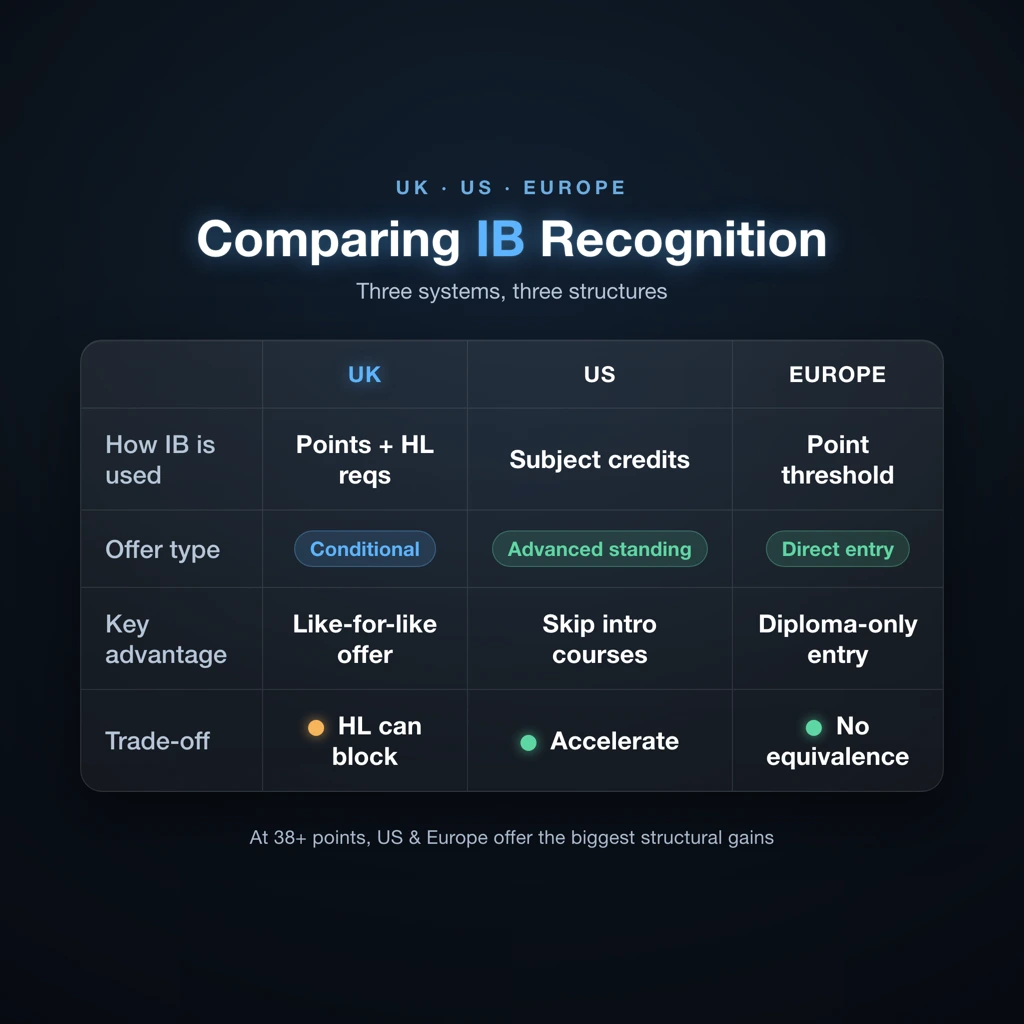
The three systems use the IB Diploma in structurally different ways, and understanding the distinction matters more than knowing which universities have the highest offers.
| Region | How IB is used | Key advantage for IB students |
|---|---|---|
| UK | Conditional offers set in IB points, with specific HL subject and grade requirements | Clear, like-for-like offer structure; no ambiguity about what 38 points means |
| US | HL credits awarded by subject and score, often granting advanced standing or exemptions | A high scorer can skip introductory courses and accelerate their degree |
| Europe | Direct IB total-point thresholds for English-taught programmes, often without additional national exams | Entry is assessed on the diploma alone, with no separate equivalence conversion needed |
Canada sits closer to the US model. Universities including the University of British Columbia and McGill grant HL credit for strong scores, typically 5 or above, across a range of subjects. The practical effect is similar to US advanced standing: a student may enter with a semester's worth of credits already recognised.
The non-obvious trade-off in the UK system is that a subject-specific HL requirement can disqualify a strong overall scorer. A student with 40 points overall but a 5 in HL Chemistry may not meet a medical school's HL Chemistry grade condition, even though their total outperforms candidates who do qualify.
For students with a score of 38 or above, the US and European systems offer the most tangible structural advantages. Credit exemptions and direct-entry thresholds convert those extra points into real time and cost savings, rather than simply meeting a bar.
10. Where to Go From Here
Your shortlist means nothing without checking how each university actually treats your IB scores. Open recognition.ibo.org this week, search each target institution, and record two things: the credit or advanced standing policy, and whether an IB-specific scholarship is listed. Both filters are available on the same search. One non-obvious catch: a university may grant credit for a Higher Level subject at grade 5, but not at grade 4 - that single grade boundary can determine whether you enter second year or first.
Cross-reference every result against the university's own admissions pages, because recognition.ibo.org reflects submitted policies that institutions update on their own schedule.
For what to study and how to apply, see our guides on IB subject choices and UCAS applications for IB students.
This week, run your shortlist through recognition.ibo.org and note the credit policy for each. It takes under 10 minutes per university and could save you a semester's tuition.
Courses by IB points, from the course directory:
- Universities That Accept 36 IB Points: UK Courses and Offers
- Universities That Accept 38 IB Points: UK Courses and Offers
- Universities That Accept 40+ IB Points: Courses and Offers
- Russell Group IB Requirements: Typical Offers by University
FAQ
Do IB students get into better colleges?
IB students are not admitted at higher rates overall, but the Diploma's breadth and the Extended Essay provide strong preparation for the writing and research demands that selective US and UK universities assess, and HL credits can shorten a US degree by a full semester or more.
Does Harvard accept IB students?
Harvard accepts the IB Diploma and considers it strong preparation, but does not grant course credit for HL results - it may grant advanced standing, allowing students to graduate in fewer than four years or skip introductory courses, depending on their scores.
Which universities are best for IB students in Europe?
Universities in the Netherlands (Amsterdam, Leiden, Maastricht), Switzerland (ETH Zurich, Geneva), and Germany are consistently cited as strong options because they set entry requirements directly in IB points for English-taught programmes and often have lower tuition than UK or US equivalents.
Do IB students have an advantage in UK university admissions?
In the UK, the IB Diploma is treated as equivalent to A-Levels for offer purposes, and the Extended Essay and Theory of Knowledge are valued by tutors at research-intensive universities, but the IB does not grant credit or exemptions at UK institutions the way it does in the US.
How do I find out what credit a university gives for my IB Higher Level results?
Use the IB's recognition database at recognition.ibo.org, which lets you filter by country, university, and - for US institutions - by individual subject and grade to see exactly what credit or advanced standing you would receive.
Are there scholarships specifically for IB students?
A number of universities offer IB-specific scholarships; you can find them by filtering recognition.ibo.org by 'IB-specific scholarships' and your target country - the IB also runs a scholarship programme with University of the People, though that is aimed at educators pursuing a postgraduate degree.
References
- International Baccalaureate - find out more | UCAS - https://www.ucas.com/further-education/post-16-qualifications/qualifications-you-can-take/international-baccalaureate-ib
- Home - https://recognition.ibo.org/
- Contextual admissions | UCAS - https://www.ucas.com/applying/applying-university/individual-needs/contextual-admissions
- University of the People Master of Education scholarships - International Baccalaureate® - https://ibo.org/professional-development/about-our-workshops/ib-collaborations/university-of-the-people-med-in-advanced-teaching/ib-scholarships/
- IB and University of the People 2026 scholarship applications now open - International Baccalaureate® - https://ibo.org/news/news-about-the-ib/ib-and-university-of-the-people-2026-scholarship-applications-now-open/