Missed Offer University: 7 Options When Grades Fall Short
By Michael Thompson · Education Specialist; 10 years teaching the IB at Bromsgrove School · Published 21 May 2026 · Updated 12 June 2026
A missed offer at university feels catastrophic at 8am on results day - but most students have more paths forward than they realise. Before you do anything else, log into UCAS Hub: universities sometimes confirm places even when grades fall slightly short, without any action needed from you. If your Hub status shows you've lost your firm place, you still have seven concrete options, from calling your university directly to entering Clearing, appealing your grade, or switching to a degree apprenticeship. This guide walks through each one in order of what to try first.
Key Takeaways
- Check UCAS Hub before assuming the worst: Universities sometimes accept students who missed their offer by a grade without requiring any contact - your status may already show confirmed.
- Call your firm choice the same morning: Admissions teams handle near-miss calls on results day; a polite, factual conversation about mitigating circumstances sometimes secures your place.
- Clearing opens the same day as results: More than 50,000 students find university places through Clearing every year, and courses range from Russell Group alternatives to competitive professional programmes.
- A-Level grade appeals are possible but take weeks: You can request a review of marking, but turnaround time means you may need to enter Clearing provisionally while the appeal is considered.
- Resitting and reapplying with achieved grades strengthens your application: Applying with confirmed A-Level or IB results rather than predicted grades removes the uncertainty that conditional offers carry.
- Degree apprenticeships are a credible alternative: With more than 670 apprenticeship standards available, including nursing, law, and engineering, this route offers a degree without tuition fees.
In This Article
- Check UCAS Hub Before You Do Anything Else
- Option 1: Call Your Firm Choice and Make Your Case
- Option 2: Accept Your Insurance Choice (or Go to Clearing)
- Option 3: Go Into Clearing the Same Day
- Option 4: Appeal Your A-Level Grade
- Option 5: Defer Entry and Resit Your A-Levels or IB
- Option 6: Take a Structured Gap Year and Reapply
- Option 7: Explore Degree Apprenticeships as a Credible Alternative
- What to Do Right Now
1. Check UCAS Hub Before You Do Anything Else
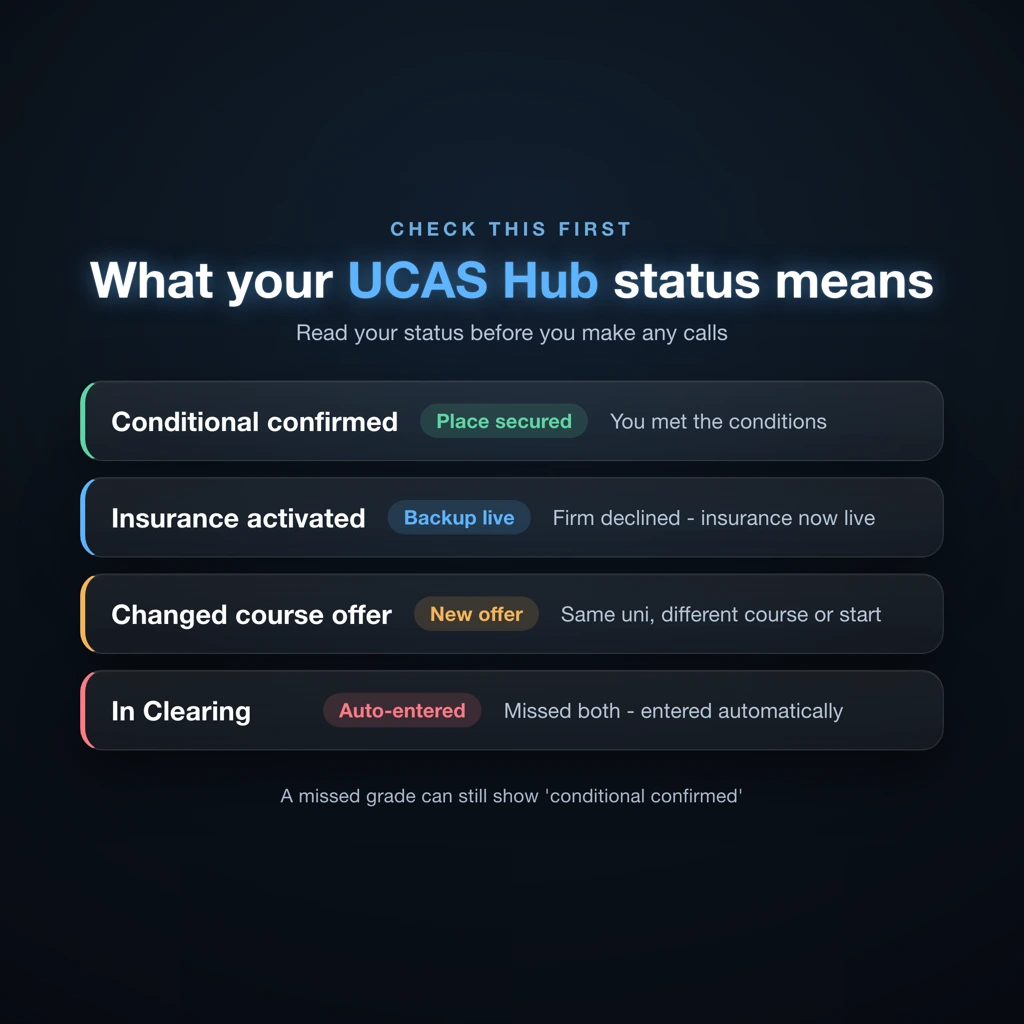
If you've missed offer university conditions on results day, the first thing to do is log into UCAS Hub and read your status before making any calls. What it shows determines every option available to you, and it may already contain good news you haven't spotted yet.
Here is what each status means in practice, per UCAS:
| Hub status | What it means |
|---|---|
| Conditional confirmed | You met the conditions. Your place is secured. |
| Insurance activated | Your firm choice declined you; your insurance choice is now live. |
| Changed course offer | The university still wants you, but on a different course or start date. |
| In Clearing | You met neither firm nor insurance conditions. The system has entered you into Clearing automatically. |
The non-obvious detail: universities sometimes confirm a place for a student who missed by one grade without saying anything publicly. Admissions teams have unfilled seats and quiet discretion to waive a missed grade, particularly in subjects running below target numbers. Your Hub status updates to "conditional confirmed" when this happens. Check it before you assume the worst.
One important constraint: if your status shows a changed course offer from your firm choice but your insurance choice has already confirmed an unconditional place, UCAS requires you to actively choose between the two. The system will not choose for you.
2. Option 1: Call Your Firm Choice and Make Your Case
Phone the admissions office at your firm choice university as early as possible on results day, before the phones are overwhelmed. Emails sit in inboxes; a call gets you to a person who can actually pull up your application.
What to say when you get through:
- Name the specific grade that fell short. "I needed AAB and I got ABB, so my Chemistry grade is the issue" is more useful than a vague "I didn't quite make it."
- Mention any mitigating circumstances: illness, a family bereavement, disruption during the exam period. Be brief and factual, not emotional.
- Ask directly: "Is there still a place available on this course for this cycle?"
One thing most students don't know: the university may issue a changed course offer, meaning they still want you, but on a different course, a different entry point, or a later start date. This is worth asking about explicitly rather than waiting to see what appears in UCAS Hub.
The counter-intuitive part is that admissions tutors have more discretion here than the offer letter implies. A one-grade shortfall on a non-critical subject, from an otherwise strong candidate, is a different conversation to a two-grade miss on the subject the degree is built around. Give them the information they need to make that call.
3. Option 2: Accept Your Insurance Choice (or Go to Clearing)
If your firm choice has released you but your insurance choice has confirmed your place, that is a real outcome worth taking seriously. Many students treat the insurance choice as a fallback they will never need, then feel deflated when it activates. The practical question is whether it is the right fit for the next three years, not whether it was your first preference.
Per UCAS, a student holding an insurance confirmation has one decision to make: accept the place, or press the "Decline my place" button in UCAS Hub to release yourself into Clearing. The second option is non-obvious and underused. If your insurance choice is a course or city you chose reluctantly, Clearing may produce a better match.
One specific gotcha: if both your firm and your insurance choices issue changed course offers (the university still wants you but for a different course or entry point), UCAS confirms you can simply pick between the two. You are not automatically tied to either.
If you missed the conditions of both choices, UCAS places you in Clearing automatically. No action is needed to enter it.
Your decision tree:
- Insurance confirmed: accept it, or decline and enter Clearing.
- Both choices issued changed course offers: compare them and choose.
- Neither confirmed: you are already in Clearing.
4. Option 3: Go Into Clearing the Same Day
Clearing is not a last resort for students who failed. According to UCAS, students who missed their grades made up just 24% of all Clearing users in 2024, the lowest share on record. The majority use it strategically: switching course, trading up to a better offer, or applying direct without a prior offer at all.
The process runs from 2 July to 19 October 2026, and more than 50,000 students find places through it every year. Here is how it works:
- Search the UCAS vacancy list - the only official source of Clearing places.
- Call the university directly with your Clearing number and Personal ID.
- Once the university confirms your place verbally, add the choice in UCAS Hub using the 'Add Clearing choice' button.
- You can only hold one Clearing choice at a time. If a university does not confirm, you can add a different one.
Clearing Plus takes some of the cold-calling out of the process. UCAS matches you to up to 50 courses based on your existing application data, and universities can contact you directly if there is a vacancy that fits your profile. You can still search the standard vacancy list at the same time.
One non-obvious gotcha: Cambridge does not use Clearing, and conservatoires have entirely separate processes that you will need to check directly with each institution. Do not waste a results-day phone call assuming otherwise.
5. Option 4: Appeal Your A-Level Grade
A grade boundary is not always final. If you believe an examiner has made an error, your school or college can submit a formal post-results request to the relevant exam board: AQA, OCR, Edexcel/Pearson, or another awarding body if applicable. The process starts with a clerical check (confirming all marks were added correctly), and can escalate to a full review of marking where an examiner re-evaluates your script.
The non-obvious detail most students miss: you cannot submit an appeal yourself. The request must go through your school or college, so contact your exams officer on results day, not later in the week. Internal admin is often the bottleneck that costs students time.
On timeline: reviews typically take several weeks. Results day is the start of the process, not the end, which means an appeal will not resolve before Clearing places fill up.
The practical move is to run both tracks in parallel:
- Enter Clearing immediately and provisionally hold a place
- Pursue the appeal at the same time
- If a grade change comes through and your firm choice reinstates your offer, you can withdraw from Clearing
Be realistic about your chances. Borderline scripts, where you were one or two marks from the next grade, are the strongest candidates. A script that fell well short is unlikely to move. A review can also, in theory, lower a mark, so discuss the risk honestly with your exams officer before proceeding.
6. Option 5: Defer Entry and Resit Your A-Levels or IB
Resitting is often framed as the consolation option, but it has a structural advantage: universities assess achieved grades differently from predictions. An offer built on real results is firmer ground than one built on forecast.
A-Level resits work on a full cycle. Per the Education Hub, students can resit all A-Level subjects the following summer. Autumn sittings exist, but they are restricted to GCSE English Language and Maths only - every other subject waits until June.
IB students face an earlier deadline than most realise. The IBO sets its own resit windows, but your school's internal registration deadline comes first, sometimes weeks earlier. Miss the school deadline and the IBO's window is irrelevant.
Before committing to a resit year, weigh the trade-off honestly:
- Time and cost. A resit year typically means another year of living and study costs, with no guarantee of a better outcome.
- Course necessity. Ask whether the specific course you want genuinely demands the higher grade, or whether a Clearing place on a comparable course is a better use of twelve months.
- Deferral option. Some universities will allow you to defer a Clearing place by a year. It is not standard practice, but it is worth asking directly - securing a place before you resit removes the uncertainty of reapplying.
The non-obvious gotcha: sitting an A-Level again as a private candidate at a different centre can affect grade boundaries and coursework submission rules. Confirm the logistics with AQA, Edexcel, or OCR directly before assuming the process mirrors a school sitting.
7. Option 6: Take a Structured Gap Year and Reapply
A gap year is often treated as a fallback, but reapplying through UCAS the following cycle with confirmed grades in hand actually removes the single biggest source of ambiguity from your application. Admissions tutors can see exactly what you achieved, with no conditional offer to second-guess.
The gap year itself needs structure to earn that goodwill. Something concrete counts: paid work that shows responsibility, volunteering with a named organisation, or travel with a clear purpose you can articulate in a personal statement. Vague "life experience" is difficult to write about and harder to read.
One counter-intuitive point worth knowing: some competitive courses, including medicine, law, and Oxbridge admissions, view a purposeful gap year positively, but only when the candidate explains the rationale clearly in their statement. A year that "just happened" reads very differently from one with a coherent plan and outcome.
The UCAS application deadline for the following cycle is typically mid-January, though the exact date varies by course and institution. Check UCAS for the confirmed deadline for your chosen course as soon as possible, since Oxford, Cambridge, and most medicine courses have an earlier October deadline that falls before the standard January window.
The practical action this week: sketch a gap year itinerary on paper before you commit to anything. What you do matters less than whether you can explain why you did it.
8. Option 7: Explore Degree Apprenticeships as a Credible Alternative
If you missed your offer, a degree apprenticeship is worth serious consideration, not as a fallback, but as a genuinely different route to a full honours degree.
The structure is simple: you work for an employer full-time and complete a degree alongside that work. The employer funds your tuition fees, so you pay nothing as the apprentice. You graduate with a degree and typically three or four years of paid work experience on your CV.
The range is broader than most students realise. According to the Education Hub, more than 670 apprenticeship standards exist across roles including nursing, engineering, law, and science, with new programmes such as the first NHS doctor apprenticeship and a space systems engineering degree both launching from September 2024.
From autumn 2023, you can search apprenticeships directly through UCAS as well as the government's Find an Apprenticeship website, which makes comparison easier.
One non-obvious point: entry requirements are set by individual employers, not a national standard. Some employers accept lower A-Level grades than the equivalent university course, but others, particularly at large accountancy firms or NHS trusts, receive hundreds of applications per place. Competition can exceed that of the university route. Research each employer's specific criteria before assuming this is an easier entry.
9. What to Do Right Now
Open UCAS Hub right now and note your exact status in writing before you call anyone. One overlooked detail: your status in Hub determines which options are even available to you. Calling your firm choice while still showing as "unconditional firm" is a different conversation than calling when you are already released.
Work through the priority order:
- Hub check - confirm your status and write it down.
- Firm choice call - make your case before accepting any release.
- Insurance decision - accept if the course fits; do not hold it as a placeholder while searching Clearing.
- Clearing search - use the UCAS Clearing vacancy search, the only official vacancy list, which is live until 19 October 2026.
Before you pick up the phone, write down which of the seven options from this article applies to your exact situation. That single step keeps the conversation focused and stops panic driving the decision.
FAQ
What happens if you get no offers from university?
If you hold no offers and are not yet placed, you can enter Clearing from 2 July, which lists thousands of vacant course places across UK universities and runs until 19 October.
What happens if you miss your university offer by one grade?
Check UCAS Hub first - universities sometimes confirm places for students who missed by one grade without requiring contact; if not, call your firm choice admissions team the same morning to discuss your case.
Can you still go to university if you miss your offer?
Yes - through your insurance choice, Clearing, a grade appeal, or by reapplying the following year with achieved grades; more than 50,000 students find places through Clearing alone each year.
What is Clearing and how does it work?
Clearing is the UCAS process that matches unplaced applicants to universities with unfilled course vacancies; you search the UCAS vacancy list, call the university with your Clearing number, and add the choice in UCAS Hub.
Can you appeal an A-Level grade after missing a university offer?
Yes - ask your school or college to request a review of marking from the relevant exam board (AQA, OCR, Edexcel); the process takes several weeks, so enter Clearing provisionally while you wait for the outcome.
What if you missed your insurance choice conditions too?
If you meet neither firm nor insurance conditions, UCAS automatically enters you into Clearing, where you can search for available courses and contact universities directly.
References
- Understand Your Exam Results & UCAS Application Status | Clearing - https://www.ucas.com/applying/after-you-apply/clearing-and-results-day/results-day/what-your-application-status-means
- The new era of Clearing: What it means for universities | UCAS - https://www.ucas.com/connect/blogs/the-new-era-of-clearing-what-it-means-for-universities
- What is Clearing? Find out when Clearing happens and how it works - https://www.ucas.com/applying/after-you-apply/clearing-and-results-day/what-is-clearing
- Clearing: What you need to know | UCAS - https://www.ucas.com/connect/blogs/clearing-what-you-need-to-know
- A Level and T Level results day: What to do if you don’t get the grades you need for your university course – The Education Hub - https://educationhub.blog.gov.uk/2023/08/a-level-and-t-level-results-day-what-to-do-if-you-dont-get-the-grades-you-need-for-your-university-course/