University Open Days: The Complete How-To Guide
By Michael Thompson · Education Specialist; 10 years teaching the IB at Bromsgrove School · Published 5 July 2026
University open days are the single best opportunity you have to test whether a course and campus actually match what the prospectus promises - but only if you arrive with a plan. Most students turn up, collect a tote bag of leaflets, and leave with a vague impression that dissolves within a fortnight. This guide shows you what to look for, what to ask, and how to record your visits so they feed directly into your five UCAS choices. Whether you are visiting in person or attending virtually, the same framework applies.
Key Takeaways
- Book early: Popular open days fill up fast - Cambridge's 10 July 2026 date was fully booked while its 9 July date still had places, so check availability the moment bookings open.
- Arrive with a written question list: Grouped by theme - teaching, assessment, accommodation, student support, graduate destinations - so you ask the same questions at every university and can compare answers fairly.
- Look past the tour route: Walk to the actual teaching buildings and labs, not just the freshly painted show accommodation; note the commute from the halls they recommend to the lecture theatres.
- Do both pre- and post-results visits: A summer open day before your UCAS deadline shapes your application; Clearing open days in August give you a second look if results change your options.
- Score each university on four axes: Course fit, cost of living, location, and gut feel - a simple numerical score makes the comparison concrete when memory fades after your fifth visit.
- Virtual open days are a real alternative: If you cannot attend in person, UCAS lists virtual tours and videos for most institutions, and emailing the admissions team with structured questions gets you answers on record.
In This Article
- When university open days fall in the cycle
- How to book and prepare before you go
- The printable question checklist for every open day
- What to observe that the prospectus hides
- Virtual open days and uni open day events for students who cannot attend
- How to score your visits and build a shortlist for your UCAS choices
- What to do next
1. When university open days fall in the cycle
University open days run almost year-round, but the calendar has two distinct phases that serve different purposes depending on where you are in your application.
The main season runs from June through to October. The heaviest cluster falls in June, July and September, timed so that Year 12 students in England and Wales can visit before the UCAS October deadline and make informed choices about their firm and insurance offers. Cambridge's main open days fall on 9 and 10 July 2026 (one day per visitor, booking essential), with a separate Colleges Open Day on 11 September 2026. Merton College Oxford runs its July open days on 1 and 2 July 2026. These pre-deadline visits are where you form the opinions that shape your application list.
A second wave arrives in August after results day: Clearing open days for students whose grades have opened or closed doors. Birkbeck, University of London has a Clearing open day listed for 15 August 2026, and Bangor University holds an August date alongside October ones. Later in the autumn, universities such as Manchester Metropolitan, Bradford, and Chester run October and November dates aimed at applicants still refining choices.
The practical starting point for building your calendar is the UCAS events directory, which currently lists over 237 events filterable by type, audience, and scheme. One non-obvious quirk: popular days at competitive universities fill fast, as Cambridge's 10 July date was already fully booked while 9 July still had places, so check booking status the moment dates go live rather than waiting until term ends.
2. How to book and prepare before you go
Booking is not a formality - it is often a hard limit. Cambridge's July open days require you to book in advance, allow only one guest per attendee, and each day fills independently: one of the two July 2026 days was already fully booked while the other still had places. Oxford colleges follow a similar pattern: Merton College's July 2026 accommodation was fully booked while the event itself remained open. Less selective universities sell out too, just more quietly. Check and book the moment dates are published, not when your predicted grades arrive.
Before you travel, UCAS recommends checking transport links and parking in advance. Pack a bag large enough for prospectuses and leaflets, and if you have a disability or access requirement, contact the university's disability support team directly before the day, not on arrival.
If attending individual open days is not possible, UCAS Discovery events let you meet representatives from multiple universities in one place, covering degrees, apprenticeships, and careers in a single visit.
The less obvious preparation step is building a standard question template you take to every visit. Asking each university the same questions, in the same order, means you can compare answers directly rather than relying on vague impressions. The next section sets out exactly what that checklist should contain.
3. The printable question checklist for every open day
Print one copy of this list per university. Fill it in on the day, ideally while talking to current students or academic staff rather than admissions officers, and keep it with any prospectus notes you collect. UCAS recommends preparing questions in advance and writing a pros-and-cons list after each visit. This is the raw material for that list.
One non-obvious gotcha: contact hours vary sharply between universities offering the same subject. A humanities course at one institution might timetable six hours a week; another might schedule fourteen. That gap affects how much independent study you need to self-direct, and it is rarely visible in the prospectus.
Teaching and contact hours
- How many timetabled hours per week in year one?
- What proportion of teaching is delivered by permanent academic staff versus postgraduate teaching assistants?
- What does a typical week look like outside lectures (seminars, lab sessions, independent study expectations)?
Assessment style
- What is the split between exams and coursework?
- Are there group projects, and do they contribute to your individual grade?
- Are assessments spread across the year or concentrated at the end?
Accommodation
- How many weeks does the contract run?
- Is catering included, or is it self-catered?
- What is the realistic commute time from recommended halls to your department?
- What support exists for finding private housing in year two?
Student support and wellbeing
- What is the process for flagging academic difficulties early?
- Is there a named personal tutor assigned to each student?
- How quickly can students access mental health support?
Graduate destinations and hidden costs
- What proportion of graduates go into graduate-level employment or further study?
- Is there a careers service with placement support?
- Are there compulsory field trips, software licences, or professional body memberships that carry an additional cost?
Takeaway: ask the hidden-costs question of a current student, not a staff member at a stand. Students know whether the GIS software licence or the clinical placement travel actually adds up to a meaningful sum each year.
4. What to observe that the prospectus hides
The official tour is curated. Every university puts its newest building and shiniest equipment on the route. Your job is to wander off it.
Find the actual teaching spaces for your subject. Not the atrium or the student union, but the seminar rooms, labs, or studios where your course runs. Are the computers running current software? Is there enough bench space in the lab, or would twelve students be working shoulder to shoulder? A cramped, underequipped space tells you something a glossy brochure cannot.
Talk to current students away from the information stands. The students staffing official tables are volunteers who want to be there, which means they skew positive. Find someone sitting outside with a coffee and ask directly: how many contact hours do they actually get each week, do they feel supported when something goes wrong, and what do they wish they had known before accepting their offer? UCAS recommends asking specifically about teaching hours and assessment methods, but a current student will give you a more honest answer than the prospectus figure.
Time the real commute. Walk from the accommodation they recommend to your subject's main lecture venue, phone in hand, and clock it. Then walk the area around campus at around 5 or 6 pm, not at 11am on a bright open-day morning. The feel of a neighbourhood after dark is something no virtual tour captures.
Read the everyday spaces. A well-maintained canteen, a library with extended evening hours, and a common room people actually use signal more about the day-to-day experience than a flagship sports centre that opened two years ago.
One counter-intuitive thing to watch: how staff respond to direct questions they find uncomfortable. Ask a lecturer about contact hours or reassessment rules and notice whether the answer is specific or evasive. Scripted deflection is itself data.
5. Virtual open days and uni open day events for students who cannot attend
Not everyone can travel to campus. Cost, distance, disability, or clashing school commitments all get in the way. The good news is that a well-planned remote visit covers more ground than most people expect.
Start with the UCAS search tool. UCAS publishes a dedicated list of virtual tours and videos from universities and colleges across the UK. You can filter the UCAS events search by 'virtual and digital' to find online events running alongside, or instead of, in-person open days.
The Cambridge counter-intuitive case. At most universities, remote attendees miss the practical detail. Cambridge flips this. Talks on admissions, finance, and interviews are not delivered at the in-person open days at all - they are delivered exclusively through the Applicant Webinar Series online. A student who skips the in-person day but watches every webinar may actually be better informed than one who spent the day queuing for campus tours.
International applicants considering Cambridge within the next three years are advised to email CAOevents@admin.cam.ac.uk directly for tailored visit information rather than trying to attend a general open day.
What to do if you cannot attend any event:
- Send your question checklist directly to the admissions team or department by email. Written answers are more reliable than notes taken under pressure on the day.
- Ask the department to connect you with a current student for a virtual conversation.
- Request a link to a recorded campus tour if the university holds one.
Watch for offer-holder days. After offer decisions land in late February, most universities run separate offer-holder events before the May confirmation deadline. These are a second chance to visit before you commit. Watch your inbox for the invitation - they often fill up quickly.
6. How to score your visits and build a shortlist for your UCAS choices
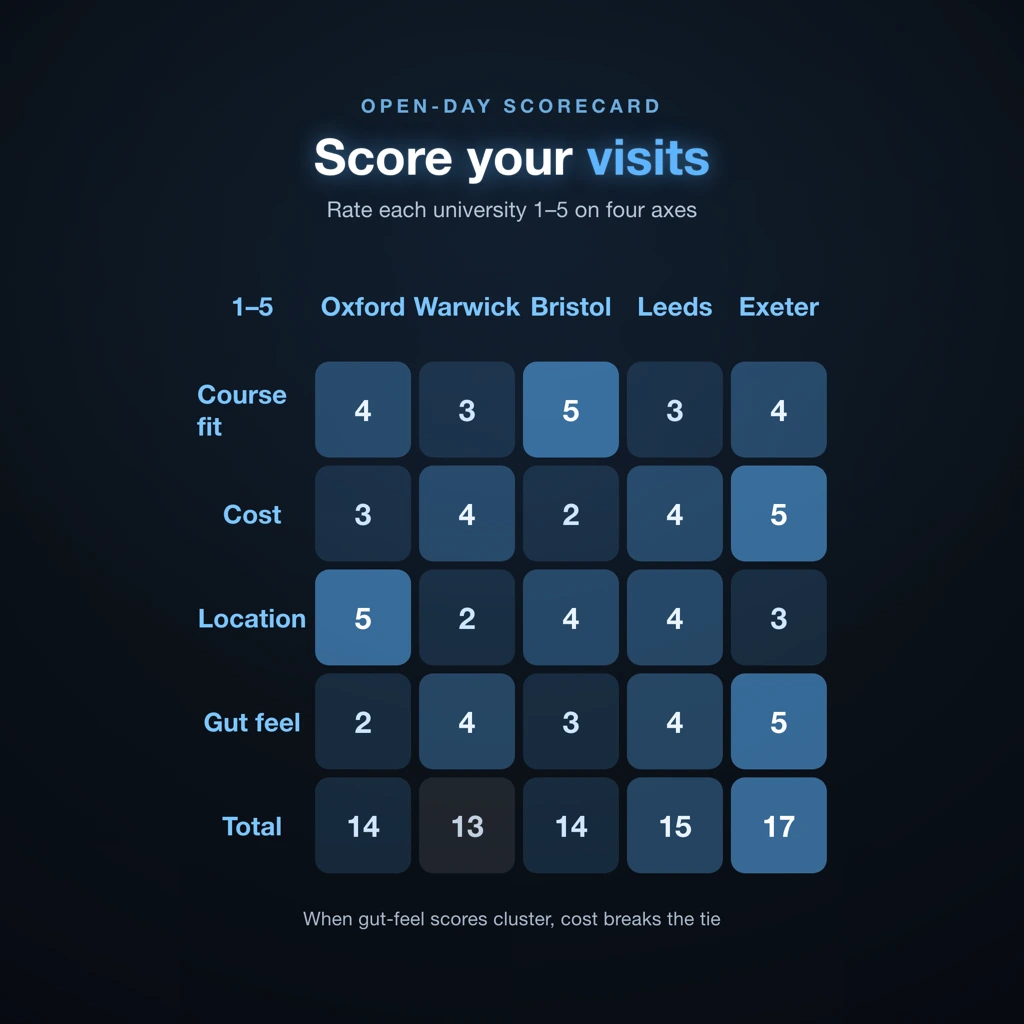
Write up your notes the same evening you visit. By the time you have toured a fifth campus, early impressions blur together, and the specific detail that made one course stand out gets overwritten by the next. UCAS recommends writing a pros-and-cons list for each university after your visit while it is still fresh.
A simple four-axis scorecard works well. Rate each university 1-5 on:
| Axis | What you are scoring |
|---|---|
| Course fit | Content, contact hours, assessment method |
| Cost | Tuition, accommodation, city cost of living |
| Location | City feel, distance from home, commute |
| Gut feel | Could you actually study here for three years? |
Keep every scorecard in one place, whether that is a shared spreadsheet or a notebook, so you can line them up side by side when you sit down to build your UCAS list.
One non-obvious point: gut feel scores tend to cluster, which means cost often becomes the tiebreaker. Check accommodation contract length in weeks, not just the headline weekly rate, since a 51-week contract at a lower nightly rate can cost significantly more than a 39-week contract at a higher one.
When the scores are in, build a risk-spread list of five choices: at least one target where your predicted grades comfortably clear the offer, two to three realistic choices around your predicted grades, and one insurance choice with a lower entry requirement.
Use the UCAS choices Shortlist Optimiser to balance your five picks across that risk spread before you submit.
7. What to do next
Open the UCAS events search this week, filter by your subject and preferred region, and book at least one open day before the end of July. September dates fill quickly, and the UCAS platform currently lists over 237 open day events across undergraduate, postgraduate, and virtual formats, so the earlier you search, the more choice you have.
One non-obvious point: university open day slots and the UCAS application deadline are on the same calendar. If you wait until August to start visiting, you will be writing your personal statement at the same time as attending open days, which compresses your thinking considerably. Visit first, then draft.
Once you have attended, feed your notes into the scoring framework from section 6. Those scores map directly onto the order of your five UCAS choices, turning gut feeling into a defensible ranking.
Read university profiles and compare courses before your next visit to arrive with sharper questions.
FAQ
When should you go to university open days?
The most important open days to attend are the main summer dates (June-September) before the UCAS October deadline, so your visits inform your application; a second opportunity comes with Clearing open days in August after results day.
How many open days should you attend?
UCAS recommends visiting every university you are seriously considering, and attending at least one open day per institution on your shortlist before you submit your UCAS application; for most students that means three to five visits.
What are university open days and what happens at them?
University open days are in-person events where prospective students can tour campus facilities, attend course presentations and sample lectures, and speak with current students and staff - Cambridge's programme, for example, runs 9:30am-4:30pm and includes college tours, department presentations, and Q&A sessions.
Do you need to book university open days in advance?
Yes - booking is essential at almost all universities; Cambridge's 10 July 2026 open day was fully booked while its 9 July date still had places, so you should register as soon as bookings open.
What if I can't attend a university open day in person?
UCAS lists virtual tours and digital open day events for most institutions, and many universities - including Cambridge - deliver admissions, finance, and interview information exclusively online via webinar series that are open to all applicants regardless of location.
When are university open days for 2026 entry?
For 2026 entry, the main open day season runs from June to October 2025, with universities such as Cambridge holding July and September dates; check the UCAS events directory, which listed over 237 open day events, for specific dates by institution and subject.
References
- Cambridge Open Days | Undergraduate Study - https://www.undergraduate.study.cam.ac.uk/events/cambridge-open-days
- Access and Outreach: Open Days - https://www.merton.ox.ac.uk/undergraduate/open-days
- Search | Open days and events | "university open days" | UCAS - https://www.ucas.com/explore/search/events?query=university+open+days
- Preparing for a university open day | UCAS - https://www.ucas.com/applying/before-you-apply/what-and-where-to-study/university-open-days/preparing-for-a-university-open-day
- University Open Days | Visit Universities and Colleges | UCAS - https://www.ucas.com/applying/before-you-apply/what-and-where-to-study/university-open-days
- Open Days FAQ 2026 | Undergraduate Study - https://www.undergraduate.study.cam.ac.uk/events/cambridge-open-days/faq