How to Fill In Your UCAS Application: Step-by-Step Guide
By Michael Thompson · Former IB Diploma Programme coordinator; 10 years at Bromsgrove School · Published 5 July 2026
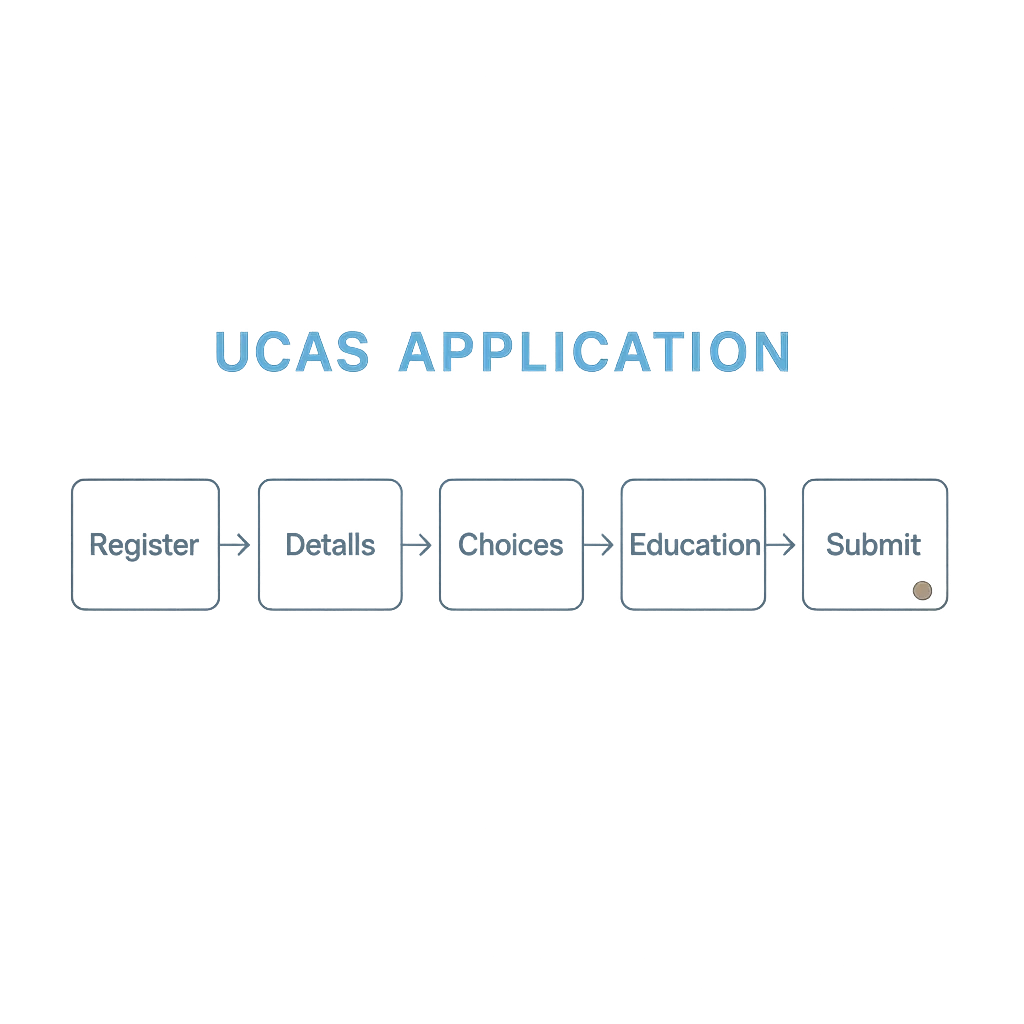
Filling in your UCAS application is more methodical than difficult, but the order matters and several sections catch applicants off guard. The UCAS Hub walks you through registration, personal details, education history, choices, personal statement, and reference before you pay and submit - and most sections stay editable right up to that final step. Get a qualification entry wrong or misread the choices rules and an offer can be withdrawn before you realise what happened. This guide follows the Hub in the sequence you will actually meet it, flags the specific sections where IB students need to take extra care, and explains the payment step that locks everything in.
Key Takeaways
- Register with your school's buzzword: If you are applying through a school or college, enter their buzzword during registration so your reference attaches automatically - without it, your application is not linked to your adviser.
- One personal statement covers all five choices: The 2026 format asks three set questions inside a single 4,000-character limit, so every answer must work for every course you have applied to.
- Separate completed grades from pending ones: In the education section, results you already hold and qualifications still to be sat must be entered in different fields - a mis-keyed grade or missing subject can put a conditional offer at risk.
- IB students must log every diploma component: Each Higher Level and Standard Level subject, Theory of Knowledge, Extended Essay, and CAS should be recorded; CAS carries no UCAS Tariff points but still belongs in the entry.
- Medicine, dentistry, and veterinary medicine cap at four choices: Applicants for those three subjects cannot use all five choice slots for them, and only one Oxbridge choice is permitted per cycle.
- The application fee is £28.95: Paying and clicking Send submits to your school (or directly to UCAS if you are an independent applicant) and locks most sections from further editing.
In This Article
- Register in the UCAS Hub and link to your school
- Personal details, contact information, and residency
- Education history and entering qualifications correctly
- Choosing your courses: rules that catch people out
- Writing your personal statement for 2026 entry
- The reference, payment, and submitting your application
- What to do next
1. Register in the UCAS Hub and link to your school
Knowing how to fill in your UCAS application starts before you type a single word of your personal statement. The entry point is UCAS Hub, and getting your account set up correctly matters more than most students realise.
Registration takes roughly five minutes and follows three steps: go to ucas.com/hub, verify the code sent to your email, then sign in. On your first sign-in, UCAS asks you to confirm your intended level of study (select "undergraduate") and your planned start year. Get the start year wrong here and every subsequent deadline you see in the platform will be wrong too.
The step most students skip past is the buzzword. If you are applying through a school or college, your UCAS adviser will give you a buzzword to enter during registration. This is what links your application to your school so your referee can attach their reference. Without it, your reference simply will not connect to your application, and no amount of chasing your teacher will fix it after the fact.
If you are an independent applicant, not going through a school, you register without a buzzword and arrange your own referee separately. UCAS confirms you can also complete the entire application in Welsh by changing the language setting in the Preferences area of your profile.
Before you move on: ask your sixth form or college for the buzzword on day one. Schools typically set internal deadlines earlier than the official UCAS dates, so you want that link in place before anything else.
2. Personal details, contact information, and residency
Your details must match your official documents exactly - passport, birth certificate, or driving licence - including your date of birth formatted as day/month/year. A mismatch here can cause problems at enrolment, so check the spelling of your name character by character before moving on. Per UCAS, you can record up to two nationalities, which covers dual citizenship without requiring you to choose one over the other.
The contact section asks for your address history covering the three years prior to your course start date. This is not just an admin formality: your home address is the primary signal UCAS uses to confirm your fee status, which determines whether you pay domestic or international tuition fees. If you have moved recently, include all addresses for the full three-year window.
The Finance and Funding section then asks you to identify the local authority that assesses your tuition fees, defined as the authority to which you or your parents pay council tax. Students often skip past this assuming it is obvious, but if your parents live in a different local authority to your term-time address, pick the one covering their home.
The diversity and inclusion questions cover ethnicity, religious beliefs, sexual orientation, and parental education. Per UCAS, none are compulsory, and responses are used for research and statistical reporting only, never shared in a way that influences individual admissions decisions.
Finally, you can grant a nominated person, a parent, carer, or teacher, access to contact UCAS and manage the application on your behalf. This is worth setting up early if you anticipate needing support during the process.
3. Education history and entering qualifications correctly
List every school you have attended since age 11, including your current one. For each qualification, you need the exam board (AQA, Edexcel, OCR, IB, SQA, and so on), the subject title, the date you sat or expect to sit it, and the grade.
The single most common error here is putting everything in one place. UCAS separates completed qualifications with confirmed grades from subjects you have not yet sat. Pending subjects go in the pending field. If you enter a predicted grade where a confirmed result should appear, admissions tutors may misread your academic record when checking your application.
IB Diploma applicants: what to enter
The IB Diploma has no single UCAS Tariff value. You enter each component separately, as UCAS confirms education covers all qualifications since age 11. Per the Lanterna IB to UCAS Tariff Guide, the point conversions work as follows:
| Component | Grade 7 | Grade 6 | Grade 5 | Grade 4 |
|---|---|---|---|---|
| Higher Level (HL) | 56 pts | 48 pts | 32 pts | 24 pts |
| Standard Level (SL) | 28 pts | 24 pts | 16 pts | 12 pts |
| EE + TOK combined | up to 12 pts |
Enter every HL subject, every SL subject, Theory of Knowledge, the Extended Essay, and CAS as separate line items. CAS carries zero UCAS Tariff points but should still be included. If you are still studying, enter your predicted grades against each component in the pending field. If you have already received results, enter your achieved grades instead.
The less obvious reason accuracy matters: many Russell Group universities make IB offers in diploma points with specific HL grade conditions, for example "38 points with 6,6,5 at Higher Level", rather than in UCAS Tariff points alone. A mis-keyed HL grade or a missing subject line does not just affect your Tariff total; it can put a conditional offer at risk when the university checks your results against the original application after results day.
4. Choosing your courses: rules that catch people out
UCAS allows up to five choices per application cycle, and universities cannot see where else you have applied. That confidentiality cuts both ways: you cannot tell whether a rival applicant has used Oxford as a safety choice.
The subject caps that trip people up:
- Medicine, dentistry, and veterinary medicine are each capped at four choices. If you apply to all four dentistry courses you want, your fifth slot must be a different subject entirely.
- Oxford and Cambridge: one application only per cycle. Applying to both is not permitted.
- All other subjects have no restriction beyond the five-choice total.
The non-obvious gotcha with medicine is that the cap applies per subject, not per institution. So three medicine courses plus one dentistry course uses four of your five slots across two capped subjects, leaving you one free choice for anything else.
Employment and extra activities
Record all paid and voluntary work in the employment section. UK applicants also complete a separate extra activities section covering things outside formal education. Neither section is optional if the information applies to you.
Editing and substituting choices
Your choices remain editable until you pay and submit. After your welcome email arrives, you have 14 days to substitute a choice. Each choice can only be substituted once, and no substitutions are permitted after 30 June.
5. Writing your personal statement for 2026 entry
For 2026 entry, UCAS has replaced the single free-text essay with three structured questions. Admissions staff read all three answers as one whole statement, so the logic needs to flow across them, not just within each box.
The three questions are:
- Question 1 - why you want to study this course or subject. Cover your motivations, what you know about the subject, and where you want it to take you. Draft this one first: it anchors the argument for everything that follows.
- Question 2 - how your qualifications and studies have prepared you. This is where formal education goes: A-levels, the IB Diploma, an EPQ, UKMT competition entries, private music or sports qualifications, online courses. Do not include grades here; they already appear elsewhere in the application.
- Question 3 - what you have done outside education to prepare. Work experience, volunteering, independent reading, relevant projects. There is no fixed rule about what belongs in question 2 versus question 3 - place evidence where it makes the strongest case.
The overall character limit is 4,000 characters including spaces, with a minimum of 350 characters per question. You can distribute the remaining allowance in any proportion across the three answers.
One non-obvious consequence of the new format: the counter-intuitive trade-off is that questions 2 and 3 now have no prescribed split, which means weaker applications tend to repeat the same evidence in both. Map your material before you write.
Because one statement covers all five course choices, standard UCAS personal statement advice is clear: never name a specific university and avoid writing only about one narrow course variant. If your five choices span Economics and Politics, a statement written purely about econometrics will count against you at the Politics departments.
Practical tips:
- Use the character count display on each question box as you draft, not at the end.
- Avoid restating your predicted grades in the text; admissions staff can already see them.
- Question 1 is the hardest to write last, because it has to feel genuinely motivated rather than retrofitted.
6. The reference, payment, and submitting your application
**You do not write your own reference.** Your school adviser writes it and attaches it to your application before forwarding it to UCAS. If you are applying independently, you nominate a referee who is contacted separately. Either way, the reference is invisible to you throughout the process.
When you click "Send" inside the UCAS Hub, your application goes to your school adviser, not directly to UCAS. Your school checks the application, adds the reference, and then pays and forwards it to UCAS. The practical consequence: your school's internal deadline will almost certainly be earlier than the official UCAS date, sometimes by several weeks. Miss it and your school may decline to process your application on time.
The application fee for 2026 entry is £28.95 for up to five choices. Students who received UK government-funded free school meals at any point during secondary school may be eligible for a fee waiver, which is a new payment option being introduced for the 2026 cycle.
Once you pay and submit, most sections lock. You can still update your postal address and phone number via the UCAS Hub, but any change to your name or date of birth requires an update form plus official documentation, such as a birth certificate or passport.
**Key UCAS deadline dates for 2026 entry:**
- Equal consideration deadline: **14 January 2026**
- Advisory deadline: 31 March 2026
- Last date to add an Extra choice: 1 July 2026
- Clearing opens: 2 July 2026
Check your school's internal cut-off first. Everything else flows from that date.
7. What to do next
Ask your school adviser for your centre's internal UCAS deadline this week. Most schools set it weeks before the 14 January 2026 equal consideration deadline, and missing it means your reference may not be ready in time. While you have their attention, collect the buzzword your school uses to link your UCAS Hub account to the centre - you cannot complete registration without it, and tracking it down later wastes time you could spend on the personal statement.
The counter-intuitive thing many applicants miss: the January deadline is the last date universities are required to consider you equally, not a guaranteed safety net. Getting your application in earlier gives you more time to respond to any queries.
Read our full guide to the UCAS Hub registration process before you open the application. Check your internal deadline today.
FAQ
How long does it take to fill in a UCAS application?
Registration itself takes about five minutes, but completing all sections - education history, choices, and the personal statement - typically takes several hours spread across multiple sessions; most students work on it over several weeks.
Can I change my UCAS application after I've submitted it?
Contact details can be updated in the Hub after submission, but most other changes - including qualifications - require a Qualification Amendment Form and can take up to 21 days to process; name or date of birth changes require official documentation.
What is the UCAS buzzword and where do I get it?
The buzzword is a code provided by your school or college that links your application to their adviser portal so they can attach your reference; ask your sixth-form or college administrator before you start registering.
How do IB students fill in the education section of UCAS?
IB students should enter each Higher Level and Standard Level subject separately, plus Theory of Knowledge, Extended Essay, and CAS; students still studying enter predicted grades, while those with results enter achieved grades.
How much does it cost to submit a UCAS application?
The 2026 application fee is £28.95 for up to five choices; students who received UK government-funded free school meals at any point during secondary school may qualify for a fee waiver.
What are the UCAS deadline dates for 2026 entry?
The equal consideration deadline for most courses is 14 January 2026; an advisory deadline falls on 31 March 2026; Extra runs until 1 July 2026 and Clearing opens on 2 July 2026.
References
- What is UCAS Hub? Your place to make inspired choices - https://www.ucas.com/advisers/help-and-training/guides-resources-and-training/tools-and-resources-help-you/your-guide-ucas-hub/what-ucas-hub
- Learn all about filling in your UCAS application for uni - https://www.ucas.com/applying/applying-to-university/filling-in-your-ucas-application
- How to fill in the UCAS application | UCAS - https://www.ucas.com/discover/advice-for-parents-guardians-and-carers/how-to-fill-in-the-ucas-application
- IB to UCAS Tariff Guide 2026 | Lanterna Education - https://lanterna.com/resources/ib-to-ucas-tariff-guide-2026
- Making changes to your UCAS Undergraduate application - https://www.ucas.com/applying/after-you-apply/making-changes-to-your-application-after-you-apply
- How to write your personal statement: 2026 entry onwards | UCAS - https://www.ucas.com/applying/applying-to-university/writing-your-personal-statement/how-to-write-your-personal-statement-for-2026-entry-onwards
- 2026 cycle toolkit | UCAS - https://www.ucas.com/advisers/help-and-training/toolkits/2026-cycle-toolkit