Aspirational University Choices: How to Build a Balanced UCAS List
By Michael Thompson · Former IB Diploma Programme coordinator; 10 years at Bromsgrove School · Published 5 July 2026
Aspirational university choices are courses where the typical offer sits above your predicted grades - and including one or two on your UCAS list is sensible. The problem arises when every choice is a reach, leaving you with no safety net if results day goes badly. UCAS gives you five choices for a reason: the system works best when those five slots span a genuine range of risk. This guide explains how to sort your list into three honest risk bands, how to judge a reach using UCAS tariff points or IB points, and how to avoid the shortlist mistake that catches out more applicants than any other.
Key Takeaways
- Three risk bands, not just 'dream' and 'backup': Sorting your five choices into aspirational, on-target, and safe bands - defined by comparing your predicted grades to each course's typical offer - gives your list structure instead of guesswork.
- At least one genuine safety choice is non-negotiable: A safety choice is a course whose typical offer sits clearly below your predicted grades and that you would genuinely be happy to attend - not just a placeholder.
- Use UCAS tariff points to measure the gap honestly: Convert your predicted grades to tariff points and compare them to a course's stated entry requirements; where a university states specific grades rather than points, check the grade condition directly.
- IB applicants face a different calculation: Universities phrase IB offers in total points and Higher Level grades, so an IB student must check both figures against their predicted score - not just the A-level equivalent.
- Five aspirational choices is the honesty trap to avoid: A list built entirely of reaches removes the protection the five-choice system exists to provide, and leaves Clearing as your only fallback on results day.
- Firm and insurance choices lock in your post-offer safety net: Once offers arrive, your firm choice (your preferred offer) and insurance choice (a lower-grade backup offer you hold simultaneously) are the final layer of risk management before results day.
In This Article
- What an Aspirational University Choice Actually Means
- The Three Risk Bands: Safe, On-Target, and Aspirational
- How Many of Each Band Should You Hold Across Your Five Choices?
- How to Judge a Reach Using UCAS Tariff Points and Entry Requirements
- Judging a Reach as an IB Applicant
- UCAS Firm and Insurance Choices: Your Post-Offer Safety Net
- Common Mistakes When Building Your Shortlist
- What to Do Next
1. What an Aspirational University Choice Actually Means
Aspirational university choices are courses whose typical conditional offer is higher than your predicted grades, full stop. The definition is grades-based, not reputation-based. That distinction matters more than most applicants realise when building a UCAS list.
Prestige and risk are not the same thing. A Russell Group university running a course with a standard offer of BBB is not a reach for a student predicted AAB. Conversely, a specialist conservatoire or a highly selective medicine programme at any institution can be a genuine reach regardless of where it sits in a league table. The question to ask is always: what does this specific course typically require, and how does that compare to my predicted grades?
The non-obvious gotcha here is that entry requirements vary sharply between courses at the same university. An applicant predicted A*AB might find that Economics at a given institution is a safe choice while Law at the same institution is a reach, because the two departments set different standard offers.
That is why the three-band framework replaces loose labels like "dream school" with a concrete grades-based test. Safe, on-target, and aspirational are defined by the gap between your predictions and the course offer, not by name recognition. Sections 2 and 3 set out exactly how to apply that test across all five of your UCAS choices.
2. The Three Risk Bands: Safe, On-Target, and Aspirational
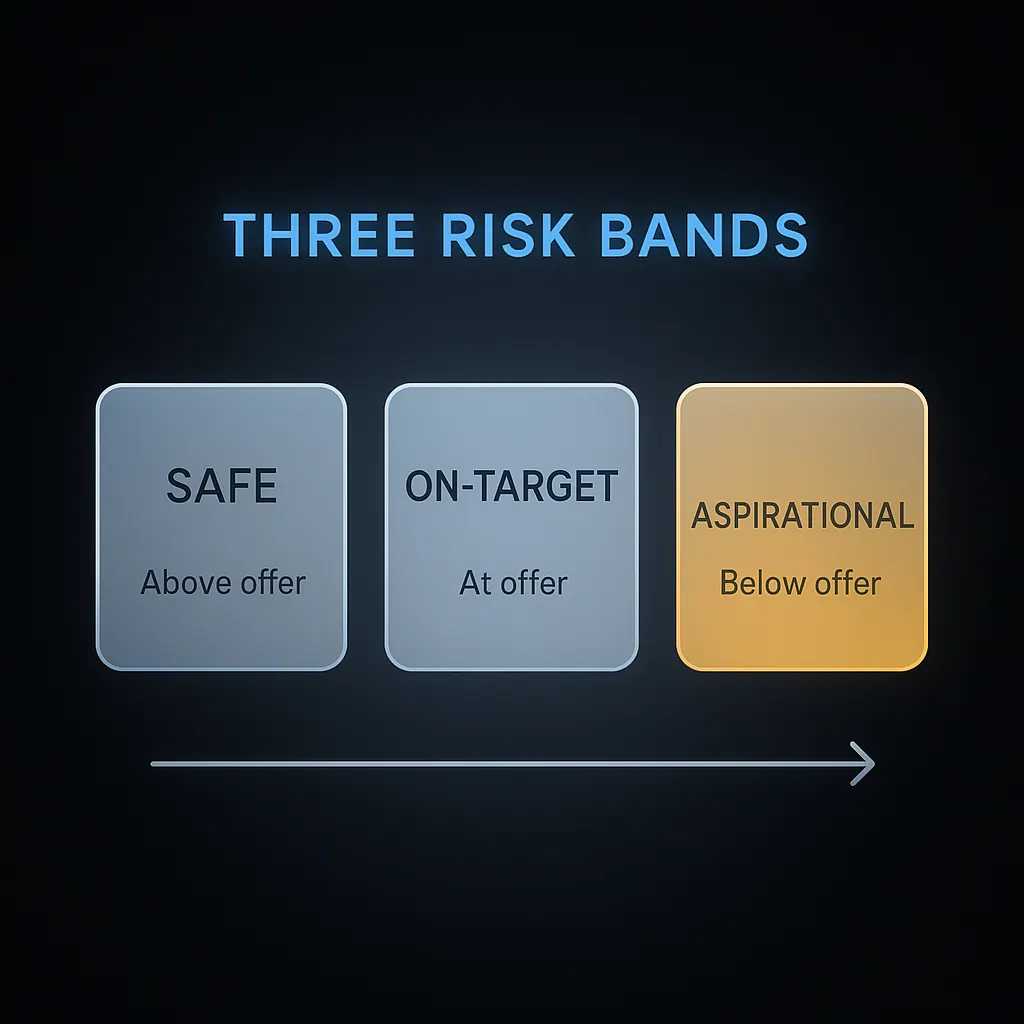
Every choice on your UCAS application sits in one of three bands, defined by a single comparison: where your predicted grades land relative to a course's typical published offer. The logic is straightforward, but the application is often misunderstood.
| Band | How to identify it | Predicted grades vs typical offer | Example signal |
|---|---|---|---|
| Safe | Typical offer sits clearly below your predicted grades | Predicted comfortably above | You're predicted A\*AA; the course typically asks AAB |
| On-target | Typical offer matches your predicted grades | Roughly equal | You're predicted AAB; the course typically asks AAB |
| Aspirational | Typical offer sits above your predicted grades | Predicted below the standard ask | You're predicted AAB; the course typically asks A\*AA |
The non-obvious point: bands are course-specific, not institution-wide. A Russell Group university is not automatically a reach. If you are predicted A\A\A and apply to a less competitive department at a highly ranked institution, that choice may sit in the safe or on-target band. Equally, a specialist course at a post-92 university with a particularly high typical offer could qualify as aspirational for a given applicant.
This matters practically because students often write off mid-ranked institutions as safe without checking the actual entry requirements for the specific subject. A physiotherapy degree or a nursing programme can carry offers that match or exceed those for history at Oxford, depending on the university.
When you classify your five choices, apply the band test per course, not per institution name.
3. How Many of Each Band Should You Hold Across Your Five Choices?
A workable rule of thumb for most applicants: no more than two aspirational choices, at least two on-target choices, and at least one genuine safety choice. That spread uses all five slots purposefully rather than letting ambition crowd out realism.
The honesty trap catches a surprising number of otherwise well-prepared applicants. A shortlist made entirely of aspirational university choices removes the very safety net the five-choice system exists to provide. If every offer requires grades you are unlikely to hit, and results day goes badly, Clearing becomes your only option. Clearing works, but it puts you in a reactive position with limited time and a narrowed field of available courses.
A safety choice is not simply the lowest-entry course you can find. It has to be a course and institution you would genuinely accept an offer from. Picking a subject you dislike at an institution you would resent attending is not a safety net; it is a trap of a different kind.
Here is what a balanced spread looks like in practice:
| Band | Choices | What it means |
|---|---|---|
| Aspirational | 1-2 | You are competitive, but below the typical offer range |
| On-target | 2 | Your predicted grades match the standard offer |
| Safety | 1 | You are comfortably above the entry requirements |
One counter-intuitive point worth noting: some applicants treat a well-regarded post-92 university as a token safety entry, when in fact certain courses there, nursing and physiotherapy in particular, are highly selective. Entry requirements alone do not tell the full story of competition for a place.
4. How to Judge a Reach Using UCAS Tariff Points and Entry Requirements
UCAS Tariff points give you a common currency for comparing predicted grades across different qualifications. Each A-level grade maps to a points value: an A* is 56 points, an A is 48, a B is 40, a C is 32, and so on down the scale. Add up the points from your top three A-level subjects (or equivalent) and you have a tariff total you can stack against a course's published requirement.
That comparison is useful, but it has a significant blind spot. Many competitive courses, particularly those at Russell Group universities, publish grade-by-grade conditions rather than a tariff total. A typical offer for a high-demand course might read "A\*AA" - and meeting that with AAA does not count, even though the tariff difference is only 8 points. The grade profile matters, not just the sum.
Worked example: what one grade boundary costs you
Suppose you are predicted AAA (144 tariff points) and a course entry requirement is A\*AA (152 tariff points):
| Predicted grades | Tariff total | Gap to requirement |
|---|---|---|
| AAA | 144 points | -8 points |
| A\*AA (required) | 152 points | 0 |
Eight points sounds small, but in grade-condition terms it is an entire grade in your strongest subject. That is a meaningful gap for an aspirational choice - not necessarily a dealbreaker, but worth naming clearly before you decide whether to apply.
The less obvious gotcha: some courses also set a minimum grade for a specific subject (for instance, "must include an A in Mathematics") regardless of the overall offer string. Checking only the headline requirement and missing the subject condition is one of the most common errors when researching aspirational university choices. Always read the full entry requirements page for each course on UCAS or the university's own admissions site.
5. Judging a Reach as an IB Applicant
IB Diploma Programme offers work differently from A-level offers, and the difference matters when you are assessing risk. A university will typically state two conditions: a total points score (for example, 38 points out of 45) and Higher Level grade requirements (for example, 6,6,5 at HL). You must satisfy both. A student predicted 38 points overall but with a 5 in an HL subject the course requires at 6 has not met the offer, even though the total looks fine.
This means your risk assessment has two dimensions:
- Total points gap. Compare your predicted IB total against the stated points threshold.
- HL grade gap. Check each individual HL predicted grade against the course's HL conditions. A single weak HL can turn a borderline application into a clear reach, regardless of the overall total.
The less obvious catch is that IB and A-level entry requirements for the same course are not always equivalent in difficulty. Some universities set a relatively high IB points threshold compared with their A-level ask, while others set a lower one. Assuming the IB offer mirrors the A-level offer is a common error. Always read the IB-specific conditions in the course entry requirements on the university's own website, not a third-party conversion table.
One practical check: if a course lists a required HL subject, confirm that your chosen HL options actually include it. Changing HL subjects mid-Diploma is rarely straightforward.
6. UCAS Firm and Insurance Choices: Your Post-Offer Safety Net
Once you have received offers and must reply, UCAS asks you to make two selections: a firm choice and an insurance choice. Your firm choice is the offer you most want to accept. If it carries grade conditions, you hold it conditionally until results day. Your insurance choice is a second offer held at the same time as a fallback, and it should carry a lower grade condition than your firm.
That last point is where many applicants quietly undermine themselves. If your firm requires AAA and your insurance requires AAB, you have a genuine safety net. If both require the same grades, the insurance offers no protection at all. The insurance choice should sit in your safe or lower on-target band, not mirror your firm.
One non-obvious gotcha: some universities place conditions on insurance offers that look lower on paper but are structured differently. A firm offer of AAA at UCL paired with an insurance of ABB at a university that specifies ABB including a B in a named subject* can still catch you out if your weakest subject is the one named.
If you do not reply to your offers by the UCAS deadline, UCAS can decline all outstanding offers on your behalf, leaving you without any confirmed place. Check your UCAS Hub for the exact reply deadline, which varies depending on when your last offer arrived.
7. Common Mistakes When Building Your Shortlist
The most common error is filling all five UCAS choices with reaches. It feels like ambition, but it removes every fallback. If your predicted grades slip slightly or your results come in below offer level, you have no safety net, and Clearing becomes your only option under pressure.
Three specific mistakes appear repeatedly:
- Five reaches, no safety. Applicants treat the UCAS list as a wishlist rather than a strategy. A balanced shortlist needs at least one choice where your predicted grades sit comfortably above the typical offer range, not at or below it.
- Confusing institutional reputation with course-level requirements. A Russell Group university with a strong general reputation may run specific courses with entry requirements well below its flagship programmes, and vice versa. A newer university may hold firm on A*AA for a highly specialist course. Always check the entry requirements for the exact course, not the institution's average.
- **Treating the personal statement as a wildcard.** A strong personal statement for competitive courses matters, but admissions tutors use it to differentiate between candidates who already meet the grade threshold. It cannot compensate for predicted grades that fall significantly short of a course's typical offer. The personal statement is the tiebreaker, not the ticket in.
The non-obvious gotcha here: some courses at the same university carry different entry requirements depending on whether they include a placement year or a foundation module. Check each course code individually on UCAS, not just the university's homepage.
8. What to Do Next
You have a framework. Now put your actual predicted grades against each of your five choices and see where the gaps are. One thing that catches students out: the band a course falls into can shift depending on whether the university publishes a typical offer or a minimum, and those are rarely the same figure. Check which one you are being measured against before you commit.
Use the UCAS choices shortlist optimiser, enter your predicted grades for each of your five choices, and confirm which risk band each one sits in before your UCAS application deadline.
If any choice comes back as two bands higher than your predictions suggest, treat that as a prompt to revisit your personal statement for that course. Do not wait until after results day to find out your list was unbalanced.
FAQ
How do aspirational university choices work in the UCAS system?
An aspirational choice is one where the course's typical entry offer sits above your predicted grades; UCAS allows up to five choices, so the system is designed to accommodate a mix of aspirational and safer options within the same application.
Do aspirational university choices affect your other offers?
Including an aspirational choice does not affect the offers you receive from other universities on your list - each institution makes its own decision independently based on your application.
How many aspirational choices should I put on my UCAS application?
Most advisers recommend no more than two aspirational choices across your five, leaving room for at least two on-target choices and one genuine safety choice you would be happy to attend.
What is the difference between a firm and insurance choice on UCAS?
Once you have received your offers, your firm choice is the offer you most want to accept (your first preference), while your insurance choice is a second offer with a lower grade condition that acts as a backup if you miss the grades for your firm choice.
Do predicted grades matter for applying to Russell Group universities?
Predicted grades are a central part of the UCAS application and are used by Russell Group universities to assess whether applicants are likely to meet the course's typical entry requirements - courses at these universities frequently state specific grade conditions rather than a tariff points total.
How does an IB student judge whether a UK university choice is a reach?
An IB applicant should compare their predicted total IB Diploma points and their individual Higher Level predicted grades against the university's stated IB offer for that course, since both the overall score and the HL grade conditions must be met.
References
(none cited - see notes in research.json)