How to Choose UCAS Choices: A Complete Guide
By Michael Thompson · Former IB Diploma Programme coordinator; 10 years at Bromsgrove School · Published 5 July 2026
Knowing how to choose UCAS choices well is one of the most consequential decisions in your application, yet the rules that govern it are buried in small print most students only discover after they've already made mistakes. You have up to five choices, all sitting under a single application with one personal statement that must speak convincingly to every course you list. The firm and insurance mechanic means the whole system is designed around a best case and a fallback - but only if you pick them correctly. This guide walks through the structural rules, the offer mechanics, the gotchas around Oxford, Cambridge, medicine, dentistry and veterinary medicine, and the specific considerations for IB Diploma students reading offers stated in points rather than A-level grades.
Key Takeaways
- Up to five choices, one personal statement: Every course you apply to sees the same personal statement, so a mixed list only works if your statement can genuinely address all of them.
- Firm and insurance are not the same thing: Your insurance choice should carry a noticeably lower entry requirement than your firm so it functions as a real safety net, not a second firm.
- Medicine, dentistry and veterinary medicine are capped at four: These three subjects share a four-choice cap, leaving your fifth slot free for a different course - which most applicants use as a genuine safety.
- Only one Oxford or Cambridge choice per cycle: You can apply to either Oxford or Cambridge, but not both in the same application cycle.
- IB offers are usually stated in points or specific HL grades: Map each choice's offer conditions against your predicted HL and SL profile before committing to a list.
- Choices can be changed, but within tight windows: You can substitute a choice within 14 days of your welcome email and no later than 30 June, and each choice can only be substituted once.
In This Article
- The structural frame: five choices, one application, one personal statement
- Do your five choices have to be the same subject?
- Firm vs insurance: how the offer mechanic works
- Spreading risk: building a balanced list of five choices
- Rule gotchas: Oxbridge, and the four-choice cap for medicine, dentistry and veterinary medicine
- Choosing the right university course as an IB student
- Key UCAS deadlines that shape when you choose
- Changing UCAS choices after you apply
- Common mistakes when picking UCAS choices
- What to do next
1. The structural frame: five choices, one application, one personal statement
Knowing how to choose UCAS choices starts with understanding what the application actually is: a single form, submitted once, listing up to five universities or colleges at the same time. Per UCAS, every choice sits inside one application, and all five institutions receive it together. There is no priority order visible to universities at this stage. They cannot see which other institutions you have applied to, and they do not know whether they are your first preference or your fifth.
The second structural fact shapes everything about how you build your list. All five institutions read the same personal statement. For 2026 entry onwards, UCAS changed the format from a single block of text to [three structured questions](/guides/how-to-write-ucas-personal-statement-2026), with a total limit of 4,000 characters including spaces. The first question asks why you want to study this course or subject. The second asks how your qualifications and studies have prepared you. A third question also requires a response, with each answer needing at least 350 characters. Admissions staff read all three answers as one whole document.
That constraint is the hidden rule that governs how mixed your five choices can realistically be. UCAS imposes no rule requiring your choices to share a subject. The practical limit is your personal statement: if your five courses are too different, your answers to those three questions will read as contradictory or vague to every institution on the list. A student applying to History at three universities and Computer Science at two will struggle to write a single Question 1 answer that convinces either department.
The takeaway: treat your personal statement as the blueprint, then pick courses it can honestly serve.
2. Do your five choices have to be the same subject?
No. UCAS places no rule requiring your five choices to cover the same subject. You could, in theory, apply to five entirely different disciplines on one application.
The real constraint is the personal statement. For 2026 entry, the first question asks directly: "Why do you want to study this course or subject?" per UCAS. Admissions staff read all three questions as a single whole, so your answer to that opening question has to make coherent sense against every course on your list simultaneously. A wildly mixed list makes that almost impossible to pull off credibly.
The counter-intuitive gotcha: the 2026 format removed the old single continuous text and replaced it with three separate, structured questions. Students who assumed the new format gave them more flexibility to cover mixed subjects are often surprised to find the opposite is true. A focused question demands a focused answer.
In practice, most applicants keep choices within one subject area or two closely related areas:
- Workable combination: Economics and Computer Science share enough intellectual overlap that one answer can address both honestly.
- Very difficult combination: Medicine and Fine Art pull in such different directions that any single answer to "why this subject?" will read as unconvincing to at least one set of admissions tutors.
If your interests genuinely span two distinct fields, the safer move is to commit to one application now and treat the other as a future decision, not a simultaneous one.
3. Firm vs insurance: how the offer mechanic works
Once universities have responded to your application, you reply to your offers by selecting two: a **firm choice (the offer you are committing to) and, optionally, an insurance choice** as a genuine fallback. UCAS confirms that offers can be unconditional (you already meet the entry requirements) or conditional (based on grades you are yet to achieve).
The logic only works if there is a real gap between the two entry requirements. If your firm asks for AAB and your insurance also asks for AAB, the insurance gives you nothing. The insurance should sit noticeably lower, so that a near-miss on results day still lands you a confirmed place somewhere you would genuinely attend.
Three outcomes on results day:
- You meet your firm offer. You are placed there automatically. The insurance is released.
- You miss your firm but meet your insurance. The insurance activates and you are placed at that institution.
- You miss both. You enter Clearing, which opens 2 July for both 2026 and 2027 entry cycles.
The non-obvious gotcha: you cannot hold an unconditional firm and an unconditional insurance at the same time. If you accept an unconditional offer as your firm, UCAS automatically releases your insurance. Choose carefully which unconditional you commit to, because the safety net disappears the moment you do.
4. Spreading risk: building a balanced list of five choices
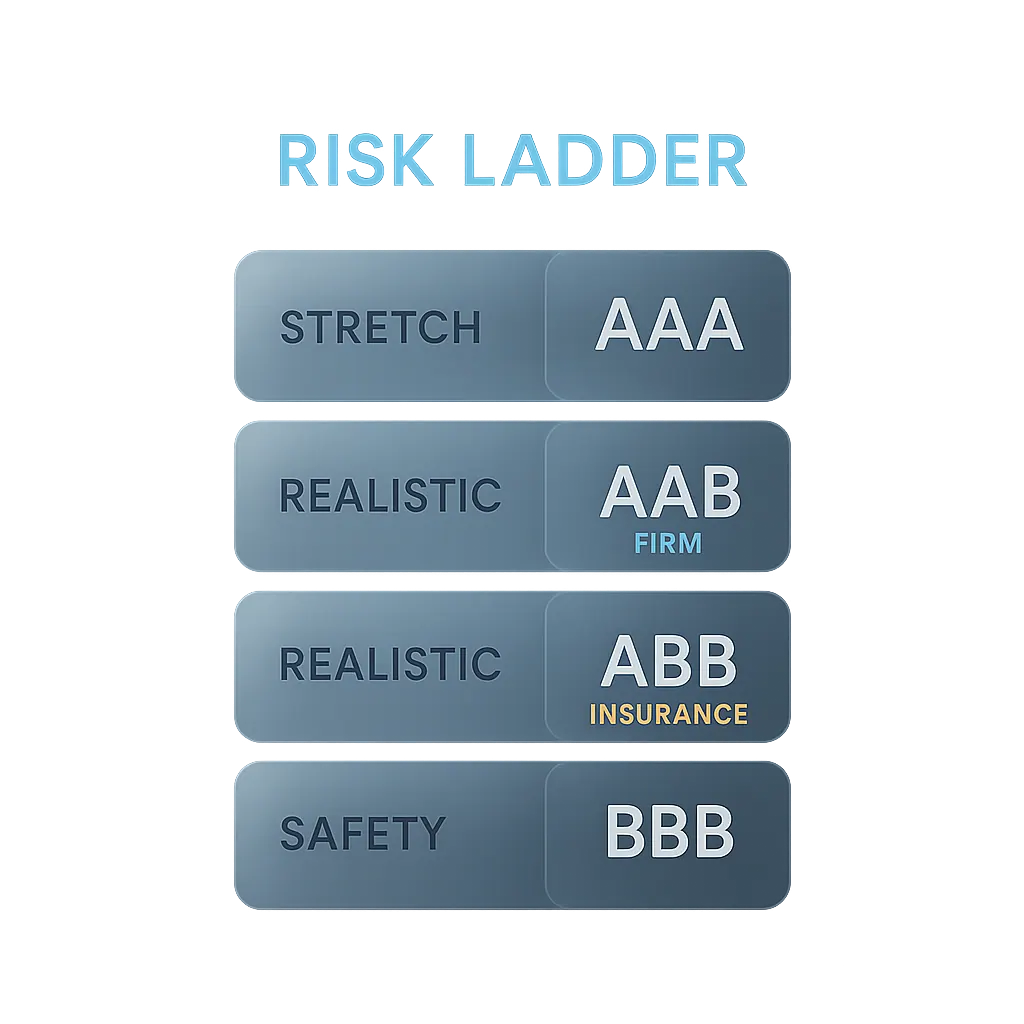
A well-balanced list covers three bands of selectivity:
- Stretch choices (one or two): courses where your predicted grades sit at or just below the typical conditional offer. You might get in, but you need a strong performance.
- Realistic choices (two or three): courses where your predicted grades comfortably meet the standard offer. These are your most likely outcomes.
- Safety choice (at least one): a course where your grades clearly exceed the entry requirement and where you would genuinely enrol if it was your only offer.
That last category is the one most applicants skip. The usual reasoning is that listing a lower-tariff course signals low ambition. It doesn't, for a simple structural reason: no university can see your other choices. Per UCAS, applicants make up to five choices on a single application, but each institution only sees its own entry. Your safety choice is invisible to your stretch choices, and vice versa.
The non-obvious gotcha is the "genuine enrolment" test. There is no mechanical benefit to listing a course you would reject if it were your only offer. If you receive only that one offer and turn it down, you enter Clearing without a place. A safety choice only functions as a safety if you would actually go.
The practical approach: build your list from the bottom up. Identify your safety choice first, then work upward through realistic options to your stretch picks. That order forces you to confirm the safety is real rather than an afterthought.
5. Rule gotchas: Oxbridge, and the four-choice cap for medicine, dentistry and veterinary medicine
Two structural rules sit outside the normal five-choice framework, and both catch applicants off guard.
The Oxbridge rule is straightforward: you may apply to Oxford or Cambridge, but not both, in the same application cycle. One Oxbridge institution per year, no exceptions.
The medicine, dentistry, and veterinary medicine cap is subtler. These three subjects share a hard limit of four choices between them, regardless of how you mix and match. You could apply to four Medicine programmes, or to three Medicine programmes and one Dentistry programme, but you cannot fill all five slots with choices from this group.
That fourth restriction leaves you with a fifth choice that must be a different course entirely. The non-obvious part: this slot is not a throwaway. Most competitive applicants use it for a subject they would genuinely accept, such as Biomedical Sciences or Pharmacology, rather than leaving it blank or selecting something arbitrary. A blank fifth choice is a missed safety net; a poorly chosen one creates a real dilemma if you receive an offer you never intended to consider.
The 15 October deadline applies to all Oxbridge and medicine, dentistry, and veterinary medicine applications, so there is no room to revisit these decisions after the main January cycle opens.
6. Choosing the right university course as an IB student
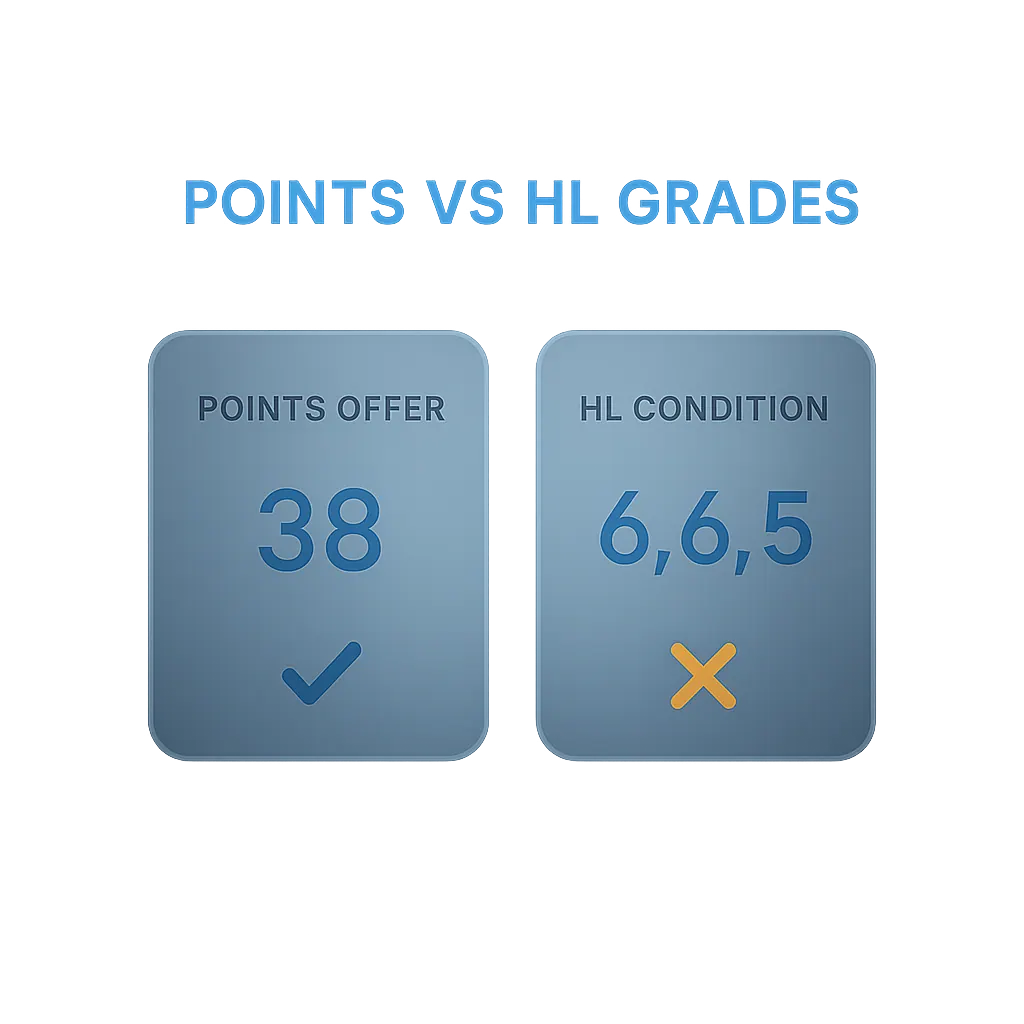
UK universities make IB offers in two main ways. Some set a **total points threshold (for example, 36 points overall including bonus points from Theory of Knowledge and the Extended Essay). Others specify Higher Level grade requirements**, such as HL Chemistry at grade 6 or HL Mathematics at grade 7. Many competitive courses combine both: a total points score and a minimum grade in one or more HL subjects. That combination is the one to watch, because a student can hit the points threshold and still miss the offer if a single HL grade falls short.
The counter-intuitive part is that the IB Diploma Programme's scoring structure makes HL grades disproportionately volatile in points terms. Each HL subject is worth up to seven points, and a drop of one grade band removes three or four points from your total instantly. A predicted score of 38 might sit comfortably above a total-points offer at one university, but that same prediction could be one HL grade away from missing a different university's HL-specific requirement.
When choosing the right university course as an IB student, map each of your five choices against both conditions: total points and any HL minimums. For your insurance choice, that mapping matters most. Pick an insurance offer you can still meet if one HL comes in a grade below your prediction. A two-point buffer in total score is not enough protection if the course also requires a grade 6 in an HL subject where you are currently predicted a 7.
7. Key UCAS deadlines that shape when you choose
Three dates structure the entire application calendar, and missing the right one for your course type costs more than just time.
**Oxford, Cambridge, medicine, dentistry, and veterinary medicine** all share the earliest cut-off: 15 October at 18:00 UK time. That deadline is firm for both 2026 and 2027 entry cycles. If you are balancing reach and safe choices in healthcare, every one of your four permitted choices must be finalised and submitted before that date, with no grace period.
For almost every other undergraduate course, the equal consideration deadline is 14 January 2026 at 18:00 UK time for 2026 entry. "Equal consideration" means universities are not obliged to review applications arriving after that point on the same terms as earlier ones, even though the portal stays open.
The less-discussed gotcha is the 30 June 18:00 cut-off. Any application received after that date is automatically routed into Clearing, bypassing the standard offer process entirely. That means a student who drifts past January thinking they still have time has, by summer, lost the protection of the equal consideration window and must compete for whatever vacancies remain.
| Deadline | Date (2026 entry) | Who it affects |
|---|---|---|
| Oxford, Cambridge, medicine, dentistry, vet medicine | 15 October 18:00 | Those specific courses only |
| Equal consideration | 14 January 2026 18:00 | Most other undergraduate courses |
| Automatic Clearing entry | 30 June 18:00 | Any application submitted after this date |
Build your list well before January. The later you apply within the equal consideration window, the less time you leave yourself to revise choices if a school or adviser flags a problem.
8. Changing UCAS choices after you apply
Once your application is submitted, you still have some room to make changes, but the windows are narrow and each option can only be used once.
Substituting a choice is possible within 14 days of receiving your UCAS welcome email, and no later than 30 June. Each choice can only be substituted once, so if you swap a university and then change your mind again, that second change is not available. Per UCAS, course, year, or campus changes are handled differently: you contact the university directly, and the institution notifies UCAS if it agrees.
**Changing your offer reply** is also possible once, within 14 days of replying, by contacting a UCAS adviser. You do not need permission from your chosen universities or colleges for this, but no reply swaps are possible at all after 24 July 2026. That is the less-obvious catch: the window closes regardless of whether results day has passed.
If you used all five choices and received no offers, UCAS Extra runs from 26 February to 1 July 2026. It lets you apply to one course at a time, and there is no insurance choice available through Extra. Universities have until 15 July to respond. If you have not used all five original choices, you can simply add one to your application before 30 June, provided you have not yet accepted or declined any offers, with no need to use Extra at all.
9. Common mistakes when picking UCAS choices
Three errors come up repeatedly, and each one is avoidable.
Treating firm and insurance as interchangeable. If your firm offer asks for AAB and your insurance offer also asks for AAB, you have no safety net at all. The insurance choice only protects you if it carries a meaningfully lower grade requirement, one you are confident of meeting even on a bad results day. A common oversight is selecting a prestigious insurance university without checking whether its entry requirements actually differ from the firm.
**Choosing on reputation rather than fit.** A university's league table position tells you nothing about whether its course structure suits you. Two universities might both offer Economics, but one runs problem-set-heavy teaching from week one while the other is essay-led throughout. Visiting open days and reading course handbooks before you finalise matters more than the name on the prospectus.
**Ignoring the personal statement constraint when mixing subjects.** For 2026 entry onwards, UCAS splits the personal statement into three questions, the first being "Why do you want to study this course or subject?" A list spanning, say, Engineering, History, and Nursing forces you to answer that question for three incompatible disciplines within a 4,000-character limit. The answer ends up vague for all three. A tighter subject focus almost always produces a sharper, more convincing response.
10. What to do next
Start this week by opening the UCAS Choices Shortlist Optimiser and entering your predicted grades, subject combination, and any rule constraints (Oxbridge, medicine, dentistry, or veterinary medicine). The tool maps your list against offer-range data so you can see at a glance whether your five choices are spread across realistic grade bands or quietly clustered at the same difficulty level, which is the single most common structural flaw in a UCAS application.
One counter-intuitive check worth doing before you finalise anything: confirm that your insurance choice has entry requirements at least one full grade below your firm. A choice that sits only narrowly lower offers almost no protection if results day goes badly.
Check your school or college's internal UCAS submission deadline this week. It will almost certainly fall earlier than the official UCAS date.
FAQ
How do I choose my firm choice on UCAS?
Your firm choice should be the offer you most want to accept and are confident you can meet - it becomes your primary placed destination if you achieve the required grades.
What does the UCAS insurance choice mean?
The insurance choice is a backup offer you hold alongside your firm; it should carry a lower entry requirement so that a near-miss on results still secures you a place.
Can I change my UCAS choices after submitting?
You can substitute a choice within 14 days of your welcome email and no later than 30 June, but each choice can only be substituted once.
Do all five UCAS choices have to be for the same subject?
No, UCAS does not require a uniform subject list, but your single personal statement must make coherent sense across every course you apply to, which is the practical constraint on how mixed the list can be.
How many UCAS choices can I make for medicine?
Medicine, dentistry and veterinary medicine share a cap of four choices between them, with a fifth slot available only for a different, unrestricted course.
How should IB students approach choosing UCAS choices?
IB students should map each choice against predicted HL and SL grades individually, since UK offers may specify a total points threshold, specific HL grades, or both - and a single HL grade drop can shift the total by three or four points.
References
- Learn all about filling in your UCAS application for uni - https://www.ucas.com/applying/applying-to-university/filling-in-your-ucas-application
- How to write your personal statement: 2026 entry onwards | UCAS - https://www.ucas.com/applying/applying-to-university/writing-your-personal-statement/how-to-write-your-personal-statement-for-2026-entry-onwards
- Key dates and the application journey | UCAS - https://www.ucas.com/discover/advice-for-parents-guardians-and-carers/key-dates-and-the-application-journey
- Making changes to your UCAS Undergraduate application - https://www.ucas.com/applying/after-you-apply/making-changes-to-your-application-after-you-apply
- UCAS Extra | No Offers? Add More Choices With Our 'Extra' Service - https://www.ucas.com/applying/after-you-apply/types-of-offers/extra-choices