Applying to University Without Predicted Grades
By Michael Thompson · Former IB Diploma Programme coordinator; 10 years at Bromsgrove School · Published 5 July 2026
Applying to university without predicted grades is more straightforward than most people assume - and for some applicants, it is actually the stronger route. If you already hold your results, whether from A-levels, the IB Diploma, an Access to HE qualification, or equivalent, universities assess what you have achieved rather than what a teacher guesses you might achieve. This guide covers who this route applies to, how the UCAS process works when you apply with confirmed grades, what to do about references when you are no longer in school, and the realistic timing windows available to you.
Key Takeaways
- Achieved grades remove prediction uncertainty: Applying with confirmed results means universities assess what you have actually earned, not an estimate - which can strengthen your case where you clearly meet the entry requirements.
- Three main groups apply this way: Mature applicants past formal schooling, gap-year students who already hold their results, and anyone applying during or after Clearing on results day all apply without predicted grades.
- References do not have to come from a teacher: If you are no longer at school, a referee such as an employer, tutor, or professional contact can write your reference - it should cover your academic readiness and relevant skills or experience.
- IB applicants with final results can apply on confirmed points and HL grades: Removing the uncertainty of predictions, an IB applicant who already holds their diploma can state their actual total and higher-level grade breakdown on the UCAS form.
- Clearing opens on results day and runs until courses fill: This is the primary post-results application route through UCAS, available to anyone who is not already holding an accepted offer.
- Access to HE and work-based qualifications carry UCAS Tariff points: Mature applicants without A-levels can evidence readiness through Access to HE diplomas, NVQs, BTEC, or professional qualifications, all of which universities accept alongside work experience.
In This Article
- Who Can Apply to University Without Predicted Grades
- How Applying With Achieved Grades Differs From the Predicted-Grade Route
- References When You Are No Longer at School
- IB Applicants Applying on Final Diploma Results
- UCAS Application Timing: Applying After Results Day
- Mature Applicants: Evidencing Readiness Without School Grades
- What to Do Next
1. Who Can Apply to University Without Predicted Grades
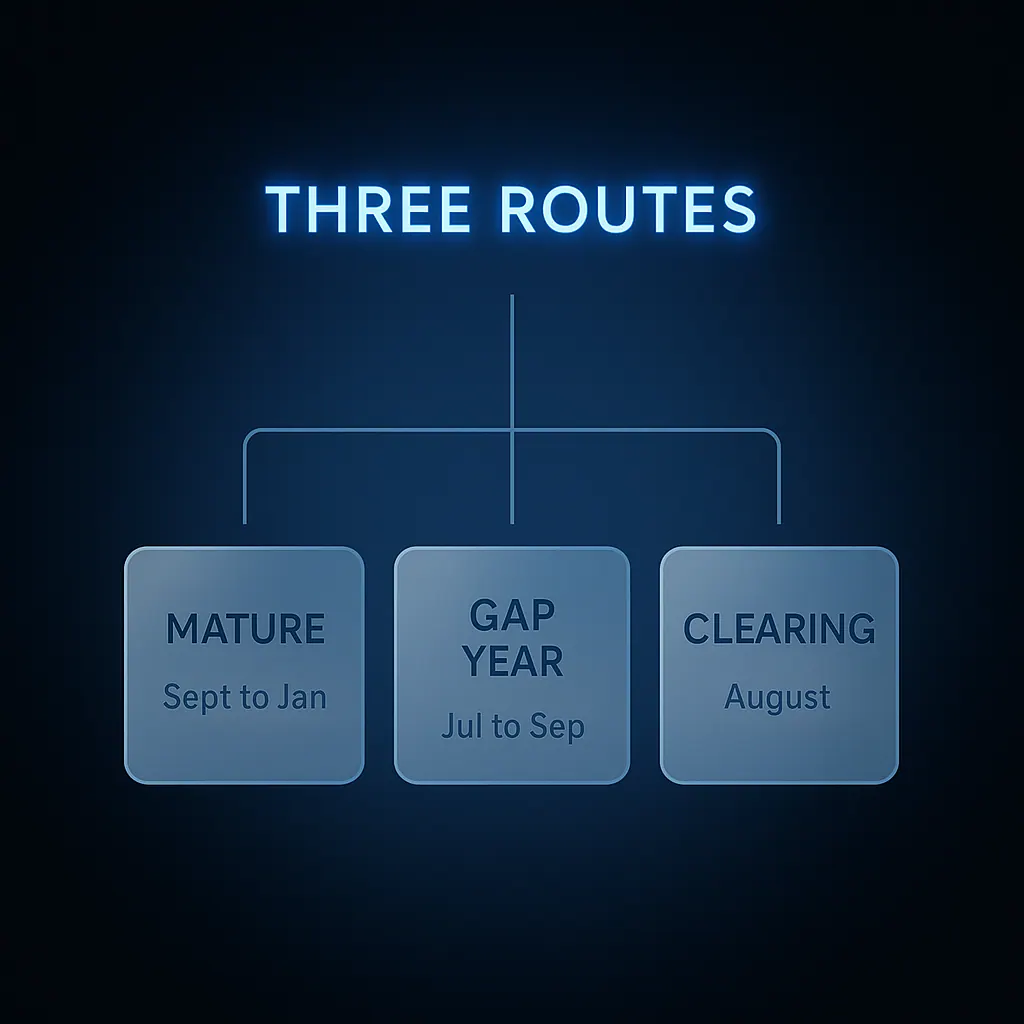
Applying to university without predicted grades is more straightforward than it sounds. It simply means your UCAS application carries confirmed, already-achieved results rather than a teacher's forecast of what you might get. Three groups of people find themselves in this position: mature applicants who left school some time ago, gap-year students who sat their A levels or IB Diploma and are now applying on final grades, and students applying post-results day, including through Clearing.
The standard UCAS cycle is built around applicants who are still in school or college and whose exam results are months away. Predicted grades exist to fill that gap. If you already hold your results, that assumption does not apply to you, and the predicted-grade fields in your UCAS application become a formality rather than the centrepiece of your case.
One non-obvious point worth knowing early: UCAS accepts over 450 different qualifications from applicants each year, and entry requirements listed on university websites are not exhaustive. For mature applicants especially, relevant work experience can substitute for formal results at many institutions. That means "no predicted grades" does not automatically mean a weaker application. In some cases, confirmed results and professional evidence make for a stronger one.
2. How Applying With Achieved Grades Differs From the Predicted-Grade Route
The standard UCAS cycle runs on uncertainty. A student applying in autumn submits predicted grades, and universities respond with conditional offers: meet these grades in August and the place is yours. Applying with confirmed results removes that entire mechanism from the process.
When your grades already exist, admissions tutors assess them immediately against the course entry requirements. If your results meet the threshold, any offer made is unconditional from the outset. There is no August cliff-edge, no grade-drop risk, and no summer spent anxious about whether a borderline prediction holds up.
Cambridge illustrates the principle precisely. Per Cambridge Undergraduate Admissions, an unconditional offer from Cambridge is only issued if the applicant has already completed their qualifications and achieved the required grades. Cambridge does not issue conditional offers speculatively against predicted performance.
One counter-intuitive trade-off is worth flagging: confirmed-results applicants do not apply into a full cohort. Many course places are already filled by conditional-offer holders from the main cycle. You are often competing for a smaller pool of remaining spots, which means strong grades alone are not sufficient cover.
Universities also assess the full application, not just the grade profile. Your personal statement and reference remain part of the decision. A referee who can speak directly to completed work, rather than forecasting potential, can actually make for a more grounded and credible application than a predicted-grade equivalent.
3. References When You Are No Longer at School
If you left school or college more than a few years ago, a former teacher is rarely a realistic option for a UCAS reference. UCAS allows applicants who have left education to use a non-teacher referee, provided that person can comment meaningfully on your suitability for degree-level study.
Suitable referees include:
- An employer or line manager who can speak to your professional skills and work ethic
- A further education tutor from a recent Access to HE course or night school class
- A professional mentor, such as a supervisor from a voluntary placement or apprenticeship
- A community or training organisation contact who has observed you in a learning context
What the reference should cover mirrors what a school reference would address: your academic potential, your commitment to independent study, and any relevant skills developed through work or life experience. If you have done any recent formal study, even a short on-the-job qualification, UCAS advises mentioning it and your referee should echo that evidence.
The non-obvious gotcha here is alignment. Admissions tutors read your personal statement and your reference together. If your statement describes managing a team or completing an Access to HE course and your reference never mentions either, the gap is noticeable. Brief your referee on what you have written so both documents reinforce the same picture of readiness.
4. IB Applicants Applying on Final Diploma Results
An IB student reapplying after a gap year, or one who sat the Diploma Programme and is now applying for the first time with results in hand, can submit confirmed total points and individual higher-level (HL) grades through UCAS. That removes the single biggest problem with the predicted-IB-points route: the IB Diploma is notoriously difficult to predict accurately, because the final score combines external exams, internal assessments, Theory of Knowledge, the Extended Essay, and CAS, each of which can shift the total by several points in either direction.
University offers for IB applicants are usually structured in two parts:
- A total points threshold (for example, 38 points overall).
- Specific HL grade conditions (for example, 6,6,5 in three HL subjects).
When you hold confirmed results, both you and the admissions team can check immediately whether every condition is met, with no need for the conditional-offer machinery that governs the standard UCAS cycle.
One non-obvious detail: the UCAS Tariff converts IB points into a comparable UK tariff score using the same conversion table whether those points are predicted or confirmed. Holding confirmed results does not change the arithmetic, but it does mean your tariff figure is fixed rather than provisional, which matters when a course lists a tariff-based entry requirement rather than a points-and-HL structure.
If you are applying on confirmed IB results, list the exact total and each subject score clearly in the education section of your UCAS application.
5. UCAS Application Timing: Applying After Results Day
Two distinct post-results routes exist for anyone applying to university without predicted grades: Clearing in the current cycle, and a fresh main-cycle application the following year.
Clearing opens on A-level results day in August and runs until courses fill. It is the primary route if you did not submit a UCAS application earlier in the year, or if you applied but did not accept any offer. Courses are listed on the UCAS website in real time, and you can call universities directly to discuss vacancies. The window can stretch into October for less competitive courses, but popular programmes at selective universities close within hours of opening.
The new UCAS cycle opens in early September each year, allowing applicants with confirmed results to submit a main-cycle application for the following year's entry. Because your grades are already on your transcript, no predicted grade is needed. The standard UCAS deadline of 15 October applies; Christ's College Cambridge notes that applications for 2027 entry open in early September 2026 when the next cycle begins.
One non-obvious detail worth knowing: at Cambridge, unsuccessful applicants may be invited for reconsideration in August after results are released. Per Cambridge's undergraduate admissions guidance, applicants register that interest using an online form in August, not before. This is separate from both Clearing and a new-cycle application.
All UCAS deadlines shift slightly year to year. Verify current dates on the UCAS website before you act.
6. Mature Applicants: Evidencing Readiness Without School Grades
Not having A levels or recent school results does not close the door to university. UK universities accept over 450 different qualifications from applicants each year, and some institutions will consider relevant work experience even where no formal qualifications exist at all.
**Access to Higher Education Diplomas are the most direct formal route.** These are typically one- or two-year programmes designed specifically for adults returning to education, and they are widely recognised by universities as preparation for degree study. One non-obvious detail worth knowing: if you fund an Access to HE Diploma with an Advanced Learner Loan, that loan is written off once you complete a subsequent higher education course, so the financial risk of taking the qualification is lower than it first appears.
BTEC, NVQ, and other work-based qualifications all carry UCAS Tariff points and are treated as standard evidence of attainment on any course that uses a Tariff threshold. Some universities also accept professional qualifications or relevant work experience in place of traditional academic results.
If you hold no qualifications at all, the Open University requires no entry qualifications and is open to everyone. It requires a direct application to the institution rather than going through UCAS.
The personal statement matters more for mature applicants, not less. UCAS now splits it into three separate questions for all applicants. UCAS explicitly identifies five things mature applicants should address: answering "why now", demonstrating personal progression, discussing life and work experience, showing understanding of degree study time commitments, and keeping the statement honest. Question 2, which asks how your qualifications have prepared you, is the one where UCAS expects mature applicants to write less than school leavers. The space you save there should go into Questions 1 and 3.
7. What to Do Next
First, pin down which category applies to you: post-results applicant, gap-year IB candidate, or mature student returning after time away. That category determines your timing window, and getting it wrong means missing the right application route entirely.
Once you know where you stand, search for degree courses that match your confirmed or expected qualifications using the course finder, filtering by subject and entry requirement.
One non-obvious gotcha: entry requirements listed on university websites are not exhaustive, and UCAS notes that UK universities accept over 450 different qualifications each year, so a course that looks closed to you may not be.
If results day has not yet passed, check the UCAS website now for the current cycle's Clearing opening date. Do not wait until August to look it up.
FAQ
Can you apply to university without predicted grades?
Yes - mature applicants, gap-year students who already hold results, and anyone applying through Clearing all apply without predicted grades, submitting confirmed achieved results instead.
How do I apply to university with achieved grades instead of predictions?
You apply through UCAS in the normal way, entering your confirmed qualification results on the form; universities then assess you against their entry requirements based on what you have actually achieved.
Who can write my UCAS reference if I am no longer at school?
An employer, further education tutor, professional mentor, or another adult who can speak to your academic potential and suitability for degree study can write your UCAS reference.
Can I apply to university through Clearing without predicted grades?
Clearing is explicitly designed for applicants who hold confirmed results - it opens on A-level results day in August and allows you to apply directly to courses that still have vacancies.
How are Access to HE and BTEC qualifications treated in a UCAS application?
Access to HE diplomas, BTECs, and NVQs all carry UCAS Tariff points and are accepted by UK universities as evidence of attainment, alongside or in place of A-levels.
Can an IB student apply to university using their final confirmed results?
Yes - an IB applicant who already holds their final diploma can apply stating confirmed total points and higher-level grade breakdowns, removing the uncertainty that comes with predicted IB scores.
References
- Mature Students | Entry Requirements & The Qualifications You Need - https://www.ucas.com/applying/applying-university/mature-students/mature-students-your-qualifications
- Outcome of your application and what to do next | Undergraduate Study - https://www.undergraduate.study.cam.ac.uk/apply/after/application-outcomes
- Writing your personal statement if you're a mature student | UCAS - https://www.ucas.com/applying/applying-to-university/writing-your-personal-statement/writing-your-personal-statement-if-youre-a-mature-student
- Post-qualification applications | Christs College Cambridge - https://www.christs.cam.ac.uk/how-apply-1/post-qualification
- Mature students: university and funding - GOV.UK - https://www.gov.uk/mature-student-university-funding