IB Design Technology: The Complete Course Guide
By Michael Thompson · Education Specialist; 10 years teaching the IB at Bromsgrove School · Published 4 September 2026 · Updated 4 October 2026
IB design technology is a Group 4 science subject in the IB Diploma Programme that treats design as a rigorous, evidence-based discipline - not an art elective. A new course was first taught in August 2025 and is first examined in May 2027. It is built around the design thinking process and organised into three themes: design in theory, design in practice and design in context. Paper 3 and the optional topics have gone, so every student sits two papers and completes a design project that starts from the redesign of an existing product. Whether you are choosing between SL and HL, planning your design project, or trying to understand how the papers work, this guide covers the full picture.
Key Takeaways
- Group 4 science subject: IB design technology sits in the sciences group alongside Biology, Chemistry, Physics, and Computer Science, not in arts or technology electives.
- Three themes, not six topics: The new course replaces the old six core topics and four HL extension topics with three themes studied at both levels: design in theory, design in practice and design in context.
- Two papers, no Paper 3: From May 2027 SL and HL students both sit Paper 1 (multiple choice) and Paper 2 (short-answer and extended-response questions); Paper 3 and the optional topics have been removed.
- The design project starts from a redesign: You identify, analyse, evaluate and redesign an existing product, test a physical fidelity model, and write an individual report of up to 3,500 words, with the same criteria and marks at SL and HL.
- Past papers follow the old course: The new course is first examined in May 2027, so earlier past papers reflect a different specification and there are no grade boundaries for the new papers yet.
- Extended essay option: Design technology is still an Extended Essay subject; from May 2027 the EE is marked against new 30-mark criteria, and a focused, testable research question still matters most.
In This Article
- What Is IB Design Technology?
- The IB Design Technology Syllabus: Three Themes
- IB Design Tech HL vs SL: What Is Different
- The Assessment Model: Papers, Weightings, and What They Test
- The Design Project: IA Criteria and What Examiners Expect
- IB Design Tech IA Ideas: Choosing a Strong Project
- Sketching, Modelling, and the Skills Examiners Reward
- Design Technology IB Extended Essay
- IB MYP Design Technology: How It Connects to the DP
- What to Do Next
1. What Is IB Design Technology?
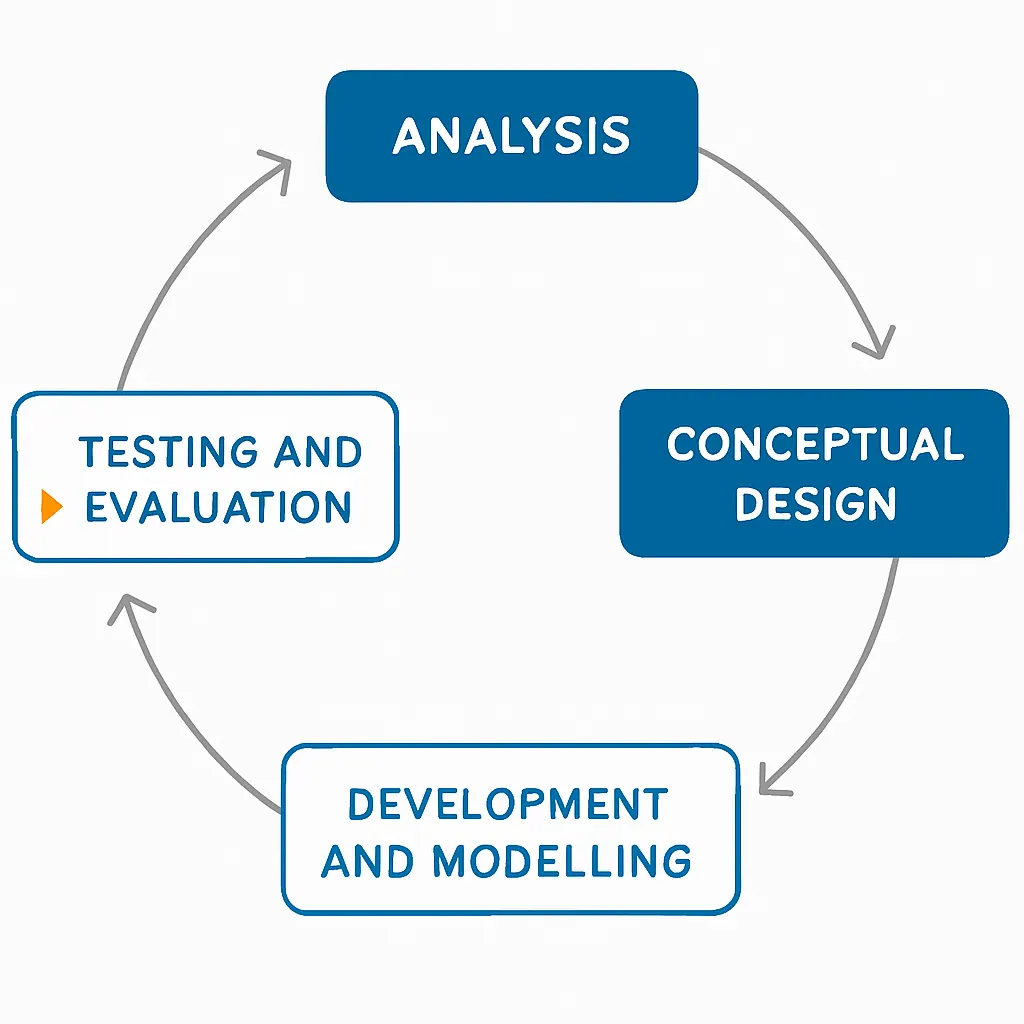
IB Design Technology is a Group 4 science in the IB Diploma Programme, sitting alongside Biology, Chemistry, and Physics. That classification matters: this is not a vocational trade course or an arts elective. It is a rigorous academic subject assessed through written examinations, a substantial internal project, and scientific reasoning about how products and systems are made.
The new course is built around the design thinking process: a flexible, iterative way of solving problems that puts the needs and perspectives of the intended end users first. You use it in the written papers and, above all, in the design project, where you redesign a real product, test a physical model with users, and justify each decision along the way.
The current course has a specific timeline to know. It was first taught in August 2025 and is first examined in May 2027. If you sit your exams in May 2027 or later, this is the course you are on.
Both SL and HL students study the same three themes, so the conceptual foundation is identical at both levels. HL adds HL-only topics within those themes and more teaching time. The counter-intuitive consequence: choosing SL does not make the shared content lighter - it leaves out the HL-only topics, not the difficulty of what remains.
2. The IB Design Technology Syllabus: Three Themes
According to the International Baccalaureate, the new course explores three themes, studied by all students whether SL or HL:
| Theme | Topics in the IB's subject brief |
|---|---|
| A: Design in theory | Ergonomics; user-centred research methods; prototyping techniques; material classification and properties. HL only: introductions to structural, mechanical and electronic systems; manufacturing techniques |
| B: Design in practice | User-centred design; the IB DP design process; modelling and prototyping; material selection. HL only: applying and selecting structural, mechanical and electronic systems; production systems |
| C: Design in context | Responsibility of the designer; inclusive design; design for sustainability; design for a circular economy; product analysis and evaluation. HL only: beyond usability; life cycle analysis; design for manufacture strategies |
This replaces the old structure of six core topics plus four HL-only topics (ManageBac/Faria). The IB's design technology subject brief organises each theme around people, process, product and production, so familiar content such as ergonomics, materials, prototyping, manufacturing and sustainability now sits inside the three themes rather than in separate numbered units. Your teacher has the subject guide with the full content and the depth expected for each topic.
One thing that catches students out: the design thinking process is not a separate unit you tick off and move on from. The IB uses the three themes to build your understanding of it, so it structures how you analyse problems, develop solutions, and evaluate outcomes across the whole course. Treating it as a checklist rather than a continuous method is a common source of lost marks.
3. IB Design Tech HL vs SL: What Is Different
Choosing HL over SL no longer means separate extension topics and an extra paper. In the new course:
- Same themes, HL-only topics inside them. SL and HL study the same three themes; HL adds topics within them, such as structural, mechanical and electronic systems and production. HL has more teaching time (the IB recommends 240 hours at HL against 150 at SL) and expects a greater body of knowledge, understanding and skills (IB DP curriculum).
- Same two papers, longer at HL. Both levels sit Paper 1 and Paper 2, and the HL papers are longer. Paper 3 has been removed (IB design technology updates).
- Same design project. The IA's assessment criteria, duration and marks are the same at SL and HL; the only difference is the weighting (IB design technology updates).
What that means in practice: the old HL-only IA criteria on commercial production have gone, and there is no longer a separate HL paper on a case study. Some third-party sites still publish HL weightings that include a Paper 3; those describe the old course.
4. The Assessment Model: Papers, Weightings, and What They Test
From May 2027 every student, SL or HL, sits two external papers and completes the design project (IB design technology updates). Times and weightings come from the IB's subject brief:
| Component | Format | SL | HL |
|---|---|---|---|
| Paper 1 | Multiple-choice questions on the syllabus | 1 hour, 20% | 1 hour 30 minutes, 25% |
| Paper 2 | Short-answer and extended-response questions that combine skills, concepts and understandings in a design technology context | 1 hour 30 minutes, 40% | 2 hours 30 minutes, 45% |
| Internal assessment | Design project that starts from the redesign of an existing product, written up as an individual report of up to 3,500 words | 50 hours, 40% | 50 hours, 30% |
Weightings. The two papers make up 60% of the grade at SL and 70% at HL; the design project is worth the remaining 40% at SL and 30% at HL. The weighting is the only part of the design project that differs between the levels.
What the papers actually reward
Papers 1 and 2 test whether you can apply design thinking to unfamiliar scenarios, critique design decisions using technical vocabulary, and interpret sketches or modelling data. Extended-response questions often present a product or system and ask you to evaluate it, so practise judging designs against the needs of their users.
No grade boundaries yet. Boundaries for the new papers are set after the first exams, and May 2027 results are released on 6 July 2027. Do not treat boundaries from the old course as a guide. See how IB grade boundaries work.
November 2026 candidates only: you are on the previous course, with six core topics, four HL extension topics, an HL Paper 3 and the older design project criteria. Follow your teacher and the previous subject guide; the rest of this page describes the new course.
5. The Design Project: IA Criteria and What Examiners Expect
The design project is the internal assessment component of IB Design Technology. In the new course it is an open-ended task: you identify, analyse, evaluate and redesign an existing product to meet the needs of its intended users, and you develop a physical fidelity model for testing and evaluation (IB design technology updates). Redesign is the starting point, so you are improving something that already exists rather than inventing a product from scratch.
The key requirements:
- Starting point: the redesign of an existing product
- Physical fidelity model: built and used to test and evaluate your redesign
- Individual report: no more than 3,500 words
- Time: about 50 hours
- SL and HL: the same criteria, duration and marks; only the weighting differs (40% at SL, 30% at HL)
Assessment criteria
The IB's design technology updates page lists five criteria, marked out of 33 at both levels:
| Criterion | Marks | Recommended words |
|---|---|---|
| A: Empathize | 9 | 900 |
| B: Defining the project | 6 | 1,200 |
| C: Ideation and modelling | 6 | 900 |
| D: Designing a solution | 6 | 300 |
| E: Presents a solution | 6 | 200 |
The word counts per criterion are a recommendation, not a target; the limit is 3,500 words in total. The IB also suggests about 35 pages overall and sets image requirements per page for criteria C, D and E in its clarifications, so get the full descriptors from your teacher or the subject guide before you plan. The criteria from the old course, including the two HL-only commercial production criteria, no longer apply from May 2027.
What your report needs to show
Your teacher and the moderator are looking for evidence of design thinking as it actually happened: annotated sketches, modelling iterations, testing data from real users, and the reasoning behind each decision. A counter-intuitive point worth knowing: a neat, linear account often scores less well than one that shows genuine iteration and honest dead ends. Justified decision-making is rewarded, not the appearance of a smooth process. The 3,500-word limit means you have to be selective, so keep your best evidence and cut description.
Critically, evaluation must be honest. A student who identifies real weaknesses in their fidelity model and explains why they occurred will outscore one who claims the design met every requirement without evidence.
Given the weight of the IA, building your evidence as you go is far more effective than treating it as a last-minute sprint.
6. IB Design Tech IA Ideas: Choosing a Strong Project
The strongest projects start with an existing product that genuinely fails some of its users. Because the design project starts from redesign, begin by finding a product whose problems you can observe and evidence, not with a pre-decided solution. If you pick a product first and retrofit a "problem" around it, your analysis will not survive scrutiny.
Real users are not optional. The project redesigns a product to meet the needs of its intended users, so you need people you can observe, ask and test with. Without them, your testing phase has nothing to anchor it. A specific person, community group, or organisation gives you a named context to return to throughout the project, and makes evaluation evidence far easier to gather and present.
Project types that tend to generate enough technical depth include:
- Ergonomic redesign - taking an existing product and improving it for a defined user, using human factors data as your design brief
- Functional redesign - an everyday object that does its job poorly, where materials, ergonomics, and manufacturing process can all be interrogated
- Sustainability-led redesign - reworking a product's materials, assembly, or end of life to reduce its environmental impact without making it harder to use
Common pitfalls to avoid:
- Scope too broad to evaluate: redesigning an entire public transport system leaves no room for a testable physical model
- No real testing phase: a redesign that cannot be trialled with users leaves your evaluation with nothing to stand on
- Purely decorative outcomes: aesthetic-only changes cannot demonstrate the functional evaluation the project demands
The non-obvious trade-off most students miss: a narrower, well-tested redesign scores higher than an ambitious concept evaluated only theoretically. Choose your product for its testability first, not its impressiveness.
7. Sketching, Modelling, and the Skills Examiners Reward
Both the written papers and the design project reward evidence of design thinking made visible. That means annotated sketches, physical or digital models, and a clear iterative trail showing how your ideas developed over time.
Annotation is where most marks are lost. A well-drawn sketch with no labels is close to useless in this subject. Examiners expect annotations to cover material choices and why they suit the application, approximate dimensions, how the component functions, and how it would be manufactured. Arrows pointing to a shape with the word "handle" written next to it is not annotation. "Injection-moulded ABS, 12 cm grip length, ergonomic taper to reduce wrist strain" is.
Modelling means testing a concept before committing to a final version. In the design project it has a concrete job: you must develop a physical fidelity model to test and evaluate your redesign. Scale card models, foam mock-ups, and CAD all help along the way. The non-obvious point: a digital render that has never been tested against a design requirement is not modelling in any useful sense. It is illustration. Modelling requires a question being answered by the physical or digital object.
Paper 2's short-answer and extended-response questions may ask you to sketch or diagram a solution as part of your written response. Practise producing labelled diagrams under timed conditions, not just in your project report.
The practical habit to build: get comfortable communicating design decisions visually first, then support them in writing. The visual evidence leads; the text explains the reasoning behind it.
8. Design Technology IB Extended Essay
Design Technology is still an Extended Essay subject. From May 2027 every EE is written under the new guide: no more than 4,000 words, marked out of 30 against five common criteria (see extended essay criteria and the IB's extended essay updates). Design technology can be the single subject of a subject-focused essay or one of the two subjects in an interdisciplinary essay. As a Group 4 subject, a design technology essay is expected to show rigour, including testing, data collection, and analysis against design criteria, not a descriptive account of a product's history.
The research question is where most EEs go wrong. The IB's earlier design technology guidance drew a clear line between focused and broad topics. A question like "Appliances for sufferers of arthritis" is too wide to investigate properly. Narrowing it to "Ergonomic design of kettles for use by those with arthritic wrist joints" gives you a specific user group, a specific product, and a testable criterion. The same logic applies to mechanical topics: "Braking on a free-ride bicycle" is broad; "Investigating the limitations affecting maximum braking on a free-ride bicycle" is focused and assessable. The design technology example in the IB's Extended essay guide (first assessment 2027) follows the same pattern: a specific product, a defined group of users in a named market, primary evidence of the problem, and fidelity models tested against those users' needs.
Essays do not have to centre on a single product. The earlier guidance also treated systems-design topics as valid, including cold chain distribution of heat-sensitive vaccines in tropical climates and automated manufacturing systems for mass customisation.
Two topic types to avoid:
- Purely historical topics that document how a product or technology developed over time
- Topics that simply review a technological product rather than investigate a question
Keep it separate from your design project. The Extended essay guide (first assessment 2027) says no content from your IA can be duplicated in your EE. Resources can be shared between the two, but the IB advises against it, and the essay needs a substantially different angle and focus. Students who duplicate work risk not being awarded the diploma.
The IB's published example EE on climbing rope analysis was marked under the criteria used before May 2027, so do not compare its mark with the new 30-mark scale. The research question, "What factors should novice climbers take into account when choosing their first rope?", is user-centred and testable. The examiner comments note deductions for inconsistent testing methodology (different abrasive wheels used across tests, some rope ends sealed and others not) and for mixed-up tables. The lesson still holds: methodological consistency matters as much as the choice of topic.
9. IB MYP Design Technology: How It Connects to the DP
IB MYP design and technology is a separate programme for students aged 11-16, sitting within the Middle Years Programme rather than the Diploma. It is not a feeder course for DP design technology in any formal sense. Students without MYP backgrounds take DP design technology regularly and do not face a structural disadvantage.
That said, MYP design does use an iterative design cycle framework, so students who completed it arrive in the DP already comfortable with the language of inquiry, prototyping, and evaluation. The counter-intuitive catch: MYP design cycle habits are sometimes less structured than what DP examiners expect. MYP students can underestimate how precisely the DP requires each design cycle stage to be documented and justified, and may need to rebuild that habit from the start rather than assuming prior experience carries over.
If you are coming from MYP design, treat the DP as a fresh start on documentation standards.
10. What to Do Next
If you sit your exams in May 2027 or later, you are on the new course: three themes, two papers, no Paper 3, and a design project that starts from redesign. Revision guides and past papers written for the old course cover a different specification, with separate HL topics, a Paper 3 and different IA criteria, so use them selectively. Do not assume a revision guide written for an earlier cohort maps onto your year.
Read the IB's design technology updates page this week. Then ask your teacher for the subject guide (first assessment 2027) and the full descriptors for the five design project criteria.
FAQ
What is IB design technology?
IB design technology is a Group 4 science subject in the IB Diploma Programme built around the design thinking process. From May 2027 it is organised into three themes - design in theory, design in practice and design in context - studied at both SL and HL.
Is IB design technology hard?
Difficulty depends on the student's strengths: the course rewards visual-spatial thinking, iterative problem-solving, and practical making, but also demands written analysis and scientific reasoning, and HL adds HL-only topics within the same three themes.
How is the IB design technology IA assessed?
The IA is a design project that starts from the redesign of an existing product, with a physical fidelity model for testing and an individual report of up to 3,500 words. It is marked out of 33 against five criteria - Empathize, Defining the project, Ideation and modelling, Designing a solution, and Presents a solution - with the same criteria, duration and marks at SL and HL; only the weighting differs (40% at SL, 30% at HL).
What is the difference between IB design technology SL and HL?
From May 2027 SL and HL study the same three themes, sit the same two types of paper and complete the same design project against the same criteria. HL adds HL-only topics within the themes, more teaching time and longer papers; the design project is worth 40% at SL and 30% at HL, and there is no Paper 3 at either level.
When is the first assessment for the new IB design technology syllabus?
The new course was first taught in August 2025 and is first assessed in May 2027. Past papers from before May 2027 follow the old course, which had six core topics, four HL extension topics and an HL Paper 3.
Can I write my Extended Essay in IB design technology?
Yes - design technology is still an Extended Essay subject. From May 2027 the essay is marked out of 30 under the new guide; the key requirement is a focused, testable research question about a specific product or system, with no content duplicated from your design project.
References
- DP design technology - International Baccalaureate® - https://ibo.org/programmes/diploma-programme/curriculum/sciences/design-technology
- Design technology updates - International Baccalaureate - https://www.ibo.org/university-admission/latest-curriculum-updates/design-technology-updates/
- Design technology subject brief - International Baccalaureate - https://www.ibo.org/globalassets/new-structure/university-admission/pdfs/dp_destech_subjectbrief_en.pdf
- DP curriculum - International Baccalaureate - https://www.ibo.org/programmes/diploma-programme/curriculum/
- Preparing for Change: IB Design Technology Curriculum 2027 - ManageBac - https://www.managebac.com/subject-support/preparing-for-change-ib-design-technology-curriculum-2027
- DP extended essay updates - International Baccalaureate - https://www.ibo.org/university-admission/latest-curriculum-updates/dp-extended-essay-updates/