Parents Guide to IB: What You Actually Need to Know
By Michael Thompson · Education Specialist; 10 years teaching the IB at Bromsgrove School · Published 21 May 2026 · Updated 4 October 2026
A parents guide to IB is harder to find than it should be - most official documentation is written for students or coordinators, not families trying to work out what their teenager has signed up for. The International Baccalaureate Diploma Programme (IBDP) is a two-year pre-university qualification taken in Years 12 and 13, recognised by universities worldwide including every Russell Group institution. It is more demanding in breadth than A-Levels: students study six subjects simultaneously alongside three compulsory core components, and they must meet specific pass conditions or the full diploma is withheld. This guide explains how the programme works, what the grading means, which deadlines matter most, and what kind of support from home actually helps.
Key Takeaways
- Six subjects plus three core components: Every IB student studies subjects from six groups at the same time, and must also complete Theory of Knowledge (TOK), an Extended Essay (EE), and Creativity, Activity, Service (CAS) - all are compulsory.
- Grades run from 1 to 7 per subject: The maximum total is 45 points (42 from subjects plus up to 3 bonus points from the EE and TOK combination); the minimum to pass the diploma is 24 points, with no grade below 2 in any subject.
- UCAS predicted grades are set by the school, not the IB: Because IB exams happen from late April to May of Year 13, UK universities rely on teacher-predicted grades submitted via UCAS - these matter enormously for competitive offers.
- Internal Assessment deadlines fall months before the exams: IA coursework, EE drafts, and the TOK exhibition have school-set deadlines typically running from October of Year 13 through to February - parents should track these, not just the May exam dates.
- Re-mark requests must go through the school coordinator: The IB does not accept Enquiry Upon Results (EUR) requests directly from students or parents - only the school's DP coordinator can submit them, and a re-mark can lower a grade.
- Practical support at home outweighs academic supervision: Research consistently shows that managing logistics, keeping home calm, and watching for burnout signs does more good than checking homework or comparing your child's progress with others.
In This Article
- What Is the IB Diploma Programme
- IB vs A-Levels: The Key Differences for Parents
- IB Grading Criteria Explained
- IB Subject Choices: Advice for Parents
- Key IB Deadlines Parents Should Track
- Supporting an IB Student at Home in the UK
- Signs of Overload and Burnout - What to Watch For
- When to Get a Tutor and How to Choose One
- Talking to the School: When and How to Escalate
- Where to Go From Here
1. What Is the IB Diploma Programme
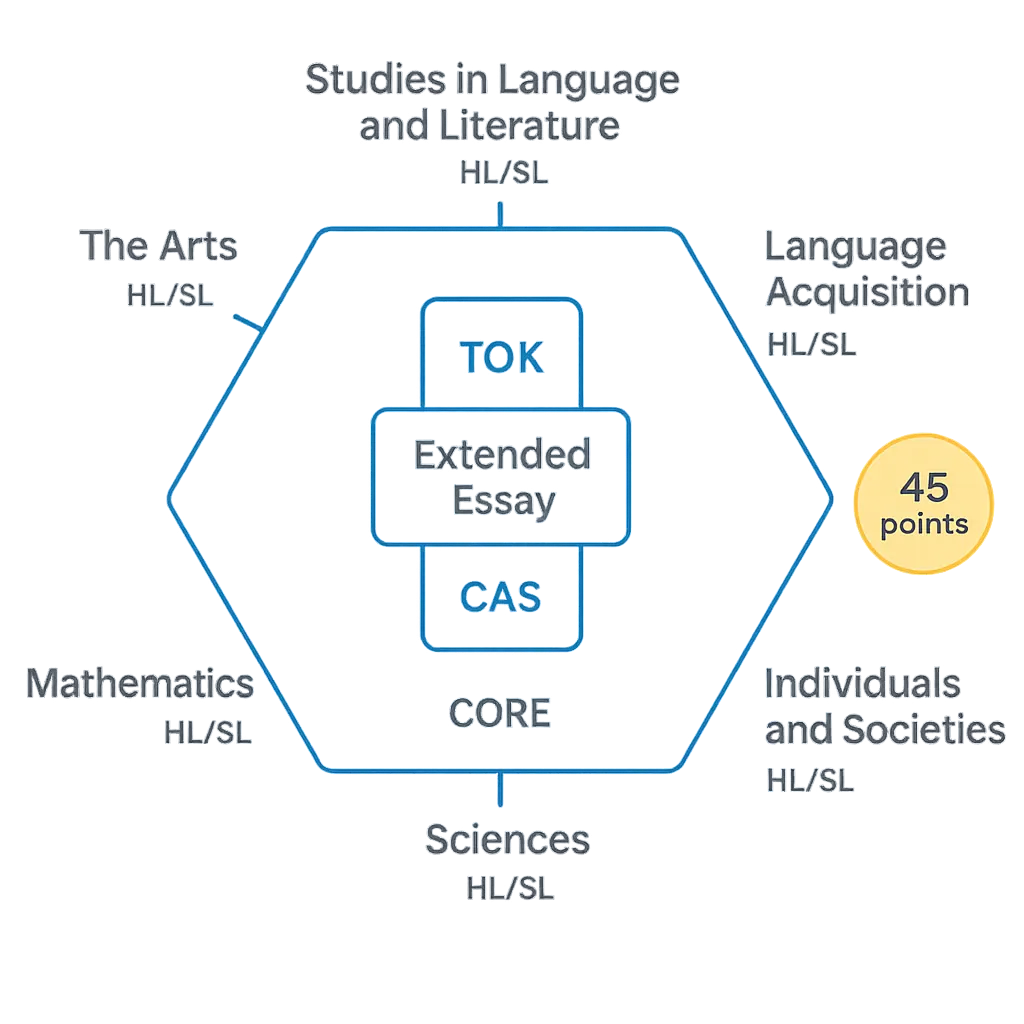
The IB Diploma Programme (IBDP) is a two-year pre-university qualification taken in Years 12 and 13, designed and administered by the International Baccalaureate Organization. This parents guide to ib exists because the IBDP works quite differently from A-Levels, and the structure can catch families off guard. UK universities, including Oxford, Cambridge, and the Russell Group broadly, recognise the diploma and publish specific entry requirements for it alongside A-Level equivalents.
The programme has two interlocking parts: six academic subjects and three compulsory core components.
The six subject groups
Students choose one subject from each of these groups:
- Studies in Language and Literature
- Language Acquisition
- Individuals and Societies
- Sciences
- Mathematics
- The Arts (or a second subject from another group)
Three of the six must be studied at Higher Level (HL), which involves roughly 240 teaching hours each. The other three are taken at Standard Level (SL), at around 150 hours each. The HL/SL split is where most subject-choice decisions get complicated, and it is worth discussing early.
The three core components
These are not optional extras. Every diploma candidate must complete all three:
- Theory of Knowledge (TOK): a philosophy-of-knowledge course assessed through an essay and an exhibition
- Extended Essay (EE): an independent research essay of up to 4,000 words in a chosen subject
- Creativity, Activity, Service (CAS): a portfolio of extracurricular projects, not graded but required for diploma completion
Scoring
The six subjects are each marked on a 1-7 scale, giving a maximum of 42 points from subjects alone. The EE and TOK are assessed together and can award up to 3 additional bonus points, making the overall maximum 45 points. Per the IB, results show subject grades, total points, and EE/TOK bonus points.
The minimum score to be awarded the diploma is 24 points, subject to conditions including no failing grades in individual subjects. A student can score above 24 overall and still not receive the diploma if a subject grade falls below the required threshold - a detail worth knowing early.
2. IB vs A-Levels: The Key Differences for Parents
The most immediate difference is breadth. A-Level students typically study three or four subjects in depth; IB Diploma students study six simultaneously, drawn from across the arts, sciences, languages, and humanities. For a student who is genuinely curious across disciplines, that breadth is appealing. For one who wants to focus early, it can feel relentless.
The IB's compulsory core has no A-Level equivalent, and this is where most parents are caught off guard. Three components sit outside the six subjects and must be completed alongside them:
- Theory of Knowledge (TOK) - a philosophy-adjacent course asking students to examine how different subjects produce knowledge. It is assessed through an essay and an exhibition, not an exam.
- Extended Essay (EE) - a 4,000-word independent research paper in a subject of the student's choosing, supervised by a school mentor over roughly 18 months.
- Creativity, Activity, Service (CAS) - a portfolio of extracurricular projects across creative, physical, and community-based activity. It is not graded, but failing to complete it can block the award of the diploma entirely.
Within the six subjects, students take three or four at Higher Level (HL) and the rest at Standard Level (SL). HL courses cover additional content and carry more assessment hours than SL, broadly comparable to A-Level depth in those specific subjects.
The counter-intuitive trade-off: IB students who struggle with HL Maths often find their SL science peers doing genuinely easier content, yet everyone is sitting the same number of subjects. The workload is not evenly distributed.
Both qualifications are accepted by UK universities, including Russell Group institutions. Neither is universally harder; the workload patterns are simply different. A-Levels reward deep focus and strategic subject choice. The IB rewards students who are comfortable with sustained independent work, structured enquiry across multiple disciplines, and managing several long-term deadlines at once.
3. IB Grading Criteria Explained
Each of the six IB subjects is marked on a scale of 1 to 7, where 7 is the highest. Add those six grades together and you get a maximum of 42 subject points. On top of that, students can earn up to 3 bonus points from the combination of their Extended Essay (EE) and Theory of Knowledge (TOK) assessment. The absolute maximum is therefore 45 points.
Passing the diploma
Reaching 45 is rare. The minimum to pass is more important to understand:
- 24 points total across subjects and bonus points
- No grade below 2 in any subject
- EE and TOK must both be passed (a failing grade in either blocks the diploma regardless of total points)
- CAS must be completed - there is no numerical mark for it, but a failure to complete it means no diploma
The counter-intuitive detail here: a student can score 30 points and still fail if they get a grade 1 in a single subject. Total points and subject minimums are separate conditions, both of which must be met.
How grade boundaries are set
The IB does not apply a fixed percentage to determine grades. Per the International Baccalaureate, grade boundaries are set each session by reviewing candidate work against established grade descriptors, then dividing aggregated scores along the 1-7 scale. This means the boundary for a 6 can shift between sessions depending on how candidates performed overall.
What you can and cannot see
When results are published, subject grades, total points, and the EE/TOK bonus are visible on candidates.ibo.org. Component-level marks, such as individual paper scores, are not visible by default. A more detailed breakdown may be granted at the IB coordinator's discretion.
Results release dates to put in your calendar:
| Session | Release date | Time |
|---|---|---|
| May | 6 July | 12:00 GMT |
| November | 16 December | 9:00 pm GMT to schools; students see them 6 to 48 hours later |
If your child cannot log in, the fix goes through the school's DP coordinator, not the IB directly.
4. IB Subject Choices: Advice for Parents
The IB Diploma requires students to study six subjects, one from each of the IB's six subject groups: studies in language and literature, language acquisition, individuals and societies, sciences, mathematics, and the arts (or a second subject from another group). Of those six, three must be taken at Higher Level (HL) and three at Standard Level (SL). That constraint is fixed. The school's timetable then narrows the options further, since not every subject is offered at both levels at every school.
Why HL choices matter more than most parents expect
Universities in the UK specify HL subjects, not just the overall points score. A student targeting Medicine at a Russell Group university typically needs HL Chemistry and HL Biology. Engineering courses commonly require HL Mathematics: Analysis and Approaches (not the easier Mathematics: Applications and Interpretation). Economics degrees at competitive universities often ask for HL Economics or HL Mathematics. If a student picks the wrong level in Year 1, the options narrow sharply - and switching after the first term is disruptive enough that most IB coordinators advise against it.
The non-obvious gotcha: HL Mathematics: Analysis and Approaches and HL Mathematics: Applications and Interpretation look similar on a timetable but are treated very differently by admissions tutors. Checking which one a target course accepts is worth doing before subjects are confirmed.
What parents can practically do
- Ask your student to list two or three target university courses and look up the specific HL requirements on each university's admissions page before subject choices are finalised.
- Encourage them to flag any conflicts to the school's IB coordinator early.
- Avoid lobbying for a particular subject combination yourself. The coordinator knows the timetable, the teaching staff, and the student's predicted workload. Your role is to make sure the conversation happens, not to direct the outcome.
5. Key IB Deadlines Parents Should Track
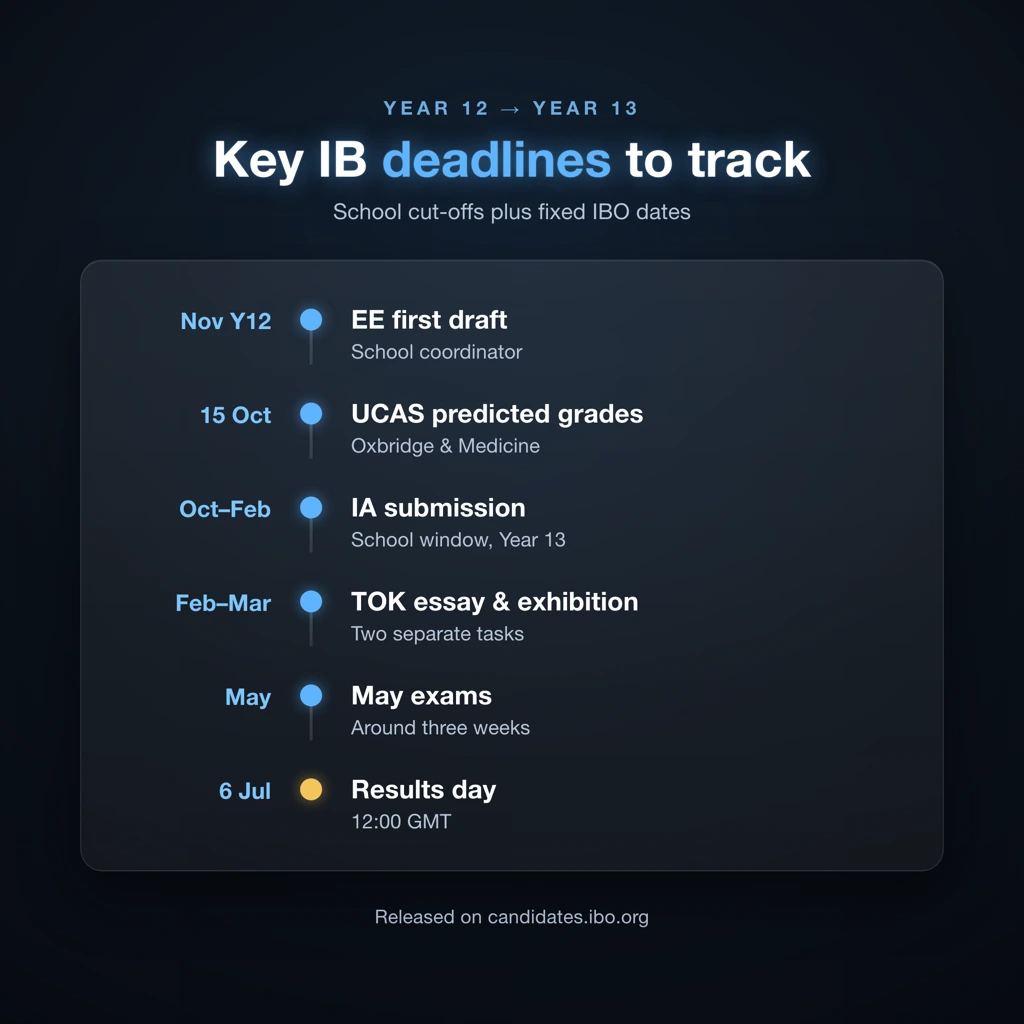
The IB runs on two separate deadline tracks: internal school deadlines set by the coordinator, and fixed IBO dates that are the same worldwide. Missing an internal deadline can be as damaging as missing the external one, because schools need time to moderate and upload work.
Internal Assessments (IAs) are submitted to the IBO by the school, but your child must meet the school's own submission window first. That window typically falls somewhere between October and February of Year 13, depending on the subject. A late or incomplete IA cannot simply be handed in the following week, it goes to the examiner as-is or not at all.
Extended Essay has two crunch points. Most schools set a first full draft deadline in November of Year 12 or very early Year 13, with the final version uploaded before the school's internal cut-off. A failing grade on the EE (an E) results in no diploma being awarded, regardless of how well everything else went.
Theory of Knowledge runs on a separate timetable. The TOK essay and the TOK exhibition each have their own deadlines, usually landing in February or March of Year 13. Treat them as distinct tasks, not one combined block.
UCAS predicted grades are entered by school advisers and submitted as part of the reference. For Oxbridge and Medicine applicants, the 15 October UCAS deadline means predicted grades must be finalised before that date. Once an application is sent to UCAS, neither UCAS nor the adviser can amend the predicted grades, so errors made before submission cannot be corrected afterwards.
Exam registration is handled entirely by the school's IB coordinator. Ask them to confirm your child is registered before the end of Year 12.
May exam session runs for about four weeks from late April into May (it starts on 23 April in 2027). Results are released on candidates.ibo.org from 12:00 GMT on 6 July.
| Deadline | Typical timing | Who owns it |
|---|---|---|
| IA school submission | Oct - Feb, Year 13 | School coordinator |
| EE first draft | Nov, Year 12 / early Year 13 | School coordinator |
| TOK essay and exhibition | Feb - Mar, Year 13 | School coordinator |
| UCAS Oct 15 predicted grades | Before 15 October, Year 13 | School adviser |
| May exam results | 6 July, 12:00 GMT | IBO |
Ask the coordinator for a single written list of all internal deadlines at the start of Year 12. Schools are not required to send reminders, and the IBO does not contact families directly.
6. Supporting an IB Student at Home in the UK
The most useful thing you can do at home has nothing to do with the IB curriculum. A stable, low-drama domestic environment does more for performance than any flashy study resource. Reliable meals, predictable transport, and a quiet workspace with consistent lighting and minimal interruptions outperform expensive revision guides. The workspace does not need to be elaborate; it needs to be the same place every evening.
What genuinely helps:
- Managing logistics so your student is not also project-managing the household
- Keeping a predictable evening routine, particularly around mealtimes
- Treating dinner as dinner, not a progress meeting
What makes things worse:
- Hovering over homework or asking to check drafts; the IB's assessment model rewards independent thinking, and over-supervision undercuts exactly that
- Comparing your student's grades or workload to siblings or IB peers at other schools (different schools set Internal Assessment deadlines differently, so the comparison is rarely fair)
- Asking about grades after every assessment; the IB's 1-7 scale measures different things at different points in the two-year course, and early marks do not predict final results cleanly
Emotional availability matters more than academic involvement. Your student needs to know they can say "I'm not coping" without that triggering a family crisis response. Keep the door open without making every conversation a debrief.
One specific, non-obvious gotcha: many parents escalate directly to the head of sixth form when something goes wrong. The IB has its own staffing structure. Know these three people before a problem arises:
- Form tutor or personal tutor - first point of contact for day-to-day welfare
- CAS coordinator - oversees Creativity, Activity, Service requirements and can flag if a student is falling behind on that strand quietly
- DP coordinator (Diploma Programme coordinator) - the person who communicates with the IB Organisation, manages predicted grades, and handles any formal concerns about the programme
Introducing yourself to the DP coordinator at the start of Year 12 is worth the five-minute conversation.
7. Signs of Overload and Burnout - What to Watch For
Normal exam stress is short-lived and tied to a specific event. Burnout has a different shape: it builds slowly, persists after the trigger has passed, and affects the student across multiple areas of life at once. Duration and degree are the two things to track.
Watch for these patterns, not one-off bad days:
- Sleep disruption that runs for weeks, not just the fortnight before exams. Stress causes the brain to overproduce cortisol, which directly disrupts sleep cycles, per BBC Bitesize. Chronic disruption is a different problem from pre-exam nerves.
- Withdrawal from CAS activities. This is a specific signal in the IB context: a student who was previously committed to their creativity, activity, and service hours and quietly stops showing up is telling you something.
- Emotional flatness or irritability lasting several weeks, not a rough weekend.
- Frequent illness, appetite changes, or headaches appearing as a recurring pattern rather than a one-off.
The non-obvious gotcha: students can appear functional at school while hiding significant distress at home. Maintained grades are not a reliable indicator of wellbeing.
When to act, not just reassure:
If your child is missing Internal Assessment or Extended Essay deadlines, has withdrawn from all social contact, or is expressing hopelessness about the future, a conversation with the school coordinator is the right next step, not a pep talk. These are structural signals, not mood signals.
For students who need someone outside the family to talk to, Childline counsellors are available 24 hours a day, 7 days a week.
8. When to Get a Tutor and How to Choose One
Tutoring is worth considering in specific, identifiable situations, not as a general precaution. If your child is consistently scoring below a 4 in a Higher Level subject, struggling to structure their Extended Essay argument independently, or stuck on the methodology section of an Internal Assessment, a subject-specific tutor can address that gap directly. These are concrete problems with concrete fixes.
Parental anxiety about the IB's difficulty is not, by itself, a reason to hire a tutor. Pre-emptive tutoring without a clear gap tends to add to a student's schedule without adding much to their grade.
When you do look for a tutor, the subject specialism has to be IB-specific, not just general. A tutor with strong A-Level chemistry knowledge may not know how IB Chemistry HL assessment objectives are weighted, or how the mark scheme treats data analysis in a Group 4 IA. Ask directly: "Have you worked with IB students on this subject?" and "Are you familiar with the current mark scheme?"
One non-obvious requirement: confirm the tutor understands the IBO's academic integrity policy for EE and IA work. A tutor who drafts arguments or edits written sections crosses a line that can result in the work being disqualified. Legitimate support means explaining concepts and asking questions, not writing.
Before going external, ask the school's IB coordinator. Many schools have internal subject support sessions or can recommend tutors who already work with their IB cohort.
9. Talking to the School: When and How to Escalate
Knowing who to contact saves time and avoids conversations that go nowhere. The IB school structure has three distinct roles, and routing your concern to the right person is more effective than emailing whoever you can find.
Route concerns to the right person:
- Subject teacher - content issues: pacing, feedback quality, a missing mark on a piece of coursework.
- DP coordinator - diploma-level matters: IA submission timelines, predicted grades, EE progress, and anything involving the IB directly.
- Head of year (or pastoral lead) - welfare, workload, or anything that crosses subject boundaries.
How to frame the conversation matters more than most parents expect. Lead with a specific observation, not a verdict. "My son hasn't received any written feedback on his Extended Essay draft since October" gives the coordinator something to act on. "I think the teaching isn't good enough" closes the conversation before it starts.
A non-obvious point about predicted grades: you are entitled to ask the school what process is used to set them and whether subject teachers have reviewed them individually. Predicted grades affect university offers directly, and querying the process is a legitimate question, not an overreach.
Re-mark requests (Enquiry Upon Results): per the IB Assessment FAQ, only the school's DP/CP coordinator can submit an Enquiry Upon Results to the IB. Parents and students cannot contact the IB directly. Critically, a re-mark can lower a grade, and written consent from the student or legal guardian is required beforehand. If that consent was not obtained and the grade drops, the original grade will not be reinstated.
If the school is unresponsive: document your communications with dates, escalate to the head teacher, and note that the IB's own programme policies are publicly available at ibo.org if you need to reference what the school is obligated to follow.
10. Where to Go From Here
This week, contact your child's DP coordinator and ask for the school's internal IA submission deadlines for this academic year. Schools set these earlier than the IBO's own calendar, sometimes by several months, and missing an internal deadline can disqualify work from moderation entirely. Write every date into the family calendar now, not closer to the time.
If your child is finishing Year 12, the UCAS predicted grades process is coming into view. Schools enter IB predicted grades through the UCAS adviser portal, and once an application has been sent to UCAS, neither the adviser nor UCAS can amend those grades. Ask the DP coordinator this term what predicted grade your child is on track for in each subject before that window closes.
Email the DP coordinator this week and confirm the IA deadlines in writing.
FAQ
What is the minimum score needed to pass the IB Diploma?
Students need at least 24 points out of 45, no grade below 2 in any subject, a passing result in both the Extended Essay and Theory of Knowledge, and completion of CAS - all conditions must be met simultaneously.
How are IB predicted grades used for UCAS applications?
Because IB exams finish in May of Year 13, UK universities make offers based on teacher-predicted grades submitted via UCAS; for courses with a 15 October deadline such as Medicine or Oxbridge, predicted grades must be in place by that date.
Can parents request a re-mark of IB exam results?
No - Enquiry Upon Results (EUR) requests must be submitted by the school's DP or CP coordinator; the IB does not accept requests directly from candidates or parents, and a re-mark can result in a grade being lowered.
When are IB results released for the May exam session?
May session results are released on candidates.ibo.org from 12:00 GMT on 6 July; login credentials are provided by the school's DP coordinator, and the IB cannot issue them directly to students or parents.
Is the IB Diploma harder than A-Levels?
The IB is broader - students study six subjects simultaneously plus three compulsory core components - while A-Levels allow more depth in three or four subjects; both are accepted by UK universities, and which suits a student depends on their learning style and university course requirements.
What should parents do if their child is struggling with IB workload?
The first step is distinguishing normal exam-period stress from sustained burnout - if the student is missing internal deadlines, withdrawing from all activity, or expressing hopelessness, speak to the school's DP coordinator and, if needed, the head of year about welfare support.
References
- Assessment FAQ - International Baccalaureate® - https://ibo.org/programmes/diploma-programme/assessment-and-exams/getting-results/assessment-faq/
- Applying to the UK - the UCAS process fundamentals Q&A | UCAS - https://www.ucas.com/advisers/help-and-training/adviser-tips/applying-uk-ucas-process-fundamentals-qa
- Managing references and predicted grades in the adviser portal | UCAS - https://www.ucas.com/advisers/help-and-training/guides-resources-and-training/application-overview/our-adviser-portal/managing-references-and-predicted-grades-adviser-portal
- How do I improve my mood after my exams? - BBC Bitesize - https://www.bbc.co.uk/bitesize/articles/zdkv6v4